New Semester
Started
Get
50% OFF
Study Help!
--h --m --s
Claim Now
Question Answers
Textbooks
Find textbooks, questions and answers
Oops, something went wrong!
Change your search query and then try again
S
Books
FREE
Study Help
Expert Questions
Accounting
General Management
Mathematics
Finance
Organizational Behaviour
Law
Physics
Operating System
Management Leadership
Sociology
Programming
Marketing
Database
Computer Network
Economics
Textbooks Solutions
Accounting
Managerial Accounting
Management Leadership
Cost Accounting
Statistics
Business Law
Corporate Finance
Finance
Economics
Auditing
Tutors
Online Tutors
Find a Tutor
Hire a Tutor
Become a Tutor
AI Tutor
AI Study Planner
NEW
Sell Books
Search
Search
Sign In
Register
study help
mathematics
a first course in differential equations
A First Course in Differential Equations with Modeling Applications 10th edition Dennis G. Zill - Solutions
If the set consisting of two functions f1 and f2 is linearly independent on an interval I, then the Wronskian W(f1, f2) ≠ 0 for all x in I. __________Answer problem without referring back to the text. Fill in the blank or answer true or false.
A constant multiple of a solution of a linear differential equation is also a solution. __________Answer problem without referring back to the text. Fill in the blank or answer true or false.
For the method of undetermined coefficients, the assumed form of the particular solution yp for y'' - y = 1 + ex is __________.Answer problem without referring back to the text. Fill in the blank or answer true or false.
The only solution of the initial-value problem y'' + x2y = 0, y(0) = 0, y'(0) = 0 is __________.Answer problem without referring back to the text. Fill in the blank or answer true or false.
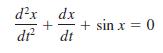
A mathematical model for the position x(t) of a moving object isd2x/dt2 + sin x = 0.Use a numerical solver to graphically investigate the solutions of the equation subject to x(0) = 0, '(0) = x1, x1 ≥ 0. Discuss the motion of the object for t ≥ 0 and for various choices of x1. Investigate the
A mathematical model for the position x(t) of a body moving rectilinearly on the x-axis in an inverse-square force field is given bySuppose that at t = 0 the body starts from rest from the position x = x0, x0 > 0. Show that the velocity of the body at time t is given by v2 = 2k2(1/x –
Discuss how to find an alternative two-parameter family of solutions for the nonlinear differential equation y'' = 2x(y')2 in Example 1. Suppose that –c21 is used as the constant of integration instead of + c21.
Discuss how the method of reduction of order considered in this section can be applied to the third-order differential equation y''' = √1 + (y'')2. Carry out your ideas and solve the equation.
In Problem 1 we saw that cos x and ex were solutions of the nonlinear equation (y'')2 - y2 = 0. Verify that sin x and e-x are also solutions. Without attempting to solve the differential equation, discuss how these explicit solutions can be found by using knowledge about linear equations. Without
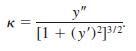
In calculus the curvature of a curve that is defined by a function y = f (x) is defined as
In problem proceed as in Example 3 and obtain the first six nonzero terms of a Taylor series solution, centered at 0, of the given initial-value problem. Use a numerical solver and a graphing utility to compare the solution curve with the graph of the Taylor polynomial.y'' = ey, y(0) = 0, y'(0) = -1
In problem proceed as in Example 3 and obtain the first six nonzero terms of a Taylor series solution, centered at 0, of the given initial-value problem. Use a numerical solver and a graphing utility to compare the solution curve with the graph of the Taylor polynomial.y'' = x2 + y2 - 2y', y(0) =
In problem proceed as in Example 3 and obtain the first six nonzero terms of a Taylor series solution, centered at 0, of the given initial-value problem. Use a numerical solver and a graphing utility to compare the solution curve with the graph of the Taylor polynomial.y'' = y2 = 1, y(0) = 2, y'(0)
In problem proceed as in Example 3 and obtain the first six nonzero terms of a Taylor series solution, centered at 0, of the given initial-value problem. Use a numerical solver and a graphing utility to compare the solution curve with the graph of the Taylor polynomial.y'' = x + y2, y(0) = 1, y'(0)
In problem show that the substitution u = y' leads to a Bernoulli equation. Solve this equation (see Section 2.5).xy'' = y' + x(y')2
In problem show that the substitution u = y' leads to a Bernoulli equation. Solve this equation (see Section 2.5).xy'' = y' + (y')3
Find two solutions of the initial-value problem
Solve the given initial-value problem.y'' + x(y')2 = 0, y (1) = 4, y'(1) = 2
Solve the given initial-value problem.2y'y'' = 1, y(0) = 2, y'(0) = 1
In problem solve the given differential equation by using the substitution u = y'.y2y'' = y'
In problem solve the given differential equation by using the substitution u = y'.y'' + 2y(y')3 = 0
In problem solve the given differential equation by using the substitution u = y'.(y + 1)y'' = (y')2
In problem solve the given differential equation by using the substitution u = y'.x2y'' + (y')2 = 0
In problem solve the given differential equation by using the substitution u = y'.y'' = 1 + (y')2
In problem solve the given differential equation by using the substitution u = y'.y'' + (y')2 + 1 = 0
Verify that y1 and y2 are solutions of the given differential equation but that y = c1y1 + c2y2 is, in general, not a solution.yy'' = ½ (y')2; y1 = 1, y2 = x2
Verify that y1 and y2 are solutions of the given differential equation but that y = c1y1 + c2y2 is, in general, not a solution.(y'')2 = y2; y1 = ex, y2 = cos x
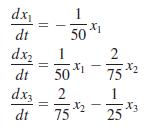
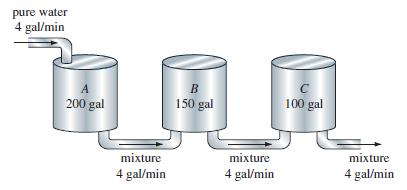
(a) Reread Problem 8 of Exercises 3.3. In that problem you were asked to show that the system of differential equationsis a model for the amounts of salt in the connected mixing tanks A, B, and C shown in Figure 3.3.7. Solve the system subject to x1(0) = 15, x2(t) = 10, x3(t) = 5.(b) Use a CAS to
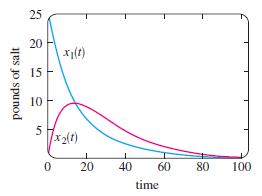
Reexamine Figure 4.9.1 in Example 3. Then use a rootfinding application to determine when tank B contains more salt than tank A.Figure 4.9.1 25 20 15 10 F 20 40 60 80 100 time pounds of salt
Examine and discuss the following system:Dx – 2Dy = t2(D + 1)x – 2(D + 1)y = 1
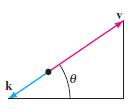
Determine a system of differential equations that describes the path of motion in Problem 23 if air resistance is a retarding force k (of magnitude k) acting tangent to the path of the projectile but opposite to its motion. See Figure 4.9.3. Solve the system. k is a multiple of velocity, say,
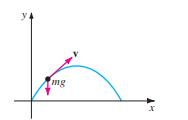
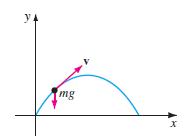
A projectile shot from a gun has weight w = mg and velocity v tangent to its path of motion. Ignoring air resistance and all other forces acting on the projectile except its weight, determine a system of differential equations that describes its path of motion. See Figure 4.9.2. Solve the system.
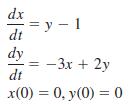
In problem solve the given initial-value problem. dx = y - 1 dt dy —Зх + 2у dt x(0) = 0, y(0) = 0
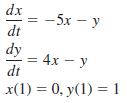
In problem solve the given initial-value problem. dx -5x - y dt dy = 4x – y dt x(1) = 0, y(1) = 1
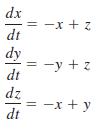
Solve the given system of differential equations by systematic elimination. dx = -x + 3 dt dy -y + z dt dz -x +y dt
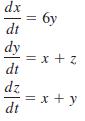
Solve the given system of differential equations by systematic elimination. dx бу dt dy = x + z dt dz = x + y dt
Solve the given system of differential equations by systematic elimination.Dx + z = et(D - 1)x + Dy + Dz = 0x + 2y + Dz = et
Solve the given system of differential equations by systematic elimination.Dx = yDy = zDz = x
Solve the given system of differential equations by systematic elimination.D2x - 2(D2 + D)y - sin tx + Dy = 0
Solve the given system of differential equations by systematic elimination.(D - 1)x + (D2 + 1)y = 1(D2 - 1)x + (D + 1)y = 2
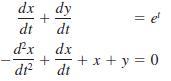
Solve the given system of differential equations by systematic elimination. dx dy = e! dt dt dx dx + x + y = 0 dt dr
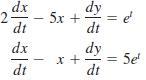
Solve the given system of differential equations by systematic elimination. dx dy dt 5x = e dt dx dy = 5e dt dt
Solve the given system of differential equations by systematic elimination.(2D2 - D - 1)x - (2D + 1)y = 1(D - 1)x + Dy = -1
Solve the given system of differential equations by systematic elimination.(D2 - 1)x - y = 0(D - 1)x + Dy = 0
Solve the given system of differential equations by systematic elimination.D2x - Dy = t(D + 3)x + (D + 3)y = 2
Solve the given system of differential equations by systematic elimination.Dx + D2y = e3t(D + 1)x = (D - 1)y = 4e3t
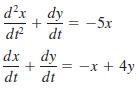
Solve the given system of differential equations by systematic elimination. d?x dy dt dr -5x dx, dy -x + 4y dt dt
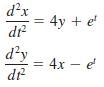
Solve the given system of differential equations by systematic elimination. d?x 4y + e dr d'y = 4x – e dr
Solve the given system of differential equations by systematic elimination.(D + 1)x + (D - 1)y = 23x + (D + 2)y = -1
Solve the given system of differential equations by systematic elimination.(D2 + 5)- = 2y = 0-2x + (D2 + 2)y = 0
Solve the given system of differential equations by systematic elimination.dx/dt – 4y = 1dy/dt + x = 2
Solve the given system of differential equations by systematic elimination.dx/dt = -y + tdy/dt = x – t
Solve the given system of differential equations by systematic elimination.dx/dt = 4x + 7ydy/dt = x - 2y
Solve the given system of differential equations by systematic elimination.dx/dt = 2x – ydy/dt = x
Use the result in Problem 45 to solvey'' + y = 1, y(0) = 5, y(1) = -10.
Suppose the solution of the boundary-value problemy'' + Py' + Qy = f(x), y(a) = 0, y(b) = 0,a < b, is given by yp(x) = ∫baG(x,t)f(t)dt where y1(x) and y2(x) are solutions of the associated homogeneous differential equation chosen in the construction of G(x, t) so that y1(a) = 1 and y2(b) = 0.
In problem proceed as in Examples 7 and 8 to find a solution of the given boundary value problem.x2y" - 4xy' + 6y = x4, y(1) - y'(1) = 0, y(3) = 0
In problem proceed as in Examples 7 and 8 to find a solution of the given boundary value problem.x2y" + xy' = 1, y(e-1) = 0 , y(1) = 0
In problem proceed as in Examples 7 and 8 to find a solution of the given boundary value problem.y" - y' = e2x, y(0) = 0, y(1) = 0
In problem proceed as in Examples 7 and 8 to find a solution of the given boundary value problem.y" - 2y' + 2y = ex, y(0) = 0, y(π/2) = 0
In problem proceed as in Examples 7 and 8 to find a solution of the given boundary value problem.y'' + 9y = 1, y(0) = 0, y'(π) = 0
In problem proceed as in Examples 7 and 8 to find a solution of the given boundary value problem.y'' + y = 1, y(0) = 0, y(1) = 0
In problem 36 find a solution of the BVP when f(x) = x.Problem 36In problems,(a) Use (27) and (28) to find a solution of the boundary-value problem.(b) Verify that the function yp(x) satisfies the differential equations and both boundary-conditions.y'' = f(x), y(0) = 0, y(1) + y'(1) = 0
In Problem 35 find a solution of the BVP when f(x) = 1.Problem 35In problems,(a) Use (27) and (28) to find a solution of the boundary-value problem.(b) Verify that the function yp(x) satisfies the differential equations and both boundary-conditions.y'' = f(x), y(0) = 0, y(1) = 0
In problems,(a) Use (27) and (28) to find a solution of the boundary-value problem.(b) Verify that the function yp(x) satisfies the differential equations and both boundary-conditions.y'' = f(x), y(0) = 0, y(1) + y'(1) = 0
In problems,(a) Use (27) and (28) to find a solution of the boundary-value problem.(b) Verify that the function yp(x) satisfies the differential equations and both boundary-conditions.y'' = f(x), y(0) = 0, y(1) = 0
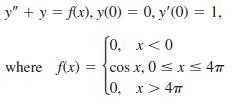
In problem proceed as in Example 6 to find a solution of the initial-value problem with the given piecewisedefined forcing function.
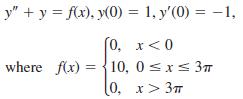
In problem proceed as in Example 6 to find a solution of the initial-value problem with the given piecewisedefined forcing function.
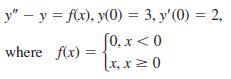
In problem proceed as in Example 6 to find a solution of the initial-value problem with the given piecewisedefined forcing function.
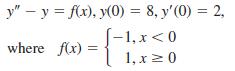
In problem proceed as in Example 6 to find a solution of the initial-value problem with the given piecewisedefined forcing function.
In problem proceed as in Example 5 to find a solution of the given initial-value problem.x2y'' – xy' + y = x2, y(1) = 4, y'(1) = 3
In problem proceed as in Example 5 to find a solution of the given initial-value problem.x2y'' - 6y = ln x, y(1) = 1, y'(1) = 3
In problem proceed as in Example 5 to find a solution of the given initial-value problem.x2y'' - 2xy' + 2y = x ln x, y(1) = 1, y'(1) = 0
In problem proceed as in Example 5 to find a solution of the given initial-value problem.x2y'' - 2xy' + 2y = x, y(1) = 2, y'(1) = -1
In problem proceed as in Example 5 to find a solution of the given initial-value problem.y'' + 3y' + 2y = 1/1 + ex, y(0) = 0, y'(0) = 1
In problem proceed as in Example 5 to find a solution of the given initial-value problem.y'' + 3y' + 2y = sin ex, y(0) = -1, y'(0) = 0
In problem proceed as in Example 5 to find a solution of the given initial-value problem.y'' + y = sec2x, y(π) = 1/2, y'(π) = -1
In problem proceed as in Example 5 to find a solution of the given initial-value problem.y'' + y = csc x cot x, y(π/2) = -π/2, y'(π/2) = -1
In problem proceed as in Example 5 to find a solution of the given initial-value problem.y'' + 6y' + 9y = x, y(0) = 1, y'(0) = -3
In problem proceed as in Example 5 to find a solution of the given initial-value problem.y'' - 10y' + 25y = e5x, y(0) = -1, y'(0) = 1
In problem proceed as in Example 5 to find a solution of the given initial-value problem.y'' – y' = 1, y(0) = 10, y'(0) = 1
In problem proceed as in Example 5 to find a solution of the given initial-value problem.y'' - 4y = e2x, y(0) = 1, y'(0) = -4
In problem proceed as in Example 3 to find a solution of the given initial-value problem. Evaluate the integral that defines yp(x).y'' + y = sec2x, y(π) = 0, y'(π) = 0
In problem proceed as in Example 3 to find a solution of the given initial-value problem. Evaluate the integral that defines yp(x).y'' + y = csc x cot x, y(π/2) = 0, y'(π/2) = 0
In problem proceed as in Example 3 to find a solution of the given initial-value problem. Evaluate the integral that defines yp(x).y'' + 6y' + 9y = x, y(0) = 0, y'(0) = 0
In problem proceed as in Example 3 to find a solution of the given initial-value problem. Evaluate the integral that defines yp(x).y'' - 10y' + 25y = e5x, y(0) = 0, y'(0) = 0
In problem proceed as in Example 3 to find a solution of the given initial-value problem. Evaluate the integral that defines yp(x).y'' – y' = 1, y(0) = 0, y'(0) = 0
In problem proceed as in Example 3 to find a solution of the given initial-value problem. Evaluate the integral that defines yp(x).y'' - 4y = e2x, y(0) = 0, y'(0) = 0
In problem proceed as in Example 2 to find the general solution of the given differential equation. Do not evaluate the integral that defines yp(x).y'' - 2y' + 2y = cos2x
In problem proceed as in Example 2 to find the general solution of the given differential equation. Do not evaluate the integral that defines yp(x).y'' + 9y = x + sin x
In problem proceed as in Example 2 to find the general solution of the given differential equation. Do not evaluate the integral that defines yp(x).4y'' - 4y' + y = arctan x
In problem proceed as in Example 2 to find the general solution of the given differential equation. Do not evaluate the integral that defines yp(x).y'' + 2y' + y = e-x
In problem proceed as in Example 2 to find the general solution of the given differential equation. Do not evaluate the integral that defines yp(x).y'' + 3y' - 10y = x2
In problem proceed as in Example 2 to find the general solution of the given differential equation. Do not evaluate the integral that defines yp(x).y'' - 16y = xe-2x
In problem proceed as in Example 1 to find a particular solution yp(x) of the given differential equation in the integral form (10).y'' - 2y' + 2y = f(x)
In problem proceed as in Example 1 to find a particular solution yp(x) of the given differential equation in the integral form (10).y'' + 9y = f(x)
In problem proceed as in Example 1 to find a particular solution yp(x) of the given differential equation in the integral form (10).4y'' - 4y' + y = f(x)
In problem proceed as in Example 1 to find a particular solution yp(x) of the given differential equation in the integral form (10).y'' + 2y' + y = f(x)
In problem proceed as in Example 1 to find a particular solution yp(x) of the given differential equation in the integral form (10).y'' + 3y' - 10y = f(x)
In problem proceed as in Example 1 to find a particular solution yp(x) of the given differential equation in the integral form (10).y'' - 16y = f(x)
Showing 1000 - 1100
of 1259
1
2
3
4
5
6
7
8
9
10
11
12
13
Step by Step Answers

 Get 50% OFF
Claim Now
Get 50% OFF
Claim Now