New Semester
Started
Get
50% OFF
Study Help!
--h --m --s
Claim Now
Question Answers
Textbooks
Find textbooks, questions and answers
Oops, something went wrong!
Change your search query and then try again
S
Books
FREE
Study Help
Expert Questions
Accounting
General Management
Mathematics
Finance
Organizational Behaviour
Law
Physics
Operating System
Management Leadership
Sociology
Programming
Marketing
Database
Computer Network
Economics
Textbooks Solutions
Accounting
Managerial Accounting
Management Leadership
Cost Accounting
Statistics
Business Law
Corporate Finance
Finance
Economics
Auditing
Tutors
Online Tutors
Find a Tutor
Hire a Tutor
Become a Tutor
AI Tutor
AI Study Planner
NEW
Sell Books
Search
Search
Sign In
Register
study help
mathematics
a first course in differential equations
A First Course in Differential Equations with Modeling Applications 10th edition Dennis G. Zill - Solutions
In problem use the Adams-Bashforth-Moulton method to approximate y(1.0), where y(x) is the solution of the given initial-value problem. First use h = 0.2 and then use h = 0.1. Use the RK4 method to compute y1, y2, and y3.y' = (x - y)2, y(0) = 0
In problem use the RK4 method with h = 0.1 to obtain a four-decimal approximation of the indicated value.y' = e-y, y(0) = 0; y(0.5)
In problem use the improved Euler’s method to obtain a four-decimal approximation of the indicated value. First use h = 0.1 and then use h = 0.05.y' = (x - y)2, y(0) = 0.5; y(0.5)
Use the Adams-Bashforth-Moulton method to approximate y(0.4), where y(x) is the solution of the initialvalue problem y' = 4x - 2y, y(0) = 2. Use h = 0.1 and the RK4 method to compute y1, y2, and y3.
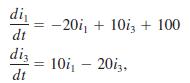
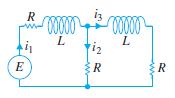
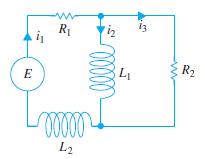
When E = 100 V, R = 10 Ω, and L = 1 h, the system of differential equations for the currents i1(t) and i3(t) in the electrical network given in Figure 9.4.3 iswhere i1(0) = 0 and i3(0) [1] 0. Use the RK4 method to approximate i1(t) and i3(t) at t [1] 0.1, 0.2, 0.3, 0.4, and 0.5. Use h = 0.1. Use a
In problem use the Adams-Bashforth-Moulton method to approximate y(1.0), where y(x) is the solution of the given initial-value problem. First use h = 0.2 and then use h = 0.1. Use the RK4 method to compute y1, y2, and y3.y' = y + cos x, y(0) = 1
In problem use the RK4 method with h = 0.1 to obtain a four-decimal approximation of the indicated value.y' = x2 + y2, y(0) = 1; y(0.5)
In problem use the improved Euler’s method to obtain a four-decimal approximation of the indicated value. First use h = 0.1 and then use h = 0.05.y' = x + y2, y(0) = 0; y(0.5)
Use Euler’s method to approximate y(0.2), where y(x) is the solution of the initial-value problemy'' - (2x + 1)y = 1, y(0) = 3, y'(0) = 1. First use one step with h [1] 0.2 and then repeat the calculations using two steps with h = 0.1.
Use the RK4 method to approximate y(0.2), where y(x) is the solution of the initial-value problemy'' - 2y' + 2y = et cos t, y(0) = 1, y'(0) [1] 2.First use h = 0.2 and then use h = 0.1.
In problem use the Adams-Bashforth-Moulton method to approximate y(1.0), where y(x) is the solution of the given initial-value problem. First use h = 0.2 and then use h = 0.1. Use the RK4 method to compute y1, y2, and y3.y' = 1 + y2, y(0) = 0
In problem use the RK4 method with h = 0.1 to obtain a four-decimal approximation of the indicated value.y' = 1 + y2, y(0) = 0; y(0.5)
In problem use the improved Euler’s method to obtain a four-decimal approximation of the indicated value. First use h = 0.1 and then use h = 0.05.y' = e-y , y(0) = 0; y(0.5)
In problem 1-4 construct a table comparing the indicated values of y(x) using Euler’s method, the improved Euler’s method, and the RK4 method. Compute to four rounded decimal places. First use h = 0.1 and then use h = 0.05.y' = xy + y2, y(1) = 1;y(1.1), y(1.2), y(1.3), y(1.4), y(1.5)
In problem repeat the indicated problem using the RK4 method. First use h = 0.2 and then use h = 0.1.Problem 2Use Euler’s method to approximate y(1.2), where y(x) is the solution of the initial-value problemx2 y'' - 2xy' + 2y = 0, y(1) = 4, y'(1) = 9,where x > 0. Use h = 0.1. Find the analytic
In problem use the Adams-Bashforth-Moulton method to approximate y(0.8), where y(x) is the solution of the given initial-value problem. Use h = 0.2 and the RK4 method to compute y1, y2, and y3.y' = 4x - 2y, y(0) = 2
In problem use the RK4 method with h = 0.1 to obtain a four-decimal approximation of the indicated value.y' = 4x - 2y, y(0) = 2; y(0.5)
In problem use the improved Euler’s method to obtain a four-decimal approximation of the indicated value. First use h = 0.1 and then use h = 0.05.y' = X2 ± Y2, Y(0) = 1; Y(0.5)
In problems 1-4 construct a table comparing the indicated values of y(x) using Euler’s method, the improved Euler’s method, and the RK4 method. Compute to four rounded decimal places. First use h = 0.1 and then use h = 0.05. y' = Vx + y, y(0.5) = 0.5; y(0.6), y(0.7), y(0.8), y(0.9), y(1.0)
In problem repeat the indicated problem using the RK4 method. First use h = 0.2 and then use h = 0.1.Problem 1Use Euler’s method to approximate y(0.2), where y(x) is the solution of the initial-value problemy'' - 4y' + 4y = 0, y (0) = -2, y'(0) = 1.Use h = 0.1. Find the analytic solution of the
In problem use the Adams-Bashforth-Moulton method to approximate y(0.8), where y(x) is the solution of the given initial-value problem. Use h = 0.2 and the RK4 method to compute y1, y2, and y3.y' = 2x - 3y + 1, y(0) = 1
In problem use the improved Euler’s method to obtain a four-decimal approximation of the indicated value. First use h = 0.1 and then use h = 0.05.y' = 1 + y2, y(0) = 0; y(0.5)
In =roblem construct a table comparing the indicated values of y(x) using Euler’s method, the improved Euler’s method, and the RK4 method. Compute to four rounded decimal places. First use h = 0.1 and then use h = 0.05.y' = sin x2 + cos y2, y(0) = 0;y(0.1), y(0.2), y(0.3), y(0.4), y(0.5)
Use Euler’s method to approximate y(1.2), where y(x) is the solution of the initial-value problemx2 y'' - 2xy' + 2y = 0, y(1) = 4, y'(1) = 9,where x > 0. Use h = 0.1. Find the analytic solution of the problem, and compare the actual value of y(1.2) with y2.
Write a computer program to implement the Adams- Bashforth-Moulton method.
Assume w2 = 3/4 that in (4). Use the resulting secondorder Runge-Kutta method to approximate y(0.5), where y(x) is the solution of the initial-value problem in Problem 1. Compare this approximate value with the approximate value obtained in Problem 11 in Exercises 9.1.Problem 11Consider the
In problem use the improved Euler’s method to obtain a four-decimal approximation of the indicated value. First use h = 0.1 and then use h = 0.05.y' = 4x - 2y, y(0) = 2; y(0.5)
In problem construct a table comparing the indicated values of y(x) using Euler’s method, the improved Euler’s method, and the RK4 method. Compute to four rounded decimal places. First use h = 0.1 and then use h = 0.05.y' = 2 ln xy, y(1) = 2;y(1.1), y(1.2), y(1.3), y(1.4), y(1.5)
Use Euler’s method to approximate y(0.2), where y(x) is the solution of the initial-value problemy'' - 4y' + 4y = 0, y (0) = -2, y'(0) = 1.Use h = 0.1. Find the analytic solution of the problem, and compare the actual value of y(0.2) with y2.
Find the analytic solution of the initial-value problem in Example 1. Compare the actual values of y(0.2), y(0.4), y(0.6), and y(0.8) with the approximations y1, y2, y3, and y4.
Use the RK4 method with h = 0.1 to approximate y(0.5), where y(x) is the solution of the initial-value problem y' = (x + y - 1)2, y(0) = 2. Compare this approximate value with the actual value obtained in Problem 11 in Exercises 9.1.Problem 11Consider the initial-value problem y' = (x + y - 1)2,
In problem use the improved Euler’s method to obtain a four-decimal approximation of the indicated value. First use h = 0.1 and then use h = 0.05.y' = 2x - 3y + 1, y(1) = 5; y(1.5)
Examine your phase portraits in Problem 47. Under what conditions will the phase portrait of a 2 x 2 homogeneous linear system with complex eigenvalues consist of a family of closed curves? consist of a family of spirals? Under what conditions is the origin (0, 0) a repeller? An attractor?
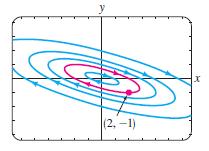
Obtain a Cartesian equation of the curve defined parametrically by the solution of the linear system in Example 6. Identify the curve passing through (2, -1) in Figure 8.2.5. Compute x2, y2, and xy.Figure 8.2.5. (2. -1)
Consider the 5 × 5 matrix given in Problem 31. Solve the system ' = AX without the aid of matrix methods, but write the general solution using matrix notation. Use the general solution as a basis for a discussion of how the system can be solved using the matrix methods of this section. Carry out
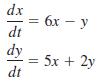
Solve each of the following linear systems.a.b.Find a phase portrait of each system. What is the geometric significance of the line y = -x in each portrait? X' = 1
(a) Solve (2) of Section 7.6 using the first method outlined in the Remarks (page 345)—that is, express (2) of Section 7.6 as a first-order system of four linear equations. Use a CAS or linear algebra software as an aid in finding eigenvalues and eigenvectors of a 4 × 4 matrix. Then apply
Find phase portraits for the systems in Problems 36, 37, and 38.Problems 36, 37, and 38.Find the general solution of the given system. X' = -4.
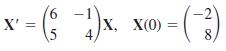
Solve the given initial-value problem. -2 X' = 15 Х. ХО) 4 X(0) 8/
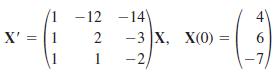
Solve the given initial-value problem. -12 -14) X' = |1 2 -3 X, X(0) = 6. 1 -2) -7
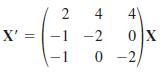
Find the general solution of the given system. 2 4 X' =-1 -2 0 -2/ 0 X -1
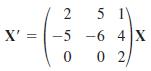
Find the general solution of the given system. 5 1' -6 4 X 0 0 2 2 5 X' =-5
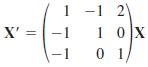
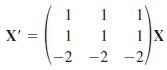
Find the general solution of the given system. 1 -1 2) 1 0X X' =-1 -1 0 1
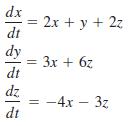
Find the general solution of the given system. dx 2x + y + 2z dt dy 3x + 6z dt dz -4x – 3z dt
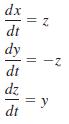
Find the general solution of the given system. 一Z y |如山山|山水山
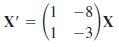
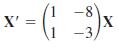
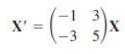
Find the general solution of the given system. X' = (; ) 1 -3,
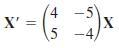
Find the general solution of the given system. 4 X' = -4.
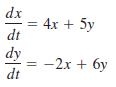
Find the general solution of the given system. dx 4x + 5y dt dy -2x + 6y dt
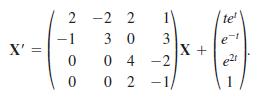
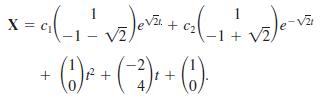
Solving a nonhomogeneous linear system X' = AX + F(t) by variation of parameters when A is a 3 × 3 (or larger) matrix is almost an impossible task to do by hand. Consider the system(a) Use a CAS or linear algebra software to find the eigenvalues and eigenvectors of the coefficient matrix.(b) Form
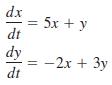
Find the general solution of the given system. dx 5x + y dt dy -2x + 3y dt %3D
If y1 and y2 are linearly independent solutions of the associated homogeneous DE for y'' + P(x)y' + Q(x)y = f (x), show in the case of a nonhomogeneous linear second-order DE that (9) reduces to the form of variation of parameters discussed in Section 4.6.
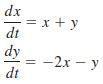
Find the general solution of the given system. dx = x + y di dy -2х — у dt
The system of differential equations for the currents i1(t) and i2(t) in the electrical network shown in Figure 8.3.2 isUse variation of parameters to solve the system if R1 = 8 Ω, R2 = 3 Ω, L1 = 1 h, L2 = 1 h, E(t) = 100 sin t V, i1(0) = 0, and i2(0) = 0. -(-(R, + R2)/L2 R2/L, R2/L, -R/L \i2,
Find the general solution of the given system. dx = 6x - y dt dy 5x + 2y dt
In problem use (14) to solve the given initialvalue problem. x' = (; )x• G) xo=(-) X' = )x + X(1) = 1
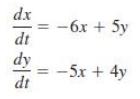
Find phase portraits for the systems in Problems 20 and 21. For each system find any half-line trajectories and include these lines in your phase portrait.Problems 20 and 21. dx -6x + 5y dt -5x + 4y dt
In problem use (14) to solve the given initialvalue problem. X' = 3 -1 4e2 X + X(0) = 3 4et
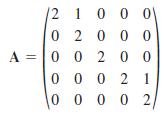
Show that the 5 × 5 matrixhas an eigenvalue λ1 of multiplicity 5. Show that three linearly independent eigenvectors corresponding to λ1 can be found. 2 1 00 0' 0 2 0 0 0 A = 0 0 2 0 0 0 0 0 0 2 1 0 0 0 0 2
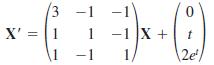
In problem use variation of parameters to solve the given system. 3 -1 -1 X' =1 X + 1 -1 1/ 2e/
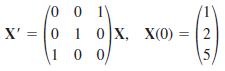
Solve the given initial-value problem. /0 0 1 X' = 0 1 0X, X(0) = |2 10 0
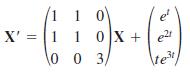
In problem use variation of parameters to solve the given system.
Solve the given initial-value problem. 2 4 X, X(0) = -1 6/ X' = 6)
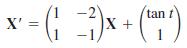
In problem use variation of parameters to solve the given system. X' = (;) tan i X +
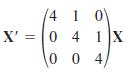
Find the general solution of the given system. /4 1 0\ X' = 0 4 4 1X 0 0 4/ 0 4/
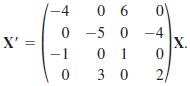
Use (1) to find the general solution ofUse MATLAB or a CAS to find eAt. -4 0 6 X' = -1 -5 0 -4 X. 0 1 3 0 2/
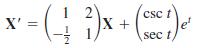
In problem use variation of parameters to solve the given system. 1 X + csc c t X' = sec t
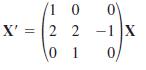
Find the general solution of the given system. /1 0 0\ X' = 2 2 -1 X 0 1 0/
In problem use variation of parameters to solve the given system. X' = ( ); X + -1 cot t)
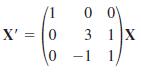
Find the general solution of the given system. X' = 0 3 1X 0 -1 1
Prove that the general solution ofon the interval (-∞, ∞) is X' = -6
(a) Use (1) to find the general solution ofUse a CAS to find eAt. Then use the computer to find eigenvalues and eigenvectors of the coefficient matrixand form the general solution in the manner of Section 8.2. Finally, reconcile the two forms of the general solution of the system.(b) Use (1) to
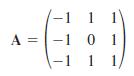
A matrix A is said to be nilpotent if there exists some positive integer m such that Am = 0. Verify thatis nilpotent. Discuss why it is relatively easy to compute eAt when A is nilpotent. Compute eAt and then use (1) to solve the system X' = AX. -1 1 -1 0 -1 1 A = 1
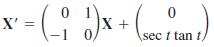
In problem use variation of parameters to solve the given system. X' = (: X + 0, -1 sec t tan t,
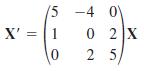
Find the general solution of the given system. (5 -4 0V X' = 1 0 2 X 2 5
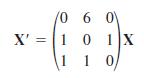
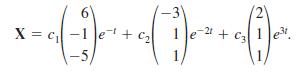
Prove that the general solution ofon the interval (-∞, ∞) is (0 6 0 X' = 1 0 1X 11 0
Reread the discussion leading to the result given in (7). Does the matrix sI - A always have an inverse? Discuss.
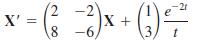
In problem use variation of parameters to solve the given system. X' = (2 -2 X + %3D 8 -6, t
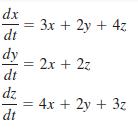
Find the general solution of the given system. dx 3x + 2y + 4z dt dy 2x + 2z dt dz 4x + 2y + 3z dt
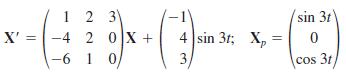
Verify that the vector Xp is a particular solution of the given system. 1 2 3 X' =|-4 2 0X + -6 1 0/ sin 3t 4 sin 3t; X, = 3 cos 3t
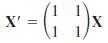
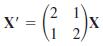
Solve the given system. X' = %3D 1 2.
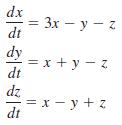
Find the general solution of the given system. dx = 3x – y - z dt dy = x + y - z dt dz = x - y + z dt
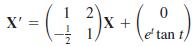
Verify that the vector Xp is a particular solution of the given system. X' = 3 x-G x- () x.-()- -() |e'; X, =
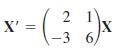
Solve the given system. 2 1 X' = -3 6
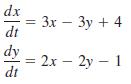
In problem use variation of parameters to solve the given system. dx = 3x – 3y + 4 dt dy = 2x – 2y - 1 dt
In problem solve the given linear system. X' X + e tan tan t)
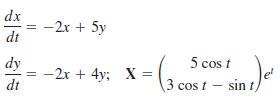
Verify that the vector X is a solution of the given system. dx -2x + 5y dt %3D 5 cos t dy -2r + 4y; X = dt 3 cos t - sin t
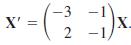
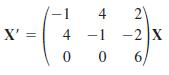
Find the general solution of the given system. 2 -1 -2 X 6| -1 4 X' =
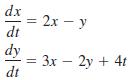
In problem use variation of parameters to solve the given system. dx = 2x - y dt dy = 3x – 2y + 4t dt
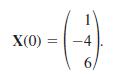
Solve the system in Problem 7 subject to the initial conditionProblem 7In problem use (1) to find the general solution of the given system. X(0) -4 6/
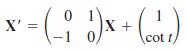
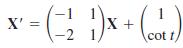
In problem solve the given linear system. (-1 X' = -2 )x + (o) (cot t/
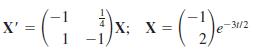
Verify that the vector X is a solution of the given system. x -( x-( X' = - 3t/2 -1,
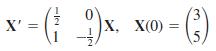
Solve the given initial-value problem. X' 3. X, X(0) = =
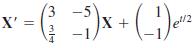
In problem use variation of parameters to solve the given system. (3 -5 X' = X +
Solve the system in Problem 9 subject to the initial conditionProblem 9In problem use (5) to find the general solution of the given system. X(0) 3)
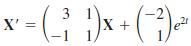
In problem solve the given linear system. 3 X' = -1 -2' X +
Verify that the vector X is a solution of the given system. X' = ( 2 X; X = et te 4
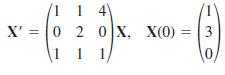
Solve the given initial-value problem. (1 1 4 X' = 0 2 0 X, X(0) = 3 1 1 1
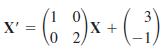
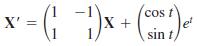
In problem use variation of parameters to solve the given system. x' = (; )x+ () cos t et sin t
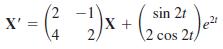
In problem use variation of parameters to solve the given system. X' = (; )* + (2cos 2) sin 21 ,21 2 cos 2t,
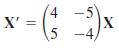
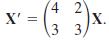
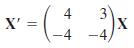
In problem use the method of Example 2 to compute eAt for the coefficient matrix. Use (1) to find the general solution of the given system. X' = 4 3 -4 -4,
Showing 100 - 200
of 1259
1
2
3
4
5
6
7
8
9
10
11
12
13
Step by Step Answers

 Get 50% OFF
Claim Now
Get 50% OFF
Claim Now