New Semester
Started
Get
50% OFF
Study Help!
--h --m --s
Claim Now
Question Answers
Textbooks
Find textbooks, questions and answers
Oops, something went wrong!
Change your search query and then try again
S
Books
FREE
Study Help
Expert Questions
Accounting
General Management
Mathematics
Finance
Organizational Behaviour
Law
Physics
Operating System
Management Leadership
Sociology
Programming
Marketing
Database
Computer Network
Economics
Textbooks Solutions
Accounting
Managerial Accounting
Management Leadership
Cost Accounting
Statistics
Business Law
Corporate Finance
Finance
Economics
Auditing
Tutors
Online Tutors
Find a Tutor
Hire a Tutor
Become a Tutor
AI Tutor
AI Study Planner
NEW
Sell Books
Search
Search
Sign In
Register
study help
mathematics
a first course in differential equations
A First Course in Differential Equations with Modeling Applications 10th edition Dennis G. Zill - Solutions
In problem use the Laplace transform to solve the given initial value problem.2y'' + 3y'' - 3y' - 2y = e-t, y(0) = 0, y'(0) = 0, y''(0) = 1
Find ℒ{f (t)} by first using a trigonometric identity.f(t) = sin(4t + 5)
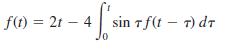
In Problem use the Laplace transform to solve the given integral equation or integrodifferential equation. f(t) = 21 – 4 si sin Tf(t – 7) dr
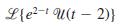
Find either F(s) or f (t), as indicated. L{e?-1 U(t – 2)}
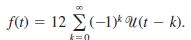
Use the Laplace transform to solve the given equation.y'' + 5y + 4y = f(t), y(0) = 0, y'(0) = 3 f(t) = 12 (-1)* U(t – k). よ=0
In problem use the Laplace transform to solve the given initial value problem.y'' + 9y = et, y(0) = 0, y'(0) = 0
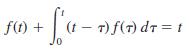
In Problem use the Laplace transform to solve the given integral equation or integrodifferential equation. f(t) + T) f(7) dr = t
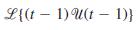
Find either F(s) or f (t), as indicated. L{(t – 1)U(t – 1)}
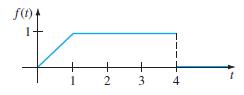
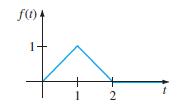
Use the Laplace transform to solve the given equation.y' + 2y = f(t), y(0) = 1, where f(t) is given in Figure 7.R.10. f() 4 3.
In problem use the Laplace transform to solve the given initial value problem.y'' + y = √2 sin √2t, y(0) = 10, y'(0) = 0
Find ℒ{f (t)} by first using a trigonometric identity.f(t) = cos2t
Find {f (t)} by first using a trigonometric identity.f(t) = sin 2t cos 2t
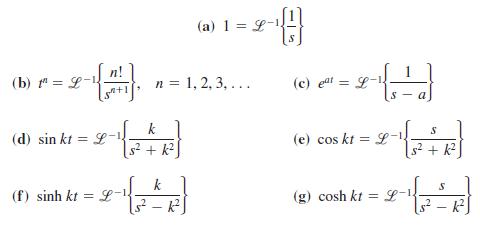
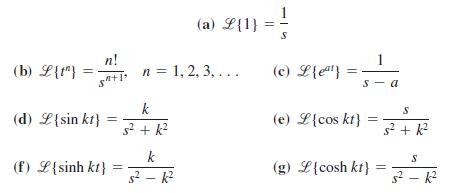
In problem use Theorem 7.1.1 to find ℒ [1]{f(t)}.f(t) = e-t cosh tTheorem 7.1.1 1 (a) L{1} = - n! n = 1, 2, 3, ... =-- s - a (b) L{t"} (c) L{e"} k (d) L{sin kt} (e) L{cos kt} 5? + k? s? + k? k (f) L{sinh kt} (g) L{cosh kt} s2 – k2 s2 – k2
Use the Laplace transform and the results of Problem 35 to solve the initial-value problemy'' + y = sin t + t sin t, y(0) = 0, y'(0) = 0Use a graphing utility to graph the solution.
Use the Laplace transform to find the charge q(t) in an RC series circuit when q(0) = 0 and E(t) = E0e-kt, k > 0. Consider two cases: k ≠ 1/RC and k = 1/RC.
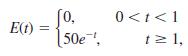
Use the Laplace transform to solve the given equation.y' - 5y = f(t), where 2. 0st
In problem use the Laplace transform to solve the given initial value problem.y'' - 4y' = 6e3t - 3e-t, y(0) = 1, y'(0) = -1
In problem use Theorem 7.1.1 to find ℒ [1]{f(t)}.f(t) = et sinh tTheorem 7.1.1 1 (a) L{1} = - n! n = 1, 2, 3, ... =-- s - a (b) L{t"} (c) L{e"} k (d) L{sin kt} (e) L{cos kt} 5? + k? s? + k? k (f) L{sinh kt} (g) L{cosh kt} s2 – k2 s2 – k2
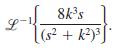
The table in Appendix III does not contain an entry for(a) Use (4) along with the results in (5) to evaluate this inverse transform. Use a CAS as an aid in evaluating the convolution integral.(b) Reexamine your answer to part (a). Could you have obtained the result in a different manner? 8k°s + k?)
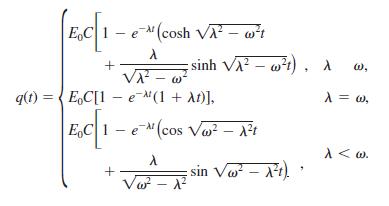
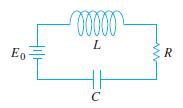
Consider a battery of constant voltage E0 that charges the capacitor shown in Figure 7.3.9. Divide equation (20) by L and define 2λ = R/L and ω2 = 1/LC.Use the Laplace transform to show that the solution q(t) of q'' + 2λq' + ω2q = E0/L subject to q(0) = 0, i(0) = 0 is - e " (cosh VA – wt sinh
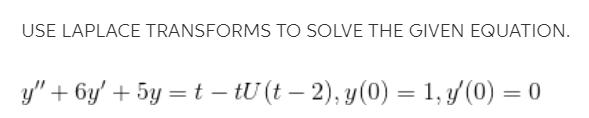
USE LAPLACE TRANSFORMS TO SOLVE THE GIVEN EQUATION. y" + 6y' + 5y = t – tU (t – 2), y(0) = 1, y/ (0) = 0
In problem use the Laplace transform to solve the given initial value problem.y'' + 5y' + 4y = 0, y(0) = 1, y'(0) = 0
In problem use Theorem 7.1.1 to find ℒ [1]{f(t)}.f(t) = cosh ktTheorem 7.1.1 1 (a) L{1} = - n! n = 1, 2, 3, ... =-- s - a (b) L{t"} (c) L{e"} k (d) L{sin kt} (e) L{cos kt} 5? + k? s? + k? k (f) L{sinh kt} (g) L{cosh kt} s2 – k2 s2 – k2
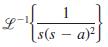
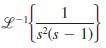
In problem use (8) to evaluate the given inverse transform. -1, [s(s – a)
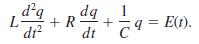
Recall that the differential equation for the instantaneous charge q(t) on the capacitor in an LRC-series circuit is given bySee Section 5.1. Use the Laplace transform to find q(t) when L = 1 h, R = 20 Ω, C = 0.005 f, E(t) = 150 V, t > 0, q(0) = 0, and i(0) = 0. What is the current i(t)? d'q 1
Use the Laplace transform to solve the given equation.y'' - 8y' + 20y = tet, y(0) = 0, y'(0) = 0
In problem use the Laplace transform to solve the given initial value problem.y' – y = 2 cos 5t, y(0) = 0
In problem use Theorem 7.1.1 to find ℒ [1]{f(t)}.f(t) = sinh ktTheorem 7.1.1 1 (a) L{1} = - n! n = 1, 2, 3, ... =-- s - a (b) L{t"} (c) L{e"} k (d) L{sin kt} (e) L{cos kt} 5? + k? s? + k? k (f) L{sinh kt} (g) L{cosh kt} s2 – k2 s2 – k2
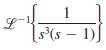
In problem use (8) to evaluate the given inverse transform. 1 L- [s(s – 1))
A 4-pound weight stretches a spring 2 feet. The weight is released from rest 18 inches above the equilibrium position, and the resulting motion takes place in a medium offering a damping force numerically equal to 7/8 times the instantaneous velocity. Use the Laplace transform to find the equation
Use the Laplace transform to solve the given equation.y'' - 2y' + y = et, y(0) = 0, y'(0) = 5
In problem use the Laplace transform to solve the given initial value problem.y' + 6y = e4t, y(0) = 2
In problem use Theorem 7.1.1 to find ℒ [1]{f(t)}.f(t) = cos 5t + sin 2tTheorem 7.1.1 1 (a) L{1} = - n! n = 1, 2, 3, ... =-- s - a (b) L{t"} (c) L{e"} k (d) L{sin kt} (e) L{cos kt} 5? + k? s? + k? k (f) L{sinh kt} (g) L{cosh kt} s2 – k2 s2 – k2
In problem use (8) to evaluate the given inverse transform. 1 -1 s(s – 1)J S(S
In problem use the Laplace transform and the procedure outlined in Example 10 to solve the given boundary-value problem.y'' + 8y' + 20y = 0, y(0) = 0, y'(π) = 0
Express f in terms of unit step functions. Find ℒ{f(t)} and ℒ{etf(t)}. 1.
In problem use the Laplace transform to solve the given initial value problem.2dy/dt + y = 0, y(0) = -3
In problem use Theorem 7.1.1 to find ℒ [1]{f(t)}.f(t) = 4t2 - 5 sin 3tTheorem 7.1.1 1 (a) L{1} = - n! n = 1, 2, 3, ... =-- s - a (b) L{t"} (c) L{e"} k (d) L{sin kt} (e) L{cos kt} 5? + k? s? + k? k (f) L{sinh kt} (g) L{cosh kt} s2 – k2 s2 – k2
In problem use (8) to evaluate the given inverse transform. L- [s(s – 1)] 1,
In problem use the Laplace transform and the procedure outlined in Example 10 to solve the given boundary-value problem.y'' + 2y' + y = 0, y'(0) = 2, y(1) = 2
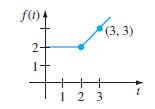
Express f in terms of unit step functions. Find ℒ{f(t)} and ℒ{etf(t)}. (3, 3) 2- 1+ + 1 2 3
In problem use the Laplace transform to solve the given initial value problem.dy/dt - y = 1, y (0) = 0
In problem use Theorem 7.1.1 to find ℒ [1]{f(t)}.f(t) = (et – e-t)2Theorem 7.1.1 1 (a) L{1} = - n! n = 1, 2, 3, ... =-- s - a (b) L{t"} (c) L{e"} k (d) L{sin kt} (e) L{cos kt} 5? + k? s? + k? k (f) L{sinh kt} (g) L{cosh kt} s2 – k2 s2 – k2
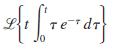
In problem use Theorem 7.4.2 to evaluate the given Laplace transform. Do not evaluate the integral before transforming.Theorem 7.4.2If f(t) and g(t) are piecewise continuous on [0, ∞) and of exponential order, then Te dr
In problem use the Laplace transform to solve the given initial-value problem.y" - 2y' + 5y = 1 + t, y(0) = 0, y'(0) = 4
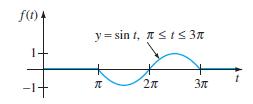
Express f in terms of unit step functions. Find ℒ{f(t)} and ℒ{etf(t)}. y= sin t, n
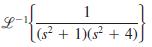
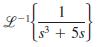
In problem use appropriate algebra and Theorem 7.2.1 to find the given inverse Laplace transform.Theorem 7.2.1 6s + 3 L-1 s + 5s? + 4]
In problem use Theorem 7.1.1 to find ℒ [1]{f(t)}.f(t) = (1 + e2t)2Theorem 7.1.1 1 (a) L{1} = - n! n = 1, 2, 3, ... =-- s - a (b) L{t"} (c) L{e"} k (d) L{sin kt} (e) L{cos kt} 5? + k? s? + k? k (f) L{sinh kt} (g) L{cosh kt} s2 – k2 s2 – k2
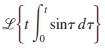
In problem use Theorem 7.4.2 to evaluate the given Laplace transform. Do not evaluate the integral before transforming.Theorem 7.4.2If f(t) and g(t) are piecewise continuous on [0, ∞) and of exponential order, then sint dr
In problem use the Laplace transform to solve the given initial-value problem.y" - y' = e cos t, y(0) = 0, y'(0) = 0
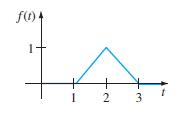
Express f in terms of unit step functions. Find ℒ{f(t)} and ℒ{etf(t)}. 1+ + 4) 3. 2.
In problem use appropriate algebra and Theorem 7.2.1 to find the given inverse Laplace transform.Theorem 7.2.1 (a) 1 = L-1 n! (b) " = L- n = 1, 2, 3, ... (c) eat = L-1 %3D k (d) sin kt = L-1 (e) cos kt = L1, s2 + k2 s? + k? k (f) sinh kt = L-1. (g) cosh kt = L-1.
In problem use Theorem 7.1.1 to find ℒ [1]{f(t)}.f(t) = t2 – e-9t + 5Theorem 7.1.1 1 (a) L{1} = - n! n = 1, 2, 3, ... =-- s - a (b) L{t"} (c) L{e"} k (d) L{sin kt} (e) L{cos kt} 5? + k? s? + k? k (f) L{sinh kt} (g) L{cosh kt} s2 – k2 s2 – k2
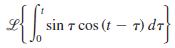
In problem use Theorem 7.4.2 to evaluate the given Laplace transform. Do not evaluate the integral before transforming.Theorem 7.4.2If f(t) and g(t) are piecewise continuous on [0, ∞) and of exponential order, then 2 sin 7 cos (t – 7) d7 sin T cos (t
In problem use the Laplace transform to solve the given initial-value problem.2y" + 20y' + 51y = 0, y(0) = 2,y'(0) = 0
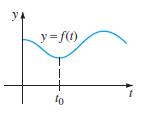
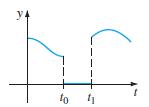
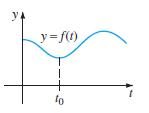
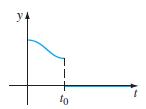
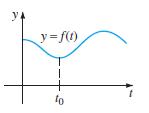
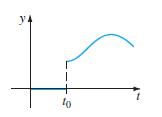
Use the unit step function to find an equation for each graph in terms of the function y = f (t), whose graph is given in Figure 7.R.1. y=f(t) to
In problem use appropriate algebra and Theorem 7.2.1 to find the given inverse Laplace transform.Theorem 7.2.1 1 L
In problem use Theorem 7.1.1 to find ℒ [1]{f(t)}.f(t) = 1 + e4tTheorem 7.1.1 1 (a) L{1} = - n! n = 1, 2, 3, ... =-- s - a (b) L{t"} (c) L{e"} k (d) L{sin kt} (e) L{cos kt} 5? + k? s? + k? k (f) L{sinh kt} (g) L{cosh kt} s2 – k2 s2 – k2
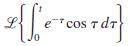
In problem use Theorem 7.4.2 to evaluate the given Laplace transform. Do not evaluate the integral before transforming.Theorem 7.4.2If f(t) and g(t) are piecewise continuous on [0, ∞) and of exponential order, then L. Tel- dr
In problem use the Laplace transform to solve the given initial-value problem.y" - 6y' + 13y = 0, y(0) = 0, y'(0) = -3
Use the unit step function to find an equation for each graph in terms of the function y = f (t), whose graph is given in Figure 7.R.1. y=f(t) to
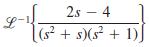
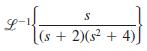
In problem use appropriate algebra and Theorem 7.2.1 to find the given inverse Laplace transform.Theorem 7.2.1 2s – 4 ((s? + s)(s? + 1).
In problem use Theorem 7.1.1 to find ℒ [1]{f(t)}.f(t) = (2t - 1)3Theorem 7.1.1 1 (a) L{1} = - n! n = 1, 2, 3, ... =-- s - a (b) L{t"} (c) L{e"} k (d) L{sin kt} (e) L{cos kt} 5? + k? s? + k? k (f) L{sinh kt} (g) L{cosh kt} s2 – k2 s2 – k2
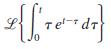
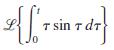
In problem use Theorem 7.4.2 to evaluate the given Laplace transform. Do not evaluate the integral before transforming.Theorem 7.4.2If f(t) and g(t) are piecewise continuous on [0, ∞) and of exponential order, then T sin T dr T sin
In problem use the Laplace transform to solve the given initial-value problem.y" - 4y' + 4y = t3, y(0) = 1, y'(0) = 0
Use the unit step function to find an equation for each graph in terms of the function y = f (t), whose graph is given in Figure 7.R.1. y=f(t) to
In problem use appropriate algebra and Theorem 7.2.1 to find the given inverse Laplace transform.Theorem 7.2.1 (s + 2)(s + 4)
In problem use Theorem 7.1.1 to find ℒ [1]{f(t)}.f(t) = (t + 1)3Theorem 7.1.1 1 (a) L{1} = - n! n = 1, 2, 3, ... =-- s - a (b) L{t"} (c) L{e"} k (d) L{sin kt} (e) L{cos kt} 5? + k? s? + k? k (f) L{sinh kt} (g) L{cosh kt} s2 – k2 s2 – k2
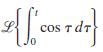
In problem use Theorem 7.4.2 to evaluate the given Laplace transform. Do not evaluate the integral before transforming.Theorem 7.4.2If f(t) and g(t) are piecewise continuous on [0, ∞) and of exponential order, then COS cos r dr
In problem use the Laplace transform to solve the given initial-value problem.y" - 6y' + 9y = t, y(0) = 0, y'(0) = 1
Use the unit step function to find an equation for each graph in terms of the function y = f (t), whose graph is given in Figure 7.R.1. y=f(t) to
In problem use appropriate algebra and Theorem 7.2.1 to find the given inverse Laplace transform.Theorem 7.2.1 (a) 1 = L-1 n! (b) " = L- n = 1, 2, 3, ... (c) eat = L-1 %3D k (d) sin kt = L-1 (e) cos kt = L1, s2 + k2 s? + k? k (f) sinh kt = L-1. (g) cosh kt = L-1.
In problem use Theorem 7.1.1 to find ℒ [1]{f(t)}.f(t) = -4t2 + 16t + 9Theorem 7.1.1 1 (a) L{1} = - n! n = 1, 2, 3, ... =-- s - a (b) L{t"} (c) L{e"} k (d) L{sin kt} (e) L{cos kt} 5? + k? s? + k? k (f) L{sinh kt} (g) L{cosh kt} s2 – k2 s2 – k2
In problem use Theorem 7.4.2 to evaluate the given Laplace transform. Do not evaluate the integral before transforming.Theorem 7.4.2If f(t) and g(t) are piecewise continuous on [0, ∞) and of exponential order, then cos r dr CoS Ta
In problem use the Laplace transform to solve the given initial-value problem.y" - 4y' + 4y = t3e2t, y(0) = 0, y'(0) = 0
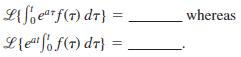
Fill in the blanks or answer true or false.
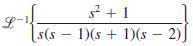
In problem use appropriate algebra and Theorem 7.2.1 to find the given inverse Laplace transform.Theorem 7.2.1 2 + 1 L s(s – 1)(s + 1)(s – 2)
In problem use Theorem 7.1.1 to find ℒ [1]{f(t)}.f(t) = t2 + 6t - 3Theorem 7.1.1 1 (a) L{1} = - n! n = 1, 2, 3, ... =-- s - a (b) L{t"} (c) L{e"} k (d) L{sin kt} (e) L{cos kt} 5? + k? s? + k? k (f) L{sinh kt} (g) L{cosh kt} s2 – k2 s2 – k2
In problem use Theorem 7.4.2 to evaluate the given Laplace transform. Do not evaluate the integral before transforming.Theorem 7.4.2If f(t) and g(t) are piecewise continuous on [0, ∞) and of exponential order, then e* dr
In problem use the Laplace transform to solve the given initial-value problem.y" + 2y' + y = 0, y(0) = 1, y'(0) = 1
Fill in the blanks or answer true or false.If ℒ{f(t) = F(s), then k > 0} then ℒ{eatf(t – k)????(t – k)} = _________.
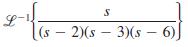
In problem use appropriate algebra and Theorem 7.2.1 to find the given inverse Laplace transform.Theorem 7.2.1 (s – 2)(s – 3)(s - 6)
In problem use Theorem 7.1.1 to find ℒ [1]{f(t)}.f(t) = 7t + 3Theorem 7.1.1 1 (a) L{1} = - n! n = 1, 2, 3, ... =-- s - a (b) L{t"} (c) L{e"} k (d) L{sin kt} (e) L{cos kt} 5? + k? s? + k? k (f) L{sinh kt} (g) L{cosh kt} s2 – k2 s2 – k2
In problem use Theorem 7.4.2 to evaluate the given Laplace transform. Do not evaluate the integral before transforming.ℒ{e2t*sin t}Theorem 7.4.2If f(t) and g(t) are piecewise continuous on [0, ∞) and of exponential order, then L{f* g} = £{f(1)) L{g(1)} = F(s) G(s). %3D
In problem use the Laplace transform to solve the given initial-value problem.y' - y = 1 + tet y(0) = 0
Fill in the blanks or answer true or false.If ℒ{f(t) = F(s), then ℒ{te8t f(t)} = _______.
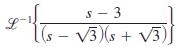
In problem use appropriate algebra and Theorem 7.2.1 to find the given inverse Laplace transform.Theorem 7.2.1 s - 3 V3)(s + V3)
In problem use Theorem 7.1.1 to find ℒ [1]{f(t)}.f(t) = 4t - 10Theorem 7.1.1 1 (a) L{1} = - n! n = 1, 2, 3, ... =-- s - a (b) L{t"} (c) L{e"} k (d) L{sin kt} (e) L{cos kt} 5? + k? s? + k? k (f) L{sinh kt} (g) L{cosh kt} s2 – k2 s2 – k2
In problem use Theorem 7.4.2 to evaluate the given Laplace transform. Do not evaluate the integral before transforming.ℒ{e-t * et cos t}Theorem 7.4.2If f(t) and g(t) are piecewise continuous on [0, ∞) and of exponential order, then L{f* g} = £{f(1)) L{g(1)} = F(s) G(s). %3D
In problem use the Laplace transform to solve the given initial-value problem.y' + 4y = e4t, y(0) = 2
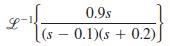
In problem use appropriate algebra and Theorem 7.2.1 to find the given inverse Laplace transform.Theorem 7.2.1 0.9s (s - 0.1)(s + 0.2)
In problem use Theorem 7.1.1 to find ℒ [1]{f(t)}.f(t) = t5Theorem 7.1.1 1 (a) L{1} = - n! n = 1, 2, 3, ... =-- s - a (b) L{t"} (c) L{e"} k (d) L{sin kt} (e) L{cos kt} 5? + k? s? + k? k (f) L{sinh kt} (g) L{cosh kt} s2 – k2 s2 – k2
In problem use Theorem 7.4.2 to evaluate the given Laplace transform. Do not evaluate the integral before transforming.ℒ{t2 * tet}Theorem 7.4.2If f(t) and g(t) are piecewise continuous on [0, ∞) and of exponential order, then L{f* g} = £{f(1)) L{g(1)} = F(s) G(s). %3D
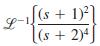
Find either F(s) or f (t), as indicated. |(s + 1)2) (s + 2)4
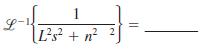
Fill in the blanks or answer true or false. 1 [Ls? + n?
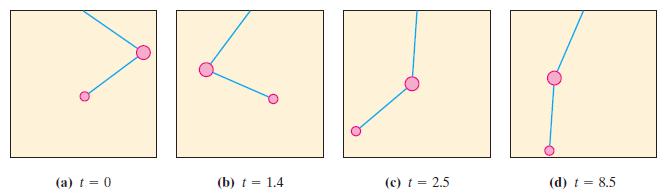
(a) Use the Laplace transform and the information given in Example 3 to obtain the solution (8) of the system given in (7).(b) Use a graphing utility to graph θ1(t) and θ2(t) in the tθ-plane. Which mass has extreme displacements of greater magnitude? Use the graphs to estimate the first time
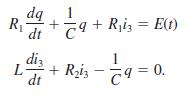
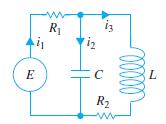
(a) Show that the system of differential equations for the charge on the capacitor q(t) and the current i3(t) in the electrical network shown in Figure 7.6.9 is(b) Find the charge on the capacitor when L = 1 h, R1 = 1 Ω, R2 = 1 Ω, C = 1 f,i3(0) = 0, and q(0) = 0.Figure 7.6.9 dą R1 C9 + Riz =
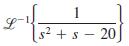
In problem use appropriate algebra and Theorem 7.2.1 to find the given inverse Laplace transform.Theorem 7.2.1 1 [s² + s - 20
In problem use Theorem 7.1.1 to find ℒ [1]{f(t)}.f(t) = 2t4Theorem 7.1.1 1 (a) L{1} = - n! n = 1, 2, 3, ... =-- s - a (b) L{t"} (c) L{e"} k (d) L{sin kt} (e) L{cos kt} 5? + k? s? + k? k (f) L{sinh kt} (g) L{cosh kt} s2 – k2 s2 – k2
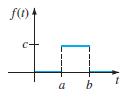
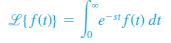
Use Definition 7.1.1 to find ℒ{f (t)}.Definition 7.1.1Let f be a function defined for t = 0. Then the integralis said to be the Laplace transform of f, provided that the integral converges. a b
Showing 400 - 500
of 1259
1
2
3
4
5
6
7
8
9
10
11
12
13
Step by Step Answers

 Get 50% OFF
Claim Now
Get 50% OFF
Claim Now




![L- [s(s – 1)] 1,](https://dsd5zvtm8ll6.cloudfront.net/si.question.images/images/question_images/1601/4/7/1/4935f7484051efc21601471492020.jpg)

![6s + 3 L-1 s + 5s? + 4]](https://dsd5zvtm8ll6.cloudfront.net/si.question.images/images/question_images/1601/4/5/1/6465f74367e85a1c1601451647549.jpg)