New Semester
Started
Get
50% OFF
Study Help!
--h --m --s
Claim Now
Question Answers
Textbooks
Find textbooks, questions and answers
Oops, something went wrong!
Change your search query and then try again
S
Books
FREE
Study Help
Expert Questions
Accounting
General Management
Mathematics
Finance
Organizational Behaviour
Law
Physics
Operating System
Management Leadership
Sociology
Programming
Marketing
Database
Computer Network
Economics
Textbooks Solutions
Accounting
Managerial Accounting
Management Leadership
Cost Accounting
Statistics
Business Law
Corporate Finance
Finance
Economics
Auditing
Tutors
Online Tutors
Find a Tutor
Hire a Tutor
Become a Tutor
AI Tutor
AI Study Planner
NEW
Sell Books
Search
Search
Sign In
Register
study help
mathematics
a first course in differential equations
A First Course in Differential Equations with Modeling Applications 10th edition Dennis G. Zill - Solutions
In problem use the Laplace transform to solve the given initial value problem.
In problem use the Laplace transform to solve the given initial value problem.
In problem use the Laplace transform to solve the given initial value problem.
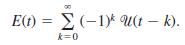
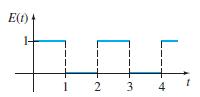
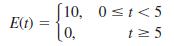
(a) Show that the square wave function E(t) given in Figure 7.4.4 can be written(b) Obtain (14) of this section by taking the Laplace transform of each term in the series in part (a).Figure 7.4.4 E(t) = E(-1)* U(t – k). k=0
m = 1, β = 2, k = 1, f is the square wave in Problem 50 with amplitude 5, and a = π, 0 ≤ t ≤ 4π.Solve the model for a driven spring/mass system with dampingwhere the driving function f is as specified. Use a graphing utility to graph x(t) for the indicated values of t. d'x dx + B + kx =
m = ½, β = 1, k = 5, f is the meander function in Problem 49 with amplitude 10, and a = π, 0 ≤ t < 2π.Solve the model for a driven spring/mass system with dampingwhere the driving function f is as specified. Use a graphing utility to graph x(t) for the indicated values of t. d'x dx + B +
Fill in the blanks or answer true or false.ℒ{e-5t} exists for s _____.
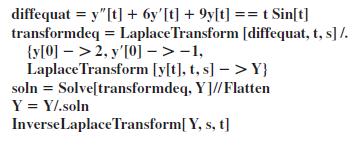
Appropriately modify the procedure of Problem 68 to find a solution ofy'' + 3y' - 4y = 0,y(0) = 0, y'(0) = 0, y''(0) = 1Problem 68In this problem you are led through the commands in Mathematica that enable you to obtain the symbolic Laplace transform of a differential equation and the
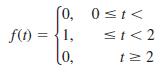
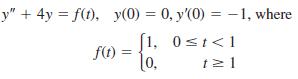
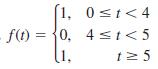
In problem use the Laplace transform to solve the given initial value problem.y'' + y = f(t), y(0) = 0, y'(0) = 1 where (0, 0st< f(1) = {1,
In this problem you are led through the commands in Mathematica that enable you to obtain the symbolic Laplace transform of a differential equation and the solution of the initial-value problem by finding the inverse transform. In Mathematica the Laplace transform of a function y(t) is obtained
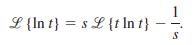
Because f(t) = ln t has an infinite discontinuity at t = 0 it might be assumed that ℒ{ln t} does not exist; however, this is incorrect. The point of this problem to guide you through the formal steps leading to the Laplace transform of f(t) = ln t, t > 0.(a) Use integration by parts
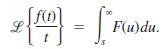
If we assume that ℒ{f(t)/t} exists and ℒ{f(t)} = F(s), thenUse this result to find the Laplace transform of the given function. The symbols a and k are positive constants.(a) f(t) = sin at/t(b) f(t) 2(1 – cos kt)/t F(u)du.
In problem use the Laplace transform to solve the given initial value problem.
Use the Laplace transform as an aide in evaluating the improper integral ∫∞0te-2t sin 4t dt.
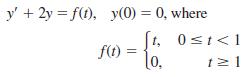
In problem use the Laplace transform to solve the given initial value problem. y' + 2y = f(t), y(0) = 0, where %3D t, 0
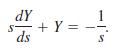
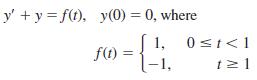
In problem use the Laplace transform to solve the given initial value problem. y' + y = f(t), y(0) = 0, where %3D 1, 0st
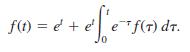
Solve the integral equation f(1) = d + ef(7) dr.
In problem use the Laplace transform to solve the given initial value problem. y' + y = f(t), y(0) = 0, where f(t) = [0, 0st
The Laplace transform ℒ{e-t2} exists, but without finding it solve the initial-value problem y'' + 7 = e-t2, y(0) = 0, y'(0) = 0.
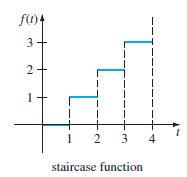
In problem write each function in terms of unit step functions. Find the Laplace transform of the given function. 3+ 2+ 1 1 2 4 staircase function
(a) Laguerre’s differential equationty'' + (1 - t)y' + ny = 0is known to possess polynomial solutions when n is a nonnegative integer. These solutions are naturally called Laguerre polynomials and are denoted by Ln(t). Find y = Ln(t), for n = 0, 1, 2, 3, 4 if it is known that Ln(0) = 1.(b) Show
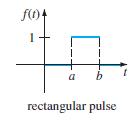
In problem write each function in terms of unit step functions. Find the Laplace transform of the given function. 1 a rectangular pulse
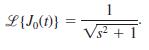
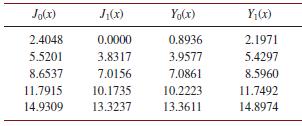
In Section 6.4 we saw that ty'' + y' + ty = 0 is Bessel’s equation of order n = 0. In view of (22) of that section and Table 6.4.1 a solution of the initial-value problem ty'' + y' + ty = 0, y(0) = 1, y'(0) = 0, is y = J0(t). Use this result and the procedure outlined in the instructions to
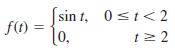
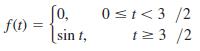
In problem write each function in terms of unit step functions. Find the Laplace transform of the given function. sin t, 0st< 2 f(t) = [0, %3D t2 2
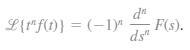
Discuss how Theorem 7.4.1 can be used to findTheorem 7.4.1If F(s) = ℒ{f(t)} and n = 1, 2, 3, . . . , then L - In s+1]
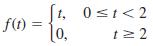
In problem write each function in terms of unit step functions. Find the Laplace transform of the given function. 0 st< 2 [0, 1, f(1) t2 2
In problem write each function in terms of unit step functions. Find the Laplace transform of the given function. fo, f(t) = (sin t, 0st
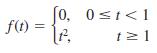
In problem write each function in terms of unit step functions. Find the Laplace transform of the given function. 0, 0st
Solve equation (15) subject to i(0) = 0 with E(t) as given. Use a graphing utility to graph the solution for 0 ≤ t ≤ 4 in the case when L = 1 and R = 1.E(t) is the sawtooth function in Problem 51 with amplitude 1 and b = 1.Problem 51In problem use Theorem 7.4.3 to find the Laplace transform of
In problem write each function in terms of unit step functions. Find the Laplace transform of the given function. (1, 0st
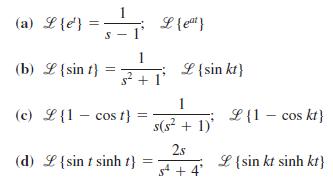
Use the given Laplace transform and the result in Problem 55 to find the indicated Laplace transform. Assume that a and k are positive constants.
Solve equation (15) subject to i(0) = 0 with E(t) as given. Use a graphing utility to graph the solution for 0 ≤ t ≤ 4 in the case when L = 1 and R = 1.E(t) is the meander function in Problem 49 with amplitude 1 and a = 1.Problem 49In problem use Theorem 7.4.3 to find the Laplace transform of
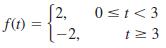
In problem write each function in terms of unit step functions. Find the Laplace transform of the given function. [2, f(t) 1-2, 0
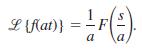
If ℒ{f(t)} = F(s) and a > 0 is a constant, show thatThis result is known as the change of scale theorem. L{ffat)} a a
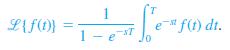
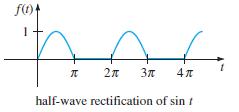
In problem use Theorem 7.4.3 to find the Laplace transform of the given periodic function.THEOREM 7.4.3If f (t) is piecewise continuous on [0, ∞), of exponential order, and periodic with period T, then half-wave rectification of sin t
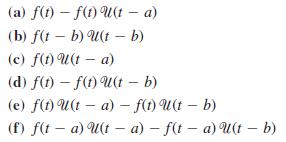
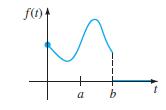
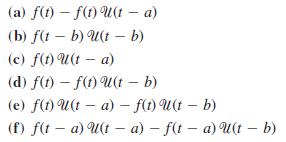
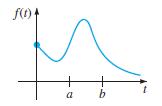
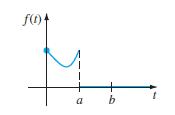
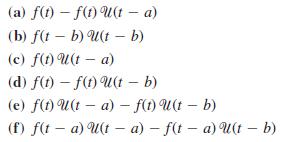
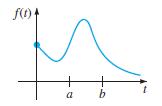
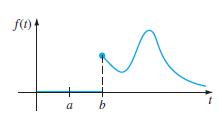
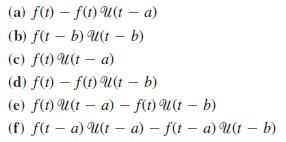
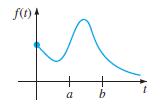
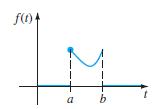
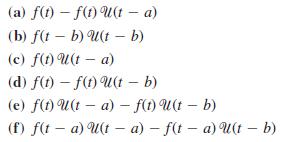
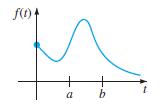
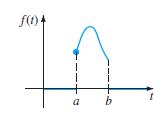
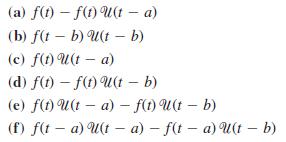
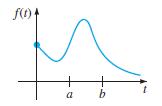
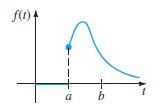
Match the given graph with one of the functions in (a)–(f ). The graph of f (t) is given in Figure 7.3.10. (a) f(t) – f(t) U(t – a) (b) f(t – b) Ut – b) (c) f(t) U(t – a) (d) f(t) – f() U(t – b) (e) f(t) U(t – a) - f(1) U(t – b) (f) f(t – a) U(t – a) – f(t – a) U(t – b)
Show that the Laplace transform ℒ{2tet2 cos et2} exists. Start with integration by parts.
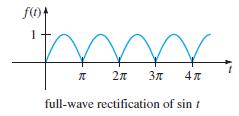
In problem use Theorem 7.4.3 to find the Laplace transform of the given periodic function.THEOREM 7.4.3If f (t) is piecewise continuous on [0, ∞), of exponential order, and periodic with period T, then 3n full-wave rectification of sin t
Match the given graph with one of the functions in (a)–(f ). The graph of f (t) is given in Figure 7.3.10. (a) f(t) – f(t) U(t – a) (b) f(t – b) Ut – b) (c) f(t) U(t – a) (d) f(t) – f() U(t – b) (e) f(t) U(t – a) - f(1) U(t – b) (f) f(t – a) U(t – a) – f(t – a) U(t – b)
Show that the function f(t) = 1/t2 does not possess a Laplace transform.Write ℒ{1/t2} as two improper integrals:Show that I1 diverges. st L{1/r²} dt+ -dt 1 + 1. %3D
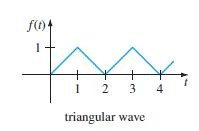
In problem use Theorem 7.4.3 to find the Laplace transform of the given periodic function.THEOREM 7.4.3If f (t) is piecewise continuous on [0, ∞), of exponential order, and periodic with period T, then 1 2 3 4 triangular wave
Match the given graph with one of the functions in (a)–(f ). The graph of f (t) is given in Figure 7.3.10. (a) f(t) – f(t) U(t – a) (b) f(t – b) Ut – b) (c) f(t) U(t – a) (d) f(t) – f() U(t – b) (e) f(t) U(t – a) - f(1) U(t – b) (f) f(t – a) U(t – a) – f(t – a) U(t – b)
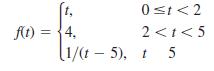
Explain why the functionis not piecewise continuous on [0, ∞). 0 st< 2 At) f(t) = {4. 2
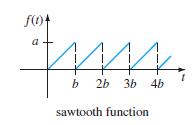
In problem use Theorem 7.4.3 to find the Laplace transform of the given periodic function.THEOREM 7.4.3If f (t) is piecewise continuous on [0, ∞), of exponential order, and periodic with period T, then b 2b 3b 4b sawtooth function
Match the given graph with one of the functions in (a)–(f ). The graph of f (t) is given in Figure 7.3.10. (a) f(t) – f(t) U(t – a) (b) f(t – b) Ut – b) (c) f(t) U(t – a) (d) f(t) – f() U(t – b) (e) f(t) U(t – a) - f(1) U(t – b) (f) f(t – a) U(t – a) – f(t – a) U(t – b)
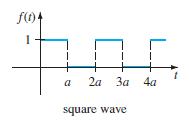
In problem use Theorem 7.4.3 to find the Laplace transform of the given periodic function.THEOREM 7.4.3If f (t) is piecewise continuous on [0, ∞), of exponential order, and periodic with period T, then 2а За 4а a square wave
Match the given graph with one of the functions in (a)–(f ). The graph of f (t) is given in Figure 7.3.10. (a) f(t) – f(t) U(t – a) (b) f(t – b) Ut – b) (c) f(t) U(t – a) (d) f(t) – f() U(t – b) (e) f(t) U(t – a) - f(1) U(t – b) (f) f(t – a) U(t – a) – f(t – a) U(t – b)
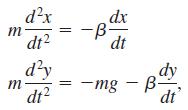
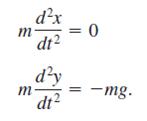
(a) Now suppose that air resistance is a retarding force tangent to the path but acts opposite to the motion. If we take air resistance to be proportional to the velocity of the projectile, then we saw in Problem 24 of Exercises 4.9 that motion of the projectile is describe by the system of
Under what conditions is a linear function f(x) = mx + b, m ≠ 0, a linear transform?
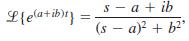
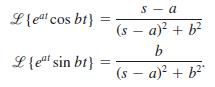
Use part (c) of Theorem 7.1.1 to show thatwhere a and b are real and i2= 1. Show how Euler’s formula (page 133) can then be used to deduce the resultsTheorem 7.1.1 s - а + ib L{ela+ibn} %3D (s- а)? + b?'
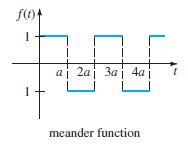
In problem use Theorem 7.4.3 to find the Laplace transform of the given periodic function.THEOREM 7.4.3If f(t) is piecewise continuous on [0, ∞), of exponential order, and periodic with period T, then 1 aj 2a 3a 4a 1 meander function
Match the given graph with one of the functions in (a)–(f ). The graph of f (t) is given in Figure 7.3.10. (a) f(t) – f(t) U(t – a) (b) f(t – b) Ut – b) (c) f(t) U(t – a) (d) f(t) – f() U(t – b) (e) f(t) U(t – a) - f(1) U(t – b) (f) f(t – a) U(t – a) – f(t – a) U(t – b)
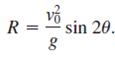
(a) A projectile, such as the canon ball shown in Figure 7.R.13, has weight w = mg and initial velocity v0 that is tangent to its path of motion. If air resistance and all other forces except its weight are ignored, we saw in Problem 23 of Exercises 4.9 that motion of the projectile is describe by
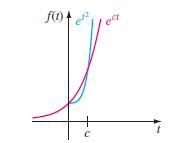
Figure 7.1.4 suggests, but does not prove, that the function f(t) = et2 is not of exponential order. How does the observation that t2 ln M + ct, for M > 0 and t sufficiently large, show that et2 > Mect for any c?Figure 7.1.4 ect +
Solve equation (10) subject to i(0) = 0 with L, R, C, and E(t) as given. Use a graphing utility to graph the solution for 0 ≤ t ≤ 3. L = 0.005 h, R =10, C = 0.02 f, E(t) = 100[t – (t – 1)U(t – 1)]
Find either F(s) or f (t), as indicated. e-25 L- s(s – 1)] 1,
In Problem 27 in Chapter 5 in Review we examined a spring/mass system in which a mass m slides over a dry horizontal surface whose coefficient of kinetic friction is a constant µ. The constant retarding force fk = µmg of the dry surface that acts opposite to the direction of motion is called
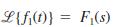
Suppose thatfor s c1 and that L{fi} = F,(s)
Solve equation (10) subject to i(0) = 0 with L, R, C, and E(t) as given. Use a graphing utility to graph the solution for 0 ≤ t ≤ 3. L = 0.1 h, R = 3 0, C = 0.05 f, E(t) = 100[U(t – 1) – U(t – 2)]
Find either F(s) or f (t), as indicated. e L s(s + 1)]
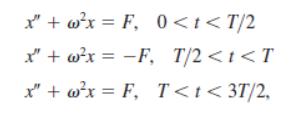
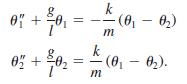
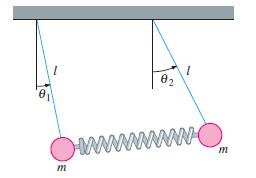
(a) Suppose two identical pendulums are coupled by means of a spring with constant k. See Figure 7.R.12. Under the same assumptions made in the discussion preceding Example 3 in Section 7.6, it can be shown that when the displacement angles θ1(t) and θ2(t) are small, the system of linear
Make up a function F(t) that is of exponential order but where f(t) = F'(t) is not of exponential order. Make up a function f that is not of exponential order but whose Laplace transform exists.
In Problem use the Laplace transform to solve the given integral equation or integrodifferential equation. dy + 6y(1) + 9y y(7) dr = 1, y(0) = 0 dt
Find either F(s) or f (t), as indicated. se s/2 L y-1 s2 + 4
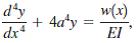
When a uniform beam is supported by an elastic foundation, the differential equation for its deflection y(x) is where a is a constant. In the case when a = 1, find the deflection y(x) of an elastically supported beam of length π that is embedded in concrete at
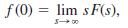
Suppose f(t) is a function for which f'(t) is piecewise continuous and of exponential order c. Use results in this section and Section 7.1 to justifywhere F(s) = ℒ{ f(t)}. Verify this result with f(t) = cos kt. f(0) = lim sF(s),
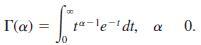
In problem use Problems 41 and 42 and the fact that Γ(1/2) = √π to find the Laplace transform of the given function.f(t) = 2t1/2 + 8t5/2Problems 41 and 42Theorem 7.1.1 I'(a) = 1a-le- dt, a 0. %3D
In Problem use the Laplace transform to solve the given integral equation or integrodifferential equation. y'() = 1 – sin t – y(7) dr, y(0) = 0 %3D
Find either F(s) or f (t), as indicated. -1, 2 + 1,
A uniform cantilever beam of length L is embedded at its left end (x = 0) and free at its right end. Find the deflection y(x) if the load per unit length is given by 2wo L2 w(x) - x+
Reread (iii) in the Remarks on page 288. Find the zero-input and the zero-state response for the IVP in Problem 36.
In problem use Problems 41 and 42 and the fact that Γ(1/2) = √π to find the Laplace transform of the given function.f(t) = t3/2Problems 41 and 42Theorem 7.1.1 I'(a) = 1a-le- dt, a 0. %3D
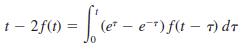
In Problem use the Laplace transform to solve the given integral equation or integrodifferential equation. t – 2f(t) = (e – e) f(t – T) dr
Find either F(s) or f (t), as indicated. [(1 + e-2)2] L- s + 2
A series circuit contains an inductor, a resistor, and a capacitor for which L = 1/2 h, R = 10 Ω, and C = 0.01 f, respectively. The voltageis applied to the circuit. Determine the instantaneous charge q(t) on the capacitor for t > 0 if q(0) = 0 and q'(0) = 0. (10, 0st
Make up two functions f1 and f2 that have the same Laplace transform. Do not think profound thoughts.
In problem use Problems 41 and 42 and the fact that Γ(1/2) = √π to find the Laplace transform of the given function.f(t) = t1/2Problems 41 and 42Theorem 7.1.1 I'(a) = 1a-le- dt, a 0. %3D
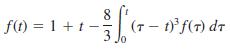
In Problem use the Laplace transform to solve the given integral equation or integrodifferential equation. 8 f(t) = 1 +t- 3. - 1' f(7) dr
Find either F(s) or f (t), as indicated. -25 e L .3
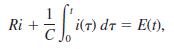
The current i(t) in an RC-series circuit can be determined from the integral equationwhere E(t) is the impressed voltage. Determine i(t) when R = 10 Ω, C = 0.5 f, and E(t) = 2(t2 + t). Ri + i(7) dr = E(t), C.
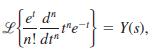
(a) With a slight change in notation the transform in (6) is the same asWith f(t) = teat, discuss how this result in conjunction with (c) of Theorem 7.1.1 can be used to evaluate ℒ{teat}.(b) Proceed as in part (a), but this time discuss how to use (7) with f (t) = t sin kt in conjunction with (d)
In problem use Problems 41 and 42 and the fact that Γ(1/2) = √π to find the Laplace transform of the given function.f(t) = t-1/2Problems 41 and 42Theorem 7.1.1 I'(a) = 1a-le- dt, a 0. %3D
In Problem use the Laplace transform to solve the given integral equation or integrodifferential equation. f(1) = cos t + ef(t - 7) dr
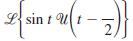
Find either F(s) or f (t), as indicated. L sin t Ut
Use the Laplace transform to solve each system.x'' + y'' = e2t2x' + y'' = -e2tx(0) = 0, y(0) = 0x'(0) = 0, y'(0) = 0
The inverse forms of the results in Problem 50 in Exercises 7.1 areIn problem use the Laplace transform and these inverses to solve the given initial-value problem.y'' - 2y' + 5y = 0, y(0) = 1, y'(0) = 3 S - a eal cos bt (s - a)? + b? b L(s - a) + b] eat sin bt.
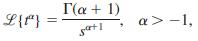
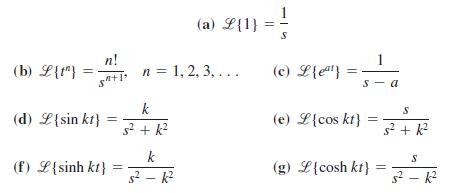
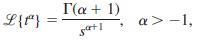
Use Problem 41 and a change of variables to obtain the generalizationof the result in Theorem 7.1.1(b).Theorem 7.1.1 Г(а + 1) a> -1,
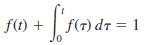
In Problem use the Laplace transform to solve the given integral equation or integrodifferential equation. f(t) +| f(7) dT = 1
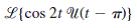
Find either F(s) or f (t), as indicated. L{cos 2t U(t – T)}
Use the Laplace transform to solve each system.x' + y = t4x + y' = 0x(0) = 1, y(0) = 2
The inverse forms of the results in Problem 50 in Exercises 7.1 areIn problem use the Laplace transform and these inverses to solve the given initial-value problem.y'' + y = e-3t cos 2t, y(0) = 0 S - a eal cos bt (s - a)? + b? b L(s - a) + b] eat sin bt.
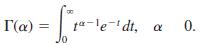
We have encountered the gamma function in our study of Bessel functions in Section 6.4 (page 258). One definition of this function is given by the improper integral Use this definition to show that Γ(α + 1) = αΓ(α). I(a) = ta-le- dt, 0. %3D
In Problem use the Laplace transform to solve the given integral equation or integrodifferential equation. f(t) + 2 f(G) cos (t – T) dr = 4e + sin t
Find either F(s) or f (t), as indicated. L{(3t + 1)U(t – 1)}
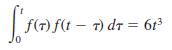
Use the Laplace transform to solve the given equation. f(T) f(t – 7) dr = 61
In problem use the Laplace transform to solve the given initial value problem.y''' + 2y'' – y' - 2y = sin 3t, y(0) = 0, y'(0) = 0, y''(0) = 1
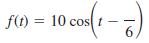
Find ℒ{f (t)} by first using a trigonometric identity. f(t) = 10 cos t 6. COS
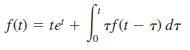
In Problem use the Laplace transform to solve the given integral equation or integrodifferential equation. f(t) = te + Tf(t – 7) dr
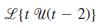
Find either F(s) or f (t), as indicated. L{t U(t – 2)}
Use the Laplace transform to solve the given equation. y'(t) = = cos t + y(7) cos(t – T) dr, y(0) = 1
Showing 300 - 400
of 1259
1
2
3
4
5
6
7
8
9
10
11
12
13
Step by Step Answers

 Get 50% OFF
Claim Now
Get 50% OFF
Claim Now










![L - In s+1]](https://dsd5zvtm8ll6.cloudfront.net/si.question.images/images/question_images/1601/5/2/8/1065f75612a9d3c11601528105768.jpg)





![L = 0.005 h, R =10, C = 0.02 f, E(t) = 100[t – (t – 1)U(t – 1)]](https://dsd5zvtm8ll6.cloudfront.net/si.question.images/images/question_images/1601/5/2/6/9125f755c802b2f41601526911297.jpg)
![e-25 L- s(s – 1)] 1,](https://dsd5zvtm8ll6.cloudfront.net/si.question.images/images/question_images/1601/4/6/3/7125f7465a0bc2721601463712202.jpg)

![L = 0.1 h, R = 3 0, C = 0.05 f, E(t) = 100[U(t – 1) – U(t – 2)]](https://dsd5zvtm8ll6.cloudfront.net/si.question.images/images/question_images/1601/5/2/6/8965f755c70d49531601526896265.jpg)
![e L s(s + 1)]](https://dsd5zvtm8ll6.cloudfront.net/si.question.images/images/question_images/1601/4/6/3/6995f7465935703b1601463698777.jpg)





![[(1 + e-2)2] L- s + 2](https://dsd5zvtm8ll6.cloudfront.net/si.question.images/images/question_images/1601/4/6/3/6435f74655bec2901601463643082.jpg)



![S - a eal cos bt (s - a)? + b? b L(s - a) + b] eat sin bt.](https://dsd5zvtm8ll6.cloudfront.net/si.question.images/images/question_images/1601/4/5/8/5725f74518c5221e1601458579365.jpg)