New Semester
Started
Get
50% OFF
Study Help!
--h --m --s
Claim Now
Question Answers
Textbooks
Find textbooks, questions and answers
Oops, something went wrong!
Change your search query and then try again
S
Books
FREE
Study Help
Expert Questions
Accounting
General Management
Mathematics
Finance
Organizational Behaviour
Law
Physics
Operating System
Management Leadership
Sociology
Programming
Marketing
Database
Computer Network
Economics
Textbooks Solutions
Accounting
Managerial Accounting
Management Leadership
Cost Accounting
Statistics
Business Law
Corporate Finance
Finance
Economics
Auditing
Tutors
Online Tutors
Find a Tutor
Hire a Tutor
Become a Tutor
AI Tutor
AI Study Planner
NEW
Sell Books
Search
Search
Sign In
Register
study help
mathematics
basic technical mathematics
Basic Technical Mathematics 12th Edition Allyn J. Washington, Richard Evans - Solutions
Perform the indicated operations and simplify each complex number to its rectangular form.(√−2)2 + j4
Find the magnitude and direction of a force on a bolt that is represented by 40.5 + 24.5 j newtons.
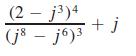
Evaluate each expression on a calculator. Express answers in the form a + bj. (2-j³)4 (j8 - j6)³ + j
Evaluate each expression on a calculator. Express answers in the form a + bj.(1 + j)−3(2 − j)−2
Give the rectangular form of each number:20∠160°
Find all of the roots of the given equations.x3 − 8 = 0
Perform the indicated operations and simplify each complex number to its rectangular form.√−27 + √12
The voltage of a certain generator is represented by 2.84 − 1.06j kV. Write this voltage in polar form.
Give the rectangular form of each number:0.62∠−72°
Find all of the roots of the given equations.x4 − 1 = 0
Perform the indicated operations and simplify each complex number to its rectangular form.√18 −√−8
The impedance in a certain circuit is Z = 8.5∠−36°Ω. Write this in rectangular form.
Evaluate each expression on a calculator. Express answers in the form a + bj.(5j − 4j2 + 3 j7)(2j12 − j13)
If E = 115e0.315j V and I = 28.6e−0.723j A, find the exponential form of Z given that E = IZ.
Give the rectangular form of each number:2.417(cos656.26° + j sin656.26°)
Use DeMoivre’s theorem to find all the indicated roots. Be sure to find all roots.The cube roots of √3 + j
Perform the indicated operations and simplify each complex number to its rectangular form.j3 − 6
Solve the given problems. Show that the conjugate of r ∠ θ is r ∠−θ.
In an electric circuit, the admittance is the reciprocal of the impedance. If the impedance is 2800 − 1450j ohms in a certain circuit, find the exponential form of the admittance.
Give the rectangular form of each number:5.011(cos123.82° + j sin123.82°)
Use DeMoivre’s theorem to find all the indicated roots. Be sure to find all roots.The square roots of 1 + j
Perform the indicated operations and simplify each complex number to its rectangular form.2j2 + 3j
Relative to the air, a plane heads north of west with a velocity that can be represented by −480 + 210j km/h. The wind is blowing from south of west with a velocity that can be represented by 60 + 210j km/h. Find the resultant velocity of the plane.
Perform the indicated operations and simplify each complex number to its rectangular form.5 − 2√25j2
For x + yj, what is the argument if x = y < 0?
The intensity of the signal from a radar microwave signal is 37.0[cos(−65.3°) + j sin(−65.3°)] V/m. Write this in exponential form.
Give the rectangular form of each number:48(cos60° + j sin60°)
Perform the indicated operations, expressing all answers in the form a + bj.(2j2 − 3j3 + 2j4 − 2j5)6
Use DeMoivre’s theorem to find all the indicated roots. Be sure to find all roots.The two square roots of −5 + 12j
Perform the indicated vector additions graphically. Check them algebraically.Two ropes hold a boat at a dock. The tensions in the ropes can be represented by 40 + 10j lb and 50 − 25j lb. Find the resultant force.
Perform the indicated operations and simplify each complex number to its rectangular form.√−4j2 + √−4
What is the argument for any negative real number?
Perform the indicated operations.The impedance in an antenna circuit is 3.75 + 1.10j ohms. Write this in exponential form and find the magnitude of the impedance.
Give the rectangular form of each number:2(cos225° + j sin 225°)
Perform the indicated operations, expressing all answers in the form a + bj.(4j5 − 5j4 + 2j3 − 3j2)2
Use DeMoivre’s theorem to find all the indicated roots. Be sure to find all roots.The three cube roots of 3 − 4j
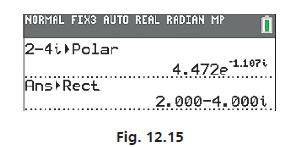
Using a calculator, express 75.6e1.25j in rectangular form. See Fig. 12.15. NORMAL FIX3 AUTO REAL RADIAN MP 2-4 Polar Ans Rect 4.472e 1.107 0 2.000-4.0001 Fig. 12.15
Perform the indicated operations and simplify each complex number to its rectangular form.−√1 −√−400
Perform the indicated vector operations graphically on the complex number 2 + 4j.Graph the number, the number multiplied by j, the number multiplied by j2, and the number multiplied by j3 on the same graph. Describe the result of multiplying a complex number by j.
Represent each complex number graphically and give the rectangular form of each.4629∠182.44°
Give the polar and exponential forms of each of the complex numbers.−4j5
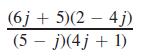
Perform the indicated operations, expressing all answers in the form a + bj. (6j+5)(24j) (5 - j)(4j + 1)
Use DeMoivre’s theorem to find all the indicated roots. Be sure to find all roots. The three cube roots of 27(cos 120° + j sin 120°)
Perform the indicated vector operations graphically on the complex number 2 + 4j. Subtract the conjugate from the number. Describe the result.
Perform the indicated operations and simplify each complex number to its rectangular form.3j −√−100
Using a calculator, express 3.73 + 5.24j in exponential form. See Fig. 12.15. NORMAL FIX3 AUTO REAL RADIAN MP 2-4 Polar Ans Rect 4.472e 1.107 0 2.000-4.0001 Fig. 12.15
Represent each complex number graphically and give the rectangular form of each.86.42∠94.62°
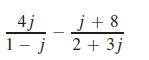
Perform the indicated operations, expressing all answers in the form a + bj. 4j 1-j j + 8 2+ 3j
Give the polar and exponential forms of each of the complex numbers.5000
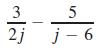
Perform the indicated operations, expressing all answers in the form a + bj. 3 2j 5 j - 6
Use DeMoivre’s theorem to find all the indicated roots. Be sure to find all roots.The two square roots of 4(cos60° + j sin60°)
Perform the indicated vector operations graphically on the complex number 2 + 4j.Add the number and its conjugate. Describe the result.
Perform the indicated operations and simplify each complex number to its rectangular form.−26 + √−64
Represent each complex number graphically and give the rectangular form of each.18.3∠540.0°
Give the polar and exponential forms of each of the complex numbers.158j − 327
Perform the indicated operations by using properties of exponents and express results in rectangular and polar forms.(18.0e5.13j)(25.5e0.77j)
Perform the indicated vector operations graphically on the complex number 2 + 4j.Graph the complex number and its conjugate. Describe the relative positions.
Perform the indicated operations by using properties of exponents and express results in rectangular and polar forms.(625e3.46j)(4.40e1.22j)
Give the polar and exponential forms of each of the complex numbers.1.07 + 4.55j
Represent each complex number graphically and give the rectangular form of each.7.32∠-270°
Perform the indicated operations and simplify each complex number to its rectangular form.2 + √−9
Perform the indicated operations, expressing all answers in the form a + bj. j² - j 2j - j8
Change each number to polar form and then perform the indicated operations. Express the result in rectangular and polar forms. Check by performing the same operation in rectangular form.(3 + 4j)4
Show the numbers a + bj, 3(a + bj), and −3(a + bj) on the same coordinate system. The multiplication of a complex number by a real number is called scalar multiplication of the complex number.−10 − 30j
Perform the indicated operations, expressing all answers in the form a + bj. js- j³ 3 + j
Simplify each of the given expressions.−√−j2
Represent each complex number graphically and give the rectangular form of each.277.8∠-342.63°
Give the polar and exponential forms of each of the complex numbers.60 − 20j
Perform the indicated operations by using properties of exponents and express results in rectangular and polar forms.(0.926e0.253j)3
Change each number to polar form and then perform the indicated operations. Express the result in rectangular and polar forms. Check by performing the same operation in rectangular form. 5j - 2 -1-j
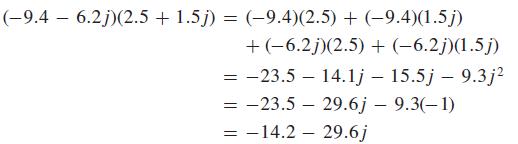
Perform the indicated operations on the resulting expressions if the given changes are made in the indicated examples of this section.In Example 2(b), change the sign before 6.2j from − to +, and then perform the multiplication.Data from Example 2(b) (-9.4 - 6.2j)(2.5 +1.5j) = (-9.4)(2.5) +
Locate the given numbers in the complex plane.2 + 6j
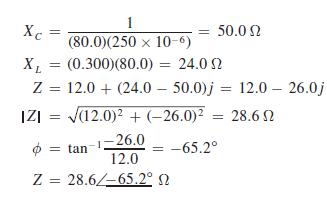
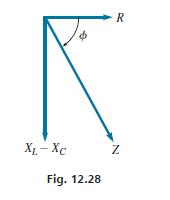
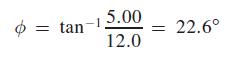
Perform the indicated operations if the given changes are made in the indicated examples of this section.In Example 5, double the values of L and C and then solve the given problem.Data from Example 5If R =12.0Ω, L = 0.300 H, C = 250 μF, and ω = 80.0 rad/s, find the impedance and the phase
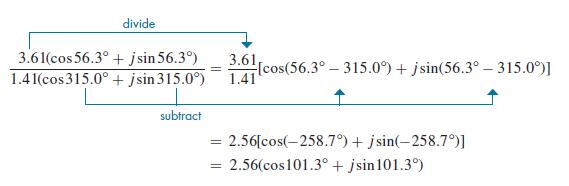
Perform the indicated operations for the resulting complex numbers if the given changes are made in the indicated examples of this section.In Example 2, change the sign of the angle in the second complex number and then divide.Data from Example 2Divide the first complex number of Example 1 by the
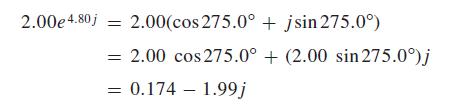
Perform the indicated operations for the resulting complex numbers if the given changes are made in the indicated examples of this section.In Example 3, change the exponent to 3.80j and then find the polar and rectangular forms.Data from Example 3Express the complex number 2.00e4.80 j in polar and
Determine each of the following as being either true or false. If it is false, explain why.4/90° = 4j
Represent each complex number graphically and give the polar form of each.8 + 6j
In Example 5(a), add 40 to the exponent and then evaluate.Data from Example 5(a)j10 = j8j2 = (1)(−1) = −1
Express the given numbers in exponential form.3.00(cos 60.0° + j sin 60.0°)
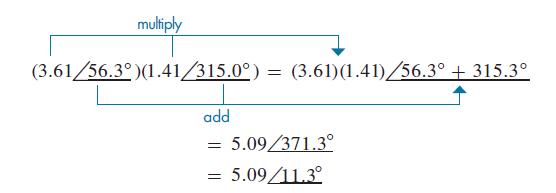
Multiply, expressing the result in polar form: (2∠130°)(3∠45°).
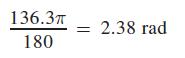
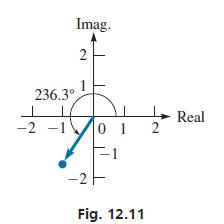
Perform the indicated operations for the resulting complex numbers if the given changes are made in the indicated examples of this section.In Example 1, change 136.3° to 226.3° and then find the exponential form.Data from Example 1Express the number 8.50∠136.3° in exponential form. Because
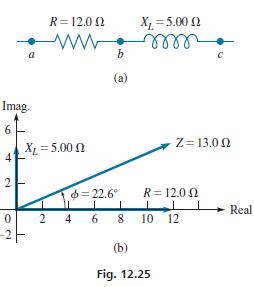
Perform the indicated operations if the given changes are made in the indicated examples of this section.In Example 1, change the value of XL to 16.0Ωand then solve the given problem.Data from Example 1In the series circuit shown in Fig. 12.25(a), R = 12.0Ωand XL = 5.00Ω. A current of 2.00 A is
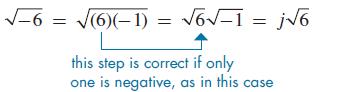
In Example 4(a), put a j in front of the radical and then simplify.Data from Example 4(a) √-6 = √(6)(-1) = √6√-1 = j√6 this step is correct if only one is negative, as in this case
Add, expressing the result in rectangular form: (3 −√−4) + (5√−9 − 1).
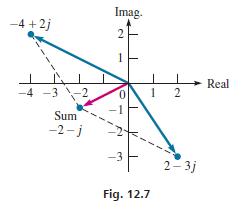
Perform the indicated operations for the resulting complex numbers if the given changes are made in the indicated examples of this section.In Example 3, change the sign of the imaginary part of the second complex number and do the subtraction graphically.Data from Example 3Subtract 4 − 2j from 2
Change the sign of the real part of the complex number in the indicated example of this section and then perform the indicated operations for the resulting complex number.Example 3Data from Example 3Represent the complex number −1.04 − 1.56j graphically and give its polar form. The graphical
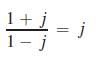
Determine each of the following as being either true or false. If it is false, explain it why. 1+ + j 1-j j
Perform the indicated operations on the resulting expressions if the given changes are made in the indicated examples of this section.In Example 1(b), change the sign in the first parentheses from + to − and then perform the addition.Data from Exercises 1(b) (6-√4)(√-9) = (6 - 2j)(3j) write
Perform the indicated operations for the resulting complex numbers if the given changes are made in the indicated examples of this section.In Example 1, change the sign of the angle in the first complex number and then perform the multiplication.Data from Example 1To multiply the complex numbers
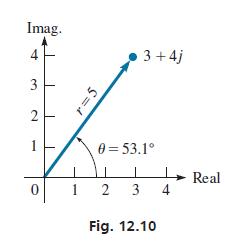
Change the sign of the real part of the complex number in the indicated example of this section and then perform the indicated operations for the resulting complex number.Example 1Data from Example 1Represent the complex number 3 + 4j graphically and give its polar form. From the rectangular form 3
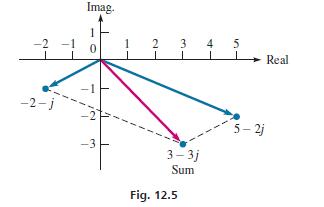
Perform the indicated operations for the resulting complex numbers if the given changes are made in the indicated examples of this section.In Example 2(a), change the sign of the imaginary part of the second complex number and then add the numbers graphically.Data from Example 2(a)Add the complex
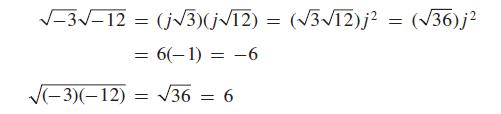
In Example 3, put a − sign before the first radical of the first illustration and then simplify.Data from Example 3To further illustrate the method of handling square roots of negative numbers, consider the difference betweenFor these expressions, we haveFor √−3 √−12, we have the product
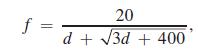
A computer analysis of an experiment showed that the fraction f of viruses surviving X-ray dosages was given bywhere d is the dosage. Express this with the denominator rationalized. f = 20 d+√3d + 400
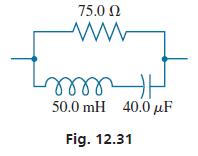
Find the combined impedance (in rectangular form) of the circuit elements in Fig. 12.31. The frequency of the current in the circuit is 60.0 Hz. See Exercise 22.Data from Exercises 22Find the combined impedance (in rectangular form) for the parallel circuit elements in Fig. 12.30 if the current in
Determine each of the following as being either true or false. If it is false, explain why.(√−9)2 = 9
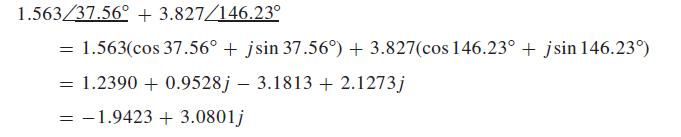
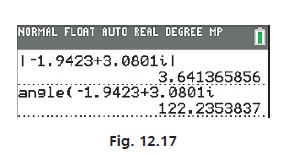
Perform the indicated operations. Express results in polar form. See Example 3.15.9∠142.6° − 18.5∠71.4°Data from Example 3Perform the addition 1.563∠37.56° + 3.827∠146.23°. In order to do this addition, we must change each number to rectangular form:Converting back to polar form, we
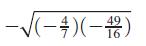
Simplify each of the given expressions. 49 -√(-4)(-48) 16
In calculating the forces on a tower by the wind, it is necessary to evaluate 0.0180.13. Write a paragraph explaining why this form is preferable to the equivalent radical form.
Perform the indicated operations. Express results in polar form. See Example 3.2.78∠56.8° + 1.37∠207.3°Data from Example 3Perform the addition 1.563∠37.56° + 3.827∠146.23°. In order to do this addition, we must change each number to rectangular form:Converting back to polar form, we get
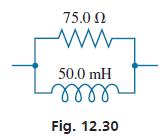
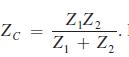
For two impedances Z1 and Z2 in parallel, the combined impedance ZC is given byFind the combined impedance (in rectangular form) for the parallel circuit elements in Fig. 12.30 if the current in the circuit has a frequency of 60.0 Hz. Zc Z₁ Z₂ Z₁ + Z₂
Showing 4100 - 4200
of 9193
First
35
36
37
38
39
40
41
42
43
44
45
46
47
48
49
Last
Step by Step Answers

 Get 50% OFF
Claim Now
Get 50% OFF
Claim Now