New Semester
Started
Get
50% OFF
Study Help!
--h --m --s
Claim Now
Question Answers
Textbooks
Find textbooks, questions and answers
Oops, something went wrong!
Change your search query and then try again
S
Books
FREE
Study Help
Expert Questions
Accounting
General Management
Mathematics
Finance
Organizational Behaviour
Law
Physics
Operating System
Management Leadership
Sociology
Programming
Marketing
Database
Computer Network
Economics
Textbooks Solutions
Accounting
Managerial Accounting
Management Leadership
Cost Accounting
Statistics
Business Law
Corporate Finance
Finance
Economics
Auditing
Tutors
Online Tutors
Find a Tutor
Hire a Tutor
Become a Tutor
AI Tutor
AI Study Planner
NEW
Sell Books
Search
Search
Sign In
Register
study help
mathematics
basic technical mathematics
Basic Technical Mathematics 12th Edition Allyn J. Washington, Richard Evans - Solutions
Express as a combination of a sum, difference, and multiple of logarithms, including log5 2. logs (4)
Plot the graphs of the given functions on semilogarithmic paper.y = x3
Express the given equations in logarithmic form.73 = 343
Find the common logarithm of each of the given numbers by using a calculator.1.174−4
Use logarithms to the base 10 to find the natural logarithms of the given numbers.0.0073267
Determine if the given functions are exponential functions.(a) y = 5x (b) y = 5−x
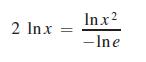
Determine each of the following as being either true or false. If it is false, explain it why. 2 lnx Inx² - Ine
Determine each of the following as being either true or false. If it is false, explain it why.If 2 ln x − 1 = ln x, then x = e.
Solve the given equations.πx = 15
Express the given equations in logarithmic form.52 = 25
Plot the graphs of the given functions on semilogarithmic paper.y = 6−x
Find the common logarithm of each of the given numbers by using a calculator.3.193
Use logarithms to the base 10 to find the natural logarithms of the given numbers.0.5017
Perform the indicated operations on the resulting expressions if the given changes are made in the original expressions of the indicated examples of this section.In Example 5(a), change the 6 to 10.Data from Example 5(a)log2 6 = log2 (2 × 3) = log2 2 + log2 3 = 1 + log2 3
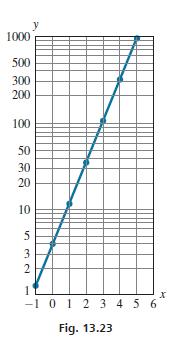
Graph the function y = 2(3x) on semilog paper.
Use a calculator to evaluate (to three significant digits) the given numbers.(2e)−√2
Solve the given equations.3.50x = 82.9
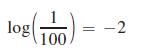
Determine each of the following as being either true or false. If it is false, explain it why. log(100) -2
Express the given equations in logarithmic form.34 = 81
Plot the graphs of the given functions on semilogarithmic paper.y = 5(4−x )
Find the common logarithm of each of the given numbers by using a calculator.9.24 ×106
Use logarithms to the base 10 to find the natural logarithms of the given numbers.1.562
Perform the indicated operations if the given changes are made in the indicated examples of this section.In Example 7, change the logarithm base to 4 and then plot the graph.Data from Example 7Plot the graph of y = log2 x.We can find the points for this graph more easily if we first put the
Perform the indicated operations on the resulting expressions if the given changes are made in the original expressions of the indicated examples of this section.In Example 4(a), change the 9 to 27.Data from Example 4(a)We may evaluate log3 9 using Eq. (13.11): log3 9 = log3 (32) = 2.We can
Graph the function y = 2 log4 x.
Use a calculator to evaluate (to three significant digits) the given numbers.(2π)−e
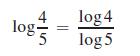
Determine each of the following as being either true or false. If it is false, explain it why. log4 log= log 5
Perform the indicated operations on the resulting expressions if the given changes are made in the original expressions of the indicated examples of this section.In Example 3(c), change the 2 to 3.Data from Example 3(c) log4 3 + 2 log4 x = log43+ log4(x²) = log4 3x²
Solve the given equations.3x = 1/81
Plot the graphs of the given functions on semilogarithmic paper.y = 3(5x)
Find the common logarithm of each of the given numbers by using a calculator.0.0640
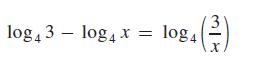
Perform the indicated operations on the resulting expressions if the given changes are made in the original expressions of the indicated examples of this section.In Example 3(b), change the 3 to 5.Data from Example 3(b) log4 3 - log4x = log4 + (²)
Use logarithms to the base 10 to find the natural logarithms of the given numbers.6310
Determine the value of x.33x+1 = 8
Use a calculator to evaluate (to three significant digits) the given numbers.1.5π
Solve the given equations.2x = 16
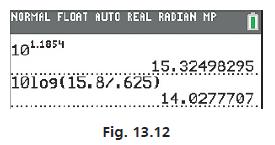
Find the indicated values if the given changes are made in the indicated examples of this section.In Example 3, change 1.1854 to 2.1854 and then find the required value.Data from Example 3Given log N = 1.1854, we find N as shown in the first line of the calculator display in Fig. 13.12. Therefore,
Perform the indicated operations if the given changes are made in the indicated examples of this section.In Example 6, change the logarithm base to 4 and then make any other necessary changes.Data from Example 6For the logarithmic function y = log2 x, we have the standard independent
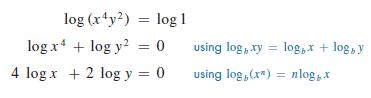
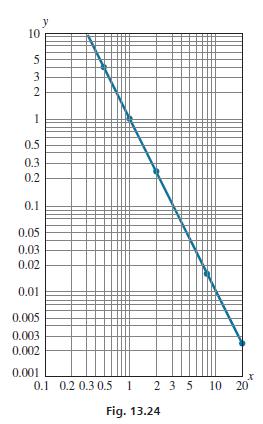
Make the given changes in the indicated examples, and then draw the graphs.In Example 3, change the 1 to 4 and then make the graph.Data from Example 3Construct the graph of x4y2 = 1 on logarithmic paper. First, we solve for y and make a table of values. Considering positive values of x and y, we
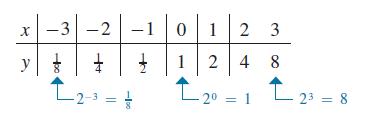
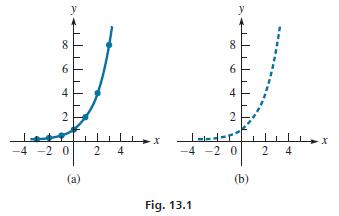
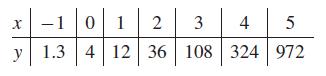
Perform the indicated operations if the given changes are made in the indicated examples of this section.In Example 3, change the sign of the exponent and then plot the graph.Data from Example 3Plot the graph of y = 2x. For this function, we have the values in the following table:The curve is shown
Plot the graphs of the given functions on semilogarithmic paper.y = 2x
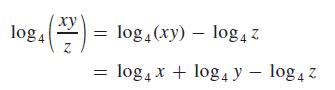
Perform the indicated operations on the resulting expressions if the given changes are made in the original expressions of the indicated examples of this section.In Example 2(d), change the x to 2 and the z to 3.Data from Example 2(d)Using Eq. (13.8) and then Eq. (13.7), we have log(): log4(xy) log
Find the common logarithm of each of the given numbers by using a calculator.278
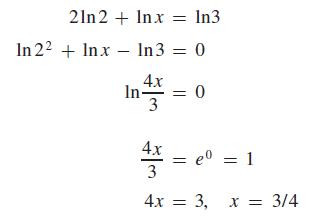
Find the indicated values if the given changes are made in the indicated examples of this section.In Example 7, change ln 3 to ln 6 and then solve the equation.Data from Example 7Solve the logarithmic equation 2 ln 2 + ln x = ln 3. Using the properties of logarithms, we have the following
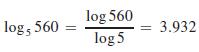
Find the indicated values if the given changes are made in the indicated examples of this section.In Example 2, change the base to 4 and then evaluate.Data from Example 2Find log5 560.In Eq. (13.13), if we let a = 10, b = 5, and x = 560, we haveFrom the definition of a logarithm, this means
Use logarithms to the base 10 to find the natural logarithms of the given numbers.26.0
Determine the value of x.logx 64 = 3
Use a calculator to evaluate (to three significant digits) the given numbers.3√5
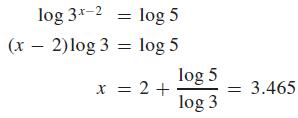
Find the indicated values if the given changes are made in the indicated examples of this section.In Example 2, change the sign in the exponent from − to + and then solve the equation.Data from Example 2Solve the equation 3x−2 = 5.Taking logarithms of each side and equating them, we haveThis
Determine each of the following as being either true or false. If it is false, explain why.The logarithmic form of y = −2−x is x = −log−2 y.
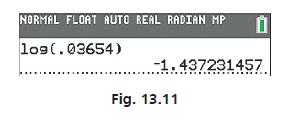
Find the indicated values if the given changes are made in the indicated examples of this section.In Example 2, change 0.03654 to 0.3654 and then find the required value.Data from Example 2Finding log 0.03654, as shown in the calculator display in Fig. 13.11, we see that log 0.03654 = −1.4372. We
Perform the indicated operations on the resulting expressions if the given changes are made in the original expressions of the indicated examples of this section.In Example 2(a), change the 15 to 21.Data from Example 2(a)Using Eq. (13.7), we may express log4 15 as a sum of logarithms: log, 15 = log
Determine the value of x.log3 x − log3 2 = 2
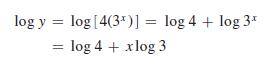
The given changes in the indicated examples, and then draw the graphs.In Example 2, change the 4 to 2 and then make the graph.Data from Example 2Construct the graph of y = 4(3x) on semilogarithmic graph paper. This is the same function as in Example 1, and we repeat the table of values:Again, we
Perform the indicated operations if the given changes are made in the indicated examples of this section.In Example 2(c), change the sign of x and then evaluate.Data from Example 2(c)If x = 3/2, y = −2(43/2) = −2(8) = −16.
Determine each of the following as being either true or false. If it is false, explain it why.y = −6−x is an exponential function.
Perform the indicated operations if the given changes are made in the indicated examples of this section.In Example 3(b), change the exponent to 4/5 and then make any other necessary changes.Data from Example 3(b)(32)3/5 = 8 in logarithmic form is 3/5 = log328
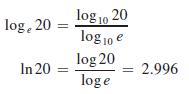
Find the indicated values if the given changes are made in the indicated examples of this section.In Example 1, change 20 to 200 and then evaluate.Data from Example 1Change log 20 to a logarithm with base e; that is, find ln 20. Using Eq. (13.13) with a = 10, b = e, and x = 20, we haveThis
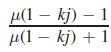
In the theory of light reflection on metals, the expressionis encountered. Simplify this expression. (1 μ(1 kj) - 1 kj) + 1
In the study of shearing effects in the spinal column, the expressionis found. Express this in rectangular form. 1 μ + jwn
Determine the value of x.log9 x = −1/2
A computer programmer is writing a program to determine the n nth roots of a real number. Part of the program is to find the number of real roots and the number of pure imaginary roots. Write one or two paragraphs explaining how these numbers of roots can be determined without actually finding the
Find the required quantities.Show that ejπ = −1.
Find the required quantities.Show that (ejπ)1/2 = j.
A boat is headed across a river with a velocity (relative to the water) that can be represented as 6.5 + 1.7j mi/h. The velocity of the river current can be represented as −1.1 − 4.3j mi/h. Express the resultant velocity of the boat in polar form.
Two cables lift a crate. The tensions in the cables can be represented by 2100 − 1200j N and 1200 + 5600j N. Express the resultant tension in polar form.
The displacement of an electromagnetic wave is given by d = A(cosωt + j sinωt) + B(cosωt − j sinωt). Find the expressions for the magnitude and phase angle of d.
What is the frequency f for resonance in a circuit for which L = 2.65 H and C = 18.3 μF?
A coil of wire rotates at 120.0 r/s. If the coil generates a current in a circuit containing a resistance of 12.07Ω, an inductance of 0.1405 H, and an impedance of 22.35Ω, what must be the value of a capacitor (in F) in the circuit?
In a series ac circuit with a resistor, an inductor, and a capacitor, R = 6250Ω, Z = 6720Ω, and XL = 1320Ω. Find the phase angle ∅.
A 60-V ac voltage source is connected in series across a resistor, an inductor, and a capacitor. The voltage across the inductor is 60 V, and the voltage across the capacitor is 60 V. What is the voltage across the resistor?
Using a calculator, express 5 − 3j in polar form.
If f(x) = 2x − (x − 1)−1, find f(1 + 2 j).
If f(x) = x−2 + 3x−1, find f (4 + j).
What is the argument for any negative imaginary number?
Show that 1/2 (1 + j√3) is the reciprocal of its conjugate.
Are 1 − j and −1 − j solutions to the equation x2 − 2x + 2 = 0?
Are 2j and −2j solutions to the equation x4 + 16 = 0?
Using a calculator, express 25.0e2.25 j in rectangular form.
Express the meaning of the given equation in a verbal statement, using the language of variation. (k and π are constants.) f kL Jm
Find the indicated ratios. The electric resistance R of a resistor is the ratio of the voltage V across the resistor to the current i in the resistor. Find R if V = 0.632 V and i = 2.03 mA.
Determine each of the following as being either true or false. If it is false, explain why.If y varies inversely as the square of x, and y = 4 when x = 1/4, then y = 4/x2.
For what values of k are the roots of the equation 2x2 + 3x + k = 0 real and unequal?
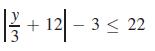
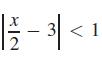
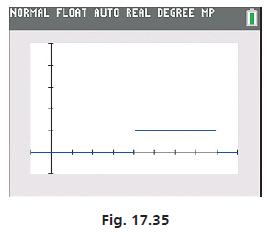
Solve the given inequalities by displaying the solutions on a calculator. See Example 6.Data from Example 6Display the solution to the inequalityon a calculator.On the calculator, set y1 = abs(x/2 − 3) < 1 and obtain the display shown in Fig. 17.35. From this display, we see that the solution
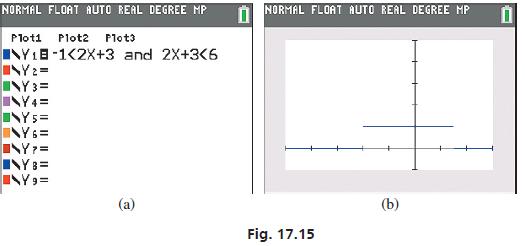
Solve the inequalities by displaying the solutions on a calculator. See Examples 9 and 10.3x − 2 < 8 − xData from Example 10Display the solution of the inequality −1 < 2x + 3 < 6 (see Example 6) on a calculator. In order to display the solution, we must write the inequality as −1
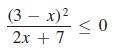
Solve the given inequalities on a calculator such that the display is the graph of the solution. (3 - x)² 2x + 7 ≤0
Solve the inequalities by displaying the solutions on a calculator. See Examples 9 and 10 in Section 17.2.Data from Example 10 of Section 17.2Display the solution of the inequality −1 < 2x + 3 < 6 (see Example 6) on a calculator. In order to display the solution, we must write the
Give verbal statements equivalent to the given inequalities involving the number x.−1 ≤ x < 3 or 5 < x < 7
Solve the inequalities by displaying the solutions on a calculator. See Examples 9 and 10 in Section 17.2.Data from Example 10 of Section 17.2Display the solution of the inequality −1 < 2x + 3 < 6 (see Example 6) on a calculator. In order to display the solution, we must write the
Draw a sketch of the graph of the region in which the points satisfy the given system of inequalities.y ≥ 0y ≤ sin x0 ≤ x ≤ 3π
Solve the inequalities by displaying the solutions on a calculator. See Examples 9 and 10.40(x − 2) > x + 60Data from Example 10Display the solution of the inequality −1 < 2x + 3 < 6 (see Example 6) on a calculator. In order to display the solution, we must write the inequality as −1
Graph the given inequalities on the number line.x < 3
Solve the given inequalities on a calculator such that the display is the graph of the solution.|x − 30| > 48
Solve the given quadratic inequalities. Check each by displaying the solution on a calculator.x2 + 3x − 1 > 3
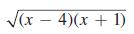
Determine the values for x for which the radicals represent real numbers. √(x-4)(x + 1)
Draw a sketch of the graph of the region in which the points satisfy the given system of inequalities.y > 0y > 1 − xy < ex
Solve the inequalities by displaying the solutions on a calculator. See Examples 9 and 10.1/2(x + 15) ≥ 5 − 2xData from Example 10Display the solution of the inequality −1 < 2x + 3 < 6 (see Example 6) on a calculator. In order to display the solution, we must write the inequality
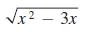
Determine the values for x for which the radicals represent real numbers. 2 Vx² - 3x
Graph the given inequalities on the number line.x ≥ −1
Solve the given inequalities on a calculator such that the display is the graph of the solution.2|2x − 9| < 8
Showing 3400 - 3500
of 9193
First
28
29
30
31
32
33
34
35
36
37
38
39
40
41
42
Last
Step by Step Answers

 Get 50% OFF
Claim Now
Get 50% OFF
Claim Now