New Semester
Started
Get
50% OFF
Study Help!
--h --m --s
Claim Now
Question Answers
Textbooks
Find textbooks, questions and answers
Oops, something went wrong!
Change your search query and then try again
S
Books
FREE
Study Help
Expert Questions
Accounting
General Management
Mathematics
Finance
Organizational Behaviour
Law
Physics
Operating System
Management Leadership
Sociology
Programming
Marketing
Database
Computer Network
Economics
Textbooks Solutions
Accounting
Managerial Accounting
Management Leadership
Cost Accounting
Statistics
Business Law
Corporate Finance
Finance
Economics
Auditing
Tutors
Online Tutors
Find a Tutor
Hire a Tutor
Become a Tutor
AI Tutor
AI Study Planner
NEW
Sell Books
Search
Search
Sign In
Register
study help
mathematics
calculus 10th edition
Calculus 10th Edition Ron Larson, Bruce H. Edwards - Solutions
In Exercises determine the work done by the constant force.A force of 112 newtons is required to slide a cement block 8 meters in a construction project.
In Exercises determine the work done by the constant force.The locomotive of a freight train pulls its cars with a constant force of 9 tons a distance of one-half mile.
In Exercises use Hooke’s Law to determine the variable force in the spring problem.A force of 5 pounds compresses a 15-inch spring a total of 3 inches. How much work is done in compressing the spring 7 inches?
In Exercises use Hooke’s Law to determine the variable force in the spring problem.A force of 250 newtons stretches a spring 30 centimeters. How much work is done in stretching the spring from 20 centimeters to 50 centimeters?
In Exercises use Hooke’s Law to determine the variable force in the spring problem.A force of 20 pounds stretches a spring 9 inches in an exercise machine. Find the work done in stretching the spring 1 foot from its natural position.
In Exercises use Hooke’s Law to determine the variable force in the spring problem.An overhead garage door has two springs, one on each side of the door. A force of 15 pounds is required to stretch each spring 1 foot. Because of the pulley system, the springs stretch only one-half the distance
In Exercises use Hooke’s Law to determine the variable force in the spring problem.Eighteen foot-pounds of work is required to stretch a spring 4 inches from its natural length. Find the work required to stretch the spring an additional 3 inches.
In Exercises use Hooke’s Law to determine the variable force in the spring problem.Seven and one-half foot-pounds of work is required to compress a spring 2 inches from its natural length. Find the work required to compress the spring an additional one-half inch.
Neglecting air resistance and the weight of the propellant, determine the work done in propelling a five-ton satellite to a height of (a) 100 miles above Earth(b) 300 miles above Earth
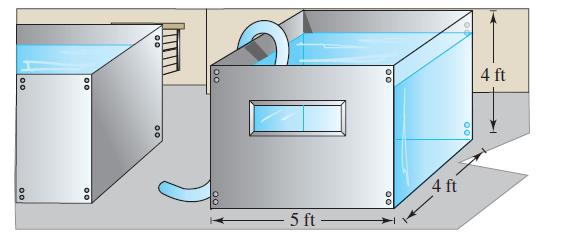
A rectangular tank with a base 4 feet by 5 feet and a height of 4 feet is full of water (see figure). The water weighs 62.4 pounds per cubic foot. How much work is done in pumping water out over the top edge in order to empt (a) Half of the tank(b) All of the tank 00 11 200 5 ft 00 00 4 ft 4 ft
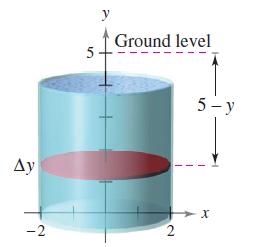
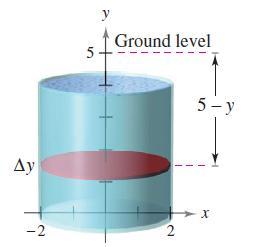
A cylindrical water tank 4 meters high with a radius of 2 meters is buried so that the top of the tank is 1 meter below ground level (see figure). How much work is done in pumping a full tank of water up to ground level? (The water weighs 9800 newtons per cubic meter.) Ay -2 5 y Ground level 2 5-y X
Use the information in Exercise 11 to write the work W of the propulsion system as a function of the height h of the satellite above Earth. Find the limit (if it exists) of Was h approaches infinity.Data from in Exercise 11Neglecting air resistance and the weight of the propellant, determine the
Neglecting air resistance and the weight of the propellant, determine the work done in propelling a 10-ton satellite to a height of (a) 11,000 miles above Earth(b) 22,000 miles above Earth
A lunar module weighs 12 tons on the surface of Earth. How much work is done in propelling the module from the surface of the moon to a height of 50 miles? Consider the radius of the moon to be 1100 miles and its force of gravity to be one-sixth that of Earth.
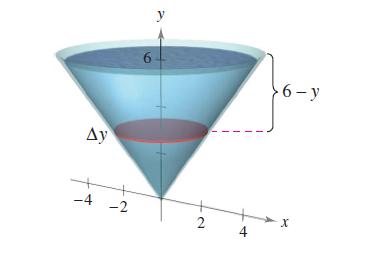
An open tank has the shape of a right circular cone (see figure). The tank is 8 feet across the top and 6 feet high. How much work is done in emptying the tank by pumping the water over the top edge? Δy -4-2 6 Μ 2 4 16-y X
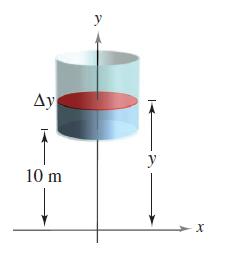
Suppose the tank in Exercise 17 is located on a tower so that the bottom of the tank is 10 meters above the level of a stream (see figure). How much work is done in filling the tank half full of water through a hole in the bottom, using water from the stream?Data from in Exercise 17A cylindrical
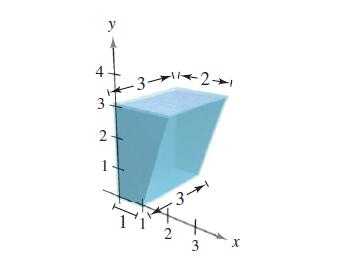
The fuel tank on a truck has trapezoidal cross sections with the dimensions (in feet) shown in the figure. Assume that the engine is approximately 3 feet above the top of the fuel tank and that diesel fuel weigh approximately 53.1 pounds per cubic foot. Find the work done by the fuel pump in
Water is pumped in through the bottom of the tank in Exercise 19. How much work is done to fill the tank(a) To a depth of 2 feet?(b) From a depth of 4 feet to a depth of 6 feet?Data from in Exercise 19An open tank has the shape of a right circular cone (see figure). The tank is 8 feet across the
A hemispherical tank of radius 6 feet is positioned so that its base is circular. How much work is required to fill the tank with water through a hole in the base when the water source is at the base?
In Exercises consider a 15-foot hanging chain that weighs 3 pounds per foot. Find the work done in lifting the chain vertically to the indicated position.Repeat Exercise 29 raising the bottom of the chain to the 12-foot level.Data from in Exercise 29Take the bottom of the chain and raise it
In Exercises find the work done in pumping gasoline that weighs 42 pounds per cubic foot.A cylindrical gasoline tank 3 feet in diameter and 4 feet long is carried on the back of a truck and is used to fuel tractors. The axis of the tank is horizontal. The opening on the tractor tank is 5 feet above
In Exercises determine which value best approximates the length of the arc represented by the integral. (Make your selection on the basis of a sketch of the arc, not by performing any calculations.)(a) 3(b) -2(c) 4(d)4π/3(e) 1 π/4 d [*²* √ 1 + [4/4 (tuan x)]* dx dx 0
In Exercises find the work done in pumping gasoline that weighs 42 pounds per cubic foot.The top of a cylindrical gasoline storage tank at a service station is 4 feet below ground level. The axis of the tank is horizontal and its diameter and length are 5 feet and 12 feet, respectively. Find the
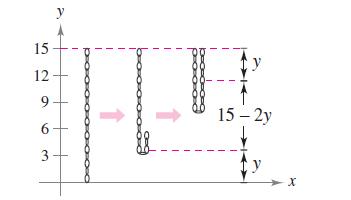
In Exercises consider a 15-foot hanging chain that weighs 3 pounds per foot. Find the work done in lifting the chain vertically to the indicated position.Take the bottom of the chain and raise it to the 15-foot level, leaving the chain doubled and still hanging vertically (see figure).
In Exercises consider a 20-foot chain that weighs 3 pounds per foot hanging from a winch 20 feet above ground level. Find the work done by the winch in winding up the specified amount of chain.Wind up the entire chain.
In Exercises consider a 20-foot chain that weighs 3 pounds per foot hanging from a winch 20 feet above ground level. Find the work done by the winch in winding up the specified amount of chain.Wind up one-third of the chain.
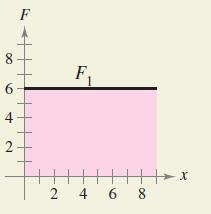
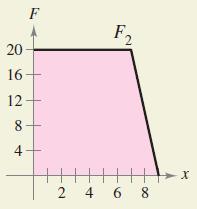
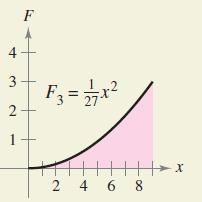
The graphs show the force Fi (in pounds) required to move an object 9 feet along the x-axis. Order the force functions from the one that yields the least work to the one that yields the most work without doing any calculations. Explain your reasoning.(a)(b)(c)(d) 8 6 4 2 F 7 F₁ |||||||| > x 468
In Exercises consider a 20-foot chain that weighs 3 pounds per foot hanging from a winch 20 feet above ground level. Find the work done by the winch in winding up the specified amount of chain.Run the winch until the bottom of the chain is at the 10-foot level.
In Exercises consider a 20-foot chain that weighs 3 pounds per foot hanging from a winch 20 feet above ground level. Find the work done by the winch in winding up the specified amount of chain.Wind up the entire chain with a 500-pound load attached to it.
Verify your answer to Exercise 34 by calculating the work for each force function.Data from in Exercise 34The graphs show the force Fi (in pounds) required to move an object 9 feet along the x-axis. Order the force functions from the one that yields the least work to the one that yields the most
In Exercises use the integration capabilities of a graphing utility to approximate the work done by a press in a manufacturing process. A model for the variable force F (in pounds) and the distance x (in feet) the press moves is given. Force F(x) = 1000[1.8 In(x + 1)] - Interval 0 ≤ x ≤ 5
State the definition of work done by a constant force.
State the definition of work done by a variable force.
In Exercises use the integration capabilities of a graphing utility to approximate the work done by a press in a manufacturing process. A model for the variable force F (in pounds) and the distance x (in feet) the press moves is given. Force F(x) = 100x 125 - x³ Interval 0 ≤ x ≤ 5
Which of the following requires more work? Explain your reasoning.(a) A 60-pound box of books is lifted 3 feet.(b) A 60-pound box of books is held 3 feet in the air for 2 minutes.
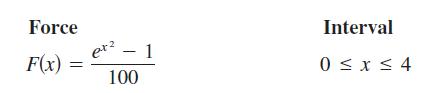
In Exercises use the integration capabilities of a graphing utility to approximate the work done by a press in a manufacturing process. A model for the variable force F (in pounds) and the distance x (in feet) the press moves is given. Force F(x) = ex² - 1 100 Interval 0 ≤ x ≤ 4
Two electrons repel each other with a force that varies inversely as the square of the distance between them. One electron is fixed at the point (2, 4). Find the work done in moving the second electron from (-2, 4) to (1, 4).
In Exercises use the integration capabilities of a graphing utility to approximate the work done by a press in a manufacturing process. A model for the variable force F (in pounds) and the distance x (in feet) the press moves is given. Force F(x) = 1000 sinh x Interval 0 ≤ x ≤ 2
In Exercises find the work done by the gas for the given volume and pressure. Assume that the pressure is inversely proportional to the volume.A quantity of gas with an initial volume of 2 cubic feet and a pressure of 1000 pounds per square foot expands to a volume of 3 cubic feet.
In Exercises find the work done by the gas for the given volume and pressure. Assume that the pressure is inversely proportional to the volume.A quantity of gas with an initial volume of 1 cubic foot and a pressure of 2500 pounds per square foot expands to a volume of 3 cubic feet.
The hydraulic cylinder on a woodsplitter has a 4-inch bore (diameter) and a stroke of 2 feet. The hydraulic pump creates a maximum pressure of 2000 pounds per square inch. Therefore, the maximum force created by the cylinder is 2000(π2²) = 8000π pounds.(a) Find the work done through one
A right circular cone is generated by revolving the region bounded by y = hx/r, y = h, and x = 0 about the y-axis. Verify that the lateral surface area of the cone is S = πr √r² + h².
Find the area of the zone of a sphere formed by revolving the graph of y = √9 - x², 0 ≤ x ≤ 2, about the y-axis.
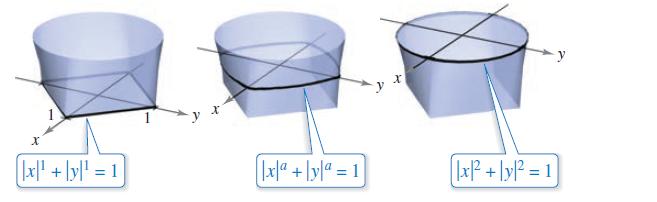
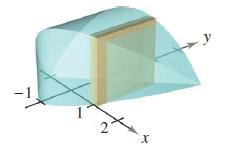
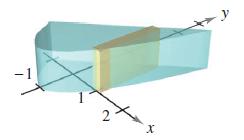
The solid shown in the figure has cross sections bounded by the graph of |x|a + |y|ª = 1, where 1 ≤ a ≤ 2.(a) Describe the cross section when a = 1 and a = 2.(b) Describe a procedure for approximating the volume of thesolid. X ||x|¹ +|y|¹ = 1 ||x|@ + |y|a = 1 y X ||x² + y² = 1
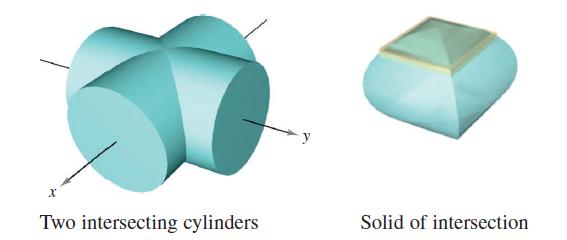
Find the volume of the solid of intersection (the solid common to both) of the two right circular cylinders of radius whose axes meet at right angles (see figure). X Two intersecting cylinders Solid of intersection
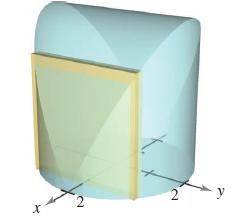
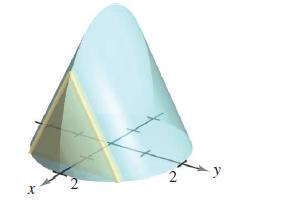
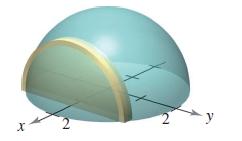
Find the volumes of the solids whose bases are bounded by the circle x² + y2 = 4, with the indicated cross sections taken perpendicular to the x-axis.(a) Squares(b) Equilateral triangles(c) Semicircles(d) Isosceles right triangles X 2
Find the volumes of the solids whose bases are bounded by the graphs of y = x + 1 and y = x² - 1, with the indicated cross sections taken perpendicular to the x-axis.(a) Squares(b) Rectangles of height 1 -1 2 X -y
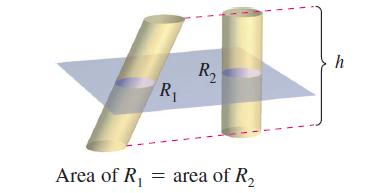
Prove that if two solids have equal altitudes and all plane sections parallel to their bases and at equal distances from their bases have equal areas, then the solids have the same volume (see figure). R₂ 40 R₁ area of R₂ Area of R₁ h
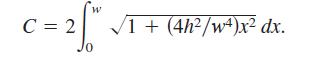
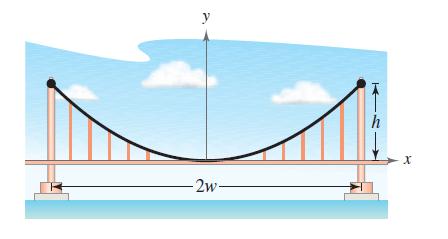
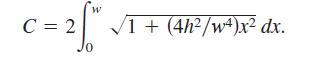
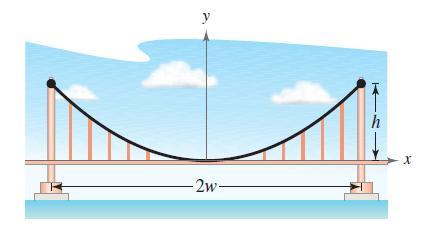
A cable for a suspension bridge has the shape of a parabola with equation y = kx². Let h represent the height of the cable from its lowest point to its highest point and let 2w represent the total span of the bridge (see figure). Show that the length C of the cable is given by C= 2 . 1 + (42/w4)x2
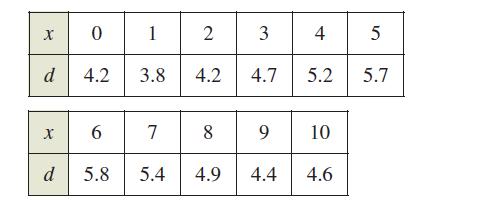
A draftsman is asked to determine the amount of material required to produce a machine part (see figure). The diameters d of the part at equally spaced points x are listed in the table. The measurements are listed in centimeters.(a) Use these data with Simpson’s Rule to approximate the volume of
The Humber Bridge, located in the United Kingdom and opened in 1981, has a main span of about 1400 meters. Each of its towers has a height of about 155 meters. Use these dimensions, the integral in Exercise 67, and the integration capabilities of a graphing utility to approximate the length of a
Find the length of the curve y² = x³ from the origin to the point where the tangent makes an angle of 45° with the x-axis.
A tank on a water tower is a sphere of radius 50 feet. Determine the depths of the water when the tank is filled to one-fourth and three-fourths of its total capacity.
Let C be the curve given by ƒ(x) = cosh x for 0 ≤ x ≤ t, where t > 0. Show that the arclength of C is equal to the area bounded by C and the x-axis.Identify another curve on the interval 0 ≤ x ≤ t with thisproperty.
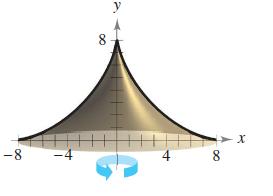
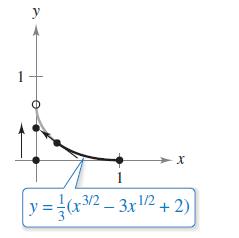
In Exercises set up the definite integral for finding the indicated arc length or surface area. Then use the integration capabilities of a graphing utility to approximate the arc length or surface area.Consider the graph ofshown in the figure. Find the area of the surface formed when the loop of
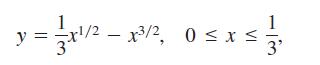
A glass container can be modeled by revolving the graph ofabout the x-axis, where x and y are measured in centimeters. Use a graphing utility to graph the function and find the volume of the container. y = √0.1x³2.2x² + 10.9x + 22.2, 2.95, 0 ≤ x ≤ 11.5 11.5 < x≤ 15
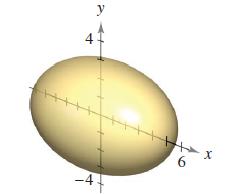
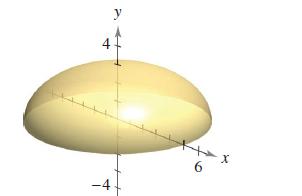
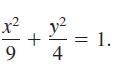
Find the volumes of the solids (see figures) generated if the upper half of the ellipse 9x² + 25y² = 225 is revolved about (a) The x-axis to form a prolate spheroid (shaped like a football)(b) The y-axis to form an oblate spheroid (shaped like half of a candy) 4 -4 y 6 X
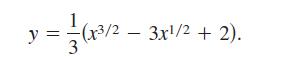
In Exercises set up the definite integral for finding the indicated arc length or surface area. Then use the integration capabilities of a graphing utility to approximate the arc length or surface area.Find the area of the surface formed by revolving the portion in the first quadrant of the graph
In Exercises set up the definite integral for finding the indicated arc length or surface area. Then use the integration capabilities of a graphing utility to approximate the arc length or surface area.An ornamental light bulb is designed by revolving the graph ofabout the x-axis, where x and y are
In Exercises set up the definite integral for finding the indicated arc length or surface area. Then use the integration capabilities of a graphing utility to approximate the arc length or surface area.A fleeing object leaves the origin and moves up the y-axis (see figure). At the same time, a
Consider the equation(a) Use a graphing utility to graph the equation.(b) Set up the definite integral for finding the first-quadrant arc length of the graph in part (a).(c) Compare the interval of integration in part (b) and the domain of the integrand. Is it possible to evaluate the definite
A tank on the wing of a jet aircraft is formed by revolving the region bounded by the graph of y= 1/8x² √2 - x and the x-axis (0 ≤ x ≤ 2) about the x-axis, where x and y are measured in meters. Use a graphing utility to graph the function and find the volume of the tank.
A sphere of radius r is cut by a plane h units above the equator, where h < r. Find the volume of the solid (spherical segment) above the plane.
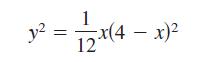
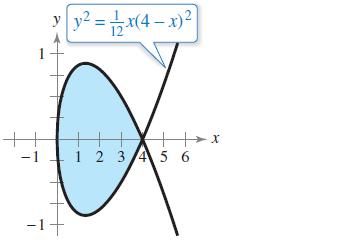
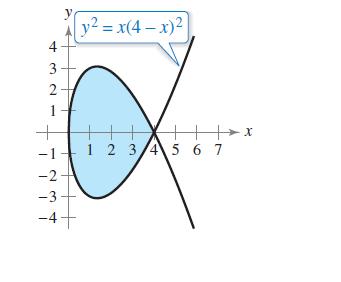
Consider the graph of y² = x(4 - x)² (see figure). Find the volumes of the solids that are generated when the loop of this graph is revolved about (a) The x-axis(b) The y-axis(c) The line x = 4 432- |y²= x(4-x)² -1 -2- -3- -4+ 1 2 3 4 5 6 7 X
A cone of height H with a base of radius r is cut by a plane parallel to and h units above the base, where h < H. Find the volume of the solid (frustum of a cone) below the plane.
Use the disk method to verify that the volume of a sphere is 4/3πr³, where r is the radius.
The region bounded by y = r² - x², y = 0, and x = 0 is revolved about the y-axis to form a paraboloid. A hole, centered along the axis of revolution, is drilled through this solid. The hole has a radius k, 0 < k < r. Find the volume of the resulting ring(a) By integrating with respect to
Use the disk method to verify that the volume of a right circular cone is 1/3πr²h, where r is the radiusof the base and h is the height.
Let V₁ and V₂ be the volumes of the solids that result when the plane region bounded by y = 1/x, y = 0, x = 1/4, and x = c (where c > 1/4) is revolved about the x-axis and the y-axis, respectively. Find the value of c for which V₁ = V₂.
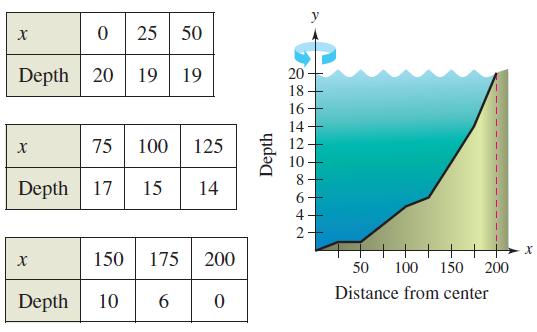
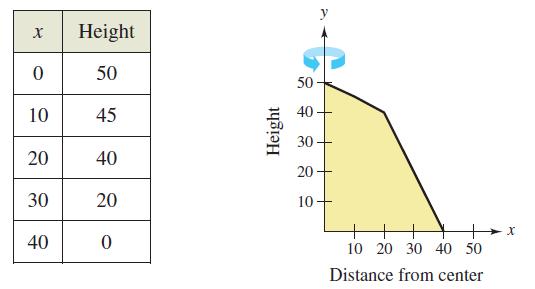
A pond is approximately circular, with a diameter of 400 feet. Starting at the center, the depth of the water is measured every 25 feet and recorded in the table (see figure).(a) Use Simpson’s Rule to approximate the volume of water in the pond.(b) Use the regression capabilities of a graphing
A storage shed has a circular base of diameter 80 feet. Starting at the center, the interior height is measured every 10 feet and recorded in the table (see figure).(a) Use Simpson’s Rule to approximate the volume of the shed.(b) Note that the roof line consists of two line segments. Find the
For the metal sphere in Exercise 57, let R = 6. What value of r will produce a ring whose volume is exactly half the volume of the sphere?Data from in Exercise 57A manufacturer drills a hole through the center of a metal sphere of radius R The hole has a radius r. Find the volume of the
Find the area of the zone of a sphere formed by revolving the graph of y = √r² - x²,0 ≤ x ≤ a, about the y-axis. Assume that a < r.
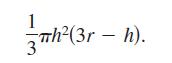
Let a sphere of radius r be cut by a plane, thereby forming a segment of height h. Show that the volume of this segment is 1 Th²(3r - h).
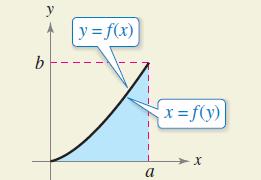
Use the graph to match the integral for the volume with the axis of rotation.(a)(b)(c)(d) b y=f(x) a x = f(y) X
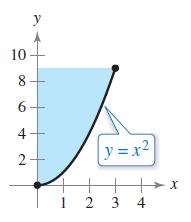
The region in the figure is revolved about the indicated axes and line. Order the volumes of the resulting solids from least to greatest. Explain your reasoning.(a) x-axis(b) y-axis(c) x = 3 10 8 6 4 2 y [y=x² 12 34 ➤ X
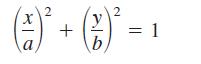
Consider the plane region bounded by the graph ofwhere a > 0 and b > 0. Show that the volume of the ellipsoid formed when this region is revolved about the y-axis isWhat is the volume when the region is revolved about the x-axis? a 2 + b 2 = 1
A manufacturer drills a hole through the center of a metal sphere of radius R The hole has a radius r. Find the volume of the resulting ring.
In Exercises consider the solid formed by revolving the region bounded by y = √x, y = 0, and x = 4 about the x-axis.Find the value of in the interval [0, 4] that divides the solid into three parts of equal volume.
In Exercises consider the solid formed by revolving the region bounded by y = √x, y = 0, and x = 4 about the x-axis.Find the value of in the interval [0, 4] that divides the solid into two parts of equal volume.
A right circular cone is generated by revolving the region bounded by y = 3x/4, y = 3, and x = 0 about the y-axis. Find the lateral surface area of the cone.
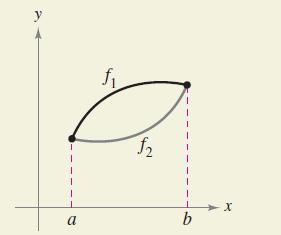
The graphs of the functions ƒ₁ and ƒ₂ on the interval [a, b] are shown in the figure. The graph of each function is revolved about the x-axis. Which surface of revolution has the greater surface area? Explain. y a f₁ $₂ b
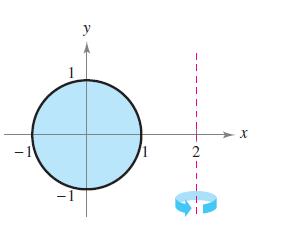
Repeat Exercise 49 for a torus formed by revolving the region bounded by the circle x² + y² = r² about the line x = R, where r < R.Data from in Exercises 49A torus is formed by revolving the region bounded by the circle x² + y² = 1 about the line x = 2 (see figure). Find the volume of this
Discuss the validity of the following statements.(a) For a solid formed by rotating the region under a graph about the x-axis, the cross sections perpendicular to the x-axis are circular disks.(b) For a solid formed by rotating the region between two graphs about the x-axis, the cross sections
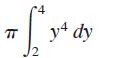
In Exercises the integral represents the volume of a solid. Describe the solid. TT J2 y4 dy
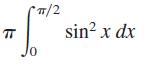
In Exercises the integral represents the volume of a solid. Describe the solid. *TT/2 TT S 0 sin² x dx
A region bounded by the parabola y = 4x - x² and the x-axis is revolved about the x-axis. A second region bounded by the parabola y = 4 - x² and the x-axis is revolved about the x-axis. Without integrating, how do the volumes of the two solids compare? Explain.
What precalculus formula and representative element are used to develop the integration formula for the area of a surface of revolution?
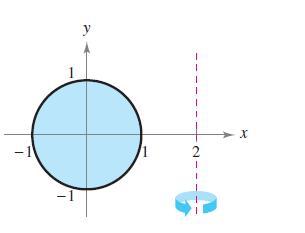
A torus is formed by revolving the region bounded by the circle x² + y² = 1 about the line x = 2 (see figure). Find the volume of this "doughnut-shaped" solid. -1 -1 y 2 X
What precalculus formula and representative element are used to develop the integration formula for arc length?
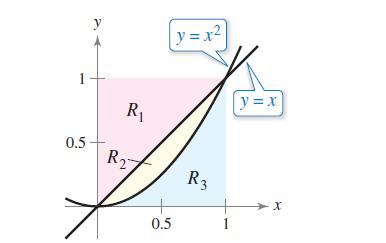
In Exercises find the volume generated by rotating the given region about the specified line.R₂ about x = 1 1 0.5 R₁ R2 0.5 y=x² R3 + 1 y = x X
In Exercises use the integration capabilities of a graphing utility to approximate the surface area of the solid of revolution. Function y = sin x Interval [0, π] Axis of Revolution x-axis
In Exercises use the integration capabilities of a graphing utility to approximate the surface area of the solid of revolution. Function y = ln x Interval [1, e] Axis of Revolution y-axis
In Exercises set up and evaluate the definite integral for the area of the surface generated by revolving the curve about the x-axis. y = √√√4x², -1 ≤ x ≤ 1
In Exercises find the volume generated by rotating the given region about the specified line.R₂ about x = 0 1 0.5 R₁ R2 0.5 y=x² R3 + 1 y = x X
Define a rectifiable curve.
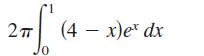
In Exercises the integral represents the volume of a solid of revolution. Identify (a) The plane region that is revolved(b) The axis of revolution 2πTS" ( п (4- x)e* dx
In Exercises find the volume generated by rotating the given region about the specified line.R3 about x = 1 1 0.5 R₁ R2 0.5 y=x² R3 + 1 y = x X
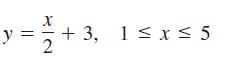
In Exercises set up and evaluate the definite integral for the area of the surface generated by revolving the curve about the y-axis. x y = 1/2 +3₁ +3, 1 ≤ x ≤ 5
A solid is generated by revolving the region bounded by y = √9 - x² and y = 0 about the y-axis. A hole, centered along the axis of revolution, is drilled through this solid so that one-third of the volume is removed. Find the diameter of the hole.
Showing 5900 - 6000
of 9867
First
53
54
55
56
57
58
59
60
61
62
63
64
65
66
67
Last
Step by Step Answers

 Get 50% OFF
Claim Now
Get 50% OFF
Claim Now