New Semester
Started
Get
50% OFF
Study Help!
--h --m --s
Claim Now
Question Answers
Textbooks
Find textbooks, questions and answers
Oops, something went wrong!
Change your search query and then try again
S
Books
FREE
Study Help
Expert Questions
Accounting
General Management
Mathematics
Finance
Organizational Behaviour
Law
Physics
Operating System
Management Leadership
Sociology
Programming
Marketing
Database
Computer Network
Economics
Textbooks Solutions
Accounting
Managerial Accounting
Management Leadership
Cost Accounting
Statistics
Business Law
Corporate Finance
Finance
Economics
Auditing
Tutors
Online Tutors
Find a Tutor
Hire a Tutor
Become a Tutor
AI Tutor
AI Study Planner
NEW
Sell Books
Search
Search
Sign In
Register
study help
mathematics
calculus 10th edition
Calculus 10th Edition Ron Larson, Bruce H. Edwards - Solutions
In Exercises solve the differential equation. xy' (x + 1)y = 0
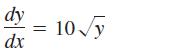
In Exercises solve the differential equation. dy dx 105
In Exercises solve the differential equation. (2 + x)y' xy = 0
In Exercises write and solve the differential equation that models the verbal statement.The rate of change of y with respect to t is proportional to 50 - t.
In Exercises find the particular solution of the differential equation that satisfies the initial condition. Differential Equation y' cos²x + y − 1 = 0 Initial Condition y(0) = 5
In Exercises write and solve the differential equation that models the verbal statement.The rate of change of y with respect to t is inversely proportional to the cube of t.
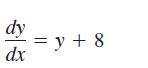
In Exercises solve the differential equation. dy dx = y + 8
In Exercises find the particular solution of the differential equation that satisfies the initial condition. Differential Equation x³y² + 2y = el/x² Initial Condition y(1) = e
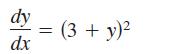
In Exercises solve the differential equation. dy dx (3 + y)²
In Exercises use Euler’s Method to make a table of values for the approximate solution of the differential equation with the specified initial value. Use n steps of size h. y' = 5x - 2y, y(0) = 2, n = 10, h = 0.1
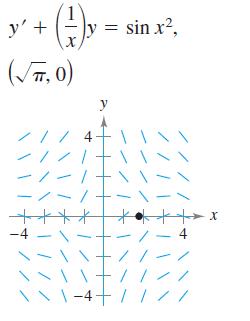
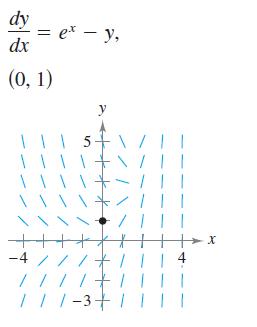
In Exercises (a) Sketch an approximate solution of the differential equation satisfying the given initial condition by hand on the slope field(b) Find the particular solution that satisfies the given initial condition(c) Use a graphing utility to graph the particular solution. Compare the
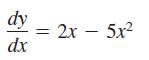
In Exercises solve the differential equation. dy dx || 2x - 5x²
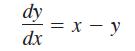
In Exercises use Euler’s Method to make a table of values for the approximate solution of the differential equation with the specified initial value. Use n steps of size h. y' = x - y, y(0) = 4, n = 10, h = 0.05
In Exercises (a) Sketch an approximate solution of the differential equation satisfying the given initial condition by hand on the slope field(b) Find the particular solution that satisfies the given initial condition(c) Use a graphing utility to graph the particular solution. Compare the
In Exercises(a) Sketch the slope field for the differential equation(b) Use the slope field to sketch the solution that passes through the given point. Use a graphing utility to verify your results y' = 2x²x, (0, 2)
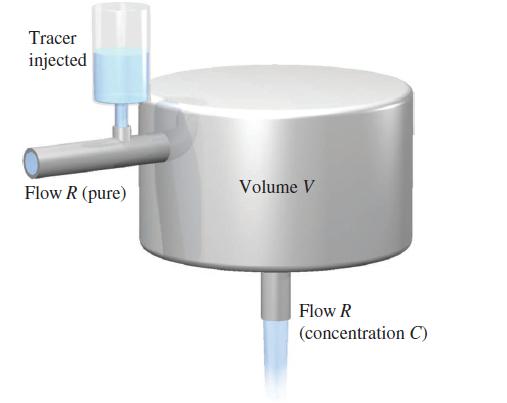
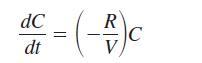
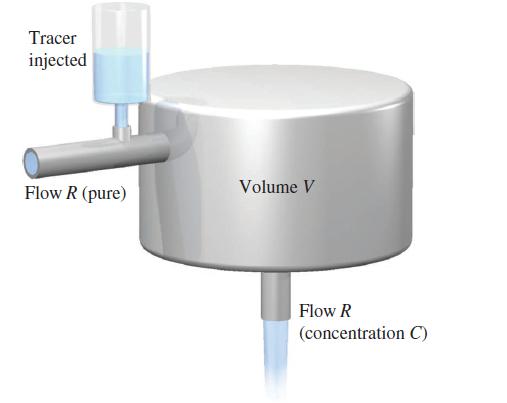
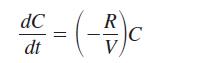
In Exercises a medical researcher wants to determine the concentration C (in moles per liter) of a tracer drug injected into a moving fluid. Solve this problem by considering a single-compartment dilution model (see figure). Assume that the fluid is continuously mixed and that the volume of the
In Exercises(a) Sketch the slope field for the differential equation(b) Use the slope field to sketch the solution that passes through the given point. Use a graphing utility to verify your results y' = y + 4x, (-1, 1)
In Exercises solve the first-order linear differential equation.y' + y tan x = sec x
In Exercises solve the first-order linear differential equation.y' - 3x²y = ex³
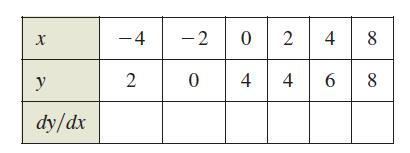
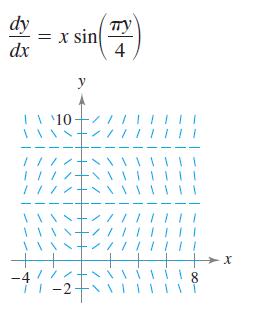
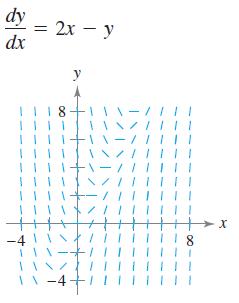
In Exercises a differential equation and its slope field are given. Complete the table by determining the slopes (if possible) in the slope field at the given points. X y dy/dx -4 -2 2 0 02 4 4 6 8 48
In Exercises a medical researcher wants to determine the concentration C (in moles per liter) of a tracer drug injected into a moving fluid. Solve this problem by considering a single-compartment dilution model (see figure). Assume that the fluid is continuously mixed and that the volume of the
In Exercises solve the first-order linear differential equation.y' + 3y = e3x
In Exercises a differential equation and its slope field are given. Complete the table by determining the slopes (if possible) in the slope field at the given points. X y dy/dx -4 -2 2 0 02 4 4 6 8 48
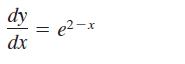
In Exercises use integration to find a general solution of the differential equation. dy dx = e2-x
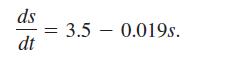
Biomass is a measure of the amount of living matter in an ecosystem. Suppose the biomass s(t) in a given ecosystem increases at a rate of about 3.5 tons per year, and decreases by about 1.9% per year. This situation can be modeled by the differential equation(a) Solve the differential equation.(b)
In Exercises solve the first-order linear differential equation.(x - 1)y' + y = x² - 1
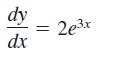
In Exercises use integration to find a general solution of the differential equation. dy dx 2e³x
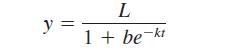
Show that the logistic equationcan be written asWhat can you conclude about the graph of the logistic equation? y L 1 + be-kt
In Exercises solve the first-order linear differential equation.(y - 1) sin x dx - dy = 0
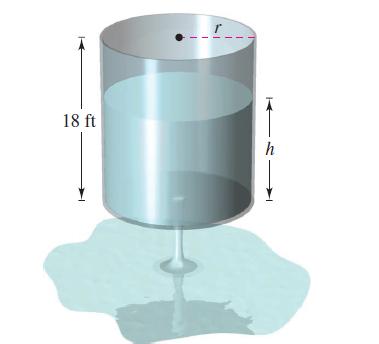
The cylindrical water tank shown in the figure has a height of 18 feet. When the tank is full, a circular valve is opened at the bottom of the tank. After 30 minutes, the depth of the water is 12 feet.(a) Using Torricelli’s Law, how long will it take for the tank to drain completely?(b) What is
In Exercises solve the first-order linear differential equation.(y + 1) cos x dx - dy = 0
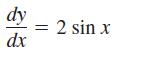
In Exercises use integration to find a general solution of the differential equation. dy dx 2 sin x
In Exercises solve the first-order linear differential equation.y' + 2xy = 10x
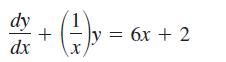
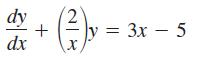
In Exercises solve the first-order linear differential equation. dy dx + (1) y = = 6x + 2
In Exercises solve the first-order linear differential equation. dy + dx X 3x - 5 = 3x
Suppose the tank in Exercise 6 has a height of 20 feet and a radius of 8 feet, and the valve is circular with a radius of 2 inches. The tank is full when the valve is opened. How long will it take for the tank to drain completely?
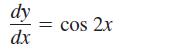
In Exercises use integration to find a general solution of the differential equation. dy dx = cos 2x
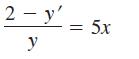
In Exercises determine whether the differential equation is linear. Explain your reasoning. 2-у y y 5x
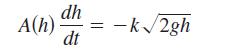
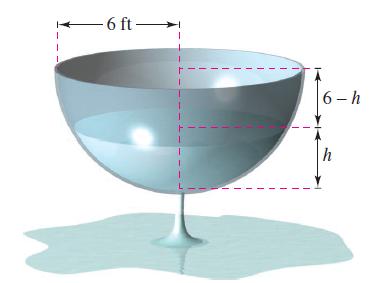
Torricelli’s Law states that water will flow from an opening at the bottom of a tank with the same speed that it would attain falling from the surface of the water to the opening. One of the forms of Torricelli’s Law iswhere h is the height of the water in the tank, k is the area of the opening
In Exercises solve the first-order linear differential equation.y' - y = 16
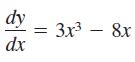
In Exercises use integration to find a general solution of the differential equation. dy dx = 3x² 8x
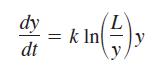
Another model that can be used to represent population growth is the Gompertz equation, which is the solution of the differential equationwhere k is a constant and L is the carrying capacity.(a) Solve the differential equation.(b) Use a graphing utility to graph the slope field for the differential
In Exercises determine whether the differential equation is linear. Explain your reasoning.y' - y sin x = xy²
Determine whether the function y = 2 sin 2x is a solution of the differential equation y'" - 8y = 0.
In Exercises determine whether the differential equation is linear. Explain your reasoning.2xy - y' In x = y
In Exercises determine whether the differential equation is linear. Explain your reasoning.x³y' + xy = ex + 1
Determine whether the function y = x³ is a solution of the differential equation 2xy' + 4y= 10x³.
Let ƒ be a twice-differentiable real-valued function satisfyingwhere g(x) ≥ 0 for all real x. Prove that |ƒ(x)| is bounded. (x),ƒ (x)8x— = (x),£ + (x)ƒ
It is known that y = ekt is a solution of the differential equation y" - 16y = 0. Find the values of k.
In Exercises determine whether the statement is true or false. If it is false, explain why or give an example that shows it is false.A slope field shows that the slope at the point (1, 1) is 6. This slope field represents the family of solutions for the differential equation y'= 4x + 2y.
Prove that if the family of integral curves of the differential equationis cut by the line x = k, the tangents at the points of intersection are concurrent. dy dx + p(x)y= g(x), p(x) · g(x) = 0 .
Repeat Exercise 93 for which the exact solution of the differential equationwhere y(0) = 1, is y = x - 1 + 2e-x.Data from in Exercises 93The exact solution of the differential equationwhere y(0) = 4, is y = 4e-2x.(a) Use a graphing utility to complete the table, where y is the exact value of the
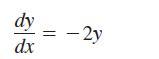
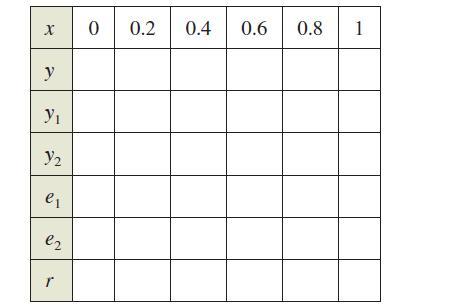
The exact solution of the differential equationwhere y(0) = 4, is y = 4e-2x.(a) Use a graphing utility to complete the table, where y is the exact value of the solution, y1 is the approximate solution using Euler's Method with h = 0.1, y2 is the approximate solution using Euler's Method with h =
It is known that y = A sin ωt is a solutionof the differential equation y" + 16y = 0. Find the values of ω.
In Exercises determine whether the statement is true or false. If it is false, explain why or give an example that shows it is false.Slope fields represent the general solutions of differential equations.
In Exercises determine whether the statement is true or false. If it is false, explain why or give an example that shows it is false.The general solution of a differential equation is y = -4.9x² + C₁x + C₂. To find a particular solution, you must be given two initial conditions.
In Exercises determine whether the statement is true or false. If it is false, explain why or give an example that shows it is false.If y = ƒ(x) is a solution of a first-order differential equation, then y = ƒ(x)+ C is also a solution.
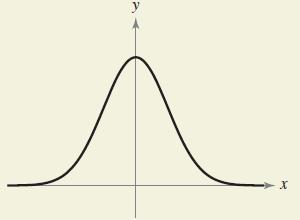
The graph shows a solution of one of the following differential equations. Determine the correct equation. Explain your reasoning.(a) y' = xy(b) y' = 4x/y(c) y' = - 4xy (d) y' = 4 - xy y X
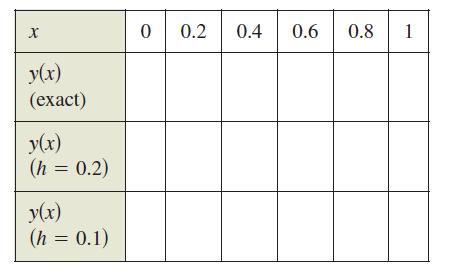
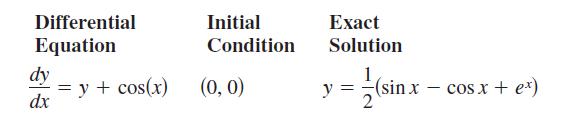
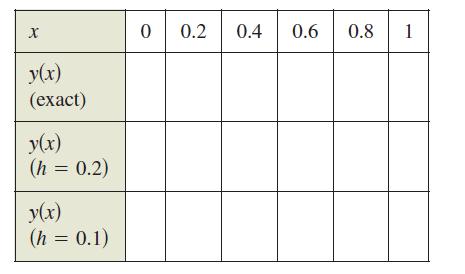
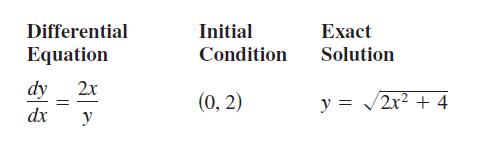
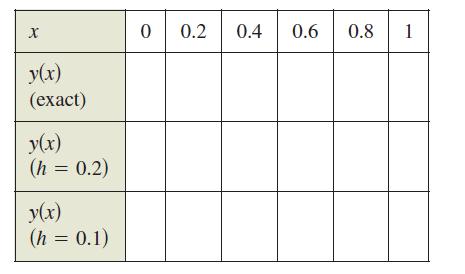
In Exercises complete the table using the exact solution of the differential equation and two approximations obtained using Euler's Method to approximate the particular solution of the differential equation. Use h = 0.2 and h = 0.1, and compute each approximation to four decimal places.
Describe how to use Euler’s Method to approximate a particular solution of a differential equation.
It is known that y = Cekx is a solution of the differential equation y' = 0.07y. Is it possible to determine C or k from the information given? If so, find its value.
Explain how to interpret a slope field.
In Exercises complete the table using the exact solution of the differential equation and two approximations obtained using Euler's Method to approximate the particular solution of the differential equation. Use h = 0.2 and h = 0.1, and compute each approximation to four decimal places.
In your own words, describe the difference between a general solution of a differential equation and a particular solution.
A not uncommon calculus mistake is to believe that the prod- uct rule for derivatives says that (ƒg)' = ƒ'g'. If ƒ(x) = ex²,determine, with proof, whether there exists an open interval(a, b) and a nonzero function g defined on (a, b) such thatthis wrong product rule is true for x in (a, b).
In Exercises use Euler’s Method to make a table of values for the approximate solution of the differential equation with the specified initial value. Use steps of size h. y' = = cos x + sin y, y(0) = 5, n = 10, h = 0.1
In Exercises determine whether the statement is true or false. If it is false, explain why or give an example that shows it is false.The families x² + y² = 2Cy and x² + y² = 2Kx are mutually orthogonal.
In Exercises determine whether the statement is true or false. If it is false, explain why or give an example that shows it is false.The differential equation y' = xy - 2y + x - 2 can be written in separated variables form.
In Exercises complete the table using the exact solution of the differential equation and two approximations obtained using Euler's Method to approximate the particular solution of the differential equation. Use h = 0.2 and h = 0.1, and compute each approximation to four decimal places.
In Exercises determine whether the statement is true or false. If it is false, explain why or give an example that shows it is false.The function y = 0 is always a solution of a differential equation that can be solved by separation of variables.
In Exercises use Euler’s Method to make a table of values for the approximate solution of the differential equation with the specified initial value. Use steps of size h. y' = 0.5x(3-y), y(0) y(0) = = 1, n = 5, h = 0.4 1,
In Exercises solve the homogeneous differential equation in terms of x and y. A homogeneous differential equation is an equation of the form M(x, y) dx + N(x, y) dy = 0, where M and N are homogeneous functions of the same degree. To solve an equation of this form by the method of separation of
In Exercises use Euler’s Method to make a table of values for the approximate solution of the differential equation with the specified initial value. Use steps of size h. y' = exy, y(0) = 1, n = 10, h = 0.1
In Exercises solve the homogeneous differential equation in terms of x and y. A homogeneous differential equation is an equation of the form M(x, y) dx + N(x, y) dy = 0, where M and N are homogeneous functions of the same degree. To solve an equation of this form by the method of separation of
In Exercises solve the homogeneous differential equation in terms of x and y. A homogeneous differential equation is an equation of the form M(x, y) dx + N(x, y) dy = 0, where M and N are homogeneous functions of the same degree. To solve an equation of this form by the method of separation of
In Exercises use Euler’s Method to make a table of values for the approximate solution of the differential equation with the specified initial value. Use steps of size h. h 20, h 0.05 = y' = x + y, y(0) = 2, n = 20,
In Exercises use Euler’s Method to make a table of values for the approximate solution of the differential equation with the specified initial value. Use steps of size h. y' = 3x - 2y, y(0) = 3, n = 10, h = 0.05
In Exercises solve the homogeneous differential equation in terms of x and y. A homogeneous differential equation is an equation of the form M(x, y) dx + N(x, y) dy = 0, where M and N are homogeneous functions of the same degree. To solve an equation of this form by the method of separation of
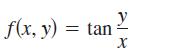
In Exercises determine whether the function is homogeneous, and if it is, determine its degree. A function ƒ(x, y) is homogeneous of degree n if ƒ(tx, ty) = tnƒ(x, y). f(x, y) = tan y X
In Exercises solve the homogeneous differential equation in terms of x and y. A homogeneous differential equation is an equation of the form M(x, y) dx + N(x, y) dy = 0, where M and N are homogeneous functions of the same degree. To solve an equation of this form by the method of separation of
In Exercises use a computer algebra system to (a) Graph the slope field for the differential equation(b) Graph the solution satisfying the specified initial condition = = dy dx 1 IC 2 ؛ 8/e-x sin T, y(0) = 2
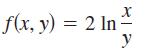
In Exercises determine whether the function is homogeneous, and if it is, determine its degree. A function ƒ(x, y) is homogeneous of degree n if ƒ(tx, ty) = tnƒ(x, y). X f(x, y) = 2 In- y
In Exercises determine whether the function is homogeneous, and if it is, determine its degree. A function ƒ(x, y) is homogeneous of degree n if ƒ(tx, ty) = tnƒ(x, y). f(x, y) = 2 In xy
In Exercises solve the homogeneous differential equation in terms of x and y. A homogeneous differential equation is an equation of the form M(x, y) dx + N(x, y) dy = 0, where M and N are homogeneous functions of the same degree. To solve an equation of this form by the method of separation of
In Exercises use Euler’s Method to make a table of values for the approximate solution of the differential equation with the specified initial value. Use steps of size h. y' = x + y, y(0) = 2, n = 10, h = 0.1
In Exercises use a computer algebra system to (a) Graph the slope field for the differential equation(b) Graph the solution satisfying the specified initial condition dy dx 0.4y(3x), y(0) = 1
In Exercises determine whether the function is homogeneous, and if it is, determine its degree. A function ƒ(x, y) is homogeneous of degree n if ƒ(tx, ty) = tnƒ(x, y). f(x, y) = tan(x + y)
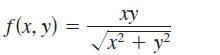
In Exercises determine whether the function is homogeneous, and if it is, determine its degree. A function ƒ(x, y) is homogeneous of degree n if ƒ(tx, ty) = tnƒ(x, y). f(x, y) = ху √x² + y²
In Exercises use a computer algebra system to (a) Graph the slope field for the differential equation(b) Graph the solution satisfying the specified initial condition dy dx = 0.2x(2y), y(0) = 9
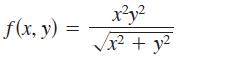
In Exercises determine whether the function is homogeneous, and if it is, determine its degree. A function ƒ(x, y) is homogeneous of degree n if ƒ(tx, ty) = tnƒ(x, y). f(x, y) x²y² √x² + y²
In Exercises determine whether the statement is true or false. If it is false, explain why or give an example that shows it is false.The diffeTruerential equation modeling exponential growth is dy/dx = ky, where k is a constant.
In Exercises use a computer algebra system to (a) Graph the slope field for the differential equation(b) Graph the solution satisfying the specified initial condition dy dx 0.02y(10 - y), y(0) = 2
In Exercises determine whether the statement is true or false. If it is false, explain why or give an example that shows it is false.If prices are rising at a rate of 0.5% per month, then they arerising at a rate of 6% per year.
Use the slope field for the differential equation y' = 1/x, where x > 0, to sketch the graph of the solution that satisfies each given initial condition. Then make a conjecture about the behavior of a particular solution of y' = 1/x as x → ∞.(a) (1, 0)(b) (2, -1)
In Exercises determine whether the function is homogeneous, and if it is, determine its degree. A function ƒ(x, y) is homogeneous of degree n if ƒ(tx, ty) = tnƒ(x, y). f(x, y) = x³ + 3x²y² - 2y²
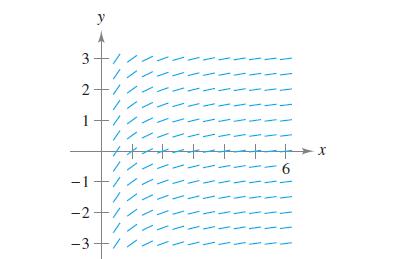
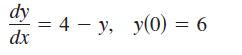
In Exercises use a computer algebra system to (a) Graph the slope field for the differential equation(b) Graph the solution satisfying the specified initial condition dy dx = 4 y, y(0) = 6
In Exercises determine whether the function is homogeneous, and if it is, determine its degree. A function ƒ(x, y) is homogeneous of degree n if ƒ(tx, ty) = tnƒ(x, y). f(x, y) = x³ 4xy² + y²
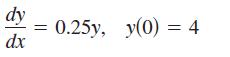
In Exercises use a computer algebra system to (a) Graph the slope field for the differential equation(b) Graph the solution satisfying the specified initial condition dy dx = 0.25y, y(0) 4
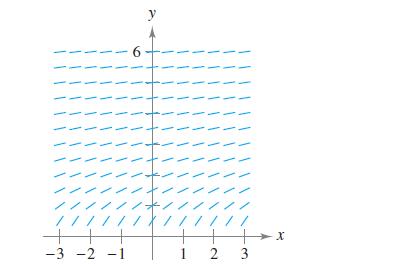
Use the slope field for the differential equation y' = 1/y, where y > 0, to sketch the graph of the solution that satisfies each given initial condition. Then make a conjecture about the behavior of a particular solution of y' = 1/y as x → ∞.(a) (0, 1)(b) (1, 1) 6 +11 -3 -2 -1 + 12 2 3 X
Ignoring resistance, a sailboat starting from rest accelerates (dv/dt) at a rate proportional to the difference between the velocities of the wind and the boat.(a) The wind is blowing at 20 knots, and after 1 half-hour, the boat is moving at 10 knots. Write the velocity v as a function of time
Showing 6300 - 6400
of 9867
First
57
58
59
60
61
62
63
64
65
66
67
68
69
70
71
Last
Step by Step Answers

 Get 50% OFF
Claim Now
Get 50% OFF
Claim Now