New Semester
Started
Get
50% OFF
Study Help!
--h --m --s
Claim Now
Question Answers
Textbooks
Find textbooks, questions and answers
Oops, something went wrong!
Change your search query and then try again
S
Books
FREE
Study Help
Expert Questions
Accounting
General Management
Mathematics
Finance
Organizational Behaviour
Law
Physics
Operating System
Management Leadership
Sociology
Programming
Marketing
Database
Computer Network
Economics
Textbooks Solutions
Accounting
Managerial Accounting
Management Leadership
Cost Accounting
Statistics
Business Law
Corporate Finance
Finance
Economics
Auditing
Tutors
Online Tutors
Find a Tutor
Hire a Tutor
Become a Tutor
AI Tutor
AI Study Planner
NEW
Sell Books
Search
Search
Sign In
Register
study help
mathematics
calculus 10th edition
Calculus 10th Edition Ron Larson, Bruce H. Edwards - Solutions
In Exercises determine whether the statement is true or false. If it is false, explain why or give an example that shows it is false.In linear growth, the rate of growth is constant.
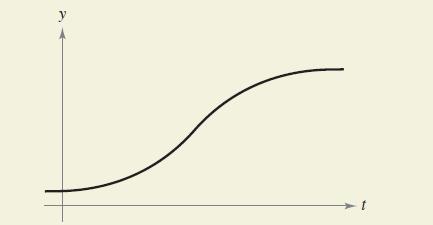
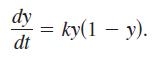
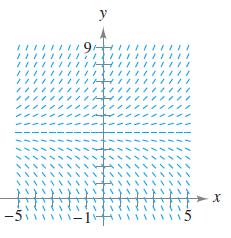
The growth of a population is modeled by a logistic equation as shown in the graph below. What happens to the rate of growth as the population increases? What do you think causes this to occur in real-life situations, such as animal or human populations? y 1
In Exercises determine whether the statement is true or false. If it is false, explain why or give an example that shows it is false.In exponential growth, the rate of growth is constant.
A container of hot liquid is placed in a freezer that is kept at a constant temperature of 20°F. The initial temperature of the liquid is 160°F. After 5 minutes, the liquid's temperature is 60°F. How much longer will it take for its temperature to decrease to 30°F?
When an object is removed from a furnace and placed in an environment with a constant temperature of 80°F, its core temperature is 1500°F. One hour after it is removed, the core temperature is 1120°F. Find the core temperature 5 hours after the object is removed from the furnace.
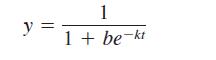
Show that ifthen y = 1 1+ be-k
For any logistic growth curve, show that the point of inflection occurs at y = L/2 when the solution starts below the carrying capacity L.
With the installation of noise suppression materials, the noise level in an auditorium was reduced from 93 to 80 decibels. Use the function into find the percent decrease in the intensity level of the noise as a result of the installation of these materials.
In Exercises(a) Sketch the slope field for the differential equation(b) Use the slope field to sketch the solution that passes through the given point(c) Discuss the graph of the solution as x→∞ and x→ -∞. Use a graphing utility to verify your results.y' = y + xy, (0, -4)
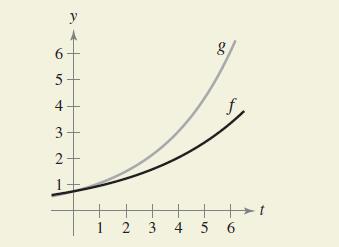
The functions ƒ and g are both of the form y = Cekt.(a) Do the functions ƒ and g represent exponential growth or exponential decay? Explain. (b) Assume both functions have the same value of C. Which function has a greater value of k? Explain. 6 5 4 3 2 ta 2 wt + 4 5 00 8 't 6 1
In Exercises(a) Sketch the slope field for the differential equation(b) Use the slope field to sketch the solution that passes through the given point(c) Discuss the graph of the solution as x→∞ and x→ -∞. Use a graphing utility to verify your results. y'=x²-x, (1, 1)
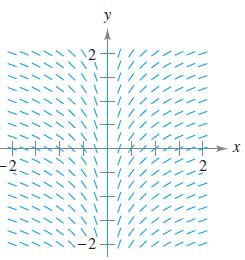
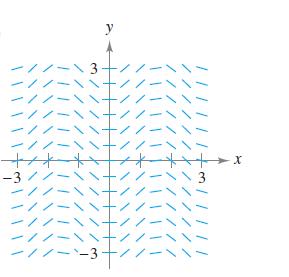
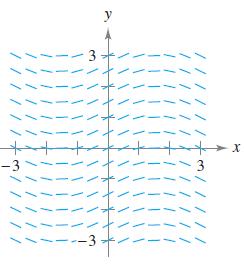
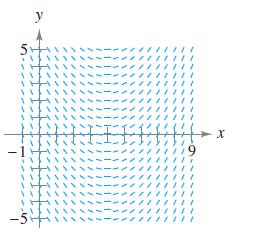
In Exercises match the differential equation with its slope field. [The slope fields are labeled (a), (b), (c), and (d).](a)(b)(c)(d) ////// ////////// // / / / / / / / / / / / / / / / / ////////////// 11 1/X / / / / / / / / 1+1 //////////// -2- + XXX 1+1 1 1 1 1 XXX | / \ \
In Exercises(a) Sketch the slope field for the differential equation(b) Use the slope field to sketch the solution that passes through the given point(c) Discuss the graph of the solution as x→∞ and x→ -∞. Use a graphing utility to verify your results.y' = y - 4x, (2, 2)
In your own words, describe the relationship between two families of curves that are mutually orthogonal.
In Exercises match the differential equation with its slope field. [The slope fields are labeled (a), (b), (c), and (d).](a)(b)(c)(d) ////// ////////// // / / / / / / / / / / / / / / / / ////////////// 11 1/X / / / / / / / / 1+1 //////////// -2- + XXX 1+1 1 1 1 1 XXX | / \ \
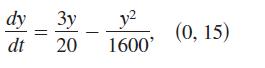
In Exercises find the logistic equation that passes through the given point. dy 3y dt 20 1² 1600' (0, 15)
In your own words, describe how to recognize and solve differential equations that can be solved by separation of variables.
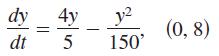
In Exercises find the logistic equation that passes through the given point. dy 4y dt 5 || 1² 150' (0,8)
In Exercises match the differential equation with its slope field. [The slope fields are labeled (a), (b), (c), and (d).](a)(b)(c)(d) ////// ////////// // / / / / / / / / / / / / / / / / ////////////// 11 1/X / / / / / / / / 1+1 //////////// -2- + XXX 1+1 1 1 1 1 XXX | / \ \
In Exercises(a) Sketch the slope fieldfor the differential equation(b) Use the slope field to sketch thesolution that passes through the given point(c) Discuss thegraph of the solution as x→∞ and x→ -∞. Use a graphingutility to verify your results.y' = 3 - x, (4,2)
In Exercises match the differential equation with its slope field. [The slope fields are labeled (a), (b), (c), and (d).](a)(b)(c)(d) ////// ////////// // / / / / / / / / / / / / / / / / ////////////// 11 1/X / / / / / / / / 1+1 //////////// -2- + XXX 1+1 1 1 1 1 XXX | / \ \
A conservation organization releases 25 Florida panthers into a game preserve. After 2 years, there are 39 panthers in the preserve. The Florida preserve has a carrying capacity of 200 panthers.(a) Write a logistic equation that models the population of panthers in the preserve.(b) Find the
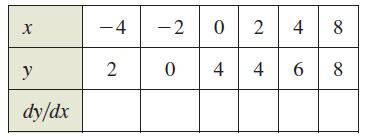
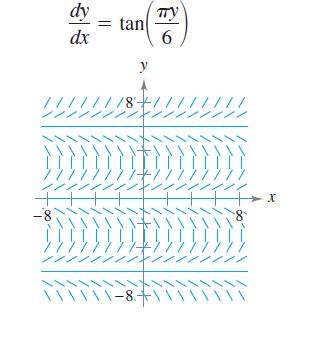
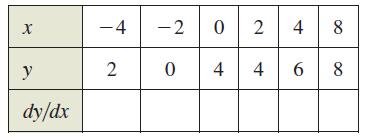
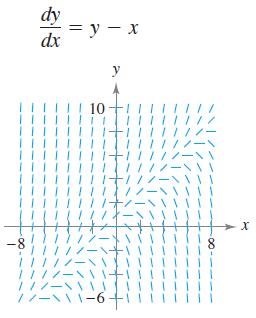
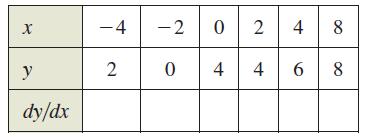
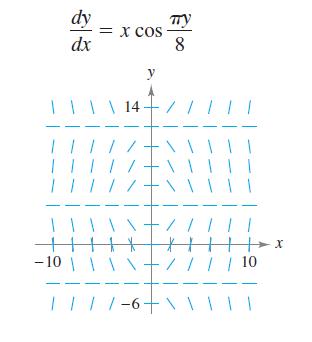
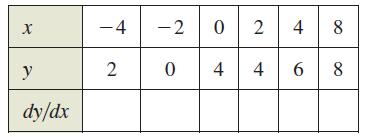
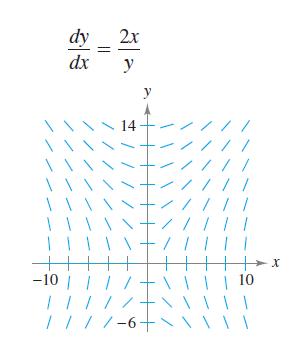
In Exercises a differential equation and its slope field are given. Complete the table by determining the slopes (if possible) in the slope field at the given points. x y dy/dx -4 -2 2 0 0 2 4 4 4 8 68
(a) Suppose an insect population increases by a constant number each month. Explain why the number of insects can be represented by a linear function.(b) Suppose an insect population increases by a constant percentage each month. Explain why the number of insects can be represented by an
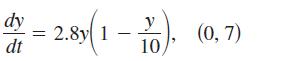
In Exercises find the logistic equation that passes through the given point. dy dt 2.8y 1- y 10 (0,7)
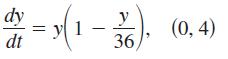
In Exercises find the logistic equation that passes through the given point. dy dt || y y 36, (0,4)
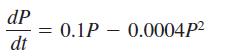
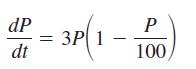
In Exercises the logistic differential equation models the growth rate of a population. Use the equation to (a) Find the value of k(b) Find the carrying capacity(c) Graph a slope field using a computer algebra system(d) Determine the value of P at which the population growth rate is the
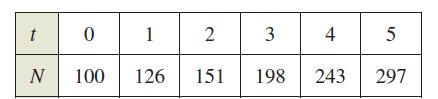
One hundred bacteria are started in a culture and the number N of bacteria is counted each hour for 5 hours. The results are shown in the table, where is the time in hours.(a) Use the regression capabilities of a graphing utility to find an exponential model for the data.(b) Use the model to
In Exercises a differential equation and its slope field are given. Complete the table by determining the slopes (if possible) in the slope field at the given points. x y dy/dx -4 -2 2 0 0 2 4 4 4 8 68
In Exercises a differential equation and its slope field are given. Complete the table by determining the slopes (if possible) in the slope field at the given points. x y dy/dx -4 -2 2 0 0 2 4 4 4 8 68
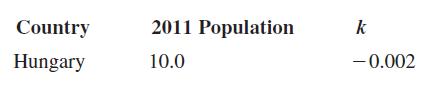
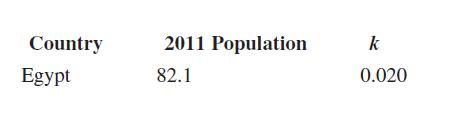
In Exercises the population (in millions) of a country in 2011 and the expected continuous annual rate of change of the population are given.(a) Find the exponential growth modelP = Cektfor the population by letting t = 0 correspond to 2010.(b) Use the model to predict the population of the country
In Exercises the population (in millions) of a country in 2011 and the expected continuous annual rate of change of the population are given.(a) Find the exponential growth modelP = Cektfor the population by letting t = 0 correspond to 2010.(b) Use the model to predict the population of the country
In Exercises the logistic differential equation models the growth rate of a population. Use the equation to (a) Find the value of k(b) Find the carrying capacity(c) Graph a slope field using acomputer algebra system(d) Determine the value of P atwhich the population growth rate is the greatest
In Exercises a differential equation and its slope field are given. Complete the table by determining the slopes (if possible) in the slope field at the given points. x y dy/dx -4 -2 2 0 0 2 4 4 4 8 68
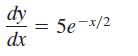
In Exercises use integration to find a general solution of the differential equation. dy dx = 5e-x/2
In Exercises the population (in millions) of a country in 2011 and the expected continuous annual rate of change of the population are given.(a) Find the exponential growth modelP = Cektfor the population by letting t = 0 correspond to 2010.(b) Use the model to predict the population of the country
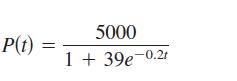
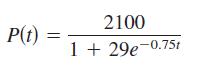
In Exercises the logistic equation models the growth of a population. Use the equation to (a) Find the value of k(b) Find the carrying capacity(c) Find the initial population(d) Determine when the population will reach 50% of its carrying capacity(e) Write a logistic differential equation that
In Exercises the population (in millions) of a country in 2011 and the expected continuous annual rate of change of the population are given.(a) Find the exponential growth modelP = Cektfor the population by letting t = 0 correspond to 2010.(b) Use the model to predict the population of the country
In Exercises the logistic equation models the growth of a population. Use the equation to (a) Find the value of k(b) Find the carryingcapacity(c) Find the initial population(d) Determine when the population will reach 50% of its carrying capacity(e) Write a logistic differential equation that
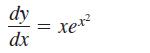
In Exercises use integration to find a general solution of the differential equation. dy dx Xex²
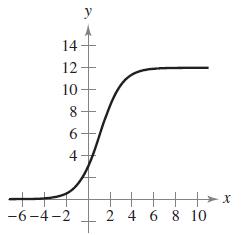
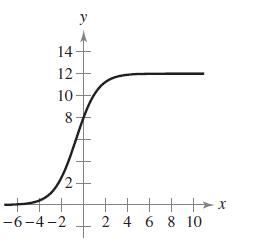
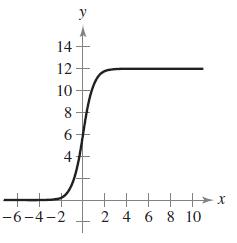
In Exercises match the logistic equation with its graph. [The graphs are labeled (a), (b), (c), and (d).](a)(b)(c)(d) 14 12 10 8 69 y -6-4-2 2 4 6 8 10 x
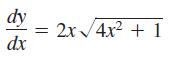
In Exercises use integration to find a general solution of the differential equation. dy dx || 2x√4x² + 1
In Exercises match the logistic equation with its graph. [The graphs are labeled (a), (b), (c), and (d).](a)(b)(c)(d) 14 12 10 8 69 y -6-4-2 2 4 6 8 10 x
In Exercises match the logistic equation with its graph. [The graphs are labeled (a), (b), (c), and (d).](a)(b)(c)(d) 14 12 10 8 69 y -6-4-2 2 4 6 8 10 x
In Exercises find the time necessary for $1000 to double when it is invested at a rate of r compounded (a) Annually(b) Monthly(c) Daily(d) Continuouslyr = 5.5%
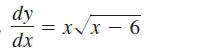
In Exercises use integration to find a general solution of the differential equation. 9 - XAX xp Не
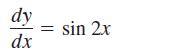
In Exercises use integration to find a general solution of the differential equation. dy dx sin 2x
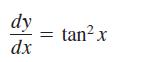
In Exercises use integration to find a general solution of the differential equation. dy dx || tan² x
In Exercises find the time necessary for $1000 to double when it is invested at a rate of r compounded (a) Annually(b) Monthly(c) Daily(d) Continuouslyr = 7%
In Exercises match the logistic equation with its graph. [The graphs are labeled (a), (b), (c), and (d).](a)(b)(c)(d) 14 12 10 8 69 y -6-4-2 2 4 6 8 10 x
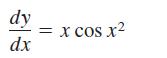
In Exercises use integration to find a general solution of the differential equation. dy dx = x cos x²
In Exercises find the principal P that must be invested at rate r, compounded monthly, so that $1,000,000 will be available for retirement in t years.r = 9%, t = 25
In Exercises find the principal P that must be invested at rate r, compounded monthly, so that $1,000,000 will be available for retirement in t years. r = 7%, t = t = 20
In Exercises find the principal P that must be invested at rate r, compounded monthly, so that $1,000,000 will be available for retirement in t years.r = 8%, t = 35
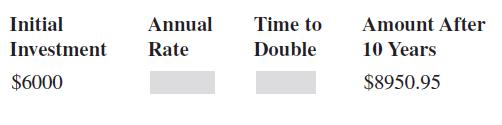
In Exercises complete the table for a savings account in which interest is compounded continuously. Initial Investment $6000 Annual Rate Time to Double Amount After 10 Years $8950.95
In Exercises find the principal P that must be invested at rate r, compounded monthly, so that $1,000,000 will be available for retirement in t years.r = 6%, t = 40
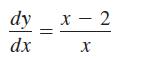
In Exercises use integration to find a general solution of the differential equation. dy dx x 2 X
In Exercises find the orthogonal trajectories of the family. Use a graphing utility to graph several members of each family.y = Cex
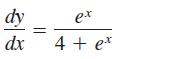
In Exercises use integration to find a general solution of the differential equation. dy dx || ex 4+ex
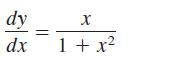
In Exercises use integration to find a general solution of the differential equation. dy dx X 1 + x²
In Exercises find the orthogonal trajectories of the family. Use a graphing utility to graph several members of each family.y² = Cx³
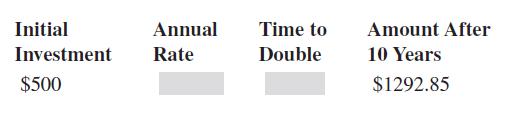
In Exercises complete the table for a savings account in which interest is compounded continuously. Initial Investment $500 Annual Rate Time to Double Amount After 10 Years $1292.85
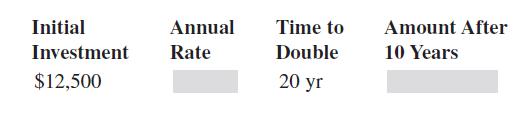
In Exercises complete the table for a savings account in which interest is compounded continuously. Initial Investment $12,500 Annual Rate Time to Double 20 yr Amount After 10 Years
In Exercises find the orthogonal trajectories of the family. Use a graphing utility to graph several members of each family.y² = 2Cx
In Exercises find the orthogonal trajectories of the family. Use a graphing utility to graph several members of each family.x² = Cy
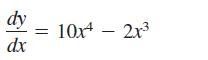
In Exercises use integration to find a general solution of the differential equation. dy dx = 10x - 2x²
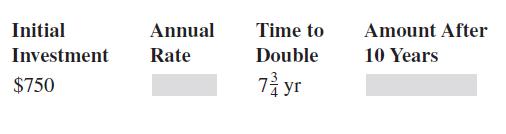
In Exercises complete the table for a savings account in which interest is compounded continuously. Initial Investment $750 Annual Rate Time to Double 73 yr Amount After 10 Years
In Exercises find the orthogonal trajectories of the family. Use a graphing utility to graph several members of each family.x² - 2y² = C
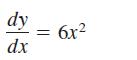
In Exercises use integration to find a general solution of the differential equation. dy dx =6x2
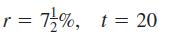
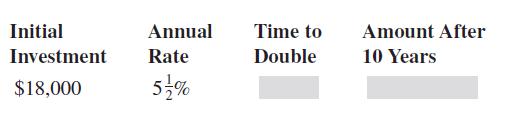
In Exercises complete the table for a savings account in which interest is compounded continuously. Initial Investment $18,000 Annual Rate 51/% Time to Double Amount After 10 Years
In Exercises find the orthogonal trajectories of the family. Use a graphing utility to graph several members of each family.x2 + y2 = C
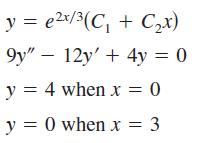
In Exercises verify that the general solution satisfies the differential equation. Then find the particular solution that satisfies the initial condition(s). y = e2x/³ (C₁ + C2₂x) 9y" 12y + 4y = 0 y = 4 when x = 0 y = 0 when x = 3
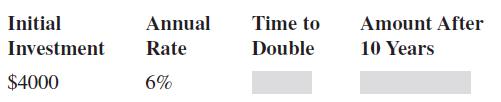
In Exercises complete the table for a savings account in which interest is compounded continuously. Initial Investment $4000 Annual Rate 6% Time to Double Amount After 10 Years
A calf that weighs 60 pounds at birth gains weight at the ratewhere w is weight in pounds and t is time in years.(a) Solve the differential equation.(b) Use a graphing utility to graph the particular solutions for k = 0.8, 0.9, and 1.(c) The animal is sold when its weight reaches 800 pounds. Find
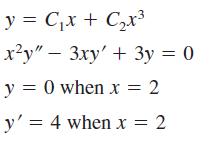
In Exercises verify that the general solution satisfies the differential equation. Then find the particular solution that satisfies the initial condition(s). y = C₁x + ₂x³ x²y" - 3xy' + 3y = 0 y = 0 when x = 2 y' = 4 when x = 2
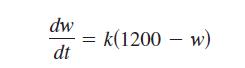
A calf that weighs wo pounds at birth gains weight at the rate dw/dt = 1200 -w, where w is weight in pounds and this time in years. Solve the differential equation.
Carbon-14 dating assumes that the carbon dioxide on Earth today has the same radioactive content as it did centuries ago. If this is true, the amount of 14C absorbed by a tree that grew several centuries ago should be the same as the amount of 14C absorbed by a tree growing today. A piece of
In a chemical reaction, a certain compound changes into another compound at a rate proportional to the unchanged amount. There is 40 grams of the original compound initially and 35 grams after 1 hour. When will 75 percent of the compound be changed?
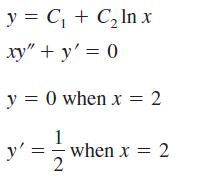
In Exercises verify that the general solution satisfies the differential equation. Then find the particular solution that satisfies the initial condition(s). y = C₁ + C₂ ln x xy" + y = 0 y = 0 when x = 2 1 2 y' when x = 2
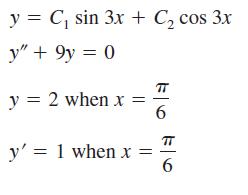
In Exercises verify that the general solution satisfies the differential equation. Then find the particular solution that satisfies the initial condition(s). y = C₁ sin 3x + C₂ cos 3x y" + 9y = 0 y = 2 when x = y' = 1 when x = 6 TT 6
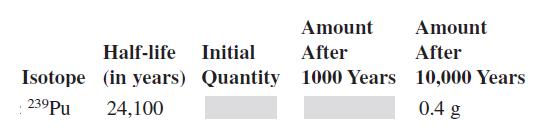
In Exercises complete the table for the radioactive isotope. Amount Half-life Initial After Isotope (in years) Quantity 1000 Years 239Pu 24,100 Amount After 10,000 Years 0.4 g
In Exercises(a) Write a differential equation for the statement, b) Match the differential equation with a possible slope field(a)(b)(c)(d) The rate of change of y with respect to x is proportional to y². //////// ///////17 / / / / / / /
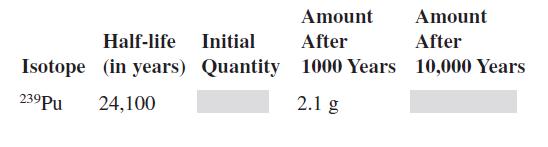
In Exercises complete the table for the radioactive isotope. Half-life Initial Isotope (in years) Quantity 239Pu 24,100 Amount After 1000 Years 2.1 g Amount After 10,000 Years
Radioactive radium has a half-life of approximately 1599 years. What percent of a given amount remains after 100 years?
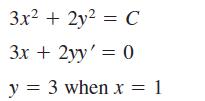
In Exercises verify that the general solution satisfies the differential equation. Then find the particular solution that satisfies the initial condition(s). 3x² + 2y² = C 3x + 2yy' = 0 y = 3 when x = 1
The rate of decomposition of radioactive radium is proportional to the amount present at any time. The half-life of radioactive radium is 1599 years. What percent of a present amount will remain after 50 years?
In Exercises(a) Write a differential equation for the statement, b) Match the differential equation with a possible slope field(a)(b)(c)(d)The rate of change of y with respect to x is proportional to the product of y and the difference between y and 4. //////// ///////17 / / / / / / /
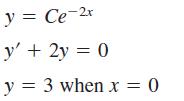
In Exercises verify that the general solution satisfies the differential equation. Then find the particular solution that satisfies the initial condition(s). y = Ce-2x y' + 2y = 0 y = 3 when x = 0
In Exercises(a) Write a differential equation for the statement, b) Match the differential equation with a possible slope field(a)(b)(c)(d)The rate of change of y with respect to x is proportional to the difference between x and 4. //////// ///////17 / / / / / / /
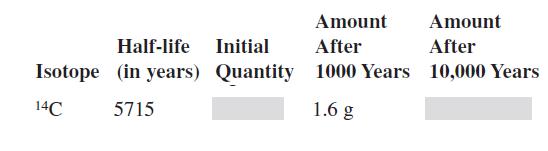
In Exercises complete the table for the radioactive isotope. Half-life Initial Isotope (in years) Quantity 14C 5715 Amount After 1000 Years 1.6 g Amount After 10,000 Years
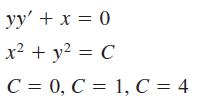
In Exercises the general solution of the differential equation is given. Use a graphing utility to graph the particular solutions for the given values of C. yy' + x = 0 x² + y² = C C = 0, C = 1, C = 4
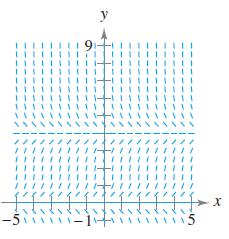
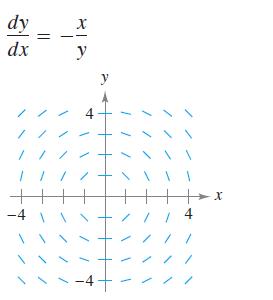
In Exercises sketch a few solutions of the differential equation on the slope field and then find the general solution analytically. dy dx -4 y -4 1
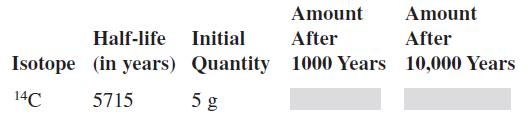
In Exercises complete the table for the radioactive isotope. Half-life Initial Isotope (in years) 14C 5715 Quantity 5 g Amount After 1000 Years Amount After 10,000 Years
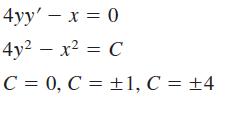
In Exercises the general solution of the differential equation is given. Use a graphing utility to graph the particular solutions for the given values of C. 4yy' - x = 0 4y² - x² = C C = 0, C = ±1, C = +4
In Exercises(a) Write a differential equation for the statement, (b) Match the differential equation with a possible slope field(a)(b)(c)(d)The rate of change of y with respect to x is proportional to the difference between y and 4. //////// ///////17 / / / / / / /
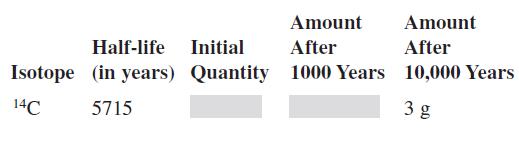
In Exercises complete the table for the radioactive isotope. Isotope 14C Amount Half-life Initial After (in years) Quantity 1000 Years 5715 Amount After 10,000 Years 3 g
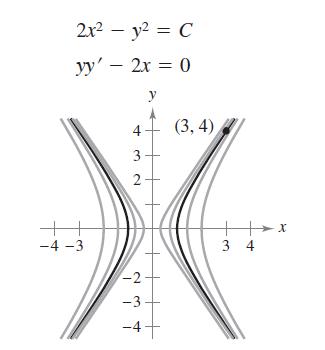
In Exercises some of the curves corresponding to different values of C in the general solution of the differential equation are shown in the graph. Find the particular solution that passes through the point shown on the graph. 2x2 – y2 = C - y' – 2x = 0 + -4 -3 4 (3, 4) 3 2 -2. -3 -4- 34 X
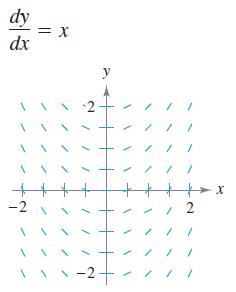
In Exercises sketch a few solutions of the differential equation on the slope field and then find the general solution analytically. dy dx -2 X = 1* 1 y / 1 1 2 X
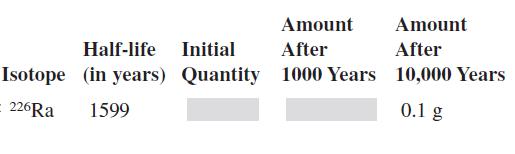
In Exercises complete the table for the radioactive isotope. Isotope = 226Ra Amount Amount After Half-life Initial (in years) Quantity 1000 Years 1599 After 10,000 Years 0.1 g
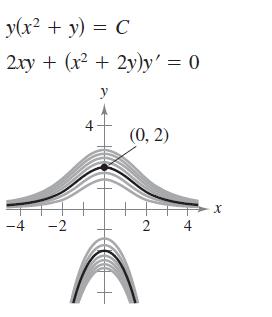
In Exercises some of the curves corresponding to different values of C in the general solution of the differential equation are shown in the graph. Find the particular solution that passes through the point shown on the graph. y(x² + y) = C 2xy + (x² + 2y)y' = 0 y -4 -2 (0, 2) 2 4 X
Showing 6400 - 6500
of 9867
First
58
59
60
61
62
63
64
65
66
67
68
69
70
71
72
Last
Step by Step Answers

 Get 50% OFF
Claim Now
Get 50% OFF
Claim Now