New Semester
Started
Get
50% OFF
Study Help!
--h --m --s
Claim Now
Question Answers
Textbooks
Find textbooks, questions and answers
Oops, something went wrong!
Change your search query and then try again
S
Books
FREE
Study Help
Expert Questions
Accounting
General Management
Mathematics
Finance
Organizational Behaviour
Law
Physics
Operating System
Management Leadership
Sociology
Programming
Marketing
Database
Computer Network
Economics
Textbooks Solutions
Accounting
Managerial Accounting
Management Leadership
Cost Accounting
Statistics
Business Law
Corporate Finance
Finance
Economics
Auditing
Tutors
Online Tutors
Find a Tutor
Hire a Tutor
Become a Tutor
AI Tutor
AI Study Planner
NEW
Sell Books
Search
Search
Sign In
Register
study help
mathematics
calculus early transcendentals
Calculus Early Transcendentals 2nd edition William L. Briggs, Lyle Cochran, Bernard Gillett - Solutions
Eliminate the parameter to find a description of the following circles or circular arcs in terms of x and y. Give the center and radius, and indicate the positive orientation.x = cos t, y = 1 + sin t; 0 ≤ t ≤ 2π
Eliminate the parameter to find a description of the following circles or circular arcs in terms of x and y. Give the center and radius, and indicate the positive orientation.x = 3 cos t, y = 3 sin t; 0 ≤ t ≤ π/2
Eliminate the parameter to find a description of the following circles or circular arcs in terms of x and y. Give the center and radius, and indicate the positive orientation.x = 3 cos t, y = 3 sin t; π ≤ t ≤ 2π
Consider the following parametric equations.a. Eliminate the parameter to obtain an equation in x and y.b. Describe the curve and indicate the positive orientation.x = e2t, y = et + 1; 0 ≤ t ≤ 25
Consider the following parametric equations.a. Eliminate the parameter to obtain an equation in x and y.b. Describe the curve and indicate the positive orientation.x = r - 1, y = r3; -4 ≤ r ≤ 4
Consider the following parametric equations.a. Eliminate the parameter to obtain an equation in x and y.b. Describe the curve and indicate the positive orientation.x = 1 - sin2 s, y = cos s; π ≤ s ≤ 2π
Consider the following parametric equations.a. Eliminate the parameter to obtain an equation in x and y.b. Describe the curve and indicate the positive orientation.x = cos t, y = sin2 t; 0 ≤ t ≤ π
Consider the following parametric equations.a. Eliminate the parameter to obtain an equation in x and y.b. Describe the curve and indicate the positive orientation.x = (t + 1)2, y = t + 2; -10 ≤ t ≤ 10
Consider the following parametric equations.a. Eliminate the parameter to obtain an equation in x and y.b. Describe the curve and indicate the positive orientation.x = √t + 4, y = 3√t; 0 ≤ t ≤ 16
Consider the following parametric equations.a. Make a brief table of values of t, x, and y.b. Plot the (x, y) pairs in the table and the complete parametric curve, indicating the positive orientation (the direction of increasing t). c. Eliminate the parameter to obtain an equation in x and
Consider the following parametric equations.a. Make a brief table of values of t, x, and y.b. Plot the (x, y) pairs in the table and the complete parametric curve, indicating the positive orientation (the direction of increasing t). c. Eliminate the parameter to obtain an equation in x and
Consider the following parametric equations.a. Make a brief table of values of t, x, and y.b. Plot the (x, y) pairs in the table and the complete parametric curve, indicating the positive orientation (the direction of increasing t). c. Eliminate the parameter to obtain an equation in x and
Consider the following parametric equations.a. Make a brief table of values of t, x, and y.b. Plot the (x, y) pairs in the table and the complete parametric curve, indicating the positive orientation (the direction of increasing t). c. Eliminate the parameter to obtain an equation in x and
Explain how to find points on the curve x = f(t), y = g(t) at which there is a horizontal tangent line.
Explain how to find the slope of the line tangent to the curve x = f(t), y = g(t) at the point (f(a), g(a)).
In which direction is the curve x = -2 sin t, y = 2 cos t, for 0 < t < 2π, generated?
Find a function y = f(x) that describes the parametric curve x = -2t + 1, y = 3t2, for -∞ < t < ∞.
Describe the similarities and differences between the parametric equations x = t, y = t2 and x = -t, y = t2, where t ≥ 0 in each case.
Find parametric equations for the parabola y = x2.
Give parametric equations that generate the line with slope -2 passing through (1, 3).
Give parametric equations that describe a full circle of radius R, centered at the origin with clockwise orientation, where the parameter varies over the interval [0, 10].
Given an acceleration vector, initial velocity (u0, v0), and initial position (x0, y0), find the velocity and position vectors, for t ≥ 0. a(t) = (e, 1), (uo. Vo) = (1,0), (xo, Yo) = (0,0)
Given an acceleration vector, initial velocity (u0, v0), and initial position (x0, y0), find the velocity and position vectors, for t ≥ 0. a(t): = (cos t, 2 sin t), (uo, Vo) = (0, 1), (xo. Yo) = (1,0)
Given an acceleration vector, initial velocity (u0, v0), and initial position (x0, y0), find the velocity and position vectors, for t ≥ 0. a(t)= (1, t), (uo, vo) = (2,-1), (xo, yo) = (0,8)
Given an acceleration vector, initial velocity (u0, v0), and initial position (x0, y0), find the velocity and position vectors, for t ≥ 0. a(t) = (0, 10), (uo. Vo). (0,5), (xo, Yo) = (1, -1)
Given an acceleration vector, initial velocity (u0, v0), and initial position (x0, y0), find the velocity and position vectors, for t ≥ 0. a(t) = (1,2), (uo, Vo) = (1, 1), (xo, yo) = (2,3)
Given an acceleration vector, initial velocity (u0, v0), and initial position (x0, y0), find the velocity and position vectors, for t ≥ 0. a(t) = (0, 1), (uo, Vo) = (2,3), (xo, Yo) = (0,0)
Determine whether the following trajectories lie on a circle in R2 or sphere in R3 centered at the origin. If so, find the radius of the circle or sphere and show that the position vector and the velocity vector are everywhere orthogonal.r(t) = (√3 cos t + √2 sin t, -√3 cos t + √2 sin t,
Determine whether the following trajectories lie on a circle in R2 or sphere in R3 centered at the origin. If so, find the radius of the circle or sphere and show that the position vector and the velocity vector are everywhere orthogonal.r(t) = (sin t, cos t, cos t), for 0 ≤ t ≤ 2π
Determine whether the following trajectories lie on a circle in R2 or sphere in R3 centered at the origin. If so, find the radius of the circle or sphere and show that the position vector and the velocity vector are everywhere orthogonal.r(t) = (3 sin t, 5 cos t, 4 sin t), for 0 ≤ t ≤ 2π
Determine whether the following trajectories lie on a circle in R2 or sphere in R3 centered at the origin. If so, find the radius of the circle or sphere and show that the position vector and the velocity vector are everywhere orthogonal.r(t) = (sin t + √3 cos t, √3 sin t - cos t), for 0 ≤ t
Determine whether the following trajectories lie on a circle in R2 or sphere in R3 centered at the origin. If so, find the radius of the circle or sphere and show that the position vector and the velocity vector are everywhere orthogonal.r(t) = (4 sin t, 2 cos t), for 0 ≤ t ≤ 2π
Determine whether the following trajectories lie on a circle in R2 or sphere in R3 centered at the origin. If so, find the radius of the circle or sphere and show that the position vector and the velocity vector are everywhere orthogonal.r(t) = (8 cos 2t, 8 sin 2t), for 0 ≤ t ≤ π
Consider the following position functions r and R for two objects.a. Find the interval [c, d] over which the R trajectory is the same as the r trajectory over [a, b].b. Find the velocity for both objects.c. Graph the speed of the two objects over the intervals [a, b] and [c, d], respectively.r(t) =
Consider the following position functions r and R for two objects.a. Find the interval [c, d] over which the R trajectory is the same as the r trajectory over [a, b].b. Find the velocity for both objects.c. Graph the speed of the two objects over the intervals [a, b] and [c, d], respectively.r(t) =
Consider the following position functions r and R for two objects.a. Find the interval [c, d] over which the R trajectory is the same as the r trajectory over [a, b].b. Find the velocity for both objects.c. Graph the speed of the two objects over the intervals [a, b] and [c, d], respectively.r(t) =
Consider the following position functions r and R for two objects.a. Find the interval [c, d] over which the R trajectory is the same as the r trajectory over [a, b].b. Find the velocity for both objects.c. Graph the speed of the two objects over the intervals [a, b] and [c, d], respectively.r(t) =
Consider the following position functions r and R for two objects.a. Find the interval [c, d] over which the R trajectory is the same as the r trajectory over [a, b].b. Find the velocity for both objects.c. Graph the speed of the two objects over the intervals [a, b] and [c, d], respectively.r(t) =
Consider the following position functions r and R for two objects.a. Find the interval [c, d] over which the R trajectory is the same as the r trajectory over [a, b].b. Find the velocity for both objects.c. Graph the speed of the two objects over the intervals [a, b] and [c, d], respectively.r(t) =
Consider the following position functions.a. Find the velocity and speed of the object.b. Find the acceleration of the object.r(t) = (13 cos 2t, 12 sin 2t, 5 sin 2t), for 0 ≤ t ≤ π
Consider the following position functions.a. Find the velocity and speed of the object.b. Find the acceleration of the object.r(t) = (1, t2, e-t), for t ≥ 0
Consider the following position functions.a. Find the velocity and speed of the object.b. Find the acceleration of the object.r(t) = (3 sin t, 5 cos t, 4 sin t), for 0 ≤ t ≤ 2π
Consider the following position functions.a. Find the velocity and speed of the object.b. Find the acceleration of the object.r(t) = (3 + t, 2 - 4t, 1 + 6t), for t ≥ 0
Consider the following position functions.a. Find the velocity and speed of the object.b. Find the acceleration of the object.r(t) = (2e2t + 1, e2t - 1, 2e2t - 10), for t ≥ 0
Consider the following position functions.a. Find the velocity and speed of the object.b. Find the acceleration of the object. 1 t? + 3, t² + 10, r(1) for t > 0
Consider the following position functions.a. Find the velocity and speed of the object.b. Find the acceleration of the object.r(t) = (3 cos t, 4 sin t), for 0 ≤ t ≤ 2π
Consider the following position functions.a. Find the velocity and speed of the object.b. Find the acceleration of the object.r(t) = (8 sin t, 8 cos t), for 0 ≤ t ≤ 2π
Consider the following position functions.a. Find the velocity and speed of the object.b. Find the acceleration of the object.r(t) = (1 - t2, 3 + 2t3), for t ≥ 0
Consider the following position functions.a. Find the velocity and speed of the object.b. Find the acceleration of the object.r(t) = (2 + 2t, 1 - 4t), for t ≥ 0
Consider the following position functions.a. Find the velocity and speed of the object.b. Find the acceleration of the object. / 5 t2 + 3, 612 + 10 r(1) for t > 0 ||
Consider the following position functions.a. Find the velocity and speed of the object.b. Find the acceleration of the object.r(t) = (3t2 + 1, 4t2 + 3), for t ≥ 0
Given the velocity of an object and its initial position, how do you find the position of the object, for t ≥ 0?
Given the acceleration of an object and its initial velocity, how do you find the velocity of the object, for t ≥ 0?
Write Newton’s Second Law of Motion for three-dimensional motion with only the gravitational force (acting in the z-direction).
Write Newton’s Second Law of Motion in vector form.
What is the relationship between the position and velocity vectors for motion on a circle?
Given the position function r of a moving object, explain how to find the velocity, speed, and acceleration of the object.
Prove that r describes a curve that lies on the surface of a sphere centered at the origin (x2 + y2 + z2 = a2) with a ≥ 0) if and only if r and r' are orthogonal at all points of the curve.
a. Graph the curve r(t) = (t3, t3). Show that r'(0) = 0 and the curve does not have a cusp at t = 0. Explain.b. Graph the curve r(t) = (t3, t2). Show that r'(0) = 0 and the curve has a cusp at t = 0. Explain.c. The functions r(t) = (t, t2) and p(t) = (t2, t4) both satisfy y = x2. Explain how the
Prove thatThere are two ways to proceed: Either express u and v in terms of their three components or use the definition of the derivative. (u(t) X v(t)) = u'(t) × v(t) + u(t) × v'(t). dt
By expressing u in terms of its components, prove that (f(t)u(t)) = f'(1)u(t) + f(t)u'(t). dt
By expressing u and v in terms of their components, prove that :(u(t) + v(t)) = u'(t) + v'(t). dt
a. If r(t) = (at, bt, ct) with (a, b, c) ≠ (0, 0, 0), show that the angle between r and r' is constant for all t > 0.b. If r(t) = (x0 + at, y0 + bt, z0 + ct), where x0, y0, and z0 are not all zero, show that the angle between r and r' varies with t.c. Explain the results of parts (a) and (b)
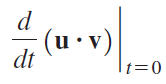
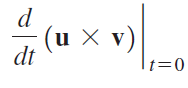
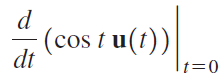
Suppose u and v are differentiable functions at t = 0 with u(0) = (0, 1, 1), u'(0) = (0, 7, 1), v(0) = (0, 1, 1), and v'(0) = (1, 1, 2). Evaluate the following expressions.a.b.c. (u • v) dt t=0 (u X v) dt t=0
Give two families of curves in R3 for which r and r' are parallel for all t in the domain.
Consider the ellipse r(t) = (2 cos t, 8 sin t, 0), for 0 ≤ t ≤ 2π. Find all points on the ellipse at which r and r' are orthogonal.
Consider the helix r(t) = (cos t, sin t, t), for -∞ < 6 t < ∞. Find all points on the helix at which r and r' are orthogonal.
Consider the curve r(t) = (√t, 1, t), for t > 0. Find all points on the curve at which r and r' are orthogonal.
Consider the parabola r(t) = (at2 + 1, t), for -∞ < t < ∞, where a is a positive real number. Find all points on the parabola at which r and r' are orthogonal.
Consider the circle r(t) = (a cos t, a sin t), for 0 ≤ t ≤ 2π, where a is a positive real number. Compute r' and show that it is orthogonal to r for all t.
Let u(t) = (1, t, t2), v(t) = (t2, -2t, 1), and g(t) = 2√t. Compute the derivatives of the following functions.u(t) × v(t)
Let u(t) = (1, t, t2), v(t) = (t2, -2t, 1), and g(t) = 2√t. Compute the derivatives of the following functions.u(t) • v(t)
Let u(t) = (1, t, t2), v(t) = (t2, -2t, 1), and g(t) = 2√t. Compute the derivatives of the following functions.v(g(t))
Let u(t) = (1, t, t2), v(t) = (t2, -2t, 1), and g(t) = 2√t. Compute the derivatives of the following functions.g(t)v(t)
Let u(t) = (1, t, t2), v(t) = (t2, -2t, 1), and g(t) = 2√t. Compute the derivatives of the following functions.v(et)
Let u(t) = (1, t, t2), v(t) = (t2, -2t, 1), and g(t) = 2√t. Compute the derivatives of the following functions.u(t3)
Suppose the vector-valued function r(t) = (f(t), g(t), h(t)) is smooth on an interval containing the point t0. The line tangent to r(t) at t = t0 is the line parallel to the tangent vector r'(t0) that passes through (f(t0), g(t0), h(t0)). For each of the following functions, find an equation of the
Suppose the vector-valued function r(t) = (f(t), g(t), h(t)) is smooth on an interval containing the point t0. The line tangent to r(t) at t = t0 is the line parallel to the tangent vector r'(t0) that passes through (f(t0), g(t0), h(t0)). For each of the following functions, find an equation of the
Suppose the vector-valued function r(t) = (f(t), g(t), h(t)) is smooth on an interval containing the point t0. The line tangent to r(t) at t = t0 is the line parallel to the tangent vector r'(t0) that passes through (f(t0), g(t0), h(t0)). For each of the following functions, find an equation of the
Suppose the vector-valued function r(t) = (f(t), g(t), h(t)) is smooth on an interval containing the point t0. The line tangent to r(t) at t = t0 is the line parallel to the tangent vector r'(t0) that passes through (f(t0), g(t0), h(t0)). For each of the following functions, find an equation of the
Determine whether the following statements are true and give an explanation or counterexample. a. The vectors r(t) and r'(t) are parallel for all values of t in thedomain.b. The curve described by the function r(t) = (t, t2 - 2t, cos πt)is smooth, for -∞ < t < ∞.c. If f, g, and h
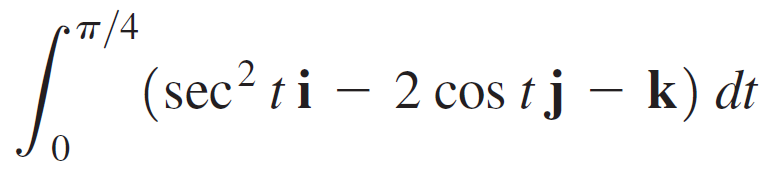
Evaluate the following definite integrals. 7/4 | (sec? ti – 2 cos tj – k) dt
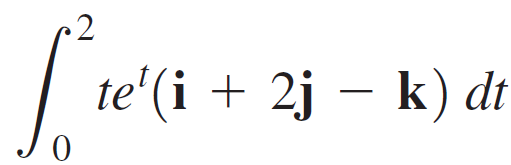
Evaluate the following definite integrals. | te'(i + 2j – k) dt
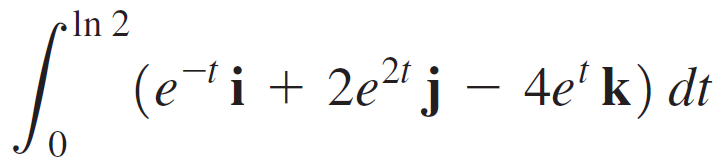
Evaluate the following definite integrals. In 2 (ei+ 2e²' j – 4e' k) dt
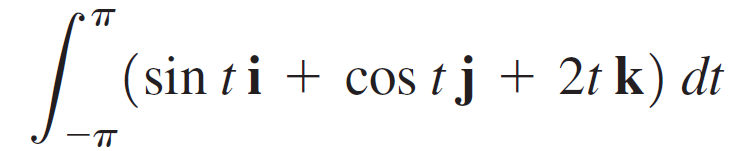
Evaluate the following definite integrals. TT (sin ti + cos t j + 2t k) dt
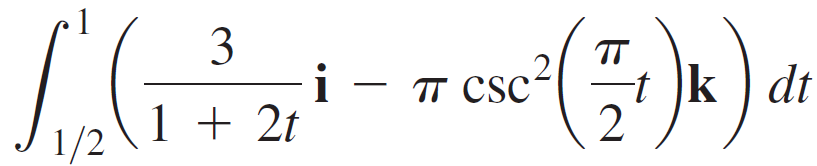
Evaluate the following definite integrals. TT і — псsc -t k ) dt 1 + 2t 1/2 (1
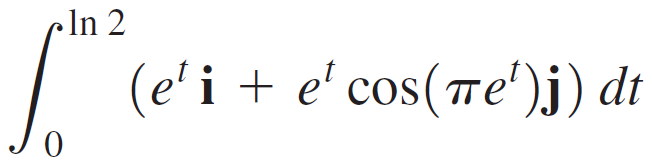
Evaluate the following definite integrals. cln 2 (e'i + e' cos(re')j) dt
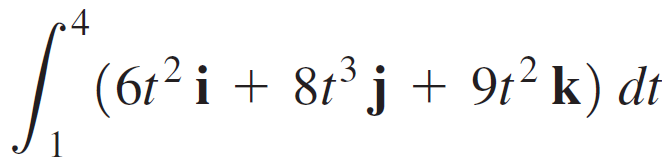
Evaluate the following definite integrals. .4 (61² i + 81° j + 9t² k) dt
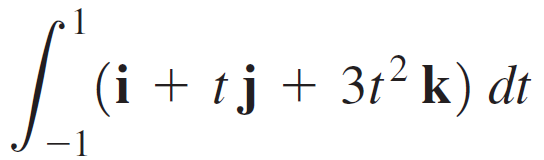
Evaluate the following definite integrals. (i + tj + 3t² k) dt -1
Find the function r that satisfies the given conditions. 3 2t k; r(0) = i + te-*j – 3k r'(t) Vi? + 4 t2 + 1
Find the function r that satisfies the given conditions.r'(t) = (e2t, 1 - 2e-t, 1 - 2et); r(0) = (1, 1, 1)
Find the function r that satisfies the given conditions.r'(t) = (√t, cos πt, 4/t); r(1) = (2, 3, 4)
Find the function r that satisfies the given conditions.r'(t) = (1, 2t, 3t2); r(1) = (4, 3, -5)
Find the function r that satisfies the given conditions.r'(t) = (0, 2, 2t); r(1) = (4, 3, -5)
Find the function r that satisfies the given conditions.r'(t) = (et, sin t, sec2 t); r(0) = (2, 2, 2)
Compute the indefinite integral of the following functions. 1 j + In t k r(t) = 2'i + 1 + 2t
Compute the indefinite integral of the following functions. 1 r(1) = ei + e'i + V2t 1 + t²
Compute the indefinite integral of the following functions. 2t t² j Vt? + 4 r(t) = te' i + t sin
Compute the indefinite integral of the following functions.r(t) = (2 cos t, 2 sin 3t, 4 cos 8t)
Compute the indefinite integral of the following functions.r(t) = (5t-4 - t2, t6 - 4t3, 2/t)
Showing 300 - 400
of 6775
1
2
3
4
5
6
7
8
9
10
11
12
13
14
15
Last
Step by Step Answers

 Get 50% OFF
Claim Now
Get 50% OFF
Claim Now