New Semester
Started
Get
50% OFF
Study Help!
--h --m --s
Claim Now
Question Answers
Textbooks
Find textbooks, questions and answers
Oops, something went wrong!
Change your search query and then try again
S
Books
FREE
Study Help
Expert Questions
Accounting
General Management
Mathematics
Finance
Organizational Behaviour
Law
Physics
Operating System
Management Leadership
Sociology
Programming
Marketing
Database
Computer Network
Economics
Textbooks Solutions
Accounting
Managerial Accounting
Management Leadership
Cost Accounting
Statistics
Business Law
Corporate Finance
Finance
Economics
Auditing
Tutors
Online Tutors
Find a Tutor
Hire a Tutor
Become a Tutor
AI Tutor
AI Study Planner
NEW
Sell Books
Search
Search
Sign In
Register
study help
mathematics
calculus early transcendentals
Calculus Early Transcendentals 2nd edition William L. Briggs, Lyle Cochran, Bernard Gillett - Solutions
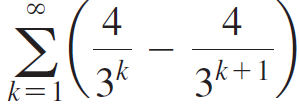
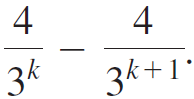
Evaluate the series two ways.a. Use a telescoping series argument.b. Use a geometric series argument after first simplifying 4 3k 3k+1 |k=1 4 3k 3k+1°
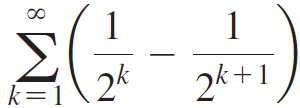
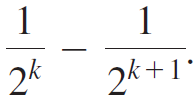
Evaluate the series two ways.a. Use a telescoping series argument.b. Use a geometric series argument after first simplifying 1 2k+1 2k k=1 2k 2k+1°
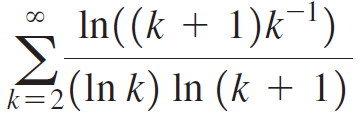
Evaluate each series or state that it diverges. In((k + 1)k¯|) =2(In k) In (k + 1) |k=2 8.
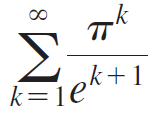
Evaluate each series or state that it diverges. _k TT k+1 k=1e iek 8.
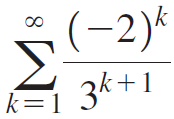
Evaluate each series or state that it diverges. (-2)* 3k+1 k=1 8.
Evaluate each series or state that it diverges. (sin-'(1/k) – sin-(1/(k + 1)), k=1
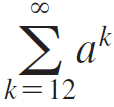
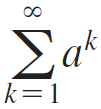
Determine whether the following statements are true and give an explanation or counterexample.a. is a convergent geometric series.b. If a is a real number andconverges, thenconverges.c. If the series converges and |a| < |b|, then the series converges.d. Viewed as a function of r, the series 1 +
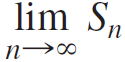
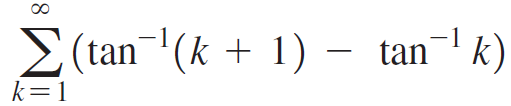
For the following telescoping series, find a formula for the nth term of the sequence of partial sums {Sn}. Then evaluate to obtain the value of the series or state that the series diverges. lim S, п 00 E(tan (k + 1) – tan k) -1 k=1
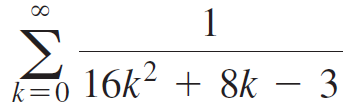
For the following telescoping series, find a formula for the nth term of the sequence of partial sums {Sn}. Then evaluate to obtain the value of the series or state that the series diverges. lim S, п Σ k=o + 8k – 3 16k²
For the following telescoping series, find a formula for the nth term of the sequence of partial sums {Sn}. Then evaluate to obtain the value of the series or state that the series diverges. lim S, п (k + 1)T sin Σ sin 2k – 1 k=0 2k + 1
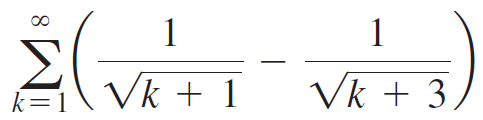
For the following telescoping series, find a formula for the nth term of the sequence of partial sums {Sn}. Then evaluate to obtain the value of the series or state that the series diverges. lim S, п k=1 Vk + 1 Vk + 3
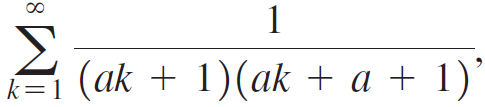
For the following telescoping series, find a formula for the nth term of the sequence of partial sums {Sn}. Then evaluate to obtain the value of the series or state that the series diverges.where a is a positive integer. lim S, п 1 (ak + 1)(ak + a + 1)’ k=1 18
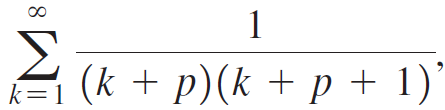
For the following telescoping series, find a formula for the nth term of the sequence of partial sums {Sn}. Then evaluate to obtain the value of the series or state that the series diverges.where p is a positive integer. lim S, п Σ 2 (k + p)(k +p + 1) k=1 8.
Consider positive real numbers x and y. Notice that 43 < 34, while 32 > 23, and 42 = 24. Describe the regions in the first quadrant of the xy-plane in which xy > yx and xy < yx. Find a parametric description of the curve that separates the two regions.
Prove that the equationsx = a cos t + b sin t, y = c cos t + d sin t,where a, b, c, and d are real numbers, describe a circle of radius R provided a2 + c2 = b2 + d2 = R2 and ab + cd = 0.
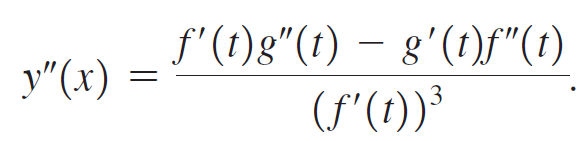
Assume a curve is given by the parametric equations x = f(t) and y = g(t), where f and g are twice differentiable. Use the Chain Rule to show that
Explain and carry out a method for graphing the curve x = 1 + cos2 y - sin2 y using parametric equations and a graphing utility.
A projectile launched from the ground with an initial speed of 20 m/s and a launch angle u follows a trajectory approximated byx = (20 cos θ)t, y = -4.9t2 + (20 sin θ)t,where x and y are the horizontal and vertical positions of the projectile relative to the launch point (0, 0).a. Graph the
A plane traveling horizontally at 100 m/s over flat ground at an elevation of 4000 m must drop an emergency packet on a target on the ground. The trajectory of the packet is given byx = 100t, y = -4.9t2 + 4000, for t ≥ 0,where the origin is the point on the ground directly beneath the plane at
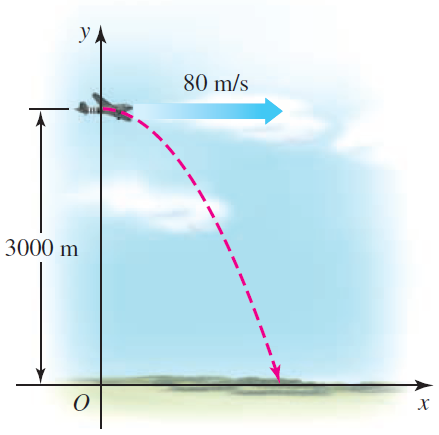
A plane traveling horizontally at 80 m/s over flat ground at an elevation of 3000 m releases an emergency packet. The trajectory of the packet is given byx = 80t, y = -4.9t2 + 3000, for t ≥ 0,where the origin is the point on the ground directly beneath the plane at the moment of the release.
Use the equations in Exercise 102 to plot the paths of the following moons in our solar system.a. Each year our moon revolves around Earth about n = 13.4 times, and the distance from the Sun to Earth is approximately a = 389.2 times the distance from Earth to our moon.b. Plot a graph of the path of
An idealized model of the path of a moon (relative to the Sun) moving with constant speed in a circular orbit around a planet, where the planet in turn revolves around the Sun, is given by the parametric equationsx(θ) = a cos θ + cos nθ, y(θ) = a sin θ + sin nθ. The distance from the
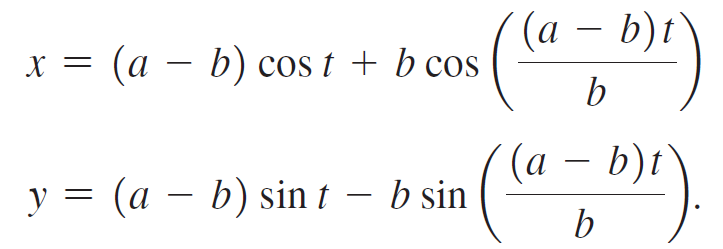
A general hypocycloid is described by the equationsUse a graphing utility to explore the dependence of the curve on the parameters a and b. (a – b)t (a – b) cos t + b cos (a – b)t y = (a – b) sin t – b sin
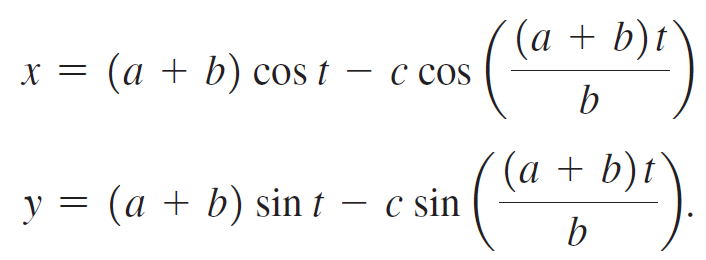
An epitrochoid is the path of a point on a circle of radius b as it rolls on the outside of a circle of radius a. It is described by the equationsUse a graphing utility to explore the dependence of the curve on the parameters a, b, and c. (а + b)г ("D") (a + b) cost – c cos х %— (a + b)t y =
A trochoid is the path followed by a point b units from the center of a wheel of radius a as the wheel rolls along the x-axis. Its parametric description is x = at - b sin t, y = a - b cos t. Choose specific values of a and b, and use a graphing utility to plot different trochoids. In particular,
A family of curves called hyperbolas (discussed in Section 10.4) has the parametric equations x = a tan t, y = b sec t, for -π < t < π and |t| ≠ π/2, where a and b are nonzero real numbers. Graph the hyperbola with a = b = 1. Indicate clearly the direction in which the curve is generated
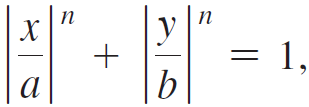
The Lamé curve described by where a, b, and n are positive real numbers, is a generalization of an ellipse.a. Express this equation in parametric form (four pairs of equations are needed).b. Graph the curve for a = 4 and b = 2, for various values of n. c. Describe how the curves change as n
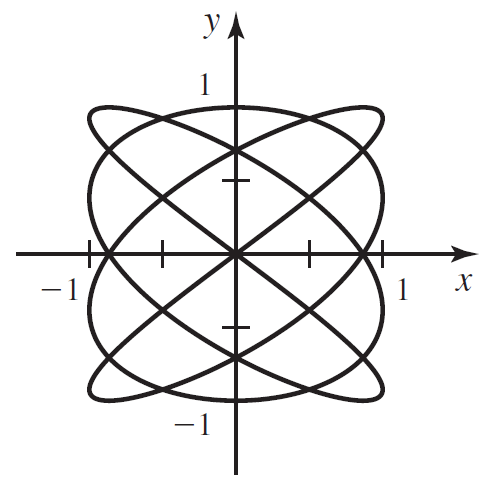
Consider the following Lissajous curves. Graph the curve and estimate the coordinates of the points on the curve at which there is (a) A horizontal tangent line.(b) A vertical tangent line.x = sin 4t, y = sin 3t; 0 ≤ t ≤ 2π 1 х -1 -1
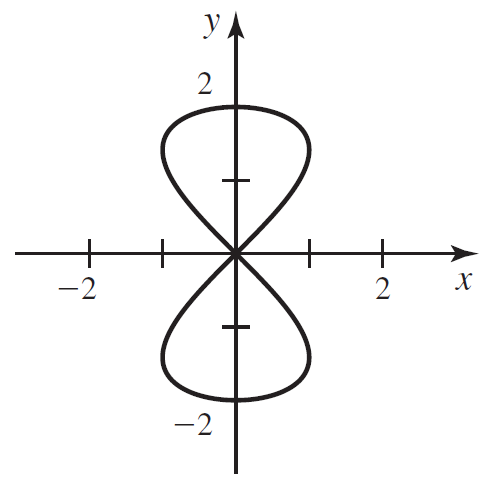
Consider the following Lissajous curves. Graph the curve and estimate the coordinates of the points on the curve at which there is (a) A horizontal tangent line.(b) A vertical tangent line.x = sin 2t, y = 2 sin t; 0 ≤ t ≤ 2π х -2 -2
Find real numbers a and b such that equations A and B describe the same curve.A: x = t + t3, y = 3 + t2; -2 ≤ t ≤ 2B: x = t1/3 + t, y = 3 + t2/3; a ≤ t ≤ b
Find real numbers a and b such that equations A and B describe the same curve.A: x = 10 sin t, y = 10 cos t; 0 ≤ t ≤ 2πB: x = 10 sin 3t, y = 10 cos 3t; a ≤ t ≤ b
Find all the points at which the following curves have the given slope.x = 2 + √t, y = 2 - 4t; slope = -8
Find all the points at which the following curves have the given slope.x = t + 1/t, y = t - 1/t; slope = 1
Find all the points at which the following curves have the given slope.x = 2 cos t, y = 8 sin t; slope = -1
Find all the points at which the following curves have the given slope.x = 4 cos t, y = 4 sin t; slope = 1/2
Eliminate the parameter to express the following parametric equations as a single equation in x and y.x = a sinn t, y = b cosn t, where a and b are real numbers and n is a positive integer
Eliminate the parameter to express the following parametric equations as a single equation in x and y.x = tan t, y = sec2 t - 1
Eliminate the parameter to express the following parametric equations as a single equation in x and y.x = √t + 1, y = 1/t + 1
Eliminate the parameter to express the following parametric equations as a single equation in x and y.x = t, y = √4 - t2
Eliminate the parameter to express the following parametric equations as a single equation in x and y.x = sin 8t, y = 2 cos 8t
Eliminate the parameter to express the following parametric equations as a single equation in x and y.x = 2 sin 8t, y = 2 cos 8t
Which of the following parametric equations describe the same curve?a. x = 2t2, y = 4 + t; -4 ≤ t ≤ 4.b. x = 2t4, y = 4 + t2; -2 ≤ t ≤ 2.c. x = 2t2/3, y = 4 + t1/3; -64 ≤ t ≤ 64.
Consider the following pairs of lines. Determine whether the lines are parallel or intersecting. If the lines intersect, then determine the point of intersection.a. x = 1 + s, y = 2s and x = 1 + 2t, y = 3t.b. x = 2 + 5s, y = 1 + s and x = 4 + 10t, y = 3 + 2t.c. x = 1 + 3s, y = 4 + 2s and x = 4 -
Find parametric equations (not unique) of the following ellipses. Graph the ellipse and find a description in terms of x and y.An ellipse centered at (0, -4) with major and minor axes of lengths 10 and 3, parallel to the x- and y-axes, respectively, generated clockwise.
Find parametric equations (not unique) of the following ellipses. Graph the ellipse and find a description in terms of x and y.An ellipse centered at (-2, -3) with major and minor axes of lengths 30 and 20, parallel to the x- and y-axes, respectively, generated counterclockwise.
Find parametric equations (not unique) of the following ellipses. Graph the ellipse and find a description in terms of x and y.An ellipse centered at the origin with major and minor axes of lengths 12 and 2, on the x- and y-axes, respectively, generated clockwise.
Find parametric equations (not unique) of the following ellipses. Graph the ellipse and find a description in terms of x and y.An ellipse centered at the origin with major axis of length 6 on the x-axis and minor axis of length 3 on the y-axis, generated counterclockwise.
An ellipse is generated by the parametric equations x = a cos t, y = b sin t. If 0 < a < b, then the long axis (or major axis) lies on the y-axis and the short axis (or minor axis) lies on the x-axis. If 0 < b < a, the axes are reversed. The lengths of the axes in the x- and
An ellipse is generated by the parametric equations x = a cos t, y = b sin t. If 0 < a < b, then the long axis (or major axis) lies on the y-axis and the short axis (or minor axis) lies on the x-axis. If 0 < b < a, the axes are reversed. The lengths of the axes in the x- and
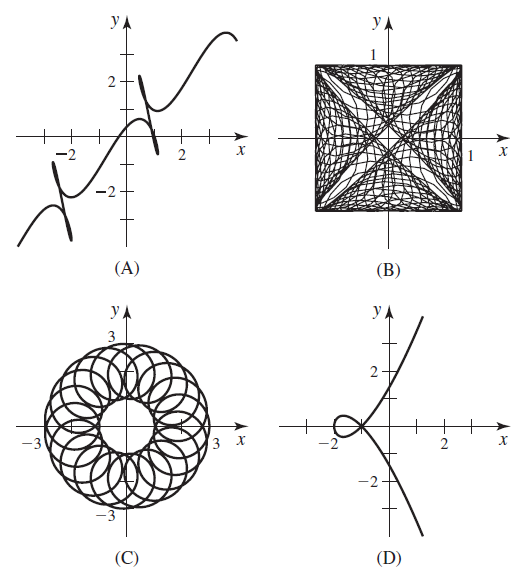
Match equations a–d with graphs A–D. Explain your reasoning.a. x = t2 - 2, y = t3 - tb. x = cos (t + sin 50t), y = sin (t + cos 50t)c. x = t + cos 2t, y = t - sin 4td. x = 2 cos t + cos 20t, y = 2 sin t + sin 20t УА УА х х (A) (B) y A УА 3 (3 х х -3 2 -2 (C) (D) 2.
Find parametric equations for the following curves. Include an interval for the parameter values. Answers are not unique.The upper half of the parabola x = y2, originating at (0, 0).
Find parametric equations for the following curves. Include an interval for the parameter values. Answers are not unique.The lower half of the circle centered at (-2, 2) with radius 6, oriented in the counterclockwise direction.
Find parametric equations for the following curves. Include an interval for the parameter values. Answers are not unique.The line that passes through the points (1, 1) and (3, 5), oriented in the direction of increasing x.
Find parametric equations for the following curves. Include an interval for the parameter values. Answers are not unique.The left half of the parabola y = x2 + 1, originating at (0, 1).
Find an equation of the line tangent to the curve at the point corresponding to the given value of t.x = cos t + t sin t, y = sin t - t cos t; t = π/4
Find an equation of the line tangent to the curve at the point corresponding to the given value of t.x = et, y = ln (t + 1); t = 0
Find an equation of the line tangent to the curve at the point corresponding to the given value of t.x = t2 - 1, y = t3 + t; t = 2
Find an equation of the line tangent to the curve at the point corresponding to the given value of t.x = sin t, y = cos t; t = π/4
Determine whether the following statements are true and give an explanation or counterexample.a. The equations x = -cos t, y = -sin t, for 0 ≤ t ≤ 2π, generate a circle in the clockwise direction.b. An object following the parametric curve x = 2 cos 2πt, y = 2 sin 2πt circles the origin once
Consider the following parametric curves.a. Determine dy/dx in terms of t and evaluate it at the given value of t.b. Make a sketch of the curve showing the tangent line at the point corresponding to the given value of t.x = √t, y = 2t; t = 4
Consider the following parametric curves.a. Determine dy/dx in terms of t and evaluate it at the given value of t.b. Make a sketch of the curve showing the tangent line at the point corresponding to the given value of t.x = t + 1/t, y = t - 1/t; t = 1
Consider the following parametric curves.a. Determine dy/dx in terms of t and evaluate it at the given value of t.b. Make a sketch of the curve showing the tangent line at the point corresponding to the given value of t.x = 2t, y = t3; t = -1
Consider the following parametric curves.a. Determine dy/dx in terms of t and evaluate it at the given value of t.b. Make a sketch of the curve showing the tangent line at the point corresponding to the given value of t.x = cos t, y = 8 sin t; t = π/2
Consider the following parametric curves.a. Determine dy/dx in terms of t and evaluate it at the given value of t.b. Make a sketch of the curve showing the tangent line at the point corresponding to the given value of t.x = 3 sin t, y = 3 cos t; t = π/2
Consider the following parametric curves.a. Determine dy/dx in terms of t and evaluate it at the given value of t.b. Make a sketch of the curve showing the tangent line at the point corresponding to the given value of t.x = 2 + 4t, y = 4 - 8t; t = 2
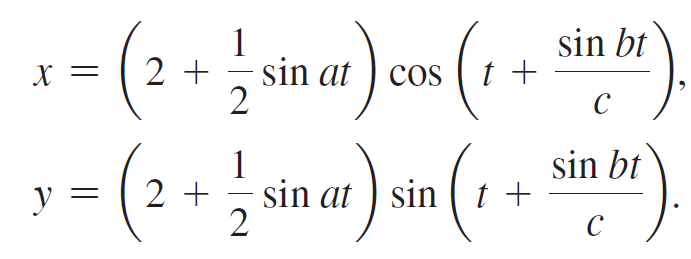
Consider the family of curvesPlot the curve for the given values of a, b, and c with 0 ≤ t ≤ 2π.a = 7, b = 4, c = 1. 1 sin at ) cos ( t- sin bt х — sin bt sin at ) sin ( t + 2 +
Consider the family of curvesPlot the curve for the given values of a, b, and c with 0 ≤ t ≤ 2π.a = 18, b = 18, c = 7. 1 sin at ) cos ( t- sin bt х — sin bt sin at ) sin ( t + 2 +
Consider the family of curvesPlot the curve for the given values of a, b, and c with 0 ≤ t ≤ 2π.a = 6, b = 12, c = 3. 1 sin at ) cos ( t- sin bt х — sin bt sin at ) sin ( t + 2 +
Consider the family of curvesPlot the curve for the given values of a, b, and c with 0 ≤ t ≤ 2π.a = b = 5, c = 2. 1 sin at ) cos ( t- sin bt х — sin bt sin at ) sin ( t + 2 +
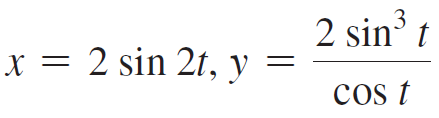
Use a graphing utility to graph the following curves. Be sure to choose an interval for the parameter that generates all features of interest. 2 sin' t 2 sin 2t, y |x = cos t cos ||
Use a graphing utility to graph the following curves. Be sure to choose an interval for the parameter that generates all features of interest. a² – b² cos a² – b² х — sin' t; a = 4 and b = 3 t, y
Use a graphing utility to graph the following curves. Be sure to choose an interval for the parameter that generates all features of interest.x = cos t + t sin t, y = sin t - t cos t
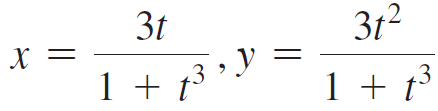
Use a graphing utility to graph the following curves. Be sure to choose an interval for the parameter that generates all features of interest. 312 1 + t° 3t 3 » Y = .3
Use a graphing utility to graph the following curves. Be sure to choose an interval for the parameter that generates all features of interest.x = 2 cot t, y = 1 - cos 2t
Use a graphing utility to graph the following curves. Be sure to choose an interval for the parameter that generates all features of interest.x = t cos t, y = t sin t; t ≥ 0
Give a set of parametric equations that describes the following curves. Graph the curve and indicate the positive orientation. If not given, specify the interval over which the parameter varies.The path consisting of the line segment from (-4, 4) to (0, 8), followed by the segment of the parabola y
Give a set of parametric equations that describes the following curves. Graph the curve and indicate the positive orientation. If not given, specify the interval over which the parameter varies.The piecewise linear path from P(-2, 3) to Q(2, -3) to R(3, 5), using parameter values 0 ≤ t ≤ 2.
Give a set of parametric equations that describes the following curves. Graph the curve and indicate the positive orientation. If not given, specify the interval over which the parameter varies.The complete curve x = y3 - 3y.
Give a set of parametric equations that describes the following curves. Graph the curve and indicate the positive orientation. If not given, specify the interval over which the parameter varies.The segment of the parabola y = 2x2 - 4, where -1 ≤ x ≤ 5.
Find a parametric description of the line segment from the point P to the point Q. Solutions are not unique.P(8, 2), Q(-2, -3)
Find a parametric description of the line segment from the point P to the point Q. Solutions are not unique.P(-1, -3), Q(6, -16)
Find a parametric description of the line segment from the point P to the point Q. Solutions are not unique.P(1, 3), Q(-2, 6)
Find a parametric description of the line segment from the point P to the point Q. Solutions are not unique.P(0, 0), Q(2, 8)
Find the slope of each line and a point on the line. Then graph the line.x = 1 + 2t/3, y = -4 - 5t/2
Find the slope of each line and a point on the line. Then graph the line.x = 8 + 2t, y = 1
Find the slope of each line and a point on the line. Then graph the line.x = 4 - 3t, y = -2 + 6t
Find the slope of each line and a point on the line. Then graph the line.x = 3 + t, y = 1 - t
Find parametric equations that describe the circular path of the following objects. For Exercises 33–35, assume (x, y) denotes the position of the object relative to the origin at the center of the circle. Use the units of time specified in the problem. There is more than one way to describe any
Find parametric equations that describe the circular path of the following objects. For Exercises 33–35, assume (x, y) denotes the position of the object relative to the origin at the center of the circle. Use the units of time specified in the problem. There is more than one way to describe any
Find parametric equations that describe the circular path of the following objects. For Exercises 33–35, assume (x, y) denotes the position of the object relative to the origin at the center of the circle. Use the units of time specified in the problem. There is more than one way to describe any
Find parametric equations that describe the circular path of the following objects. For Exercises 33–35, assume (x, y) denotes the position of the object relative to the origin at the center of the circle. Use the units of time specified in the problem. There is more than one way to describe any
Find parametric equations for the following circles and give an interval for the parameter values. Graph the circle and find a description in terms of x and y. Answers are not unique.A circle centered at (2, -4) with radius 3/2, generated counterclockwise with initial point (7/2, -4)
Find parametric equations for the following circles and give an interval for the parameter values. Graph the circle and find a description in terms of x and y. Answers are not unique.A circle centered at (-2, -3) with radius 8, generated clockwise
Find parametric equations for the following circles and give an interval for the parameter values. Graph the circle and find a description in terms of x and y. Answers are not unique.A circle centered at (2, 0) with radius 3, generated clockwise
Find parametric equations for the following circles and give an interval for the parameter values. Graph the circle and find a description in terms of x and y. Answers are not unique.A circle centered at (2, 3) with radius 1, generated counterclockwise
Find parametric equations for the following circles and give an interval for the parameter values. Graph the circle and find a description in terms of x and y. Answers are not unique.A circle centered at the origin with radius 12, generated clockwise with initial point (0, 12)
Find parametric equations for the following circles and give an interval for the parameter values. Graph the circle and find a description in terms of x and y. Answers are not unique.A circle centered at the origin with radius 4, generated counterclockwise.
Eliminate the parameter to find a description of the following circles or circular arcs in terms of x and y. Give the center and radius, and indicate the positive orientation.x = 1 - 3 sin 4πt, y = 2 + 3 cos 4πt; 0 ≤ t ≤ 1/2
Eliminate the parameter to find a description of the following circles or circular arcs in terms of x and y. Give the center and radius, and indicate the positive orientation.x = -7 cos 2t, y = -7 sin 2t; 0 ≤ t ≤ π
Eliminate the parameter to find a description of the following circles or circular arcs in terms of x and y. Give the center and radius, and indicate the positive orientation.x = 2 sin t - 3, y = 2 cos t + 5; 0 ≤ t ≤ 2π
Showing 200 - 300
of 6775
1
2
3
4
5
6
7
8
9
10
11
12
13
14
15
Last
Step by Step Answers

 Get 50% OFF
Claim Now
Get 50% OFF
Claim Now