New Semester
Started
Get
50% OFF
Study Help!
--h --m --s
Claim Now
Question Answers
Textbooks
Find textbooks, questions and answers
Oops, something went wrong!
Change your search query and then try again
S
Books
FREE
Study Help
Expert Questions
Accounting
General Management
Mathematics
Finance
Organizational Behaviour
Law
Physics
Operating System
Management Leadership
Sociology
Programming
Marketing
Database
Computer Network
Economics
Textbooks Solutions
Accounting
Managerial Accounting
Management Leadership
Cost Accounting
Statistics
Business Law
Corporate Finance
Finance
Economics
Auditing
Tutors
Online Tutors
Find a Tutor
Hire a Tutor
Become a Tutor
AI Tutor
AI Study Planner
NEW
Sell Books
Search
Search
Sign In
Register
study help
mathematics
college algebra graphs and models
College Algebra With Modeling And Visualization 6th Edition Gary Rockswold - Solutions
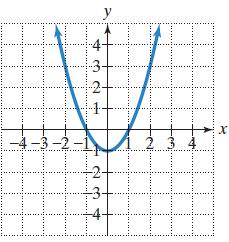
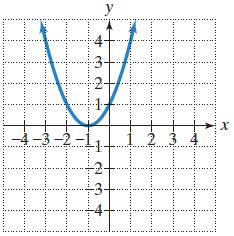
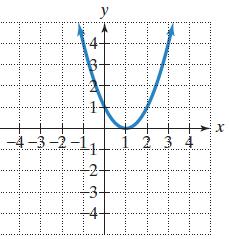
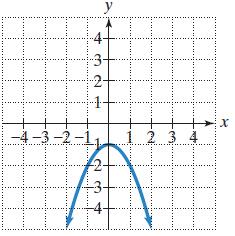
In Exercises 5–8, the graph of a quadratic function is given. Write the function’s equation, selecting from the following options. f(x) = x² + 2x + 1 2 h(x) = x² - 1 g(x) = x² - 2x + 1 j(x) = -x² - 1
Fill in each blank so that the resulting statement is true.The behavior of the graph of a polynomial function to the far left or the far right is called its_______ behavior, which depends upon the_________ term.
In Exercises 1–8, use the Rational Zero Theorem to list all possible rational zeros for each given function. f(x) = 4x4 x³ + 5x² - 2x - 6
In Exercises 1–16, divide using long division. State the quotient, q(x), and the remainder, r(x). (6x³ + 7x² + 12x - 5) = (3x - 1)
In Exercises 5–13, find all zeros of each polynomial function. Then graph the function.f(x) = (x - 2)2(x + 1)3
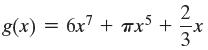
In Exercises 1–10, determine which functions are polynomial functions. For those that are, identify the degree. g(x) = 6x7 + mx5 + 213
Fill in each blank so that the resulting statement is true.y varies inversely as x can be modeled by the equation_______.
The function f(x) = -x2 + 46x - 360 models the daily profit, f(x), in hundreds of dollars, for a company that manufactures x computers daily. How many computers should be manufactured each day to maximize profit? What is the maximum daily profit?
Fill in each blank so that the resulting statement is true.True or false: The graph of f(x) = (x - 2)2 + 1 opens upward._______
In Exercises 1–4, use the vertex and intercepts to sketch the graph of each quadratic function. Give the equation for the parabola’s axis of symmetry. Use the graph to determine the function’s domain and range.f(x) = 2x2 - 4x - 6
Solve each polynomial inequality in Exercises 1–42 and graph the solution set on a real number line. Express each solution set in interval notation. x² - 4x + 3
Fill in each blank so that the resulting statement is true.If a polynomial equation is of degree n, then counting multiple roots separately, the equation has________ roots.
Use the four-step procedure for solving variation problems given on page 445 to solve Exercises 1–10.y varies inversely as x. y = 6 when x = 3. Find y when x = 9.
Fill in each blank so that the resulting statement is true.If the graph of a function f increases or decreases without bound as x approaches a, then the line x = a is a/an_______ of the graph of f. The equation of such a line for the graph of f(x) = 2/x + 5 is__________ .
In Exercises 5–8, the graph of a quadratic function is given. Write the function’s equation, selecting from the following options. f(x) = x² + 2x + 1 2 h(x) = x² - 1 g(x) = x² - 2x + 1 j(x) = -x² - 1
In Exercises 1–16, divide using long division. State the quotient, q(x), and the remainder, r(x). (6x³ + 17x² + 27x + 20) ÷ (3x + 4)
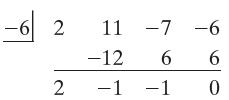
Fill in each blank so that the resulting statement is true.Consider solving 2x3 + 11x2 - 7x - 6 = 0. The synthetic division shown below indicates that______ is a root.Based on the synthetic division, 2x3 + 11x2 - 7x - 6 = 0 can be written in factored form as________ . -6 2 2 11 -7 -7
Use the four-step procedure for solving variation problems given on page 445 to solve Exercises 1–10.y varies directly as x and inversely as the square of z. y = 20. when x = 50 and z = 5. Find y when x = 3 and z = 6.
Fill in each blank so that the resulting statement is true.True or false: A test value for the rightmost interval on the number line shown in Exercise 1 could be 0.__________
Fill in each blank so that the resulting statement is true.True or false: The graph of f(x) = (x + 5)2 + 3 has its vertex at (5, 3).________
Fill in each blank so that the resulting statement is true.The graph of f(x) = x3_______ to the left and________ to the right.
Fill in each blank so that the resulting statement is true.y varies directly as x and inversely as z can be modeled by the equation_____ .
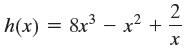
In Exercises 1–10, determine which functions are polynomial functions. For those that are, identify the degree. 2 h(x) = 8x³x² + X
Consider the function f(x) = x3 - 5x2 - 4x + 20.a. Use factoring to find all zeros of f.b. Use the Leading Coefficient Test and the zeros of f to graph the function.
Fill in each blank so that the resulting statement is true.y varies jointly as x and z can be modeled by the equation_______ .
Fill in each blank so that the resulting statement is true.The graph of f(x) = -x3_______ to the left and________ to the right.
Fill in each blank so that the resulting statement is true.If a + bi is a root of a polynomial equation with real coefficients, b≠0, then_______ is also a root of the equation.
Fill in each blank so that the resulting statement is true.True or false: The y-coordinate of the vertex of f(x) = 4x2 - 16x + 300 is f(2)._______ .
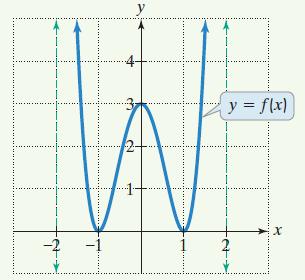
Use the graph of y = f(x) to solve Exercises 1–6.Graph g(x) = f(x + 2) + 1. PRO y y = f(x) et X
A quarterback tosses a football to a receiver 40 yards downfield. The height of the football, f(x), in feet, can be modeled by f(x) = -0.025x2 + x + 6, where x is the ball’s horizontal distance, in yards, from the quarterback.a. What is the ball’s maximum height and how far from the quarterback
In Exercises 5–13, find all zeros of each polynomial function. Then graph the function.f(x) = -(x - 2)2(x + 1)2
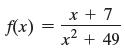
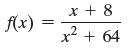
In Exercises 1–8, find the domain of each rational function. f(x) x + 7 x² + 49
In Exercises 1–16, divide using long division. State the quotient, q(x), and the remainder, r(x). (12x² + x4) (3x − 2) 응
In Exercises 5–6, use the function’s equation, and not its graph, to finda. The minimum or maximum value and where it occurs.b. The function’s domain and its range.f(x) = 2x2 + 12x + 703
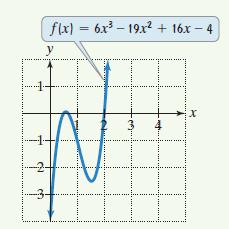
The graph of f(x) = 6x3 - 19x2 + 16x - 4 is shown in the figure.a. Based on the graph of f, find the root of the equation 6x3 - 19x2 + 16x - 4 = 0 that is an integer.b. Use synthetic division to find the other two roots of 6x3 - 19x2 + 16x - 4 = 0. f(x) = 6x³-19x² + 16x-4 y -2- ..... ...... X
In Exercises 1–8, find the domain of each rational function. f(x) x + 8 2 x² + 64
In Exercises 5–8, the graph of a quadratic function is given. Write the function’s equation, selecting from the following options. f(x) = x² + 2x + 1 2 h(x) = x² - 1 g(x) = x² - 2x + 1 j(x) = -x² - 1
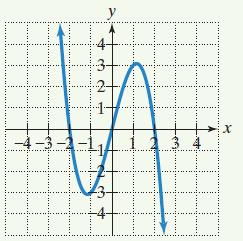
Use end behavior to explain why the following graph cannot be the graph of f(x) = x5 - x. Then use intercepts to explain why the graph cannot represent f(x) = x5 - x. # -4-3- N y DIT XENO |-| X
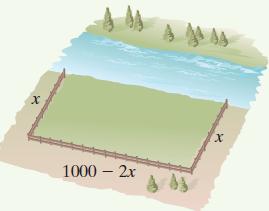
A field bordering a straight stream is to be enclosed. The side bordering the stream is not to be fenced. If 1000 yards of fencing material is to be used, what are the dimensions of the largest rectangular field that can be fenced? What is the maximum area? X 1000 - 2x
Solve each polynomial inequality in Exercises 1–42 and graph the solution set on a real number line. Express each solution set in interval notation. x2+5x+4>0
In Exercises 1–8, use the Rational Zero Theorem to list all possible rational zeros for each given function. f(x) = x³ = x² - 7x³ + 7x² - 12x - 12 -
In Exercises 5–8, the graph of a quadratic function is given. Write the function’s equation, selecting from the following options. f(x) = x² + 2x + 1 2 h(x) = x² - 1 g(x) = x² - 2x + 1 j(x) = -x² - 1
Fill in each blank so that the resulting statement is true.True or false: If the degree of the numerator of a rational function equals the degree of the denominator, then setting y equal to the ratio of the leading coefficients gives the equation of the horizontal asymptote.__________
Fill in each blank so that the resulting statement is true.After performing polynomial long division, the answer may be checked by multiplying the_________ by the________ , and then adding the________ . You should obtain the_______ .
Use the four-step procedure for solving variation problems given on page 445 to solve Exercises 1–10.A varies directly as b and inversely as the square of c. a = 7 when b = 9 and c = 6. Find a when b = 4 and c = 8.
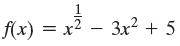
In Exercises 1–10, determine which functions are polynomial functions. For those that are, identify the degree. f(x) =x²-3x² + 5
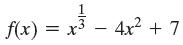
In Exercises 1–10, determine which functions are polynomial functions. For those that are, identify the degree. f(x) = X - 4x² + 7
In Exercises 5–13, find all zeros of each polynomial function. Then graph the function.f(x) = x4 - 5x2 + 4
In Exercises 5–13, find all zeros of each polynomial function. Then graph the function.f(x) = x3 - x2 - 4x + 4
Fill in each blank so that the resulting statement is true.In the equation S = 8A/P , S varies________ as A and_________ as P.
Fill in each blank so that the resulting statement is true.The graph of f(x) = x2_______ to the left and________ to the right.
Fill in each blank so that the resulting statement is true.The difference between two numbers is 8. If one number is represented by x, the other number can be expressed as_________ . The product of the numbers, P(x), expressed in the form P(x) = ax2 + bx + c, is P(x) =_________ .
Use the four-step procedure for solving variation problems given on page 445 to solve Exercises 1–10.y varies jointly as x and z. y = 25 when x = 2 and z = 5. Find y when x = 8 and z = 12.
In Exercises 7–12, solve each equation or inequality.|2x - 1| = 3
Fill in each blank so that the resulting statement is true.The perimeter of a rectangle is 80 feet. If the length of the rectangle is represented by x, its width can be expressed as_______ . The area of the rectangle, A(x), expressed in the form A(x) = ax2 + bx + c, is A(x) =_________ .
Fill in each blank so that the resulting statement is true.The Linear Factorization Theorem states that an nth-degree polynomial can be expressed as the product of a nonzero constant and______ linear factors, where each linear factor has a leading coefficient of________ .
Fill in each blank so that the resulting statement is true.To divide x3 + 5x2 - 7x + 1 by x - 4 using synthetic division, the first step is to write____ , _______ ,________ ,________ ,._________
Fill in each blank so that the resulting statement is true.Compared with the graph of f(x) = 1/x, the graph of g(x) = 1/x + 2 - 1 is shifted 2 units_______ and 1 unit________ .
Fill in each blank so that the resulting statement is true.The graph of f(x) = -x2_______ to the left and________ to the right.
Fill in each blank so that the resulting statement is true.In the equation C = 0.02P1P2/d2 , C varies_________ as P1 and P2 and___________ as the square of d.
Fill in each blank so that the resulting statement is true.A polynomial function with four sign changes must have four positive real zeros.________
Fill in each blank so that the resulting statement is true.The graph of a rational function has a slant asymptote if the degree of the numerator is_________ the degree of the denominator.
Fill in each blank so that the resulting statement is true.To divide 4x3 - 8x - 2 by x + 5 using synthetic division, the first step is to write______ ,_________ ,_________ ,________ ,________
In Exercises 1–16, divide using long division. State the quotient, q(x), and the remainder, r(x). (4x²8x + 6) = (2x - 1)
Solve each polynomial inequality in Exercises 1–42 and graph the solution set on a real number line. Express each solution set in interval notation. 0 < 9 - x + z
In Exercises 1–8, use the Rational Zero Theorem to list all possible rational zeros for each given function. f(x) = 4x58x²4x + 2
Use the four-step procedure for solving variation problems given on page 445 to solve Exercises 1–10.C varies jointly as A and T. C = 175 when A = 2100 and T = 4. Find C when A = 2400 and T = 6.
Fill in each blank so that the resulting statement is true.True or false: Odd-degree polynomial functions have graphs with opposite behavior at each end_______.
In Exercises 7–12, solve each equation or inequality.3x2 - 5x + 1 = 0
Determine, without graphing, whether the quadratic function f(x) = -2x2 + 12x - 16 has a minimum value or a maximum value. Then find:a. The minimum or maximum value and where it occurs.b. The function’s domain and its range.
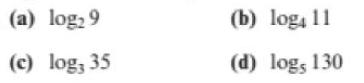
Determine mentally an integer n so that the logarithm is between n and n + 1. (a) log₂9 (c) log, 35 (b) loga 11 (d) log, 130
Change each equation to its equivalent exponential form. (a) logg x=3 (b) logo (2+x)=5 (c) log b = c
Change each equation to its equivalent logarithmic form. (a) 7x = 4 (b) = 7 (c) 10 = b
Change each equation to its equivalent logarithmic form. (a) 52x = 9 b} b = a c) d = b
Solve each equation. Use the change of base formula to approximate exact answers to the nearest hundredth when appropriate. (a) 4 = 1/6 (b) et = 2 (c) 5* = 125
Change each equation to its equivalent exponential form. (a) log x= 4 (b) In 8x = 7 (c) log x=b
Solve each equation. Use the change of base formula to approximate exact answers to the nearest hundredth when appropriate. (a) 10* = 0.01 (b) 10 = 7 (c) 10*
Determine if f is one-to-one. y = f(x) 12 X
Solve each equation. Use the change of base formula to approximate exact answers to the nearest hundredth when appropriate. (a) 10* = 1000 (b) 10%= 5 (c) 10 = -2
Solve each equation. Use the change of base formula to approximate exact answers to the nearest hundredth when appropriate. (a) 2 = 9 (b) 10 1000 (c) e = 8
Solve each equation. Use the change of base formula to approximate exact answers to the nearest hundredth when appropriate. (a) 9 = 1 TA= (3) 01A=x01 (9)
Use the given f(x) and g(x) to find each of the following. Identify its domain. (a) (fog)(x) (b) (gof)(x) (c) (f•f)(x)
Use the given f(x) and g(x) to find each of the following. Identify its domain. (a) (fog)(x) (b) (gof)(x) (c) (f•f)(x)
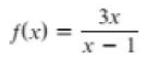
Find f-1(x). f(x) = 3x x-1
Solve each equation. Use the change of base formula to approximate exact answers to the nearest hundredth when appropriate. (a) 2* = √8 (b) 7 = 1 (c) et = Ve
Sketch a graph of y = f(x). f(x) =
Use the given f(x) and g(x) to find each of the following. Identify its domain. (a) (fog)(x) (b) (gof)(x) (c) (f•f)(x)
If possible, simplify f(x). Find the domain of f. f(x) = ln(x - 1) + In(x + 1)
If possible, simplify f(x). Find the domain of f. f(x) = log (2 - x) + log (2 + x)
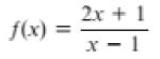
Find f-1(x). f(x) = 2x + 1 x-1
Use the given f(x) and g(x) to find each of the following. Identify its domain. (a) (fog)(x) (b) (gof)(x) (c) (f•f)(x)
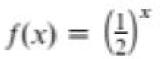
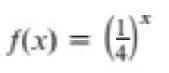
Sketch a graph of y = f(x). f(x) = (4)*
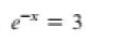
Solve each equation. Use the change of base formula to approximate exact answers to the nearest hundredth when appropriate. e = 3
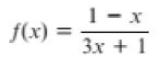
Find f-1(x). f(x) = 1-x 3x + 1
Find the domain of (f ° g)(x) and (g ° f)(x). f(x) = logx, g(x) = √x
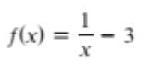
Find f-1(x) . f(x) =
Use the given f(x) and g(x) to find each of the following. Identify its domain. (a) (fog)(x) (b) (gof)(x) (c) (f•f)(x)
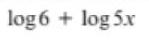
Use properties of logarithms to combine the expression as a logarithm of a single expression. log 6 + log 5x
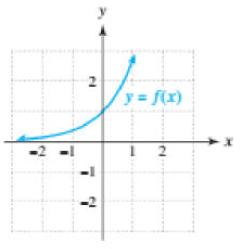
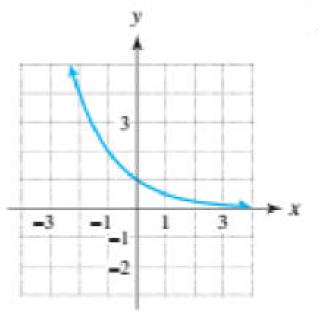
Use the graph of y = Cax to determine values for C and a. 3 3
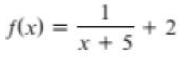
Find f-1(x). f(x) = 1 x+5 +2
Showing 6300 - 6400
of 13634
First
57
58
59
60
61
62
63
64
65
66
67
68
69
70
71
Last
Step by Step Answers

 Get 50% OFF
Claim Now
Get 50% OFF
Claim Now