New Semester
Started
Get
50% OFF
Study Help!
--h --m --s
Claim Now
Question Answers
Textbooks
Find textbooks, questions and answers
Oops, something went wrong!
Change your search query and then try again
S
Books
FREE
Study Help
Expert Questions
Accounting
General Management
Mathematics
Finance
Organizational Behaviour
Law
Physics
Operating System
Management Leadership
Sociology
Programming
Marketing
Database
Computer Network
Economics
Textbooks Solutions
Accounting
Managerial Accounting
Management Leadership
Cost Accounting
Statistics
Business Law
Corporate Finance
Finance
Economics
Auditing
Tutors
Online Tutors
Find a Tutor
Hire a Tutor
Become a Tutor
AI Tutor
AI Study Planner
NEW
Sell Books
Search
Search
Sign In
Register
study help
mathematics
college algebra
College Algebra 12th edition Margaret L. Lial, John Hornsby, David I. Schneider, Callie Daniels - Solutions
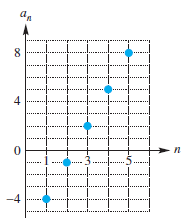
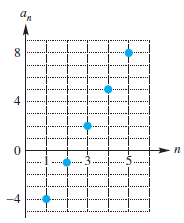
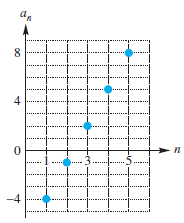
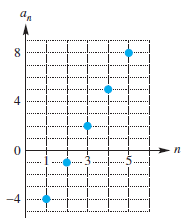
The figure shows the graph of a finite arithmetic sequence.Write a formula for the nth term of the sequence. 8. -4 4)
The figure shows the graph of a finite arithmetic sequence.What is the common difference? 8. -4 4)
The figure shows the graph of a finite arithmetic sequence.What is the first term? 8. -4 4)
The figure shows the graph of a finite arithmetic sequence.Determine the domain and range of the sequence. 8. -4 4)
Fill in the blank to correctly complete each sentence.For the arithmetic sequence with nth term an = 8n + 5, the term a5 = _________.
Fill in the blank to correctly complete each sentence.For the arithmetic sequence having a1 = 10 and d = -2, the term a3 = ________.
Fill in the blank to correctly complete each sentence.The common difference for the sequence -25, -21, -17, -13, . . . is _________.
Fill in the blank to correctly complete each sentence.In an arithmetic sequence, each term after the first differs from the preceding term by a fixed constant called the common _________.
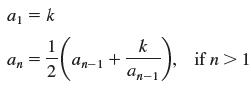
Solve the problem.The recursively defined sequencecan be used to compute √k for any positive number k. This sequence was known to Sumerian mathematicians 4000 years ago, and it is still used today. Use this sequence to approximate the given square root by finding a6. Compare the result with the
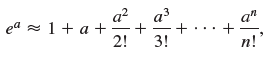
Solve the problem.The serieswhere n! = 1 · 2 · 3 · 4 ·....· n, can be used to approximate the value of e a for any real number a. Use the first eight terms of this series to approximate each expression. Compare this approximation with the value obtained on a calculator.(a) e (b) e-1 a? a3
Solve the problem.Find the sum of the first six terms of the seriesMultiply this result by 90, and take the fourth root to obtain an approximation of p. Compare this answer to the actual decimal approximation of p. 24 14 34 44 54 90 п n4 |-5
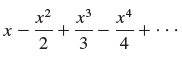
Solve the problem.The seriescan be used to approximate the value of ln (1 + x) for values of x in (-1, 1]. Use the first six terms of this series to approximate each expression. Compare this approximation with the value obtained on a calculator.(a) ln 1.02 (x = 0.02) (b) ln 0.97 (x = -0.03) x2
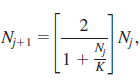
Solve the problem.Refer to Exercise 97. If the bacteria are not cultured in a medium with sufficient nutrients, competition will ensue and growth will slow. According to Verhulst’s model, the number of bacteria Nj at time 40(j - 1) in minutes can be determined by the sequencewhere K is a constant
Solve the problem.If certain bacteria are cultured in a medium with sufficient nutrients, they will double in size and then divide every 40 minutes. Let N1 be the initial number of bacteria cells, N2 the number after 40 minutes, N3 the number after 80 minutes, and Nj the number after 40(j - 1)
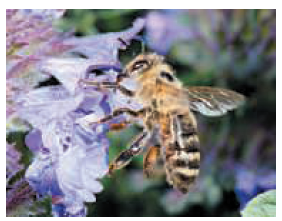
Solve the problem.One of the most famous sequences in mathematics is the Fibonacci sequence, 1, 1, 2, 3, 5, 8, 13, 21, 34, 55, . . . . (Also see Exercise 33.) Male honeybees hatch from eggs that have not been fertilized, so a male bee has only one parent, a female. On the other hand, female
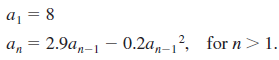
Solve each problem.Suppose an insect population density, in thousands per acre, during year n can be modeled by the recursively defined sequence(a) Find the population for n = 1, 2, 3.(b) Graph the sequence for n = 1, 2, 3, . . . , 20. Use the window [0, 21] by [0, 14]. Interpret the graph. aj = 8
Use the sequence feature of a graphing calculator to graph the first ten terms of each sequence as defined. Use the graph to make a conjecture as to whether the sequence converges or diverges. If it converges, determine the number to which it converges.an = (1 + n)1/n
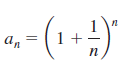
Use the sequence feature of a graphing calculator to graph the first ten terms of each sequence as defined. Use the graph to make a conjecture as to whether the sequence converges or diverges. If it converges, determine the number to which it converges. п 1+ an п
Use the sequence feature of a graphing calculator to graph the first ten terms of each sequence as defined. Use the graph to make a conjecture as to whether the sequence converges or diverges. If it converges, determine the number to which it converges.an = n(n + 2)
Use the sequence feature of a graphing calculator to graph the first ten terms of each sequence as defined. Use the graph to make a conjecture as to whether the sequence converges or diverges. If it converges, determine the number to which it converges.an = 2en
Use the sequence feature of a graphing calculator to graph the first ten terms of each sequence as defined. Use the graph to make a conjecture as to whether the sequence converges or diverges. If it converges, determine the number to which it converges. 1 + 4n an 2n
Use the sequence feature of a graphing calculator to graph the first ten terms of each sequence as defined. Use the graph to make a conjecture as to whether the sequence converges or diverges. If it converges, determine the number to which it converges. п+4 an 2n
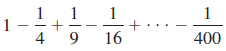
Use summation notation to write the series. 1.1 1 9. 16 400
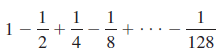
Use summation notation to write the series. 4 2 128 8
Use summation notation to write the series. 5 5 5 |1+1'1+2 '1+3 1+ 15
Use summation notation to write the series. 1 3(1) ' 3(2) 3(3) 3(9)
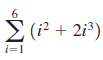
Use the summation properties and rules to evaluate the series. + 2i?) Σ(2+27) i=1
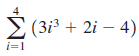
Use the summation properties and rules to evaluate the series. E (3i³ + 2i – 4) i=1
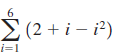
Use the summation properties and rules to evaluate the series. Σ(2+i-P) (2 + i – i²) :2Y i=1
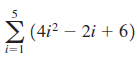
Use the summation properties and rules to evaluate the series. E (4i² – 2i + 6) i=1
Use the summation properties and rules to evaluate the series. 5 (8i – 1) i=1
Use the summation properties and rules to evaluate the series. E (5i + 3) i=1
Use the summation properties and rules to evaluate the series. 50 2i3 i=1
Use the summation properties and rules to evaluate the series. 15 Σε :2 i=1
Use the summation properties and rules to evaluate the series. 20 Σ5 i=1
Use the summation properties and rules to evaluate the series. 100 Σ6 i=1
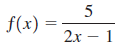
Write the terms offor each function. Evaluate the sum. Ef(x;)Ax, with x1 = 0, x2 = 2, x3 = 4, x4 = 6, and Ax = 0.5, i=1 5 f(x) 2х — 1
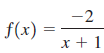
Write the terms offor each function. Evaluate the sum. Ef(x;)Ax, with x1 = 0, x2 = 2, x3 = 4, x4 = 6, and Ax = 0.5, i=1 -2 f(x) x + 1
Write the terms offor each function. Evaluate the sum.ƒ(x) = x2 - 1 Ef(x;)Ax, with x1 = 0, x2 = 2, x3 = 4, x4 = 6, and Ax = 0.5, i=1
Write the terms offor each function. Evaluate the sum.ƒ(x) = 2x2 Ef(x;)Ax, with x1 = 0, x2 = 2, x3 = 4, x4 = 6, and Ax = 0.5, i=1
Write the terms offor each function. Evaluate the sum.ƒ(x) = 6 + 2x Ef(x;)Ax, with x1 = 0, x2 = 2, x3 = 4, x4 = 6, and Ax = 0.5, i=1
Write the terms offor each function. Evaluate the sum.ƒ(x) = 4x - 7 Ef(x;)Ax, with x1 = 0, x2 = 2, x3 = 4, x4 = 6, and Ax = 0.5,
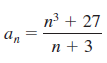
Write the terms for the series and evaluate the sum, given that x1 = -2, x2 = -1, x3 = 0, x4 = 1, and x5 = 2.How can factoring make the work in Exercises 21, 22, and 67 easier?Exercises 21Exercises 22Exercises 67 n + 8 п an n + 2 n3 + 27 an n + 3
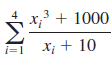
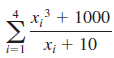
Write the terms for the series and evaluate the sum, given that x1 = -2, x2 = -1, x3 = 0, x4 = 1, and x5 = 2. 4 x,3 + 1000 i=1 X; + 10 i3D
Write the terms for the series and evaluate the sum, given that x1 = -2, x2 = -1, x3 = 0, x4 = 1, and x5 = 2. х, -1 х, + 3 i=
Write the terms for the series and evaluate the sum, given that x1 = -2, x2 = -1, x3 = 0, x4 = 1, and x5 = 2. X; + 1 i=2 Xi + 2
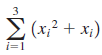
Write the terms for the series and evaluate the sum, given that x1 = -2, x2 = -1, x3 = 0, x4 = 1, and x5 = 2. Σ (α + + x;) (x,² i=1
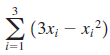
Write the terms for the series and evaluate the sum, given that x1 = -2, x2 = -1, x3 = 0, x4 = 1, and x5 = 2. Х (3х, — х?) (3x; i=1
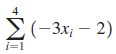
Write the terms for the series and evaluate the sum, given that x1 = -2, x2 = -1, x3 = 0, x4 = 1, and x5 = 2. – 3x; i=1
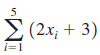
Write the terms for the series and evaluate the sum, given that x1 = -2, x2 = -1, x3 = 0, x4 = 1, and x5 = 2. (2x; + 3) i=1
Write the terms for the series and evaluate the sum, given that x1 = -2, x2 = -1, x3 = 0, x4 = 1, and x5 = 2. i=1
Write the terms for the series and evaluate the sum, given that x1 = -2, x2 = -1, x3 = 0, x4 = 1, and x5 = 2. х i=1
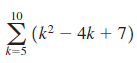
Use a graphing calculator to evaluate the series. 10 (k² – 4k + 7) k=5
Use a graphing calculator to evaluate the series. Σ13-) (3j – j?) j=3 3D3
Use a graphing calculator to evaluate the series. 10 Σ (-6) i=1
Use a graphing calculator to evaluate the series. 10 Σ(412-5) i=1
Evaluate the series.
Evaluate the series. Σ-) i=1
Evaluate the series. Σ-2)-3] i=1
Evaluate the series. Σ (3-4) i=1
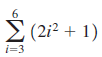
Evaluate the series. Σ (2+1) (2i² i=3
Evaluate the series. E (5i + 2) i=3
Evaluate the series. 2 Σ5(2) i=-1
Evaluate the series. Σ2/3) -2 i=
Evaluate the series. Σ (5ί (5i + 2) i=3
Evaluate the series. Σ (6-31) i=2
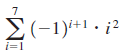
Evaluate the series. Σ-1) 2 –1)*+ i=1
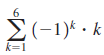
Evaluate the series. Σ-1) k –1)* k=1
Evaluate the series. 4 Σ (&+ 1) k=1
Evaluate the series. i=1
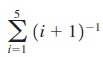
Evaluate the series. Σ((+ 1)-1 i=1
Evaluate the series. 4 j=1
Evaluate the series. Σ (31-2 ) i=1
Evaluate the series. E (2i + 1) i=1
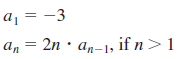
Find the first four terms of the sequence. -3 a1 = an = 2n · an-1, if n> 1
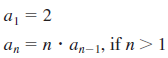
Find the first four terms of the sequence. a, = 2 а, — п. а,-1, if n > 1
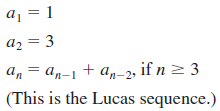
Find the first four terms of the sequence. aj = 1 az = 3 an = an-1 + a,–2, if n 2 3 (This is the Lucas sequence.) An-2
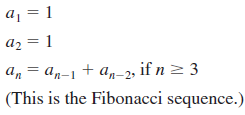
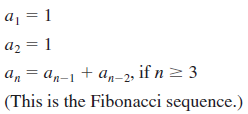
Find the first four terms of the sequence. aj = 1 az = 1 an = an-1 + an-2, if n > 3 (This is the Fibonacci sequence.)
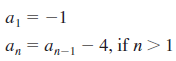
Find the first four terms of the sequence. a¡ = -1 An = an-1 – 4, if n>1 an
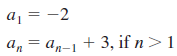
Find the first four terms of the sequence. a¡ = -2 An а, — ая1 + 3, if n > 1
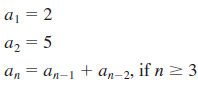
Decide whether the sequence is finite or infinite. aj = 2 az = 5 An-1 + an-2, if n² 3 an 2, if n 2 3 ||
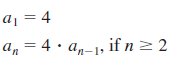
Decide whether the sequence is finite or infinite. a1 = 4 a, = 4 · an-1, if n² 2 n 2 2
Decide whether the sequence is finite or infinite.-1, -2, -3, -4, -5,. . .
Decide whether the sequence is finite or infinite.1, 2, 3, 4, 5, . . .
Decide whether the sequence is finite or infinite.-1, -2, -3, -4, -5
Decide whether the sequence is finite or infinite.1, 2, 3, 4, 5
Decide whether the sequence is finite or infinite.The sequence of pages in a book
Decide whether the sequence is finite or infinite.The sequence of days of the week
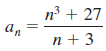
Write the first five terms of the sequence. n? + 27 an п+3
Write the first five terms of the sequence. п + 8 an п+2
Write the first five terms of the sequence. — 1 n° an п? + 1
Write the first five terms of the sequence. 4n – 1 An п? + 2
Write the first five terms of the sequence.an = (-1)n-1(n + 1)
Write the first five terms of the sequence.an = (-1)n(2n)
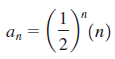
Write the first five terms of the sequence. () G)(m) (n) .2, an
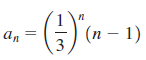
Write the first five terms of the sequence. ӨУс- (п — 1) an
Write the first five terms of the sequence. п — 7 ая п — 6
Write the first five terms of the sequence. п+5 ая п+4
Write the first five terms of the sequence.an = 6n - 3
Write the first five terms of the sequence.an = 4n + 10
Showing 12000 - 12100
of 16373
First
114
115
116
117
118
119
120
121
122
123
124
125
126
127
128
Last
Step by Step Answers

 Get 50% OFF
Claim Now
Get 50% OFF
Claim Now


















![Σ-2)-3] i=1](https://dsd5zvtm8ll6.cloudfront.net/si.question.images/images/question_images/1552/5/5/7/3415c8a251d33d741552540111918.jpg)