New Semester
Started
Get
50% OFF
Study Help!
--h --m --s
Claim Now
Question Answers
Textbooks
Find textbooks, questions and answers
Oops, something went wrong!
Change your search query and then try again
S
Books
FREE
Study Help
Expert Questions
Accounting
General Management
Mathematics
Finance
Organizational Behaviour
Law
Physics
Operating System
Management Leadership
Sociology
Programming
Marketing
Database
Computer Network
Economics
Textbooks Solutions
Accounting
Managerial Accounting
Management Leadership
Cost Accounting
Statistics
Business Law
Corporate Finance
Finance
Economics
Auditing
Tutors
Online Tutors
Find a Tutor
Hire a Tutor
Become a Tutor
AI Tutor
AI Study Planner
NEW
Sell Books
Search
Search
Sign In
Register
study help
mathematics
college algebra
College Algebra 12th edition Margaret L. Lial, John Hornsby, David I. Schneider, Callie Daniels - Solutions
Fill in the blank(s) to correctly complete each sentence, or answer the question as appropriate.For k > 0, if y varies directly as x, then when x increases, y______, and when x decreases, y_______.
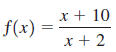
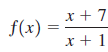
Match the rational function in Column I with the appropriate description in Column II. Choices in Column II can be used only once.A. The x-intercept is (-3, 0).B. The y-intercept is (0, 5).C. The horizontal asymptote is y = 4.D. The vertical asymptote is x = -1.E. There is a hole in its graph at
Match the rational function in Column I with the appropriate description in Column II. Choices in Column II can be used only once.A. The x-intercept is (-3, 0).B. The y-intercept is (0, 5).C. The horizontal asymptote is y = 4.D. The vertical asymptote is x = -1.E. There is a hole in its graph at
The federal government has developed the body mass index (BMI) to determine ideal weights. A person’s BMI is directly proportional to his or her weight in pounds and inversely proportional to the square of his or her height in inches. (A BMI of 19 to 25 corresponds to a healthy weight.) A
The force needed to keep a car from skidding on a curve varies inversely as the radius r of the curve and jointly as the weight of the car and the square of the speed. It takes 3000 lb of force to keep a 2000-lb car from skidding on a curve of radius 500 ft at 30 mph. What force will keep the same
Solve each problem.Find all zeros of ƒ(x) = x4 - 3x3 - 8x2 + 22x - 24, given that 1 + i is a zero.
For each polynomial function, (a) list all possible rational zeros, (b) find all rational zeros, and (c) factor ƒ(x) into linear factors.ƒ(x) = 24x3 + 80x2 + 82x + 24
Graph each polynomial function. Factor first if the polynomial is not in factored form.ƒ(x) = x4 + 3x3 - 3x2 - 11x - 6
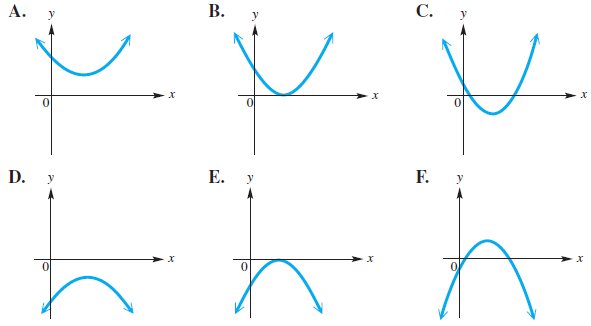
Several graphs of the quadratic function ƒ(x) = ax2 + bx + c are shown below. For the given restrictions on a, b, and c, select the corresponding graph from choices A–F.a > 0; b2 - 4ac = 0 A. B. C. х х х F. D. У E. х х х
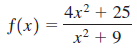
Give the equations of any vertical, horizontal, or oblique asymptotes for the graph of each rational function. f(x) = = 4x + 25 x +9
The period of a pendulum varies directly as the square root of the length of the pendulum and inversely as the square root of the acceleration due to gravity. Find the period when the length is 121 cm and the acceleration due to gravity is 980 cm per second squared, if the period is 6π seconds
Solve each problem.Find a polynomial function ƒ of degree 3 with -2, 1, and 4 as zeros, and ƒ(2) = 16.
Graph each polynomial function. Factor first if the polynomial is not in factored form.ƒ(x) = 3x4 - 7x3 - 6x2 + 12x + 8
Several graphs of the quadratic function ƒ(x) = ax2 + bx + c are shown below. For the given restrictions on a, b, and c, select the corresponding graph from choices A–F.a > 0; b2 - 4ac > 0 A. B. C. х х х F. D. У E. х х х
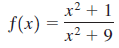
Give the equations of any vertical, horizontal, or oblique asymptotes for the graph of each rational function. x² + 1 f(x) x² + 9
For each polynomial function, use the remainder theorem to find ƒ(k). f(x) = 6x4 + x 8x + 5x+6; k= - IN
For each polynomial function, use the remainder theorem to find ƒ(k).ƒ(x) = x4 + 6x3 + 9x2 + 3x - 3; k = 4
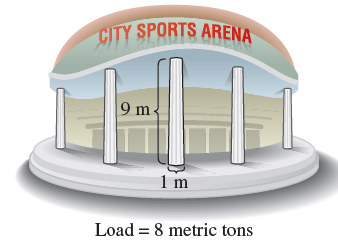
The sports arena in Exercise 43 requires a horizontal beam 16 m long, 24 cm wide, and 8 cm high. The maximum load of such a horizontal beam that is supported at both ends varies directly as the width of the beam and the square of its height and inversely as the length between supports. If a beam of
Solve each problem.Find a polynomial function ƒ with real coefficients of degree 4 with 3, 1, and -1 + 3i as zeros, and ƒ(2) = -36.
For each polynomial function, (a) list all possible rational zeros, (b) find all rational zeros, and (c) factor ƒ(x) into linear factors.ƒ(x) = 15x3 + 61x2 + 2x - 8
For each polynomial function, (a) list all possible rational zeros, (b) find all rational zeros, and (c) factor ƒ(x) into linear factors.Zero of 2 and zero of 4 having multiplicity 2; ƒ(1) = -18
A rock is projected directly upward from ground level with an initial velocity of 90 ft per sec.(a) Give the function that describes the height of the rock in terms of time t.(b) Determine the time at which the rock reaches its maximum height and the maximum height in feet.(c) For what time
Work each problem.Suppose m varies directly as p2 and q4. If p doubles and q triples, what happens to m?
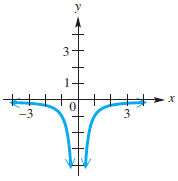
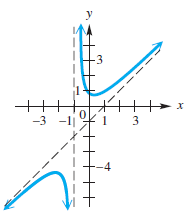
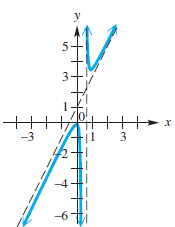
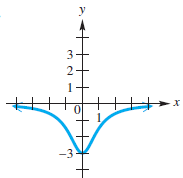
Identify any vertical, horizontal, or oblique asymptotes in the graph of y = ƒ(x). State the domain of ƒ. -3 3
Use synthetic division to decide whether the given number k is a zero of the polynomial function. If it is not, give the value of ƒ(k).ƒ(x) = x2 - 4x + 5; k = 2 - i
Show that the real zeros of each polynomial function satisfy the given conditions.ƒ(x) = x4 + x3 - x2 + 3; no real zero less than -2
For each polynomial function, (a) list all possible rational zeros, (b) find all rational zeros, and (c) factor ƒ(x) into linear factors.Zero of 0 and zero of 1 having multiplicity 2; ƒ(2) = 10
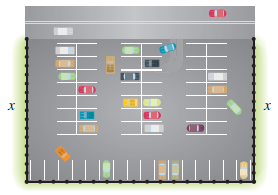
One campus of Houston Community College has plans to construct a rectangular parking lot on land bordered on one side by a highway. There are 640 ft of fencing available to fence the other three sides. Let x represent the length of each of the two parallel sides of fencing.(a) Express the length of
Identify any vertical, horizontal, or oblique asymptotes in the graph of y = ƒ(x). State the domain of ƒ. -3 -3 -1 3 -4
Use synthetic division to decide whether the given number k is a zero of the polynomial function. If it is not, give the value of ƒ(k).ƒ(x) = x2 + 3x + 4; k = 2 + i
Show that the real zeros of each polynomial function satisfy the given conditions.ƒ(x) = x5 + 2x3 - 2x2 + 5x + 5; no real zero less than -1
For each polynomial function, (a) list all possible rational zeros, (b) find all rational zeros, and (c) factor ƒ(x) into linear factors.Zero of -4 and zero of 0 having multiplicity 2; ƒ(-1) = -6
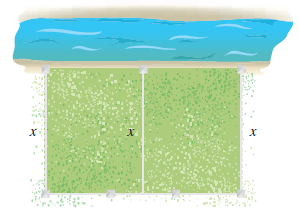
A farmer wishes to enclose a rectangular region bordering a river with fencing, as shown in the diagram. Suppose that x represents the length of each of the three parallel pieces of fencing. She has 600 ft of fencing available.(a) What is the length of the remaining piece of fencing in terms of
Identify any vertical, horizontal, or oblique asymptotes in the graph of y = ƒ(x). State the domain of ƒ. -3 3 -6 3.
Use synthetic division to decide whether the given number k is a zero of the polynomial function. If it is not, give the value of ƒ(k).ƒ(x) = x2 - 3x + 5; k = 1 - 2i
Show that the real zeros of each polynomial function satisfy the given conditions.ƒ(x) = 3x4 + 2x3 - 4x2 + x - 1; no real zero greater than 1
Find a polynomial function ƒ(x) of least degree having only real coefficients and zeros as given. Assume multiplicity 1 unless otherwise stated.5 + i and 5 - i
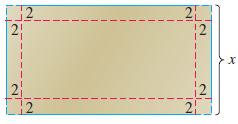
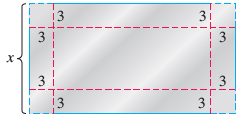
A piece of cardboard is twice as long as it is wide. It is to be made into a box with an open top by cutting 2-in. squares from each corner and folding up the sides. Let x represent the width (in inches) of the original piece of cardboard.(a) Represent the length of the original piece of cardboard
Graph each rational function. f(x)
Use synthetic division to decide whether the given number k is a zero of the polynomial function. If it is not, give the value of ƒ(k). 3 f(x) = 4x4 + x² + 17x + 3; k = -
Show that the real zeros of each polynomial function satisfy the given conditions.ƒ(x) = 3x4 + 2x3 - 4x2 + x - 1; no real zero less than -2
Find a polynomial function ƒ(x) of least degree having only real coefficients and zeros as given. Assume multiplicity 1 unless otherwise stated.7 - 2i and 7 + 2i
A piece of sheet metal is 2.5 times as long as it is wide. It is to be made into a box with an open top by cutting 3-in. squares from each corner and folding up the sides. Let x represent the width (in inches) of the original piece.(a) Represent the length of the original piece of sheet metal in
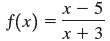
Graph each rational function. х — 5 x + 3 f(x)
Use synthetic division to decide whether the given number k is a zero of the polynomial function. If it is not, give the value of ƒ(k). 4 3x4 + 13x3 – 10x + 8; k = 3 len |
Show that the real zeros of each polynomial function satisfy the given conditions.ƒ(x) = x5 - 3x3 + x + 2; no real zero greater than 2
Find a polynomial function ƒ(x) of least degree having only real coefficients and zeros as given. Assume multiplicity 1 unless otherwise stated.0, i, and 1 + i
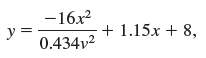
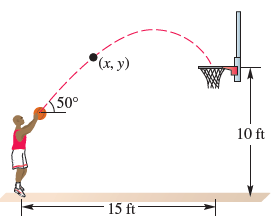
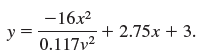
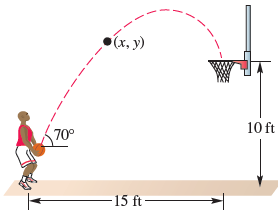
If a person shoots a free throw from a position 8 ft above the floor, then the path of the ball may be modeled by the parabolawhere v is the initial velocity of the ball in feet per second, as illustrated in the figure.(a) If the basketball hoop is 10 ft high and located 15 ft away, what initial
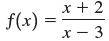
Graph each rational function. x + 2 f(x) =
Use synthetic division to decide whether the given number k is a zero of the polynomial function. If it is not, give the value of ƒ(k).ƒ(x) = x3 + 3x2 - x + 1; k = 1 + i
Show that the real zeros of each polynomial function satisfy the given conditions.ƒ(x) = x5 - 3x3 + x + 2; no real zero less than -3
Find a polynomial function ƒ(x) of least degree having only real coefficients and zeros as given. Assume multiplicity 1 unless otherwise stated.0, -i, and 2 + i
If a person shoots a free throw from an underhand position 3 ft above the floor, then the path of the ball may be modeled byRepeat parts (a) and (b) from Exercise 63. Then compare the paths for the overhand shot and the underhand shot.Exercise 63(a) If the basketball hoop is 10 ft high and located
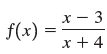
Graph each rational function. f(x) = x + 4
Use synthetic division to decide whether the given number k is a zero of the polynomial function. If it is not, give the value of ƒ(k).ƒ(x) = 2x3 - x2 + 3x - 5; k = 2 - i
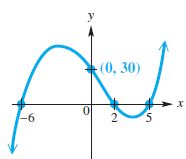
Find a polynomial function f of least degree having the graph shown. (0, 30) -6
Find a polynomial function ƒ(x) of least degree having only real coefficients and zeros as given. Assume multiplicity 1 unless otherwise stated.1 + √2, 1 - √2, and 1
Find two numbers whose sum is 20 and whose product is the maximum possible value.
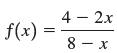
Graph each rational function. 4 — 2х f(x) 8 — х
The remainder theorem indicates that when a polynomial ƒ(x) is divided by x - k, the remainder is equal to ƒ(k). For ƒ(x) = x3 - 2x2 - x + 2, use the remainder theorem to find each of the following. Then determine the coordinates of the corresponding point on the graph of ƒ(x).ƒ (-2)
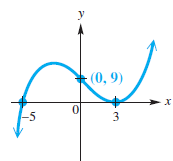
Find a polynomial function f of least degree having the graph shown. (0, 9) -5
Find two numbers whose sum is 32 and whose product is the maximum possible value.
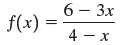
Graph each rational function. 6 — Зх f(x) 4 — х
The remainder theorem indicates that when a polynomial ƒ(x) is divided by x - k, the remainder is equal to ƒ(k). For ƒ(x) = x3 - 2x2 - x + 2, use the remainder theorem to find each of the following. Then determine the coordinates of the corresponding point on the graph of ƒ(x).ƒ (-1)
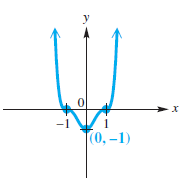
Find a polynomial function f of least degree having the graph shown. х (0, –1)
Find a polynomial function ƒ(x) of least degree having only real coefficients and zeros as given. Assume multiplicity 1 unless otherwise stated.2 - i, 3, and -1
If an object is projected upward from ground level with an initial velocity of 32 ft per sec, then its height in feet after t seconds is given by s(t) = -16t2 + 32t. Find the number of seconds it will take the object to reach its maximum height. What is this maximum height?
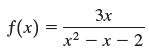
Graph each rational function. f(x) x2 — х — 2 Зх
The remainder theorem indicates that when a polynomial ƒ(x) is divided by x - k, the remainder is equal to ƒ(k). For ƒ(x) = x3 - 2x2 - x + 2, use the remainder theorem to find each of the following. Then determine the coordinates of the corresponding point on the graph of ƒ(x).f(-1/2)
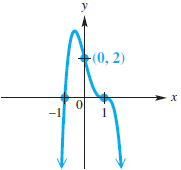
Find a polynomial function f of least degree having the graph shown. (0, 2) -1
Find a polynomial function ƒ(x) of least degree having only real coefficients and zeros as given. Assume multiplicity 1 unless otherwise stated.3 + 2i, -1, and 2
If an object is projected upward from an initial height of 100 ft with an initial velocity of 64 ft per sec, then its height in feet after t seconds is given by s(t) = -16t2 + 64t + 100. Find the number of seconds it will take the object to reach its maximum height. What is this maximum height?
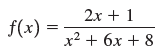
Graph each rational function. 2х + 1 f(x) : x2 + 6х + 8
The remainder theorem indicates that when a polynomial ƒ(x) is divided by x - k, the remainder is equal to ƒ(k). For ƒ(x) = x3 - 2x2 - x + 2, use the remainder theorem to find each of the following. Then determine the coordinates of the corresponding point on the graph of ƒ(x).ƒ(1)
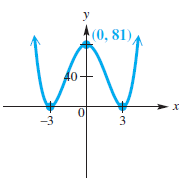
Find a polynomial function f of least degree having the graph shown. A(0, 81) 40 -3 3
Find a polynomial function ƒ(x) of least degree having only real coefficients and zeros as given. Assume multiplicity 1 unless otherwise stated.2 and 3 + i
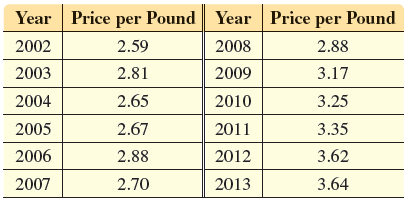
The average price in dollars of a pound of chocolate chip cookies from 2002 to 2013 is shown in the table.The data are modeled by the quadratic function ƒ(x) = 0.0095x2 - 0.0076x + 2.660, where x = 0 corresponds to 2002 and ƒ(x) is the price in dollars. If this model continues to apply, what will
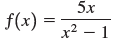
Graph each rational function. 5x f(x) : x2 – 1
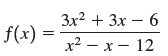
Graph each rational function. Зx2 + 3x — 6 х2 — х — 12 f(x) =
Work each problem.Find a value of c so that y = x2 - 10x + c has exactly one x-intercept.
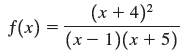
Graph each rational function. (x + 4)² | f(x) : (x- (x – 1)(x + 5)
Show that the real zeros of each polynomial function satisfy the given conditions.ƒ(x) = 2x5 - x4 + 2x3 - 2x2 + 4x - 4; no real zero greater than 1
Use synthetic division to decide whether the given number k is a zero of the polynomial function. If it is not, give the value of ƒ(k).ƒ(x) = x2 - 2x + 2; k = 1 - i
Identify any vertical, horizontal, or oblique asymptotes in the graph of y = ƒ(x). State the domain of ƒ. 1. -3
Work each problem.Suppose p varies directly as r3 and inversely as t2. If r is halved and t is doubled, what happens to p?
Solve each problem. Give approximations to the nearest hundredth.A toy rocket (not internally powered) is launched straight up from the top of a building 50 ft tall at an initial velocity of 200 ft per sec.(a) Give the function that describes the height of the rocket in terms of time t.(b)
Use synthetic division to decide whether the given number k is a zero of the polynomial function. If it is not, give the value of ƒ(k). 2; k%3 f(x) 16х4 + 3x? — —
For each polynomial function, (a) list all possible rational zeros, (b) find all rational zeros, and (c) factor ƒ(x) into linear factors.Zero of -3 having multiplicity 3; ƒ(3) = 36
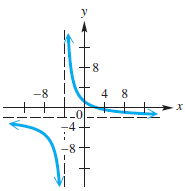
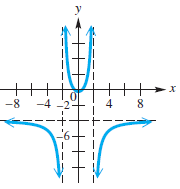
Identify any vertical, horizontal, or oblique asymptotes in the graph of y = ƒ(x). State the domain of ƒ. -8- -8 4 8 4) |-- |
Work each problem.Suppose y is inversely proportional to x, and x is tripled. What happens to y?
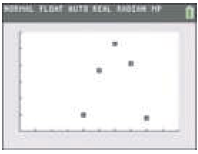
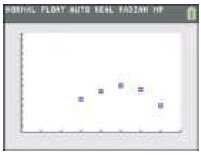
In each scatter diagram, tell whether a linear or a quadratic model is appropriate for the data. If linear, tell whether the slope should be positive or negative. If quadratic, tell whether the leading coefficient of x2 should be positive or negative.Newborns with AIDS as a function of time FLOE
For each polynomial function, (a) list all possible rational zeros, (b) find all rational zeros, and (c) factor ƒ(x) into linear factors.Zeros of 2, -3, and 5; ƒ(3) = 6
Use the intermediate value theorem to show that each polynomial function has a real zero between the numbers given.ƒ(x) = x5 + 2x4 + x3 + 3; -1.8 and -1.7
Use synthetic division to decide whether the given number k is a zero of the polynomial function. If it is not, give the value of ƒ(k). f(x) = 5x4 + 2.x³ – x + 3; k = 5
Identify any vertical, horizontal, or oblique asymptotes in the graph of y = ƒ(x). State the domain of ƒ. х -8 -4
Work each problem.Suppose y is directly proportional to x, and x is replaced by 1/3 x. What happens to y?
In each scatter diagram, tell whether a linear or a quadratic model is appropriate for the data. If linear, tell whether the slope should be positive or negative. If quadratic, tell whether the leading coefficient of x2 should be positive or negative.Social Security assets as a function of time AL
For each polynomial function, (a) list all possible rational zeros, (b) find all rational zeros, and (c) factor ƒ(x) into linear factors.Zeros of -2, 1, and 0; ƒ(-1) = -1
Use the intermediate value theorem to show that each polynomial function has a real zero between the numbers given.ƒ(x) = x4 - 4x3 - 20x2 + 32x + 12; -1 and 0
Use synthetic division to decide whether the given number k is a zero of the polynomial function. If it is not, give the value of ƒ(k).ƒ(x) = 2x3 - 3x2 - 5x; k = 0
Showing 14300 - 14400
of 16373
First
137
138
139
140
141
142
143
144
145
146
147
148
149
150
151
Last
Step by Step Answers

 Get 50% OFF
Claim Now
Get 50% OFF
Claim Now