New Semester
Started
Get
50% OFF
Study Help!
--h --m --s
Claim Now
Question Answers
Textbooks
Find textbooks, questions and answers
Oops, something went wrong!
Change your search query and then try again
S
Books
FREE
Study Help
Expert Questions
Accounting
General Management
Mathematics
Finance
Organizational Behaviour
Law
Physics
Operating System
Management Leadership
Sociology
Programming
Marketing
Database
Computer Network
Economics
Textbooks Solutions
Accounting
Managerial Accounting
Management Leadership
Cost Accounting
Statistics
Business Law
Corporate Finance
Finance
Economics
Auditing
Tutors
Online Tutors
Find a Tutor
Hire a Tutor
Become a Tutor
AI Tutor
AI Study Planner
NEW
Sell Books
Search
Search
Sign In
Register
study help
mathematics
college algebra
College Algebra 12th edition Margaret L. Lial, John Hornsby, David I. Schneider, Callie Daniels - Solutions
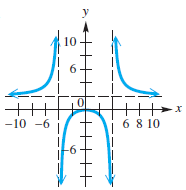
Identify any vertical, horizontal, or oblique asymptotes in the graph of y = ƒ(x). State the domain of ƒ. 10 -10 -6 i 68 10
Work each problem.What happens to y if y varies directly as x, and x is halved?
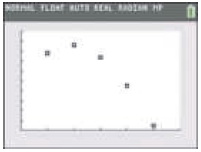
In each scatter diagram, tell whether a linear or a quadratic model is appropriate for the data. If linear, tell whether the slope should be positive or negative. If quadratic, tell whether the leading coefficient of x2 should be positive or negative.Height of an object projected upward as a
For each polynomial function, (a) list all possible rational zeros, (b) find all rational zeros, and (c) factor ƒ(x) into linear factors.Zeros of 1, -1, and 0; ƒ(2) = 3
Use the intermediate value theorem to show that each polynomial function has a real zero between the numbers given.ƒ(x) = x4 - 2x3 - 2x2 - 18x + 5; 3.7 and 3.8
Use synthetic division to decide whether the given number k is a zero of the polynomial function. If it is not, give the value of ƒ(k).ƒ(x) = x3 + 7x2 + 10x; k = 0
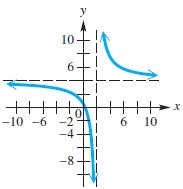
Identify any vertical, horizontal, or oblique asymptotes in the graph of y = ƒ(x). State the domain of ƒ. y 10 6 10 -10 -6 -2 -4 -8
Work each problem.What happens to y if y varies inversely as x, and x is doubled?
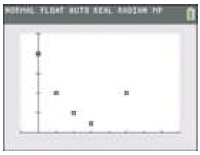
In each scatter diagram, tell whether a linear or a quadratic model is appropriate for the data. If linear, tell whether the slope should be positive or negative. If quadratic, tell whether the leading coefficient of x2 should be positive or negative. FLOA
For each polynomial function, (a) list all possible rational zeros, (b) find all rational zeros, and (c) factor ƒ(x) into linear factors.Zeros of -3, 1, and 4; ƒ(2) = 30
A ball is projected directly upward from an initial height of 200 ft with an initial velocity of 64 ft per sec.(a) Use the function s(t) = -16t2 + v0t + s0 to describe the height of the ball in terms of time t.(b) For what interval of time is the height of the ball greater than 240 ft? Round to the
Find a rational function ƒ having a graph with the given features.x-intercepts: (-1, 0) and (3, 0)y-intercept: (0, -3)Vertical asymptote: x = 1Horizontal asymptote: y = 1
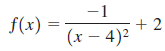
Explain how the graph of each function can be obtained from the graph of y = 1/x or y = 1/x2. Then graph f and give the (a) Domain (b) Range. Determine the largest open intervals of the domain over which the function is (c) Increasing (d) Decreasing. f(x) = -1 (x-4) +2
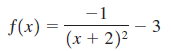
Explain how the graph of each function can be obtained from the graph of y = 1/x or y = 1/x2. Then graph f and give the (a) Domain (b) Range. Determine the largest open intervals of the domain over which the function is (c) Increasing (d) Decreasing. f(x) = -1 (x + 2) - 3
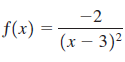
Explain how the graph of each function can be obtained from the graph of y = 1/x or y = 1/x2. Then graph f and give the (a) Domain (b) Range. Determine the largest open intervals of the domain over which the function is (c) Increasing (d) Decreasing. f(x) = -2 (x - 3)
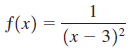
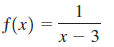
Explain how the graph of each function can be obtained from the graph of y = 1/x or y = 1/x2. Then graph f and give the (a) Domain (b) Range. Determine the largest open intervals of the domain over which the function is (c) Increasing (d) Decreasing. f(x) 1 (x - 3)
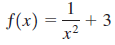
Explain how the graph of each function can be obtained from the graph of y = 1/x or y = 1/x2. Then graph f and give the (a) Domain (b) Range. Determine the largest open intervals of the domain over which the function is (c) Increasing (d) Decreasing. 1 $|- f(x) = - X' +3
Explain how the graph of each function can be obtained from the graph of y = 1/x or y = 1/x2. Then graph f and give the (a) Domain (b) Range. Determine the largest open intervals of the domain over which the function is (c) Increasing (d) Decreasing. f(x) = 2 X
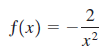
Explain how the graph of each function can be obtained from the graph of y = 1/x or y = 1/x2. Then graph f and give the (a) Domain (b) Range. Determine the largest open intervals of the domain over which the function is (c) Increasing (d) Decreasing. f(x) = - X 2
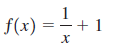
Explain how the graph of each function can be obtained from the graph of y = 1/x or y = 1/x2. Then graph f and give the (a) Domain (b) Range. Determine the largest open intervals of the domain over which the function is (c) Increasing (d) Decreasing. f(x) = X +1
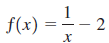
Explain how the graph of each function can be obtained from the graph of y = 1/x or y = 1/x2. Then graph f and give the (a) Domain (b) Range. Determine the largest open intervals of the domain over which the function is (c) Increasing (d) Decreasing. f(x) x 1 - 3
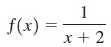
Explain how the graph of each function can be obtained from the graph of y = 1/x or y = 1/x2. Then graph f and give the (a) Domain (b) Range. Determine the largest open intervals of the domain over which the function is (c) Increasing (d) Decreasing. f(x) = = 1 x + 2
Explain how the graph of each function can be obtained from the graph of y = 1/x or y = 1/x2. Then graph f and give the (a) Domain (b) Range. Determine the largest open intervals of the domain over which the function is (c) Increasing (d) Decreasing. f(x) = 3 X
Explain how the graph of each function can be obtained from the graph of y = 1/x or y = 1/x2. Then graph f and give the (a) Domain (b) Range. Determine the largest open intervals of the domain over which the function is (c) Increasing (d) Decreasing. f(x) = al 2 X
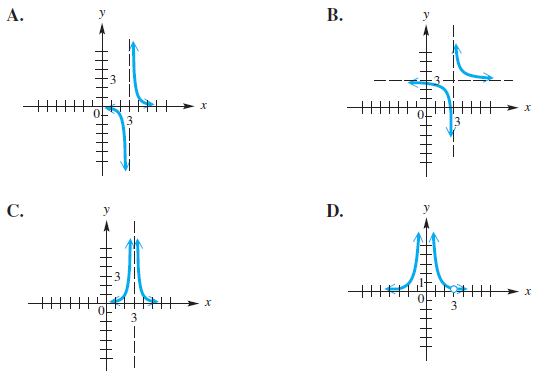
Use the graphs of the rational functions in choices A–D to answer each question. There may be more than one correct choice.Which choices are symmetric with respect to a vertical line? B. A. х C. D. 3. 3. 3.
Use the graphs of the rational functions in choices A–D to answer each question. There may be more than one correct choice.Which choices have the x-axis as a horizontal asymptote? B. A. х C. D. 3. 3. 3.
Use the graphs of the rational functions in choices A–D to answer each question. There may be more than one correct choice.Which choices have domain (-∞, 0) ∪ (0, 3) ∪ (3, ∞)? B. A. х C. D. 3. 3. 3.
Use the graphs of the rational functions in choices A–D to answer each question. There may be more than one correct choice.If ƒ represents the function, only one choice has a single solution to the equation ƒ(x) = 3. Which one is it? B. A. х C. D. 3. 3. 3.
Use the graphs of the rational functions in choices A–D to answer each question. There may be more than one correct choice.Which choices have range (0, ∞)? B. A. х C. D. 3. 3. 3.
Use the graphs of the rational functions in choices A–D to answer each question. There may be more than one correct choice.Which choices have range (-∞, 0) ∪ (0, ∞)? B. A. х C. D. 3. 3. 3.
Use the graphs of the rational functions in choices A–D to answer each question. There may be more than one correct choice.Which choices have range (-∞, 3) ∪ (3, ∞)? B. A. х C. D. 3. 3. 3.
Use the graphs of the rational functions in choices A–D to answer each question. There may be more than one correct choice.Which choices have domain (-∞, 3) ∪ (3, ∞)? B. A. х C. D. 3. 3. 3.
Provide a short answer to each question.Is ƒ(x) = 1/x an even or an odd function? What symmetry does its graph exhibit?
Provide a short answer to each question.Is ƒ(x) = 1/x2 an even or an odd function? What symmetry does its graph exhibit?
Provide a short answer to each question.What is the equation of the vertical asymptote of the graph of y = 1/(x + 2 )2 - 4? Of the horizontal asymptote?
Provide a short answer to each question.What is the equation of the vertical asymptote of the graph of y = 1/x - 3 + 2? Of the horizontal asymptote?
Provide a short answer to each question.What is the largest open interval of the domain over which the function ƒ(x) = 1/x2 increases? decreases? is constant?
Provide a short answer to each question.What is the largest open interval of the domain over which the function ƒ(x) = 1/x increases? decreases? is constant?
Provide a short answer to each question.What is the domain of the function ƒ(x) = 1/x2 ? What is its range?
Provide a short answer to each question.What is the domain of the function ƒ(x) = 1/x? What is its range?
For each polynomial function, complete the following in order.(a) Use Descartes’ rule of signs to determine the different possibilities for the numbers of positive, negative, and nonreal complex zeros.(b) Use the rational zeros theorem to determine the possible rational zeros.(c) Find the
For each polynomial function, complete the following in order.(a) Use Descartes’ rule of signs to determine the different possibilities for the numbers of positive, negative, and nonreal complex zeros.(b) Use the rational zeros theorem to determine the possible rational zeros.(c) Find the
For each polynomial function, complete the following in order.(a) Use Descartes’ rule of signs to determine the different possibilities for the numbers of positive, negative, and nonreal complex zeros.(b) Use the rational zeros theorem to determine the possible rational zeros.(c) Find the
For each polynomial function, complete the following in order.(a) Use Descartes’ rule of signs to determine the different possibilities for the numbers of positive, negative, and nonreal complex zeros.(b) Use the rational zeros theorem to determine the possible rational zeros.(c) Find the
For each polynomial function, complete the following in order.(a) Use Descartes’ rule of signs to determine the different possibilities for the numbers of positive, negative, and nonreal complex zeros.(b) Use the rational zeros theorem to determine the possible rational zeros.(c) Find the
For each polynomial function, complete the following in order.(a) Use Descartes’ rule of signs to determine the different possibilities for the numbers of positive, negative, and nonreal complex zeros.(b) Use the rational zeros theorem to determine the possible rational zeros.(c) Find the
For each polynomial function, complete the following in order.(a) Use Descartes’ rule of signs to determine the different possibilities for the numbers of positive, negative, and nonreal complex zeros.(b) Use the rational zeros theorem to determine the possible rational zeros.(c) Find the
For each polynomial function, complete the following in order.(a) Use Descartes’ rule of signs to determine the different possibilities for the numbers of positive, negative, and nonreal complex zeros.(b) Use the rational zeros theorem to determine the possible rational zeros.(c) Find the
For each polynomial function, complete the following in order.(a) Use Descartes’ rule of signs to determine the different possibilities for the numbers of positive, negative, and nonreal complex zeros.(b) Use the rational zeros theorem to determine the possible rational zeros.(c) Find the
For each polynomial function, complete the following in order.(a) Use Descartes’ rule of signs to determine the different possibilities for the numbers of positive, negative, and nonreal complex zeros.(b) Use the rational zeros theorem to determine the possible rational zeros.(c) Use synthetic
For each polynomial function, complete the following in order.(a) Use Descartes’ rule of signs to determine the different possibilities for the numbers of positive, negative, and nonreal complex zeros.(b) Use the rational zeros theorem to determine the possible rational zeros.(c) Use synthetic
For each polynomial function, complete the following in order.(a) Use Descartes’ rule of signs to determine the different possibilities for the numbers of positive, negative, and nonreal complex zeros.(b) Use the rational zeros theorem to determine the possible rational zeros.(c) Use synthetic
For each polynomial function, complete the following in order.(a) Use Descartes’ rule of signs to determine the different possibilities for the numbers of positive, negative, and nonreal complex zeros.(b) Use the rational zeros theorem to determine the possible rational zeros.(c) Use synthetic
For each polynomial function, complete the following in order.(a) Use Descartes’ rule of signs to determine the different possibilities for the numbers of positive, negative, and nonreal complex zeros.(b) Use the rational zeros theorem to determine the possible rational zeros.(c) Use synthetic
For each polynomial function, complete the following in order.(a) Use Descartes’ rule of signs to determine the different possibilities for the numbers of positive, negative, and nonreal complex zeros.(b) Use the rational zeros theorem to determine the possible rational zeros.(c) Use synthetic
For each polynomial function, complete the following in order.(a) Use Descartes’ rule of signs to determine the different possibilities for the numbers of positive, negative, and nonreal complex zeros.(b) Use the rational zeros theorem to determine the possible rational zeros.(c) Use synthetic
For each polynomial function, complete the following in order.(a) Use Descartes’ rule of signs to determine the different possibilities for the numbers of positive, negative, and nonreal complex zeros.(b) Use the rational zeros theorem to determine the possible rational zeros.(c) Use synthetic
For each polynomial function, complete the following in order.(a) Use Descartes’ rule of signs to determine the different possibilities for the numbers of positive, negative, and nonreal complex zeros.(b) Use the rational zeros theorem to determine the possible rational zeros.(c) Use synthetic
For each polynomial function, complete the following in order.(a) Use Descartes’ rule of signs to determine the different possibilities for the numbers of positive, negative, and nonreal complex zeros.(b) Use the rational zeros theorem to determine the possible rational zeros.(c) Use synthetic
The polynomial function ƒ(x) = 2x5 + 3x4 - 8x3 - 5x + 6 has three variations in sign.Determine whether each statement is true or false. If false, explain why.
A polynomial function having degree 6 and only real coefficients may have no real zeros.Determine whether each statement is true or false. If false, explain why.
Determine whether each statement is true or false. If false, explain why.Because 2 + 3i is a zero of ƒ(x) = x2 - 4x + 13, we can conclude that 2 - 3i is also a zero.
Determine whether each statement is true or false. If false, explain why.For ƒ(x) = (x + 2)4(x - 3), the number 2 is a zero of multiplicity 4.
Determine whether each statement is true or false. If false, explain why.Because ƒ(1) = 0 for ƒ(x) = x6 - x4 + 2x2 - 2, we can conclude that x - 1 is a factor of ƒ(x).
Determine whether each statement is true or false. If false, explain why.Because x - 1 is a factor of ƒ(x) = x6 - x4 + 2x2 - 2, we can also conclude that ƒ(1) = 0.
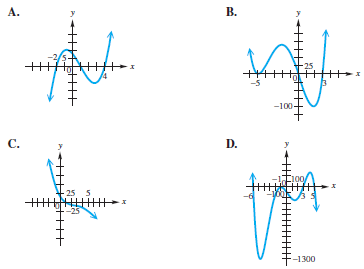
Comprehensive graphs of four polynomial functions are shown in A–D. They represent the graphs of functions defined by these four equations, but not necessarily in the order listed.y = x3 - 3x2 - 6x + 8 y = x4 + 7x3 - 5x2 - 75xy = -x3 + 9x2 - 27x + 17 y = -x5 + 36x3 - 22x2 - 147x -
Comprehensive graphs of four polynomial functions are shown in A–D. They represent the graphs of functions defined by these four equations, but not necessarily in the order listed.y = x3 - 3x2 - 6x + 8 y = x4 + 7x3 - 5x2 - 75xy = -x3 + 9x2 - 27x + 17 y = -x5 + 36x3 - 22x2 - 147x -
Determine the different possibilities for the numbers of positive, negative, and nonreal complex zeros of each function.ƒ(x) = -8x4 + 3x3 - 6x2 + 5x - 7
Determine the different possibilities for the numbers of positive, negative, and nonreal complex zeros of each function.ƒ(x) = 5x4 + 3x2 + 2x - 9
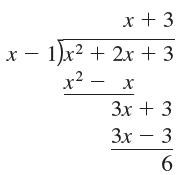
Fill in the blank(s) to correctly complete each sentence.In algebra, the result of the divisioncan be written x2 + 2x + 3 = (x - 1)(_____) + ________. х+3 х — 1)x? + 2х + 3 x? х Зх + 3 Зх — 3 6.
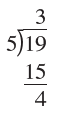
Fill in the blank(s) to correctly complete each sentence.In arithmetic, the result of the divisioncan be written 19 = 5·____ + _______. 3 5)19 15 4
Determine the different possibilities for the numbers of positive, negative, and nonreal complex zeros of each function.ƒ(x) = 4x3 - x2 + 2x - 7
The remainder theorem indicates that when a polynomial ƒ(x) is divided by x - k, the remainder is equal to ƒ(k). For ƒ(x) = x3 - 2x2 - x + 2, use the remainder theorem to find each of the following. Then determine the coordinates of the corresponding point on the graph of ƒ(x).f(3/2)
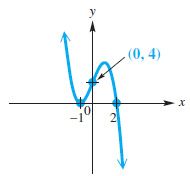
Find a polynomial function f of least degree having the graph shown. y - (0, 4) х 10. -1
Find a polynomial function ƒ(x) of least degree having only real coefficients and zeros as given. Assume multiplicity 1 unless otherwise stated.-1 and 4 - 2i
The quadratic function ƒ(x) = 0.0118x2 + 0.8633x + 317 models the worldwide atmospheric concentration of carbon dioxide in parts per million (ppm) over the period 1960–2013, where x = 0 represents the year 1960. If this model continues to apply, what will be the atmospheric CO2 concentration in
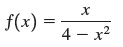
Graph each rational function. f(x) 4 - x2
The remainder theorem indicates that when a polynomial ƒ(x) is divided by x - k, the remainder is equal to ƒ(k). For ƒ(x) = x3 - 2x2 - x + 2, use the remainder theorem to find each of the following. Then determine the coordinates of the corresponding point on the graph of ƒ(x).f(2)
Graph each function in the viewing window specified. Compare the graph to the one shown in the answer section of this text. Then use the graph to find ƒ(1.25).ƒ(x) = 2x(x - 3)(x + 2); window: [-3, 4] by [-20, 12]
Find a polynomial function ƒ(x) of least degree having only real coefficients and zeros as given. Assume multiplicity 1 unless otherwise stated.1 - √2, 1 + √2, and 1 - i
The total amount spent by Americans on shoes and clothing from 2000 to 2013 can be modeled by ƒ(x) = 0.7714x2 - 3.693x + 297.9, where x = 0 represents 2000 and ƒ(x) is in billions of dollars. Based on this model, in what year did spending on shoes and clothing reach a minimum?
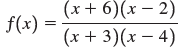
Graph each rational function. (x+ 6)(x – 2) -2) f(x) (x + 3)(x – 4)
The remainder theorem indicates that when a polynomial ƒ(x) is divided by x - k, the remainder is equal to ƒ(k). For ƒ(x) = x3 - 2x2 - x + 2, use the remainder theorem to find each of the following. Then determine the coordinates of the corresponding point on the graph of ƒ(x).ƒ(3)
Graph each function in the viewing window specified. Compare the graph to the one shown in the answer section of this text. Then use the graph to find ƒ(1.25).ƒ(x) = x2(x - 2)(x + 3)2; window: [-4, 3] by [-24, 4]
Find a polynomial function ƒ(x) of least degree having only real coefficients and zeros as given. Assume multiplicity 1 unless otherwise stated.2 + √3, 2 - √3, and 2 + 3i
According to data from the National Highway Traffic Safety Administration, the accident rate as a function of the age of the driver in years x can be approximated by the function ƒ(x) = 0.0232x2 - 2.28x + 60.0, for 16 ≤ x ≤ 85. Find both the age at which the accident rate is a minimum and the
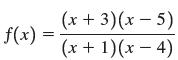
Graph each rational function. ( (x + 3)(x – 5) f(x) = (x + 1)(x – 4)
Use the results from Exercises to plot eight points on the graph of ƒ(x). Join these points with a smooth curve.
Graph each function in the viewing window specified. Compare the graph to the one shown in the answer section of this text. Then use the graph to find ƒ(1.25).ƒ(x) = (3x - 1)(x + 2)2; window: [-4, 2] by [-15, 15]
Find a polynomial function ƒ(x) of least degree having only real coefficients and zeros as given. Assume multiplicity 1 unless otherwise stated.2 - i and 6 - 3i
The table lists total fall enrollments in degree-granting postsecondary colleges in the United States for selected years.(a) Plot the data. Let x = 0 correspond to the year 2008.(b) Find a quadratic function ƒ(x) = ax2 + bx + c that models the data.(c) Plot the data together with ƒ in the same
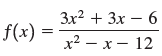
Graph each rational function. Зx2 + 3x — 6 f(x) = х2 — х— 12 %3D
Apply the method above to graph ƒ(x) = -x3 - x2 + 2x. Use x-values -3, -1, 1/2, and 2 and the fact that ƒ(0) = 0.
Graph each function in the viewing window specified. Compare the graph to the one shown in the answer section of this text. Then use the graph to find ƒ(1.25).ƒ(x) = x3 + 5x2 - x - 5; window: [-6, 2] by [-30, 30]
Find a polynomial function ƒ(x) of least degree having only real coefficients and zeros as given. Assume multiplicity 1 unless otherwise stated.5 + i and 4 - i
The table lists total fall enrollments in degree-granting two-year colleges in the United States for selected years.(a) Plot the data. Let x = 0 correspond to the year 2008.(b) Find a quadratic function g(x) = ax2 + bx + c that models the data.(c) Plot the data together with g in the same window.
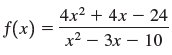
Graph each rational function. 4x2 + 4x – 24 4х — x2 — Зх — 10 f(x)
Approximate the real zero discussed in each specified exercise.Exercise 47ƒ(x) = 2x2 - 7x + 4; 2 and 3
Find a polynomial function ƒ(x) of least degree having only real coefficients and zeros as given. Assume multiplicity 1 unless otherwise stated.4, 1 - 2i, and 3 + 4i
The table lists the percent of the U.S. population that was foreign-born for selected years.(a) Plot the data. Let x = 0 correspond to the year 1930, x = 10 correspond to 1940, and so on.(b) Find a quadratic function ƒ(x) = a(x - h)2 + k that models the data. Use 140, 4.72 as the vertex and 120,
Showing 14400 - 14500
of 16373
First
138
139
140
141
142
143
144
145
146
147
148
149
150
151
152
Last
Step by Step Answers

 Get 50% OFF
Claim Now
Get 50% OFF
Claim Now