New Semester
Started
Get
50% OFF
Study Help!
--h --m --s
Claim Now
Question Answers
Textbooks
Find textbooks, questions and answers
Oops, something went wrong!
Change your search query and then try again
S
Books
FREE
Study Help
Expert Questions
Accounting
General Management
Mathematics
Finance
Organizational Behaviour
Law
Physics
Operating System
Management Leadership
Sociology
Programming
Marketing
Database
Computer Network
Economics
Textbooks Solutions
Accounting
Managerial Accounting
Management Leadership
Cost Accounting
Statistics
Business Law
Corporate Finance
Finance
Economics
Auditing
Tutors
Online Tutors
Find a Tutor
Hire a Tutor
Become a Tutor
AI Tutor
AI Study Planner
NEW
Sell Books
Search
Search
Sign In
Register
study help
mathematics
college algebra
College Algebra 12th edition Margaret L. Lial, John Hornsby, David I. Schneider, Callie Daniels - Solutions
Approximate the real zero discussed in each specified exercise.Exercise 49ƒ(x) = 2x3 - 5x2 - 5x + 7; 0 and 1
Find a polynomial function ƒ(x) of least degree having only real coefficients and zeros as given. Assume multiplicity 1 unless otherwise stated.-1, 5 - i, and 1 + 4i
Selected values of the stopping distance y, in feet, of a car traveling x miles per hour are given in the table.(a) Plot the data.(b) The quadratic function ƒ(x) = 0.056057x2 + 1.06657x is one model that has been used to approximate stopping distances. Find ƒ(45) to the nearest foot, and
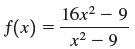
Graph each rational function. 16x2 – 9 f(x) x2 – 9
Approximate the real zero discussed in each specified exercise.Exercise 51ƒ(x) = 2x4 - 4x2 + 4x - 8; 1 and 2
Find a polynomial function ƒ(x) of least degree having only real coefficients and zeros as given. Assume multiplicity 1 unless otherwise stated.1 + 2i and 2 (multiplicity 2)
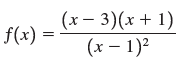
Graph each rational function. (x – 3)(x + 1) f(x) = (x – 1)2
Approximate the real zero discussed in each specified exercise.Exercise 50 ƒ(x) = 2x3 - 9x2 + x + 20; 2 and 2.5
Find a polynomial function ƒ(x) of least degree having only real coefficients and zeros as given. Assume multiplicity 1 unless otherwise stated.2 + i and -3 (multiplicity 2)
Work each problem.For what values of a does y = ax2 - 8x + 4 have no x-intercepts?
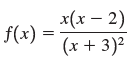
Graph each rational function. x(х — 2) f(x) = (х + 3)?
For the given polynomial function, approximate each zero as a decimal to the nearest tenth.ƒ(x) = x3 + 3x2 - 2x - 6
Determine the different possibilities for the numbers of positive, negative, and nonreal complex zeros of each function.ƒ(x) = 2x3 - 4x2 + 2x + 7
Work each problem.Define the quadratic function ƒ having x-intercepts (2, 0) and 15, 02 and y-intercept (0, 5).
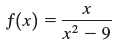
Graph each rational function. х f(x) = х2 — 9
For the given polynomial function, approximate each zero as a decimal to the nearest tenth.ƒ(x) = x3 - 3x + 3
Determine the different possibilities for the numbers of positive, negative, and nonreal complex zeros of each function.ƒ(x) = x3 + 2x2 + x - 10
Work each problem.Define the quadratic function ƒ having x-intercepts (1, 0) and (-2, 0) and y-intercept (0, 4).
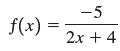
Graph each rational function. -5 f(x) : 2х + 4
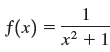
Graph each rational function. f(x) x² + 1
For the given polynomial function, approximate each zero as a decimal to the nearest tenth.ƒ(x) = -2x4 - x2 + x + 5
Work each problem.The distance between the two points P(x1, y1) and R(x2, y2) isFind the closest point on the line y = 2x to the point 11, 72. Every point on y = 2x has the form (x, 2x), and the closest point has the minimum distance. d(P, R) = V(x – x2)² + (yı – Y2)². Distance formula
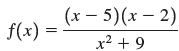
Graph each rational function. (x – 5)(x – 2) x² + 9 | f(x) :
Determine the different possibilities for the numbers of positive, negative, and nonreal complex zeros of each function.ƒ(x) = 3x3 + 6x2 + x + 7
For the given polynomial function, approximate each zero as a decimal to the nearest tenth.ƒ(x) = -x4 + 2x3 + 3x2 + 6
A quadratic equation ƒ(x) = 0 has a solution x = 2. Its graph has vertex (5, 3). What is the other solution of the equation?
Use a graphing calculator to find the coordinates of the turning points of the graph of each polynomial function in the given domain interval. Give answers to the nearest hundredth.ƒ(x) = 2x3 - 5x2 - x + 1; [-1, 0]
A quadratic inequality such as x2 + 2x - 8 < 0 can be solved by first solving the related quadratic equation x2 + 2x - 8 = 0, identifying intervals determined by the solutions of this equation, and then using a test value from each interval to determine which intervals form the solution
Determine the different possibilities for the numbers of positive, negative, and nonreal complex zeros of each function.ƒ(x) = 3x4 + 2x3 - 8x2 - 10x - 1
Use a graphing calculator to find the coordinates of the turning points of the graph of each polynomial function in the given domain interval. Give answers to the nearest hundredth.ƒ(x) = x3 + 4x2 - 8x - 8; [0.3, 1]
The real solutions of x2 + 2x - 8 = 0 are the x-values of the x-intercepts of the graph in Exercise 83. These are values of x for which ƒ(x) = 0. What are these values? What is the solution set of this equation?Exercise 83.Graph ƒ(x) = x2 + 2x - 8.
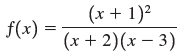
Graph each rational function. (x + 1)2 f(x) (x + 2)(x – 3) =
Use a graphing calculator to find the coordinates of the turning points of the graph of each polynomial function in the given domain interval. Give answers to the nearest hundredth.ƒ(x) = 2x3 - 5x2 - x + 1; [1.4, 2]
The real solutions of x2 + 2x - 8 > 0 are the x-values for which the graph in Exercise 83 lies below the x-axis. These are values of x for which ƒ(x) > 0 is true. What interval of x-values represents the solution set of this inequality?Exercise 83Graph ƒ(x) = x2 + 2x - 8.
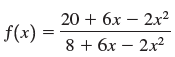
Graph each rational function. 20+ 6х — 2x2 f(x) : 8 + 6х — 2х2
Determine the different possibilities for the numbers of positive, negative, and nonreal complex zeros of each function.ƒ(x) = 6x4 + 2x3 + 9x2 + x + 5
Use a graphing calculator to find the coordinates of the turning points of the graph of each polynomial function in the given domain interval. Give answers to the nearest hundredth.ƒ(x) = x3 - x + 3; [-1, 0]
The real solutions of x2 + 2x - 8 > 0 are the x-values for which the graph in Exercise 83 lies above the x-axis. These are values of x for which ƒ(x) > 0 is true. What intervals of x-values represent the solution set of this inequality?Exercise 83Graph ƒ(x) = x2 + 2x - 8.
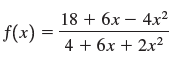
Graph each rational function. 18 + 6x – 4x2 f(x) = 4 + 6x + 2x2
Determine the different possibilities for the numbers of positive, negative, and nonreal complex zeros of each function.ƒ(x) = x5 + 3x4 - x3 + 2x + 3
Use a graphing calculator to find the coordinates of the turning points of the graph of each polynomial function in the given domain interval. Give answers to the nearest hundredth.ƒ(x) = x3 + 4x2 - 8x - 8; [-3.8, -3]
Determine the different possibilities for the numbers of positive, negative, and nonreal complex zeros of each function.ƒ(x) = -2x5 + 10x4 - 6x3 + 8x2 - x + 1
Refer to Exercise 97. If a ball has a 20-cm diameter, then the function becomesThis function can be used to determine the depth that the ball sinks in water. Find the depth that this size ball sinks when d = 0.6. Round to the nearest hundredth.Exercise 97The polynomial functioncan be used to find
Find a rational function ƒ having a graph with the given features.x-intercepts: (1, 0) and (3, 0)y-intercept: noneVertical asymptotes: x = 0 and x = 2Horizontal asymptote: y = 1
Consider the following “monster” rational function.Analyzing this function will synthesize many of the concepts of this and earlier sections.(a) What is the common factor in the numerator and the denominator?(b) For what value of x will there be a point of discontinuity (i.e., a hole)? x* –
In 1545, a method of solving a cubic equation of the form x3 + mx = n, developed by Niccolo Tartaglia, was published in the Ars Magna, a work by Girolamo Cardano. The formula for finding the one real solution of the equation isx3 + 15x = 124 2 2 3 n n -n m + ()*+G) -+ G* +G) 3 3 x = 2 3 2 3 m 3
Graph each quadratic function. Give the vertex, axis, domain, range, and largest open intervals of the domain over which the function is increasing or decreasing.(a) ƒ(x) = -2(x + 3)2 - 1 (b) ƒ(x) = 2x2 - 8x + 3
Consider the following “monster” rational function.Analyzing this function will synthesize many of the concepts of this and earlier sections.What is the y-intercept of the graph of ƒ? x* – 3x3 – 21x² + 43x + 60 f(x) = x4 – 6x3 + x² + 24x – 20
Consider the following “monster” rational function.Analyzing this function will synthesize many of the concepts of this and earlier sections.Find the equations of the vertical asymptotes. x* – 3x3 – 21x² + 43x + 60 f(x) = x4 – 6x3 + x² + 24x – 20
Consider the following “monster” rational function.Analyzing this function will synthesize many of the concepts of this and earlier sections.Determine the point or points of intersection of the graph of ƒ with its horizontal asymptote. x* – 3x3 – 21x² + 43x + 60 f(x) = x4 – 6x3 + x² +
Consider the following “monster” rational function.Analyzing this function will synthesize many of the concepts of this and earlier sections.Sketch the graph of ƒ. x* – 3x3 – 21x² + 43x + 60 f(x) = x4 – 6x3 + x² + 24x – 20
Consider the following “monster” rational function.Analyzing this function will synthesize many of the concepts of this and earlier sections.Use the graph of ƒ to solve each inequality.(a) ƒ(x) < 0 (b) ƒ(x) > 0 x* – 3x3 – 21x² + 43x + 60 f(x) = x4 – 6x3 + x² + 24x – 20
Use the technique described in Exercises to solve each inequality. Write the solution set in interval notation.x2 - x - 6 < 0
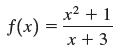
Graph each rational function. x2 + 1 f(x)
Determine the different possibilities for the numbers of positive, negative, and nonreal complex zeros of each function.ƒ(x) = 2x5 - x4 + x3 - x2 + x + 5
Use a graphing calculator to find the coordinates of the turning points of the graph of each polynomial function in the given domain interval. Give answers to the nearest hundredth.ƒ(x) = x4 - 7x3 + 13x2 + 6x - 28; [-1, 0]
Use the technique described in Exercises to solve each inequality. Write the solution set in interval notation.x2 - 9x + 20 < 0
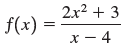
Graph each rational function. 2x2 + 3 f(x) = х — 4 4
Determine the different possibilities for the numbers of positive, negative, and nonreal complex zeros of each function.ƒ(x) = 2x5 - 7x3 + 6x + 8
Use the technique described in Exercises to solve each inequality. Write the solution set in interval notation.2x2 - 9x ≥ 18
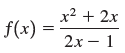
Graph each rational function. x² + 2x f(x) 2х — 1
Determine the different possibilities for the numbers of positive, negative, and nonreal complex zeros of each function.ƒ(x) = 11x5 - x3 + 7x - 5
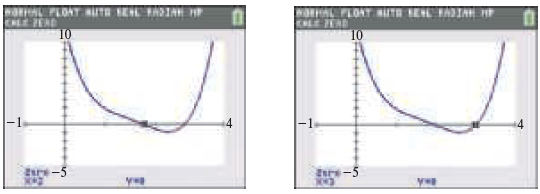
A comprehensive graph of ƒ(x) = x4 - 7x3 + 18x2 - 22x + 12 is shown in the two screens, along with displays of the two real zeros. Find the two remaining nonreal complex zeros. PLORT TH EE TASIAH HP KHLE PERD CRLE PERD 10 Ere-5 re-5
Use the technique described in Exercises to solve each inequality. Write the solution set in interval notation.3x2 + x ≥ 4
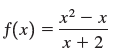
Graph each rational function. x2 – x f(x) x + 2
Determine the different possibilities for the numbers of positive, negative, and nonreal complex zeros of each function.ƒ(x) = 5x6 - 6x5 + 7x3 - 4x2 + x + 2
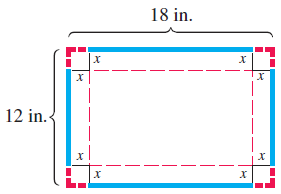
The following exercises are geometric in nature and lead to polynomial models. Solve each problem.A rectangular piece of cardboard measuring 12 in. by 18 in. is to be made into a box with an open top by cutting equal-size squares from each corner and folding up the sides. Let x represent the length
Use the technique described in Exercises to solve each inequality. Write the solution set in interval notation.-x2 + 4x + 1 ≥ 0
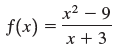
Graph each rational function. x2 – 9 f(x) x + 3
Determine the different possibilities for the numbers of positive, negative, and nonreal complex zeros of each function.ƒ(x) = 9x6 - 7x4 + 8x2 + x + 6
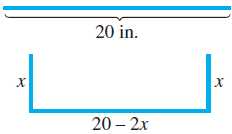
A piece of rectangular sheet metal is 20 in. wide. It is to be made into a rain gutter by turning up the edges to form parallel sides. Let x represent the length of each of the parallel sides. Give approximations to the nearest hundredth.(a) Give the restrictions on x.(b) Determine a function A
Use the technique described in Exercises to solve each inequality. Write the solution set in interval notation.-x2 + 2x + 6 > 0
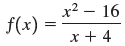
Graph each rational function. x2 – 16 f(x) x + 4
Determine the different possibilities for the numbers of positive, negative, and nonreal complex zeros of each function.ƒ(x) = 7x5 + 6x4 + 2x3 + 9x2 + x + 5
A certain right triangle has area 84 in.2. One leg of the triangle measures 1 in. less than the hypotenuse. Let x represent the length of the hypotenuse.(a) Express the length of the leg mentioned above in terms of x. Give the domain of x.(b) Express the length of the other leg in terms of x.(c)
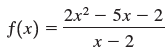
Graph each rational function. 2x? — 5х — 2 х — 2 f(x) :
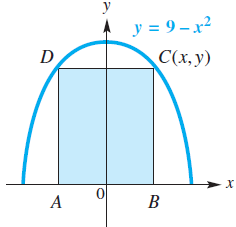
Find the value of x in the figure that will maximize the area of rectangle ABCD. Round to the nearest thousandth. y у 3 9-х2 С х, у) y = 9 – D х B
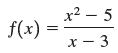
Graph each rational function. x2 – 5 f(x)
Find all complex zeros of each polynomial function. Give exact values. List multiple zeros as necessary.ƒ(x) = x4 + 2x3 - 3x2 + 24x - 180
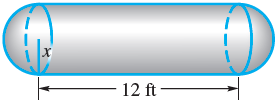
A storage tank for butane gas is to be built in the shape of a right circular cylinder of altitude 12 ft, with a half sphere attached to each end. If x represents the radius of each half sphere, what radius should be used to cause the volume of the tank to be 144p ft3? 12 ft
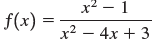
Graph each rational function. x² – 1 f(x) x2 – 4x + 3
Find all complex zeros of each polynomial function. Give exact values. List multiple zeros as necessary.ƒ(x) = x3 - x2 - 8x + 12
A standard piece of notebook paper measuring 8.5 in. by 11 in. is to be made into a box with an open top by cutting equal-size squares from each corner and folding up the sides. Let x represent the length of a side of each such square in inches. Use the table feature of a graphing calculator to do
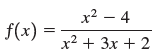
Graph each rational function. x2 – 4 | f(x) = х2 + 3x + 2
Find all complex zeros of each polynomial function. Give exact values. List multiple zeros as necessary.ƒ(x) = x4 + x3 - 9x2 + 11x - 4
The polynomial functioncan be used to find the depth that a ball 10 cm in diameter sinks in water. The constant d is the density of the ball, where the density of water is 1. The smallest positive zero of ƒ(x) equals the depth that the ball sinks. Approximate this depth for each material and
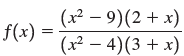
Graph each rational function. 9)(2+ x) (x² (x² – 4)(3 + x) f(x)
Find all complex zeros of each polynomial function. Give exact values. List multiple zeros as necessary.ƒ(x) = x3 - 14x + 8
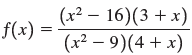
Graph each rational function. (x² – 16)(3 + x) f(x) = (x² – 9)(4 + x)
Find all complex zeros of each polynomial function. Give exact values. List multiple zeros as necessary.ƒ(x) = 2x5 + 11x4 + 16x3 + 15x2 + 36x
To allow enough distance for cars to pass on two-lane highways, engineers calculate minimum sight distances between curves and hills. The table shows the minimum sight distance y in feet for a car traveling at x miles per hour.(a) Make a scatter diagram of the data.(b) Use the regression feature of
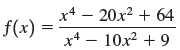
Graph each rational function. x4 – 20x2 + 64 f(x) x4 – 10x? + 9
Find all complex zeros of each polynomial function. Give exact values. List multiple zeros as necessary.ƒ(x) = 3x3 - 9x2 - 31x + 5
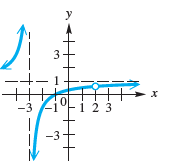
Find a rational function f having the graph shown. y Ki아123 -3 -3
For any function y = ƒ(x), the following hold true.(a) The real solutions of ƒ(x) = 0 correspond to the x-intercepts of the graph.(b) The real solutions of ƒ(x) < 0 are the x-values for which the graph lies below the x-axis.(c) The real solutions of ƒ(x) > 0 are the x-values for which the
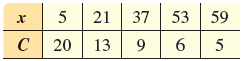
Copper in high doses can be lethal to aquatic life. The table lists copper concentrations in freshwater mussels after 45 days at various distances downstream from an electroplating plant. The concentration C is measured in micrograms of copper per gram of mussel x kilometers downstream.(a) Make a
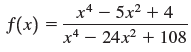
Graph each rational function. 5x2 + 4 x4 – 4 x4 – 24x2 + 108 f(x) =
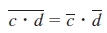
If c and d are complex numbers, prove each statement. c•d=T•d
Find all complex zeros of each polynomial function. Give exact values. List multiple zeros as necessary.ƒ(x) = x5 - 6x4 + 14x3 - 20x2 + 24x - 16
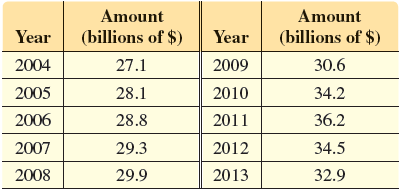
The table lists the annual amount (in billions of dollars) spent by the federal government on health research and training programs over a 10-yr period.Which one of the following provides the best model for these data, where x represents the year?A. ƒ(x) = 0.2(x - 2004)2 + 27.1 B. g(x) = (x -
Showing 14500 - 14600
of 16373
First
139
140
141
142
143
144
145
146
147
148
149
150
151
152
153
Last
Step by Step Answers

 Get 50% OFF
Claim Now
Get 50% OFF
Claim Now