New Semester
Started
Get
50% OFF
Study Help!
--h --m --s
Claim Now
Question Answers
Textbooks
Find textbooks, questions and answers
Oops, something went wrong!
Change your search query and then try again
S
Books
FREE
Study Help
Expert Questions
Accounting
General Management
Mathematics
Finance
Organizational Behaviour
Law
Physics
Operating System
Management Leadership
Sociology
Programming
Marketing
Database
Computer Network
Economics
Textbooks Solutions
Accounting
Managerial Accounting
Management Leadership
Cost Accounting
Statistics
Business Law
Corporate Finance
Finance
Economics
Auditing
Tutors
Online Tutors
Find a Tutor
Hire a Tutor
Become a Tutor
AI Tutor
AI Study Planner
NEW
Sell Books
Search
Search
Sign In
Register
study help
mathematics
college algebra
Intermediate Algebra 13th Edition Margaret Lial, John Hornsby, Terry McGinnis - Solutions
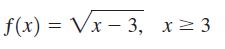
Determine whether each function is one-to-one. If it is, find the inverse. f(x) = √x - 3₂ x ≥ 3 3,
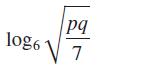
Use the properties of logarithms to express each logarithm as a sum or difference of logarithms, or as a single logarithm if possible. Assume that all variables represent positive real numbers. log6 pq V7
Evaluate each logarithm to four decimal places.ln 942.6
Evaluate each logarithm to four decimal places. In (8.59 x e²)
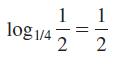
Write in exponential form. log 1/4 1 2 || 1 2
Evaluate each logarithm to four decimal places.ln 0.82
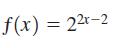
Graph each exponential function. f(x) = 22-2
Use a calculator to approximate each logarithm to four decimal places.log7 3
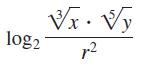
Use the properties of logarithms to express each logarithm as a sum or difference of logarithms, or as a single logarithm if possible. Assume that all variables represent positive real numbers. Vx. Vy log2 p²
Determine whether each function is one-to-one. If it is, find the inverse. f(x)=√x + 2, x ≥ −2
Factor. 24y2 - 7y - 6
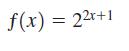
Graph each exponential function. f(x) = 22x+1
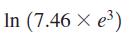
Evaluate each logarithm to four decimal places. In (7.46 X e³)
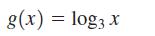
Graph each logarithmic function. g(x) = log3 x
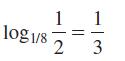
Write in exponential form. log1/8 1 2 || 113
Use a calculator to approximate each logarithm to four decimal places.log10 55
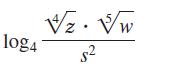
Use the properties of logarithms to express each logarithm as a sum or difference of logarithms, or as a single logarithm if possible. Assume that all variables represent positive real numbers. log4 MA ZA 5²
Factor. 5z3 - 19z2 - 4z
Solve each equation. Use natural logarithms. Approximate solutions to three decimal places when appropriate.ln e-x = π
Determine whether each function is one-to-one. If it is, find the inverse. f(x)=√x + 6, x ≥ −6
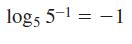
Write in exponential form. log, 5-1 = -1
Use the change-of-base rule to express log3 19 as described.(a) in terms of common logarithms (b) in terms of natural logarithms(c) approximated to four decimal places
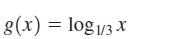
Graph each logarithmic function. g(x) = log1/3 x
Factor. 16a2 - 25b4
Solve each equation. Use natural logarithms. Approximate solutions to three decimal places when appropriate.ln e2x = π
Determine whether each function is one-to-one. If it is, find the inverse. f(x)=√x-4, x ≥ 4
Evaluate each logarithm to four decimal places.ln 10
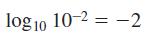
Write in exponential form. log10 10-2=-2
Solve 3x = 78, giving the solution to three decimal places.
Use the properties of logarithms to write each expression as a single logarithm. Assume that all variables are defined in such a way that the variable expressions are positive, and bases are positive numbers not equal to 1.logb x + logb y
Factor. 8c3 + d3
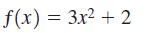
Determine whether each function is one-to-one. If it is, find the inverse. f(x) = 3x² + 2
Solve each equation. Use natural logarithms. Approximate solutions to three decimal places when appropriate.eln 2x = eln (x+1)
Evaluate each logarithm to four decimal places.log e
Solve log8 (x + 5)+ log8 (x - 2) = 1.
Use the special properties of logarithms to evaluate each expression.(a) 4log4 12(b) log9 913 (c) log5 625
Use the properties of logarithms to write each expression as a single logarithm. Assume that all variables are defined in such a way that the variable expressions are positive, and bases are positive numbers not equal to 1.logb w + logb z
Factor. 16r2 + 56rq + 49q2
Solve each equation. Use natural logarithms. Approximate solutions to three decimal places when appropriate.eln (6 - x) = eln (4 + 2x)
Use a calculator to find approximations of each logarithm.(a) log 356.8 (b) log 35.68 (c) log 3.568(d) Observe the answers and make a conjecture concerning the decimal values of the common logarithms of numbers greater than 1 that have the same digits.
Solve each equation.6x = 36
Suppose that $10,000 is invested at 3.5% annual interest, compounded quarterly.(a) How much will be in the account in 5 yr if no money is withdrawn?(b) How long, to the nearest tenth of a year, will it take for the initial principal to double?
Solve each equation. Give exact solutions. logs(5x + 10) = 3
Solve each equation. Give exact solutions. log4 (2x + 8) = 2
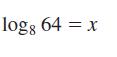
Solve each equation. logg 64 = x
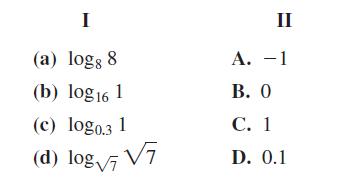
Match each logarithm in Column I with its value in Column II. I (a) logg 8 (b) log16 1 (c) log0.3 1 (d) log√ √ II A. -1 B. 0 C. 1 D. 0.1
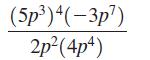
Perform the indicated operations. (5p3)4(-3p7) 2p2(4p4)
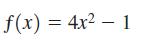
Determine whether each function is one-to-one. If it is, find the inverse. f(x) = 4x² - 1
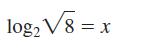
Solve each equation. log₂ V8 = x
Use the properties of logarithms to write each expression as a single logarithm. Assume that all variables are defined in such a way that the variable expressions are positive, and bases are positive numbers not equal to 1.loga m - loga n
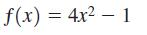
Determine whether each function is one-to-one. If it is, find the inverse. f(x) = 4x² - 1
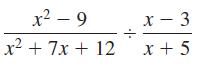
Perform the indicated operations. x² - 9 x² + 7x + 12 x-3 x + 5
Let k represent the number of letters in your last name.(a) Use a calculator to find log k.(b) Raise 10 to the power indicated by the number found in part (a). What is the result?(c) Explain why we obtained the answer found in part (b). Would it matter what number we used for k to observe the same
Suppose that $15,000 is invested at 3% annual interest, compounded continuously.(a) How much will be in the account in 5 yr if no money is withdrawn?(b) How long, to the nearest tenth of a year, will it take for the initial principal to double?
Solve each equation.8x = 64
Use the properties of logarithms to write each expression as a single logarithm. Assume that all variables are defined in such a way that the variable expressions are positive, and bases are positive numbers not equal to 1.logb x - logb y
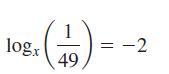
Solve each equation. (11) 49 log.x = -2
When a student asked his teacher to explain how to evaluate log9 3 without showing any work, his teacher told him to “Think radically.” Explain what the teacher meant by this hint.
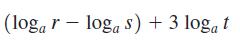
Use the properties of logarithms to write each expression as a single logarithm. Assume that all variables are defined in such a way that the variable expressions are positive, and bases are positive numbers not equal to 1. (loga r - loga s) + 3 loga t
Solve each equation. Give exact solutions. log3 (6x + 5) = 2
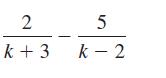
Perform the indicated operations. 2 k + 3 5 k-2
Suppose that water from a wetland area is sampled and found to have the given hydronium ion concentration. Is the wetland a rich fen, a poor fen, or a bog?3.1 × 10⁻⁵
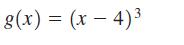
Determine whether each function is one-to-one. If it is, find the inverse. g(x) = (x-4)³
Solve each equation.100x = 1000
Use a calculator to approximate each logarithm to four decimal places.log2 9
Suppose that water from a wetland area is sampled and found to have the given hydronium ion concentration. Is the wetland a rich fen, a poor fen, or a bog?2.5 × 10⁻⁵
Solve each equation.8x = 4
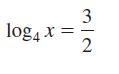
Solve each equation. log4 x X = 3 2
Use a calculator to approximate each logarithm to four decimal places.log2 15
A company has found that total sales, in thousands of dollars, are given by the functionwhere x is the number of weeks after a major advertising campaign was introduced.Graph the function. S(x) = 100 log2 (x + 2),
Use the properties of logarithms to write each expression as a single logarithm. Assume that all variables are defined in such a way that the variable expressions are positive, and bases are positive numbers not equal to 1. (loga ploga q) + 2 logar
Use the properties of logarithms to write each expression as a single logarithm. Assume that all variables are defined in such a way that the variable expressions are positive, and bases are positive numbers not equal to 1. log10 (y + 4) + log10 (y - 4)
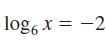
Solve each equation. log6x = -2 56
Suppose that water from a wetland area is sampled and found to have the given hydronium ion concentration. Is the wetland a rich fen, a poor fen, or a bog?3.6 × 10⁻²
Solve each equation.8x = 32
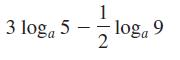
Use the properties of logarithms to write each expression as a single logarithm. Assume that all variables are defined in such a way that the variable expressions are positive, and bases are positive numbers not equal to 1. 3 loga 5 1 2 -loga 9
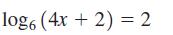
Solve each equation. Give exact solutions. log6 (4x + 2) = 2
Use a calculator to approximate each logarithm to four decimal places.log5 26
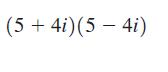
Simplify. (5 + 4i)(5 - 4i)
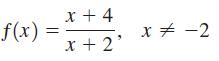
Each function is one-to-one. Find its inverse. f(x) = x + 4 x + 2' x = -2
A company has found that total sales, in thousands of dollars, are given by the functionwhere x is the number of weeks after a major advertising campaign was introduced.What were total sales 6 weeks after the campaign was introduced? S(x) = 100 log2 (x + 2),
Suppose that water from a wetland area is sampled and found to have the given hydronium ion concentration. Is the wetland a rich fen, a poor fen, or a bog?2.7 × 10⁻⁷
Solve each equation.4x-5 = 642x
Use a calculator to approximate each logarithm to four decimal places.log1/4 12
Use the properties of logarithms to write each expression as a single logarithm. Assume that all variables are defined in such a way that the variable expressions are positive, and bases are positive numbers not equal to 1. - log10 (x + 3) + log10 (x − 3)
Solve each equation. Give exact solutions. log7 (x + 1)³= 2 3
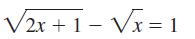
Solve each equation or inequality. √2x + 1 - √x = 1
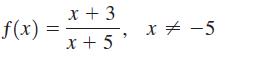
Each function is one-to-one. Find its inverse. f(x)=X+3 x = -5
Suppose that water from a wetland area is sampled and found to have the given hydronium ion concentration. Is the wetland a rich fen, a poor fen, or a bog?2.5 × 10⁻⁷
Solve each equation.1253x = 52x-7
Use a calculator to approximate each logarithm to four decimal places.log1/5 27
Solve each equation. Give exact solutions. log4 (x-3)³ = 4
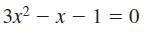
Solve each equation or inequality. 3x² x 10
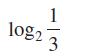
Use a calculator to approximate each logarithm to four decimal places. log₂ -13
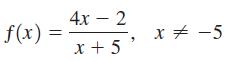
Each function is one-to-one. Find its inverse. f(x) = 4x 2 - x + 5 x = -5
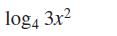
Use the properties of logarithms to express each logarithm as a sum or difference of logarithms. Assume that all variables represent positive real numbers. log4 3x²
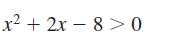
Solve each equation or inequality. x² + 2x80
Use the properties of logarithms to write each expression as a single logarithm. Assume that all variables are defined in such a way that the variable expressions are positive, and bases are positive numbers not equal to 1. log10 (x + 3) + log10 (x + 5)
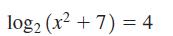
Solve each equation. Give exact solutions. log₂ (x² + 7) = 4
Find the pH (to the nearest tenth) of the substance with the given hydronium ion concentration.Ammonia, 2.5 × 10⁻¹²
Showing 3700 - 3800
of 16373
First
31
32
33
34
35
36
37
38
39
40
41
42
43
44
45
Last
Step by Step Answers

 Get 50% OFF
Claim Now
Get 50% OFF
Claim Now