New Semester
Started
Get
50% OFF
Study Help!
--h --m --s
Claim Now
Question Answers
Textbooks
Find textbooks, questions and answers
Oops, something went wrong!
Change your search query and then try again
S
Books
FREE
Study Help
Expert Questions
Accounting
General Management
Mathematics
Finance
Organizational Behaviour
Law
Physics
Operating System
Management Leadership
Sociology
Programming
Marketing
Database
Computer Network
Economics
Textbooks Solutions
Accounting
Managerial Accounting
Management Leadership
Cost Accounting
Statistics
Business Law
Corporate Finance
Finance
Economics
Auditing
Tutors
Online Tutors
Find a Tutor
Hire a Tutor
Become a Tutor
AI Tutor
AI Study Planner
NEW
Sell Books
Search
Search
Sign In
Register
study help
mathematics
contemporary mathematics
Contemporary Mathematics 1st Edition OpenStax - Solutions
What is the measure of each exterior angle of a regular hexagon?
What is the sum of the exterior angles of a triangle?
What is the sum of the exterior angles of an octagon?
Find the circumference of a circle with radius 5 .
Find the circumference of a circle with a diameter of 7.
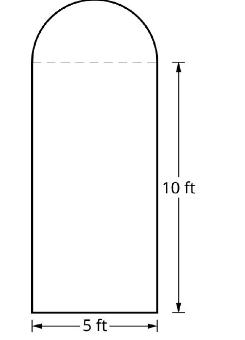
Find the perimeter of the window in the figure shown. + 5 ft- 10 ft
Find the circumference of a circle with a radius of \(1.25 \mathrm{~cm}\)
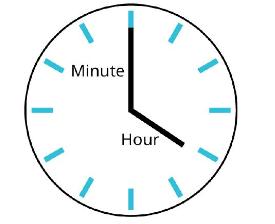
The hands of a clock vary in length. If the hour hand is 5 inches long and the minute hand is 7 inches long, how far does each hand travel in 12 hours? Minute Hour
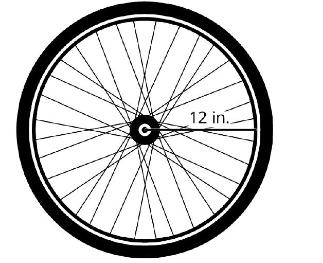
A bicycle tire has a radius of \(12 \mathrm{in}\). How many revolutions will the tire make if the bicycle travels approximately 377 \(\mathrm{ft}\) ? 12 in.
When Chicago installed its Centennial Ferris wheel at Navy Pier in 1995, there was much discussion about how big it could be. The city wanted it to be as high as possible because the incredible views of the city would surely draw the tourists. It was decided that the height of the wheel could
Find the perimeter of an equilateral triangle with side length equal to \(21 \mathrm{~cm}\).
What is the diameter of a circle whose circumference is \(39.6 \mathrm{~cm}\) ?
What type of movements are used to change the orientation and placement of a shape?
What is the name of the motion that renders a shape upside down?
What do we call the motion that moves a shape to the right or left or on the diagonal?
If you are going to tessellate the plane with a regular polygon, what is the sum of the interior angles that surround a vertex?
Does a regular heptagon tesselate the plane by itself?
What are the only regular polygons that will tessellate the plane by themselves?
What is the transformation called that revolves a shape about a point to a new position?
Transformational geometry is a study of what?
Describe how to achieve a rotation transformation.
Construct a \(90^{\circ}\) rotation of the triangle shown. A B
Shapes can be rotated around a point of rotation or a \( \qquad \)
What is the name of the transformation that involves a reflection and a translation?
What can a tessellation not have between shapes?
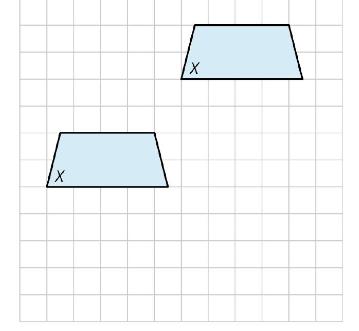
Describe the transformation shown. X X
What do we call a transformation that produces a mirror image?
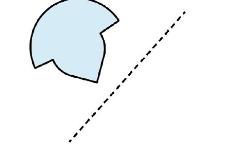
Sketch the reflection of the shape about the dashed line.
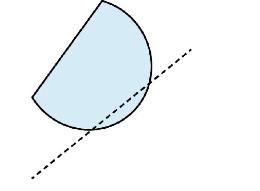
Sketch the reflection of the shape about the dashed line.
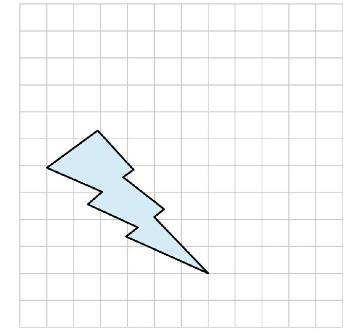
Sketch the translation of the shape 3 units to the right and 3 units vertically.
Rotate the shape \(45^{\circ}\) about the rotation point using point \(A\) as your guide. A
Do regular pentagons tessellate the plain by themselves?
What do regular tessellations have in common?
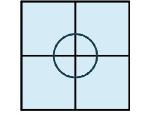
How would we name a tessellation of squares as shown in the figure?
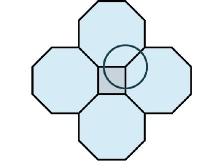
How do we name a tessellation of octagons and squares as shown in the figure?
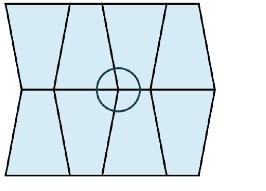
How would we name a tessellation of trapezoids as shown in the figure?
Area of a triangle with base equal to \(10 \mathrm{~cm}\), and height equal to \(15 \mathrm{~cm}\).Find the area of the figure with the given measurements.
Area of right triangle with base \(54 \mathrm{~cm}\), and height equal to \(72 \mathrm{~cm}\).Find the area of the figure with the given measurements.
A triangle has an area of \(22.5 \mathrm{~cm}^{2}\). If the base equals \(5 \mathrm{~cm}\), find the height.Find the area of the figure with the given measurements.
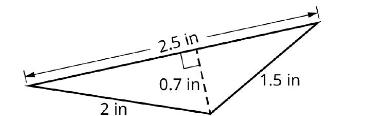
Find the area of the triangle with base equal to \(2.5 \mathrm{in}\), height equal to \(0.7 \mathrm{in}\) as shown.Find the area of the figure with the given measurements. 2.5 in 0.7 in 1.5 in 2 in
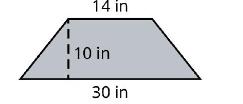
Find the area of the trapezoid with \(b_{1}=30 \mathrm{in}, b_{2}=14 \mathrm{in}\), and \(h=10 \mathrm{in}\) as shown. 14 in !10 in 30 in
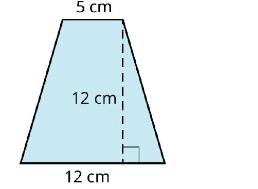
Find the area of the trapezoid shown. 5 cm 12 cm 12 cm
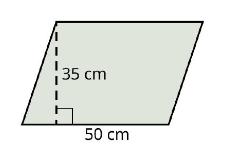
Find the area of a parallelogram with base equal to \(50 \mathrm{~cm}\) and height equal to \(35 \mathrm{~cm}\) as shown. 35 cm 50 cm
Find the area of a parallelogram with base equal to \(20 \mathrm{in}\), and height equal to \(22 \mathrm{in}\).
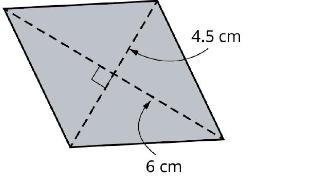
Find the area of the rhombus shown. 6 cm 4.5 cm
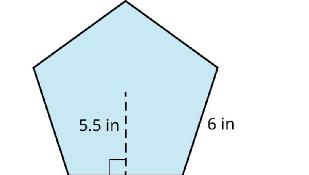
Find the area of the regular pentagon with the apothem equal to 5.5 in and the side length equal to 6 in as shown. 5.5 in 6 in
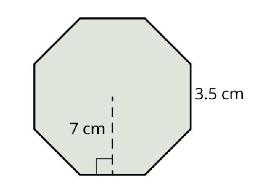
Find the area of the regular octagon with apothem equal to \(7 \mathrm{~cm}\) and the side length is \(3.5 \mathrm{~cm}\) as shown. 7 cm I 3.5 cm
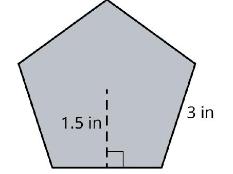
Find the area of a regular pentagon with apothem equal \(1.5 \mathrm{in}\), and the sides are equal to \(3 \mathrm{in}\) as shown. 3 in 1.5 in
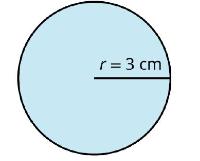
Find the area of a circle with radius of \(3 \mathrm{~cm}\) as shown. r = 3 cm
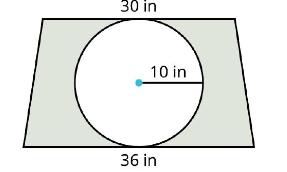
You are installing a countertop in the shape of a trapezoid with a round sink as shown in the figure. After the sink is installed, how much area is left on the countertop? 30 in 10 in C 36 in
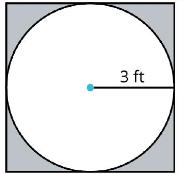
Find the area of the shaded region in the given figure. 3 ft
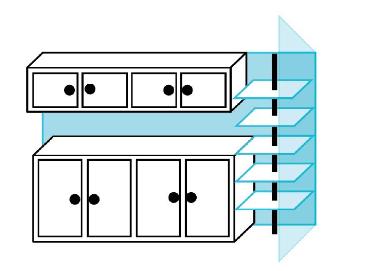
You have a structural post in the corner of your kitchen. The adjacent room is the family room and the two rooms are separated by a transparent glass wall. To camouflage the post, you decide to have five shelves built that will fill the corner, as shown in the figure. The rectangular shelves are 26
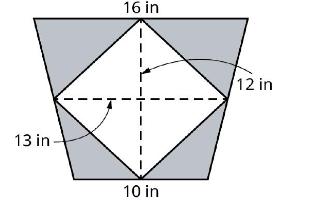
Find the area of the shaded region in the given figure. 13 in 16 in 10 in 12 in
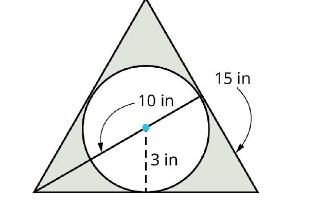
Find the area of the shaded region in the given figure. 10 in 15 in 3 in
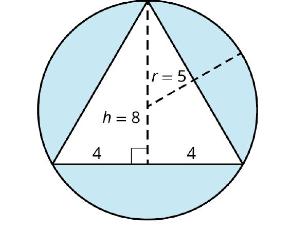
Find the area of the shaded region in the given figure. All measurements in centimeters. 4 h = 81 4
Your property measures 2 miles wide by 2.5 miles long. You want to landscape it but the landscaper charges by the square foot. How many square feet need to be landscaped?
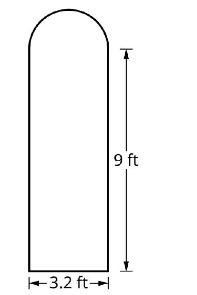
Find the area of the window shown. 3.2 ft- 9 ft
What is the area of a major league baseball diamond enclosed by the baselines if it forms a square with \(90 \mathrm{ft}\) between bases?
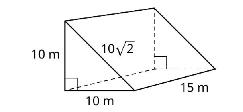
Find the volume of the right triangular prism with the two side legs of the base equal to \(10 \mathrm{~m}\), the hypotenuse equal to \(10 \sqrt{2}\), and the height or the length, depending on your viewpoint, is equal to \(15 \mathrm{~m}\). 10 m 10/2 10 m 15 m
Find the surface area of the right triangular prism in the Exercise 1 with the two legs of the base equal to \(10 \mathrm{~m}\), and the height equal to \(15 \mathrm{~m}\).
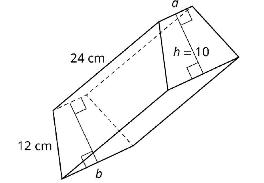
Find the surface area of the right trapezoidal prism with side \(\mathrm{a}=5 \mathrm{~cm}\), side \(\mathrm{b}=12 \mathrm{~cm}\), the height is \(10 \mathrm{~cm}\), the slant length is \(12 \mathrm{~cm}\), and the length is \(24 \mathrm{~cm}\). 24 cm 12 cm b h=10
Find the volume of the trapezoidal prism in the exercise above where the base and top have the following measurements: side \(a=5 \mathrm{~cm}\), side \(b=12 \mathrm{~cm}\), the slant lengths are each \(12 \mathrm{~cm}\), and the height of the trapezoidal base \(=10 \mathrm{~cm}\). The height or
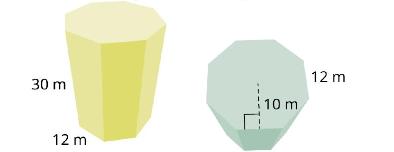
Find the surface area of the octagonal prism. The base and top are regular octagons with the apothem equal to \(10 \mathrm{~m}\), a side length equal to \(12 \mathrm{~m}\), and a height of \(30 \mathrm{~m}\). 30 m 12 m 10 m 12 m
Find the volume for the right octagonal prism, with the apothem equal to \(10 \mathrm{~m}\), the side length of the base is equal to \(12 \mathrm{~m}\), and the height equal to \(30 \mathrm{~m}\).
You decide to paint the living room. You will need the surface area of the 4 walls and the ceiling. The room measures \(20 \mathrm{ft}\) long and \(14 \mathrm{ft}\) wide, and the ceiling is \(8 \mathrm{ft}\) high.
\(r=6 \mathrm{~cm}, h=5 \mathrm{~cm}\)Find the surface area of each right cylinder.
\(r=9 \mathrm{~cm}, h=15 \mathrm{~cm}\)Find the surface area of each right cylinder.
\(r=12.2\) in, \(h=30\) in Find the surface area of each right cylinder.
\(r=3.4 \mathrm{~m}, h=10.5 \mathrm{~m}\)Find the surface area of each right cylinder.
\(d=11.4 \mathrm{~m}, h=4.4 \mathrm{~m}\)Find the surface area of each right cylinder.
\(d=20\) in, \(h=8.5\) in Find the surface area of each right cylinder.
\(r=7 \mathrm{~cm}, h=8 \mathrm{~cm}\)Find the volume of each right cylinder to the nearest tenth.
\(r=14 \mathrm{~cm}, h=19 \mathrm{~cm}\)Find the volume of each right cylinder to the nearest tenth.
\(r=14\) in, \(h=30\) in Find the volume of each right cylinder to the nearest tenth.
\(r=4.9 \mathrm{~m}, h=17 \mathrm{~m}\)Find the volume of each right cylinder to the nearest tenth.
\(r=12.6 \mathrm{~cm}, h=16.2 \mathrm{~cm}\)Find the volume of each right cylinder to the nearest tenth.
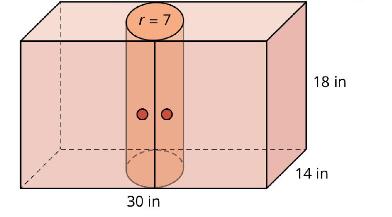
You have remodeled your kitchen and the exhaust pipe above the stove must pass through an overhead cabinet as shown in the figure. Find the volume of the remaining space in the cabinet. r = 7 30 in 18 in 14 in
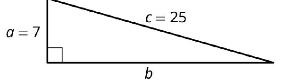
Use the Pythagorean theorem to answer the following exercise. Let \(a\) and \(b\) represent two legs of a right triangle, and let \(c\) represent the hypotenuse. Find the lengths of the missing sides. a = 7 C = 25 b
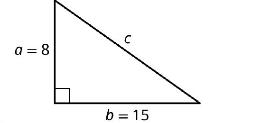
Use the Pythagorean theorem to answer the following exercise. Let \(a\) and \(b\) represent two legs of a right triangle, and let \(c\) represent the hypotenuse. Find the lengths of the missing sides. a=8 b=15
If \(b=25\) and \(c=65 \mathrm{ft}\), find \(a\).Use the Pythagorean theorem to answer the following exercise. Let \(a\) and \(b\) represent two legs of a right triangle, and let \(c\) represent the hypotenuse. Find the lengths of the missing sides.
If \(a=18 \mathrm{ft}\) and \(c=30 \mathrm{ft}\), find \(b\).Use the Pythagorean theorem to answer the following exercise. Let \(a\) and \(b\) represent two legs of a right triangle, and let \(c\) represent the hypotenuse. Find the lengths of the missing sides.
If \(b=12 \mathrm{~cm}\) and \(c=15 \mathrm{~cm}\), find \(a\).Use the Pythagorean theorem to answer the following exercise. Let \(a\) and \(b\) represent two legs of a right triangle, and let \(c\) represent the hypotenuse. Find the lengths of the missing sides.
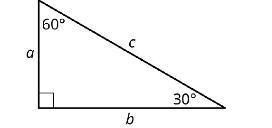
If \(b=10\), find \(c\) and \(a\)Refer to the \(30^{\circ}-60^{\circ}-90^{\circ}\) triangle shown for the following exercise. a 60 C b 30
If \(a=2 \sqrt{3} \mathrm{ft}\), find \(b\) and \(c\).Refer to the \(30^{\circ}-60^{\circ}-90^{\circ}\) triangle shown for the following exercise. a 60 C b 30
If \(b=7 \mathrm{~cm}\), find \(a\) and \(c\)Refer to the \(30^{\circ}-60^{\circ}-90^{\circ}\) triangle shown for the following exercise. a 60 C b 30
If \(c=\sqrt{3}\), find \(a\) and \(b\).Refer to the \(30^{\circ}-60^{\circ}-90^{\circ}\) triangle shown for the following exercise. a 60 C b 30
If \(c=8 \sqrt{3}\), find \(a\) and \(b\)Refer to the \(30^{\circ}-60^{\circ}-90^{\circ}\) triangle shown for the following exercise. a 60 C b 30
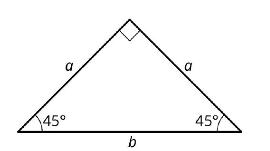
If \(a=15 \mathrm{~cm}\), find \(b\).Refer to the \(45^{\circ}-45^{\circ}-90^{\circ}\) triangle shown in the following exercise. 45 b 45%
If \(a=3 \sqrt{2} \mathrm{ft}\), find \(a\).Refer to the \(45^{\circ}-45^{\circ}-90^{\circ}\) triangle shown in the following exercise. 45 b 45%
If \(a=4 \sqrt{5} \mathrm{~cm}\), find \(b\).Refer to the \(45^{\circ}-45^{\circ}-90^{\circ}\) triangle shown in the following exercise. 45 b 45%
If \(a=10 \mathrm{ft}\), find \(b\).Refer to the \(45^{\circ}-45^{\circ}-90^{\circ}\) triangle shown in the following exercise. 45 b 45%
If \(b=\frac{\sqrt{2}}{2} \mathrm{~cm}\), find \(a\).Refer to the \(45^{\circ}-45^{\circ}-90^{\circ}\) triangle shown in the following exercise. 45 b 45%
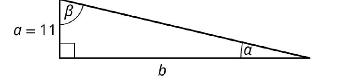
In the provided figure given \(\alpha=10^{\circ}\), find the unknown sides and angles. a=11 B. b
\(\sin ^{-1}\left(\frac{2}{5}\right)\)Evaluate the expressions in the following exercise.
\(\tan ^{-1}(5.68)\)Evaluate the expressions in the following exercise.
\(\cos ^{-1}\left(\frac{1}{9}\right)\)Evaluate the expressions in the following exercise
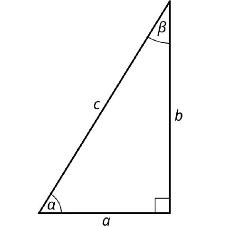
Use the figure shown to solve for all missing sides and angles given \(a=6, b=8\). a B b
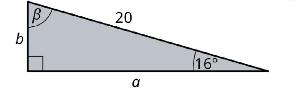
Use the figure shown to solve for all missing sides and angles given \(\alpha=16^{\circ}, c=20\).. B 20 a 16
\(m \measuredangle A=88^{\circ}, m \measuredangle B=32^{\circ}, m \measuredangle C=60^{\circ}\)Classify the triangle with the listed angle measurements as acute, right, or obtuse.
\(m \measuredangle A=65^{\circ}, m \measuredangle B=90^{\circ}, m \measuredangle C=25^{\circ}\)Classify the triangle with the listed angle measurements as acute, right, or obtuse.
Showing 1600 - 1700
of 6887
First
10
11
12
13
14
15
16
17
18
19
20
21
22
23
24
Last
Step by Step Answers

 Get 50% OFF
Claim Now
Get 50% OFF
Claim Now