New Semester
Started
Get
50% OFF
Study Help!
--h --m --s
Claim Now
Question Answers
Textbooks
Find textbooks, questions and answers
Oops, something went wrong!
Change your search query and then try again
S
Books
FREE
Study Help
Expert Questions
Accounting
General Management
Mathematics
Finance
Organizational Behaviour
Law
Physics
Operating System
Management Leadership
Sociology
Programming
Marketing
Database
Computer Network
Economics
Textbooks Solutions
Accounting
Managerial Accounting
Management Leadership
Cost Accounting
Statistics
Business Law
Corporate Finance
Finance
Economics
Auditing
Tutors
Online Tutors
Find a Tutor
Hire a Tutor
Become a Tutor
AI Tutor
AI Study Planner
NEW
Sell Books
Search
Search
Sign In
Register
study help
mathematics
contemporary mathematics
Contemporary Mathematics 1st Edition OpenStax - Solutions
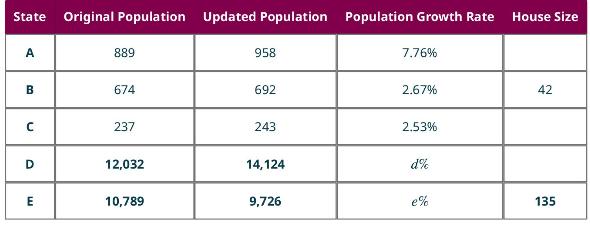
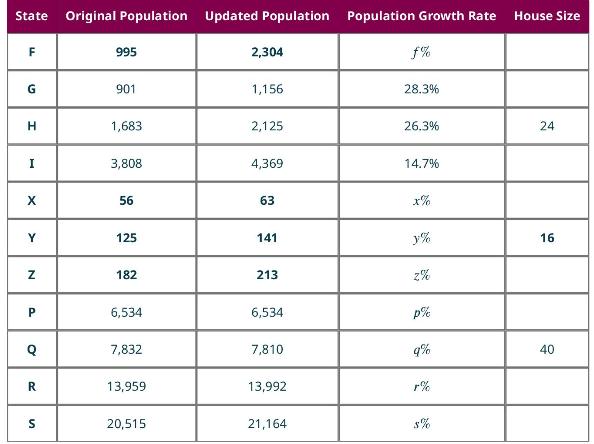
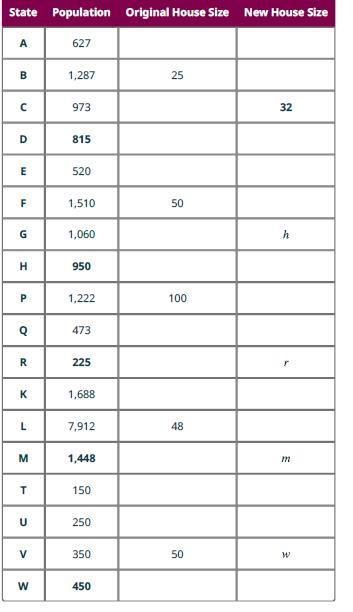
Consider States G, H, and I.a. Determine the Hamilton apportionment for States G, H, and I with the original population.b. Determine the Hamilton apportionment for States G, H, and I with the updated population.c. Does the increase in population and the use of the Hamilton method cause the
Consider States \(X, Y\), and \(Z\).a. Determine the Hamilton apportionment for States \(X, Y\), and \(Z\) with the original population.b. Determine the Hamilton apportionment for States \(X, Y\), and \(Z\) with the updated population,c. Does the increase in population and the use of the Hamilton
Consider States P, Q, R, and S.a. Determine the Hamilton apportionment for States \(P, Q, R\), and \(S\) with the original population.b. Determine the Hamilton apportionment for States \(P, Q, R\), and \(S\) with the updated population.c. Does the increase in population and the use of the Hamilton
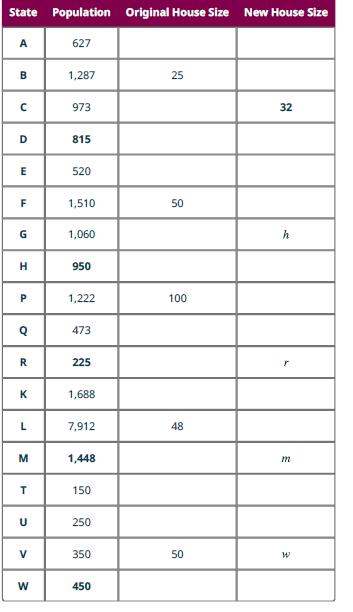
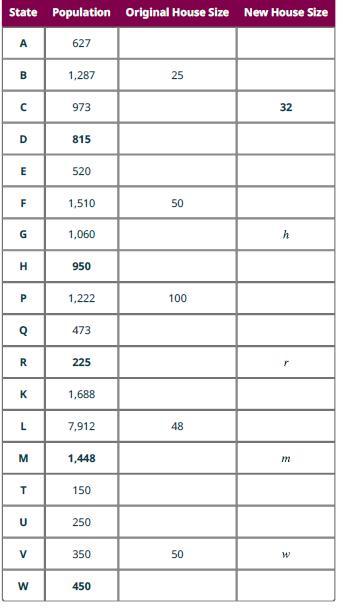
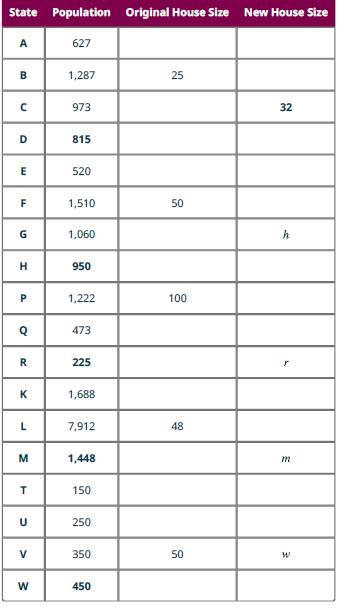
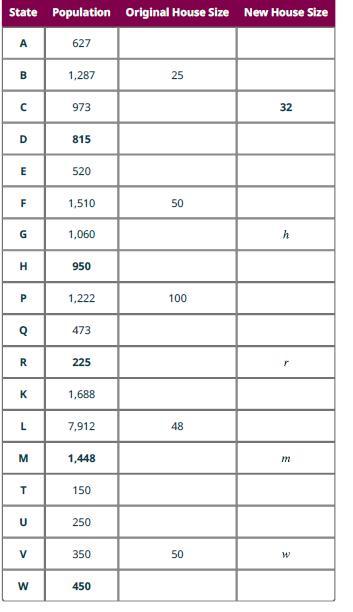
Consider States A, B, and C.a. Calculate the standard divisor based on the original house size.b. Use the Hamilton method to apportion the seats.Use the information in the table below. State Population Original House Size New House Size A 627 B 1,287 25 C 973 D 815 E 520 F 1,510 50 G 1,060 H 950 P
Consider States \(E, F\), and G.a. Calculate the standard divisor based on the original house size.b. Use the Hamilton method to apportion the seats.Use the information in the table below. State Population Original House Size New House Size A 627 B 1,287 25 C 973 D 815 E 520 F 1,510 50 G 1,060 H
Consider States \(\mathrm{P}\) and \(\mathrm{Q}\).a. Calculate the standard divisor based on the original house size.b. Use the Hamilton method to apportion the seats.Use the information in the table below. State Population Original House Size New House Size A 627 B 1,287 25 C 973 D 815 E 520 F
Consider States K and L.a. Calculate the standard divisor based on the original house size.b. Use the Hamilton method to apportion the seats.Use the information in the table below. State Population Original House Size New House Size A 627 B 1,287 25 C 973 D 815 E 520 F 1,510 50 G 1,060 H 950 P
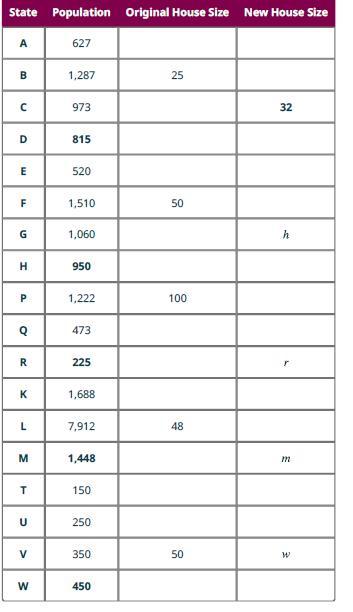
Suppose that States \(A, B\), and \(C\) annex State \(D\) and increase the house size proportionately.a. Calculate the standard divisor based on the new house size.b. Use the Hamilton method to reapportion the seats.c. Does the new-states paradox occur?Use the information in the table below. State
Suppose that States \(\mathrm{E}, \mathrm{F}\), and \(\mathrm{G}\) annex State \(\mathrm{H}\) and increase the house size proportionately.a. Determine the new house size, \(h\), that is necessary.b. Calculate the standard divisor based on the new house size.c. Use the Hamilton method to reapportion
Suppose that States \(P\) and \(Q\) annex State \(R\) and increase the house size proportionately.a. Determine the new house size, \(r\), that is necessary.b. Calculate the standard divisor based on the new house size.c. Use the Hamilton method to reapportion the seats.d. Does the new-states
Suppose that States \(K\) and \(L\) annex State \(M\) and increase the house size proportionately.a. Determine the new house size, \(m\), that is necessary.b. Calculate the standard divisor based on the new house size.c. Use the Hamilton method to reapportion the seats.d. Does the new-states
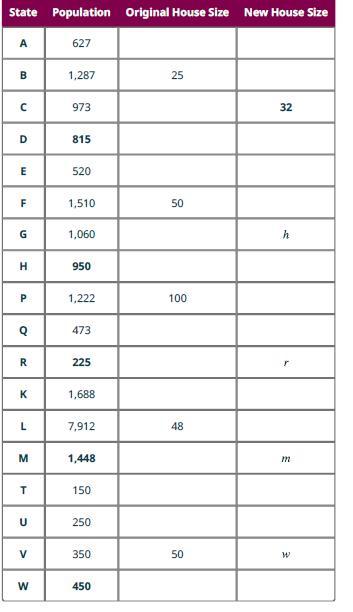
Suppose that States \(T, U\), and \(V\) annex State \(W\) and increase the house size proportionately.a. Calculate the standard divisor based on the original house size and only States T, U, and V.b. Use the Hamilton method to apportion the seats to \(T, U\), and \(V\).c. Determine the new house
Suppose 24 seats are apportioned to States A, B, and C with populations of 16,15 , and 125 respectively. Then the populations of States A, B, and C change to 17,15 , and 126 respectively.a. Demonstrate that the population paradox occurs when the Hamilton method is used.b. Determine whether the
Suppose that 10 seats are apportioned to States A, B, and C with populations 6,6 , and 2 respectively. Then the number of seats is increased to 11.Demonstrate that the Alabama paradox occurs when the Hamilton method is used.Use the information in the table below. State Population Original House
In a plurality election, the candidates have the following vote counts: A 125, B 132, C 149, D 112.Identify the winning candidate based on the described voter profile, if possible. If it is not possible, state so. Explain your reasoning.
In the first round of a ranked-choice election with three candidates-A, B, and C. Candidate \(A\) received 55 first place rankings; Candidate B received 25; and Candidate C received 30.Identify the winning candidate based on the described voter profile, if possible. If it is not possible, state so.
The pairwise matchup points for each candidate were: A 1, B \(1 \frac{1}{2}, D \frac{1}{2}\).Identify the winning candidate based on the described voter profile, if possible. If it is not possible, state so. Explain your reasoning.
In a Borda count election, the candidates have the following Borda scores: A 15, B 11, C 12, D 16.Identify the winning candidate based on the described voter profile, if possible. If it is not possible, state so. Explain your reasoning.
There is a pairwise comparison election with candidates A, B, and C. Candidate A had the most first choice rankings, Candidate \(\mathrm{B}\) has the highest Borda score, and Candidate \(\mathrm{C}\) is a Condorcet candidate.Identify the winning candidate based on the described voter profile, if
In the first round of a ranked-choice election with three candidates-A, B, and \(C-\) Candidate \(A\) received 20 first place rankings, Candidate B received 25, and Candidate C received 30.Identify the winning candidate based on the described voter profile, if possible. If it is not possible, state
Calculate the number of votes required to have a majority of the popular vote in the 2016 U.S. Democratic Presidential Primary.Use the table. O'Malley De La Fuente Clinton 110,227 67,331 Sanders Other 17,174,432 13,245,671 322,276
Which candidate had a plurality? Did this candidate have a majority?Use the table. O'Malley De La Fuente Clinton 110,227 67,331 Sanders Other 17,174,432 13,245,671 322,276
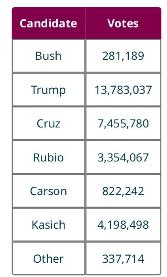
Calculate the number of votes required to have a majority of the popular vote in the 2016 U.S. Republican Presidential Primary.Use the given table. Candidate Votes Bush 281,189 Trump 13,783,037 Cruz 7,455,780 Rubio 3,354,067 Carson 822,242 Kasich 4,198,498 Other 337,714
Which candidate had a plurality? Did this candidate have a majority?Use the given table. Candidate Votes Bush 281,189 Trump 13,783,037 Cruz 7,455,780 Rubio 3,354,067 Carson 822,242 Kasich 4,198,498 Other 337,714
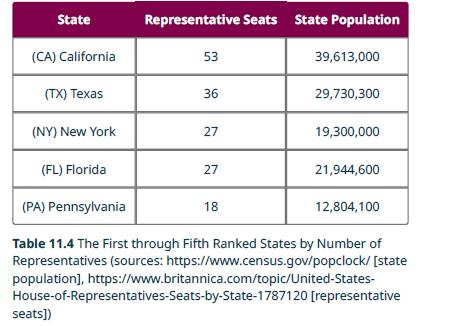
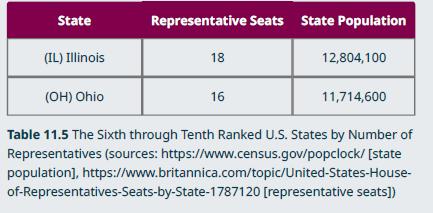
Suppose the Republican Primary in 2016 was a two-round system. Would there be a second round? Why or why not? If so, which candidates would advance to the second round?Use Table 11.4 and Table 11.5. State Representative Seats State Population (CA) California 53 39,613,000 (TX) Texas 36 29,730,300
Suppose the Democratic Primary in 2016 was a two-round system. Would there be a second round? Why or why not? If so, which candidates would advance to the second round?Use Table 11.4 and Table 11.5. State Representative Seats State Population (CA) California 53 39,613,000 (TX) Texas 36 29,730,300
Suppose the Democratic Primary in 2016 used the Hare method. Would there be a second round? Why or why not?Use Table 11.4 and Table 11.5. State Representative Seats State Population (CA) California 53 39,613,000 (TX) Texas 36 29,730,300 (NY) New York 27 19,300,000 (FL) Florida 27 21,944,600 (PA)
Suppose the Republican Primary in 2016 used the Hare method. Would there be a second round? Why or why not?Use Table 11.4 and Table 11.5. State Representative Seats State Population (CA) California 53 39,613,000 (TX) Texas 36 29,730,300 (NY) New York 27 19,300,000 (FL) Florida 27 21,944,600 (PA)
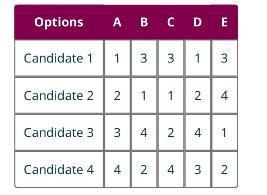
How many votes are needed to win by the Hare method?Use the following table and the Hare method. Options A B C D E Candidate 1 1 3 313 Candidate 2 2 1 1 2 4 Candidate 3 3 4 2 4 1 Candidate 4 4 2 4 3 2
How many votes does each candidate receive in Round 1 ?Use the following table and the Hare method. Options A B C D E Candidate 1 1 3 313 Candidate 2 2 1 1 2 4 Candidate 3 3 4 2 4 1 Candidate 4 4 2 4 3 2
Which candidates advance to Round \(2 ?\)Use the following table and the Hare method. Options A B C D E Candidate 1 1 3 313 Candidate 2 2 1 1 2 4 Candidate 3 3 4 2 4 1 Candidate 4 4 2 4 3 2
How many votes does each remaining candidate receive in Round 2 ?Use the following table and the Hare method. Options A B C D E Candidate 1 1 3 313 Candidate 2 2 1 1 2 4 Candidate 3 3 4 2 4 1 Candidate 4 4 2 4 3 2
Will there be a third round? Why or why not?Use the following table and the Hare method. Options A B C D E Candidate 1 1 3 313 Candidate 2 2 1 1 2 4 Candidate 3 3 4 2 4 1 Candidate 4 4 2 4 3 2
Which candidate wins the election?Use the following table and the Hare method. Options A B C D E Candidate 1 1 3 313 Candidate 2 2 1 1 2 4 Candidate 3 3 4 2 4 1 Candidate 4 4 2 4 3 2
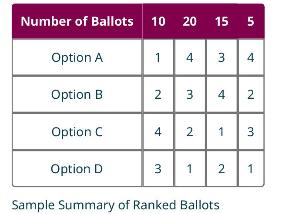
How many votes were recorded, and how many are required to have a majority?Use the sample summary of ranked ballots in the given table. Number of Ballots 10 20 20 15 5 Option A 1 4 3 4 Option B 2 3 4 2 Option C 4 2 1 3 Option D 3 1 2 1 Sample Summary of Ranked Ballots.
How many voters indicated that Option A was their first choice?Use the sample summary of ranked ballots in the given table. Number of Ballots 10 20 20 15 5 Option A 1 4 3 4 Option B 2 3 4 2 Option C 4 2 1 3 Option D 3 1 2 1 Sample Summary of Ranked Ballots.
How many voters indicated that Option B was their first choice?Use the sample summary of ranked ballots in the given table. Number of Ballots 10 20 20 15 5 Option A 1 4 3 4 Option B 2 3 4 2 Option C 4 2 1 3 Option D 3 1 2 1 Sample Summary of Ranked Ballots.
How many voters indicated that Option A was their last choice?Use the sample summary of ranked ballots in the given table. Number of Ballots 10 20 20 15 5 Option A 1 4 3 4 Option B 2 3 4 2 Option C 4 2 1 3 Option D 3 1 2 1 Sample Summary of Ranked Ballots.
How many voters indicated that Option B was their last choice?Use the sample summary of ranked ballots in the given table. Number of Ballots 10 20 20 15 5 Option A 1 4 3 4 Option B 2 3 4 2 Option C 4 2 1 3 Option D 3 1 2 1 Sample Summary of Ranked Ballots.
Use ranked-choice voting to determine the two candidates in the final round and the number of votes they each receive in that round.Use the sample summary of ranked ballots in the given table. Number of Ballots 10 20 20 15 5 Option A 1 4 3 4 Option B 2 3 4 2 Option C 4 2 1 3 Option D 3 1 2 1
Is there a winning candidate? If so, which candidate? Justify your answer.Use the sample summary of ranked ballots in the given table. Number of Ballots 10 20 20 15 5 Option A 1 4 3 4 Option B 2 3 4 2 Option C 4 2 1 3 Option D 3 1 2 1 Sample Summary of Ranked Ballots.
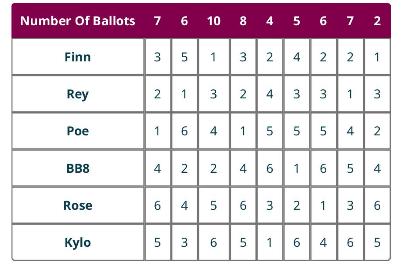
How many votes does each candidate get on the first round of voting?Suppose that 55 Star Wars fans were asked to vote for their favorite new Star Wars character. They were given a ranked ballot, and the results are shown in the table. Use this table and ranked-choice voting for the following
How many votes are required to get a majority?Suppose that 55 Star Wars fans were asked to vote for their favorite new Star Wars character. They were given a ranked ballot, and the results are shown in the table. Use this table and ranked-choice voting for the following exercises. Number Of Ballots
Which candidates remain in the final round, and how many votes do they have?Suppose that 55 Star Wars fans were asked to vote for their favorite new Star Wars character. They were given a ranked ballot, and the results are shown in the table. Use this table and ranked-choice voting for the
Who is the winner of the election?Suppose that 55 Star Wars fans were asked to vote for their favorite new Star Wars character. They were given a ranked ballot, and the results are shown in the table. Use this table and ranked-choice voting for the following exercises. Number Of Ballots 7 6 10 8 4
Find the Borda score for each candidate.
Compare your results from question 32 to those from question 26.Compare the winner and the second-place candidate using the Borda count method to those using the ranked-choice method. Are they the same?
Find the Borda score for each candidate.
Compare your results from question 34 to those from question 30.Compare the winner and the second-place candidate using the Borda count method to those using the ranked-choice method. Are they the same?
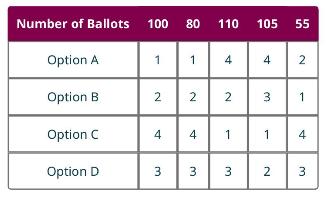
Do any candidates appear to be divisive candidates? Justify your answer.Use the table below. Number of Ballots 100 80 110 105 55 Option A 1 1 4 42 Option B 2 2 2 3 1 Option C 4 4 1 1 4 Option D 3 3 3 2 3
Do any candidates appear to be compromise candidates? Justify your answer.Use the table below. Number of Ballots 100 80 110 105 55 Option A 1 1 4 42 Option B 2 2 2 3 1 Option C 4 4 1 1 4 Option D 3 3 3 2 3
How many votes are required for a majority?Use the table below. Number of Ballots 100 80 110 105 55 Option A 1 1 4 42 Option B 2 2 2 3 1 Option C 4 4 1 1 4 Option D 3 3 3 2 3
Which candidate is eliminated first by the ranked-choice method?Use the table below. Number of Ballots 100 80 110 105 55 Option A 1 1 4 42 Option B 2 2 2 3 1 Option C 4 4 1 1 4 Option D 3 3 3 2 3
Which candidate is eliminated second by the ranked-choice method?Use the table below. Number of Ballots 100 80 110 105 55 Option A 1 1 4 42 Option B 2 2 2 3 1 Option C 4 4 1 1 4 Option D 3 3 3 2 3
Which candidate is the winner by the ranked-choice method?Use the table below. Number of Ballots 100 80 110 105 55 Option A 1 1 4 42 Option B 2 2 2 3 1 Option C 4 4 1 1 4 Option D 3 3 3 2 3
What are the Borda scores for each candidate?Use the table below. Number of Ballots 100 80 110 105 55 Option A 1 1 4 42 Option B 2 2 2 3 1 Option C 4 4 1 1 4 Option D 3 3 3 2 3
Which candidate is the winner by the Borda count method?Use the table below. Number of Ballots 100 80 110 105 55 Option A 1 1 4 42 Option B 2 2 2 3 1 Option C 4 4 1 1 4 Option D 3 3 3 2 3
Which method resulted in a win for the compromise candidate: ranked-choice voting or the Borda count method or both?Use the table below. Number of Ballots 100 80 110 105 55 Option A 1 1 4 42 Option B 2 2 2 3 1 Option C 4 4 1 1 4 Option D 3 3 3 2 3
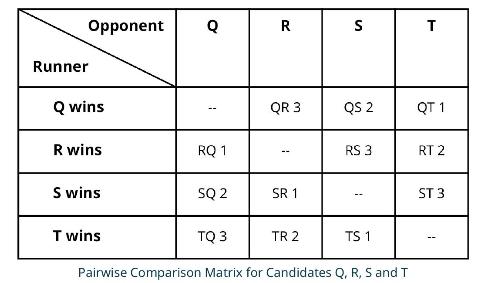
Analyze the pairwise comparison matrix. Display the pairings in a table and indicate the winner of each matchup by marking an \(\square\) through the losing matchups and a single slash \(\square\) through the ties.Use the pairwise comparison matrix in the given figure for the following exercises.
Calculate the points received by each candidate in the pairwise comparison matrix.Use the pairwise comparison matrix in the given figure for the following exercises. Opponent Q R S T Runner Q wins QR 3 QS 2 QT 1 R wins RQ 1 RS 3 RT 2 S wins SQ 2 SR 1 ST 3 Twins TQ 3 TR 2 TS 1 Pairwise Comparison
Determine whether there is a winner of the pairwise comparison election represented by the matrix. If there is a winner, determine whether the winner is a Condorcet candidate.Use the pairwise comparison matrix in the given figure for the following exercises. Opponent Q R S T Runner Q wins QR 3 QS 2
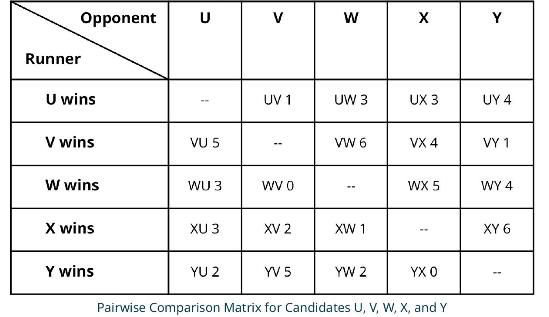
Analyze the pairwise comparison matrix. Display the pairings in a table and indicate the winner of each matchup.Use the pairwise comparison matrix in the given figure for the following exercises. Opponent U V W X Y Runner U wins UV 1 UW 3 UX 3 UY 4 V wins VU 5 VW 6 VX 4 VY 1 W wins WU 3 WV O WX 5
Calculate the points received by each candidate in the pairwise comparison matrix.Use the pairwise comparison matrix in the given figure for the following exercises. Opponent U V W X Y Runner U wins UV 1 UW 3 UX 3 UY 4 V wins VU 5 VW 6 VX 4 VY 1 W wins WU 3 WV O WX 5 WY 4 X wins XU 3 XV 2 XW 1 XY 6
Determine whether there is a winner of the pairwise comparison election represented by the matrix. If there is a winner, determine whether the winner is a Condorcet candidate and explain your reasoning.Use the pairwise comparison matrix in the given figure for the following exercises. Opponent U V
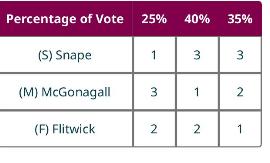
In J.K. Rowling's Harry Potter series, Albus Dumbledore was the headmaster of Hogwarts for many years. Imagine that an election is to be held to find his successor. Severus Snape, the head of Slytherin House, will be running against the heads of Gryffindor and Ravenclaw, Minerva McGonagall and
Analyze the pairwise comparison matrix you constructed for question 51.Display the pairings in a table and indicate the winner of each matchup.Data from Question 51In J.K. Rowling's Harry Potter series, Albus Dumbledore was the headmaster of Hogwarts for many years. Imagine that an election is to
Use the pairwise comparison matrix from questions 51 and 52 to find the number of points earned by each candidate. Who is the winner by the pairwise comparison method?
Is the winner of the Hogwarts headmaster election a Condorcet candidate? Explain how you know.
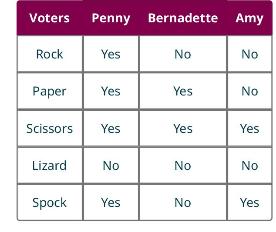
The women of The Big Bang Theory decide to hold their own approval voting election to determine the best option in Rock, Paper, Scissors, Lizard, Spock. Use the summary of their approval ballots in the table below to determine the number of votes for each candidate. Determine the winner, or state
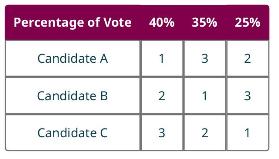
Which candidate is the winner by the ranked-choice method?Use the table below. Percentage of Vote 40% 35% 25% Candidate A 1 3 2 Candidate B 2 1 3 Candidate C 3 2 1
Suppose that they used the approval method and each voter approved their top two choices. Which candidate is the winner by the approval method?Use the table below. Percentage of Vote 40% 35% 25% Candidate A 1 3 2 Candidate B 2 1 3 Candidate C 3 2 1
Which candidate is the winner by the Borda count method?Use the table below. Percentage of Vote 40% 35% 25% Candidate A 1 3 2 Candidate B 2 1 3 Candidate C 3 2 1
In a plurality election, the candidates have the following vote counts: A 125, B 132, C 149, D 112. The pairwise matchup points for each candidate would have been: A 1, B 3, C 1, D 1.Identify which fairness criteria, if any, are violated by characteristics of the described voter profile. Explain
In a Borda count election, the candidates have the following Borda scores: A 1245, B 1360, C 787.Candidate A received 55 percent of the first-place rankings.Identify which fairness criteria, if any, are violated by characteristics of the described voter profile. Explain your reasoning.
In a pairwise comparison election, the four candidates initially received the following points for winning matchups: A 2, B \(1 \frac{1}{2}, 1 \frac{1}{2}\), C 1, D \(1 \frac{1}{2}\). When candidate C dropped out of the election, the remaining candidates received: A 1, B \(1 \frac{1}{2}\), D
In a Borda count election, the candidates have the following Borda scores: A 15, B 11, C 12, D 16.The pairwise matchup points for the same voter profiles would have been: A 2, B 0, C 1, D 3.Identify which fairness criteria, if any, are violated by characteristics of the described voter profile.
In a Borda count election, the candidates have the following Borda scores: A 15, B 11, C 12, D 16.When Candidate E was added to the ballot, the Borda scores became: A 25, B 21, C 15, D 24, E 18.Identify which fairness criteria, if any, are violated by characteristics of the described voter profile.
In a pairwise comparison election, Candidate \(\mathrm{C}\) was a Condorcet candidate in a straw poll. When the actual election took place, several voters up-ranked Candidate C on their ballots, but no other changes were made to the voter preferences, and Candidate B won the election.Identify which
In a pairwise comparison election, Candidate A was in first place, Candidate B was in second place, and Candidate \(\mathrm{C}\) was in third place. When the actual election tool place, the only changes were that several voters down-ranked Candidate B on their ballots, but the outcome remained the
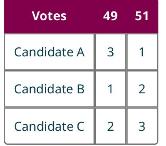
Determine the Borda score for each candidate and the winner of the election using the Borda count method.Use the table below. Votes 49 51 Candidate A 3 1 Candidate B 1 2 Candidate C 2 3
Is there a majority candidate? If so, which candidate?Use the table below. Votes 49 51 Candidate A 3 1 Candidate B 1 2 Candidate C 2 3
Does this Borda method election violate the majority criterion? Justify your answer.Use the table below. Votes 49 51 Candidate A 3 1 Candidate B 1 2 Candidate C 2 3
Is there a Condorcet candidate? If so, which candidate?Use the table below. Votes 49 51 Candidate A 3 1 Candidate B 1 2 Candidate C 2 3
Does this Borda method election violate the Condorcet criterion? Justify your answer.Use the table below. Votes 49 51 Candidate A 3 1 Candidate B 1 2 Candidate C 2 3
If Candidate \(C\) is removed from the ballot, which candidate wins by the Borda count method?Use the table below. Votes 49 51 Candidate A 3 1 Candidate B 1 2 Candidate C 2 3
Does this Borda count method election violate IIA? Justify your answer.Use the table below. Votes 49 51 Candidate A 3 1 Candidate B 1 2 Candidate C 2 3
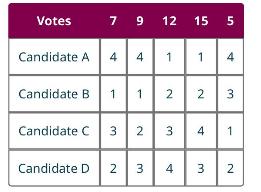
Determine Borda score for each candidate and the winner of the election using the Borda count method.Use the table below for the following exercise. Votes 7 9 12 15 5 Candidate A 4 4 1 1 4 Candidate B 1 1 2 2 3 Candidate C 32 3 4 1 Candidate D 2 3 4 3 2
Is there a majority candidate? If so, which candidate?Use the table below for the following exercise. Votes 7 9 12 15 5 Candidate A 4 4 1 1 4 Candidate B 1 1 2 2 3 Candidate C 32 3 4 1 Candidate D 2 3 4 3 2
Does this Borda method election violate the majority criterion? Justify your answer.Use the table below for the following exercise. Votes 7 9 12 15 5 Candidate A 4 4 1 1 4 Candidate B 1 1 2 2 3 Candidate C 32 3 4 1 Candidate D 2 3 4 3 2
Is there a Condorcet candidate? If so, which candidate?Use the table below for the following exercise. Votes 7 9 12 15 5 Candidate A 4 4 1 1 4 Candidate B 1 1 2 2 3 Candidate C 32 3 4 1 Candidate D 2 3 4 3 2
Does the Borda method election violate the Condorcet criterion? Justify your answer.Use the table below for the following exercise. Votes 7 9 12 15 5 Candidate A 4 4 1 1 4 Candidate B 1 1 2 2 3 Candidate C 32 3 4 1 Candidate D 2 3 4 3 2
Can an election that fails the majority criterion satisfy the Condorcet criterion? Why or why not?Use the table below for the following exercise. Votes 7 9 12 15 5 Candidate A 4 4 1 1 4 Candidate B 1 1 2 2 3 Candidate C 32 3 4 1 Candidate D 2 3 4 3 2
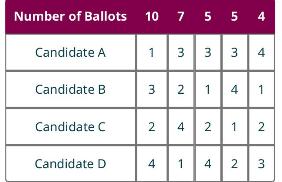
Determine the Borda score for each candidate and the winner of the election using the Borda count method.Use the table below. Number of Ballots 10 7 5 5 4 Candidate A 1 3 3 3 4 Candidate B 3 2 1 4 1 Candidate C 2 42 1 2 Candidate D 4 1 4 2 3
Is there a majority candidate?Use the table below. Number of Ballots 10 7 5 5 4 Candidate A 1 3 3 3 4 Candidate B 3 2 1 4 1 Candidate C 2 42 1 2 Candidate D 4 1 4 2 3
Does the election violate the majority criterion? Justify your answer.Use the table below. Number of Ballots 10 7 5 5 4 Candidate A 1 3 3 3 4 Candidate B 3 2 1 4 1 Candidate C 2 42 1 2 Candidate D 4 1 4 2 3
Determine the winner by pairwise comparison.Use the table below. Number of Ballots 10 7 5 5 4 Candidate A 1 3 3 3 4 Candidate B 3 2 1 4 1 Candidate C 2 42 1 2 Candidate D 4 1 4 2 3
Is there a Condorcet candidate?Use the table below. Number of Ballots 10 7 5 5 4 Candidate A 1 3 3 3 4 Candidate B 3 2 1 4 1 Candidate C 2 42 1 2 Candidate D 4 1 4 2 3
Does the Borda election violate the Condorcet criterion? Justify your answer.Use the table below. Number of Ballots 10 7 5 5 4 Candidate A 1 3 3 3 4 Candidate B 3 2 1 4 1 Candidate C 2 42 1 2 Candidate D 4 1 4 2 3
Determine the winner by the ranked-choice method.Use the table below. Number of Ballots 10 7 5 5 4 Candidate A 1 3 3 3 4 Candidate B 3 2 1 4 1 Candidate C 2 42 1 2 Candidate D 4 1 4 2 3
Does the ranked-choice election violate the majority criterion? Justify your answer.Use the table below. Number of Ballots 10 7 5 5 4 Candidate A 1 3 3 3 4 Candidate B 3 2 1 4 1 Candidate C 2 42 1 2 Candidate D 4 1 4 2 3
Showing 1100 - 1200
of 6887
First
5
6
7
8
9
10
11
12
13
14
15
16
17
18
19
Last
Step by Step Answers

 Get 50% OFF
Claim Now
Get 50% OFF
Claim Now