New Semester
Started
Get
50% OFF
Study Help!
--h --m --s
Claim Now
Question Answers
Textbooks
Find textbooks, questions and answers
Oops, something went wrong!
Change your search query and then try again
S
Books
FREE
Study Help
Expert Questions
Accounting
General Management
Mathematics
Finance
Organizational Behaviour
Law
Physics
Operating System
Management Leadership
Sociology
Programming
Marketing
Database
Computer Network
Economics
Textbooks Solutions
Accounting
Managerial Accounting
Management Leadership
Cost Accounting
Statistics
Business Law
Corporate Finance
Finance
Economics
Auditing
Tutors
Online Tutors
Find a Tutor
Hire a Tutor
Become a Tutor
AI Tutor
AI Study Planner
NEW
Sell Books
Search
Search
Sign In
Register
study help
mathematics
contemporary mathematics
Contemporary Mathematics 1st Edition OpenStax - Solutions
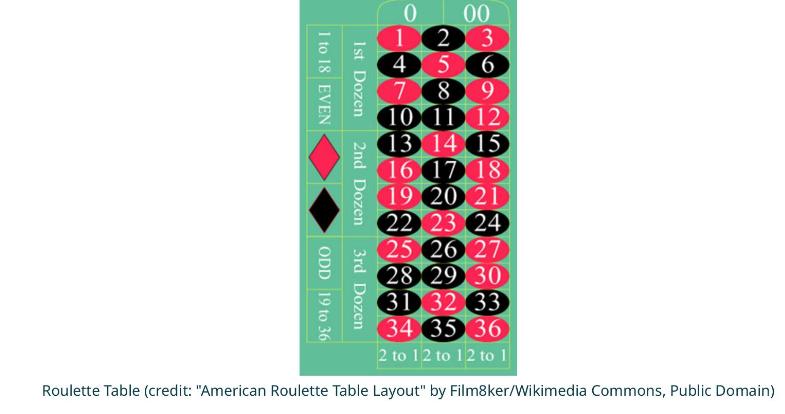
The street bet on \(1,2,3\) or even The casino game roulette. In this game, the dealer spins a marble around a wheel that contains 38 pockets that the marble can fall into. Each pocket has a number (each whole number from 0 to 36, along with a double zero) and a color ( 0 and 00 are both green; the
The corner bet (a bet on 4 numbers that form a square on the table) on 1, 2, 4,5 or first dozen The casino game roulette. In this game, the dealer spins a marble around a wheel that contains 38 pockets that the marble can fall into. Each pocket has a number (each whole number from 0 to 36, along
The corner bet on \(1,2,4,5\) or second dozen The casino game roulette. In this game, the dealer spins a marble around a wheel that contains 38 pockets that the marble can fall into. Each pocket has a number (each whole number from 0 to 36, along with a double zero) and a color ( 0 and 00 are both
The basket bet (which wins on \(0,00,1,2,3\) ) or red The casino game roulette. In this game, the dealer spins a marble around a wheel that contains 38 pockets that the marble can fall into. Each pocket has a number (each whole number from 0 to 36, along with a double zero) and a color ( 0 and 00
The basket bet or black The casino game roulette. In this game, the dealer spins a marble around a wheel that contains 38 pockets that the marble can fall into. Each pocket has a number (each whole number from 0 to 36, along with a double zero) and a color ( 0 and 00 are both green; the other 36
What is the probability of rolling two \(1 \mathrm{~s}\) ?We are considering a special 6-sided die, with faces that are labeled with a number and a letter: \(1 A, 1 B, 2 A, 2 C, 4 A\), and \(4 E\). You are about to roll this die twice.
What is the probability of rolling two vowels?We are considering a special 6-sided die, with faces that are labeled with a number and a letter: \(1 A, 1 B, 2 A, 2 C, 4 A\), and \(4 E\). You are about to roll this die twice.
What is the probability of rolling an even number first and an odd number second?We are considering a special 6-sided die, with faces that are labeled with a number and a letter: \(1 A, 1 B, 2 A, 2 C, 4 A\), and \(4 E\). You are about to roll this die twice.
What is the probability of rolling an even number and an odd number in any order?We are considering a special 6-sided die, with faces that are labeled with a number and a letter: \(1 A, 1 B, 2 A, 2 C, 4 A\), and \(4 E\). You are about to roll this die twice.
What is the probability of rolling a consonant first and a 1 second?We are considering a special 6-sided die, with faces that are labeled with a number and a letter: \(1 A, 1 B, 2 A, 2 C, 4 A\), and \(4 E\). You are about to roll this die twice.
What is the probability of rolling one number less than 3 and one number greater than 3 , in any order?We are considering a special 6-sided die, with faces that are labeled with a number and a letter: \(1 A, 1 B, 2 A, 2 C, 4 A\), and \(4 E\). You are about to roll this die twice.
If you draw 1 tile at random, computea. \(P(\) tile shows \(\mathrm{A})\)b. \(\quad P\) (tile shows \(\mathrm{A} \mid\) tile shows a vowel)You are about to draw Scrabble tiles from a bag; the bag contains the letters \(A, A, C, E, E, E, L\), \(L, N, O, R, S, S, S, T, X\).
If you draw 1 tile at random, compute:a. \(P(\) tile shows a vowel \()\)b. \(\quad P\) (tile shows a vowel | tile shows a letter that comes after \(\mathrm{M}\) alphabetically)You are about to draw Scrabble tiles from a bag; the bag contains the letters \(A, A, C, E, E, E, L\), \(L, N, O, R, S, S,
If you draw 2 tiles with replacement, compute \(P\) (both are vowels).You are about to draw Scrabble tiles from a bag; the bag contains the letters \(A, A, C, E, E, E, L\), \(L, N, O, R, S, S, S, T, X\).
If you draw 2 tiles without replacement, compute \(P\) (both are vowels).You are about to draw Scrabble tiles from a bag; the bag contains the letters \(A, A, C, E, E, E, L\), \(L, N, O, R, S, S, S, T, X\).
If you draw 2 tiles with replacement, compute \(P\) (first is a vowel and second is a consonant).You are about to draw Scrabble tiles from a bag; the bag contains the letters \(A, A, C, E, E, E, L\), \(L, N, O, R, S, S, S, T, X\).
If you draw 2 tiles without replacement, compute \(P\) (first is a vowel and second is a consonant).You are about to draw Scrabble tiles from a bag; the bag contains the letters \(A, A, C, E, E, E, L\), \(L, N, O, R, S, S, S, T, X\).
If you draw 2 tiles with replacement, compute \(P\) (one is a vowel and one is a consonant).You are about to draw Scrabble tiles from a bag; the bag contains the letters \(A, A, C, E, E, E, L\), \(L, N, O, R, S, S, S, T, X\).
If you draw 2 tiles without replacement, compute \(P\) (one is a vowel and one is a consonant).You are about to draw Scrabble tiles from a bag; the bag contains the letters \(A, A, C, E, E, E, L\), \(L, N, O, R, S, S, S, T, X\).
If you draw 2 tiles with replacement, compute \(P\) (both are Es).You are about to draw Scrabble tiles from a bag; the bag contains the letters \(A, A, C, E, E, E, L\), \(L, N, O, R, S, S, S, T, X\).
If you draw 2 tiles without replacement, compute \(P\) (both are Es).You are about to draw Scrabble tiles from a bag; the bag contains the letters \(A, A, C, E, E, E, L\), \(L, N, O, R, S, S, S, T, X\).
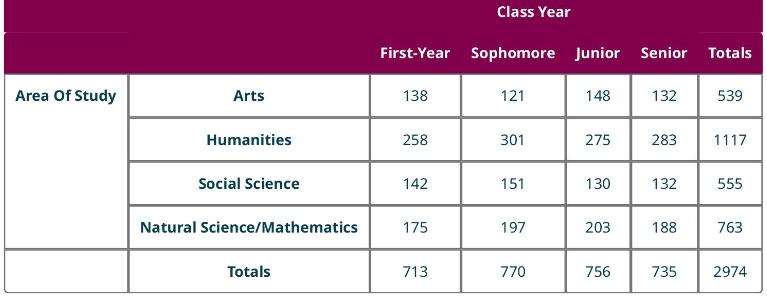
Compute the probability that a randomly selected student is a sophomore, given that they are majoring in the arts.Use the table provided, which breaks down the enrollment at a certain liberal arts college by class year and area of study. Class Year First-Year Sophomore Junior Senior Totals Area Of
Compute the probability that a randomly selected student is majoring in the arts, given that they are a sophomore.Use the table provided, which breaks down the enrollment at a certain liberal arts college by class year and area of study. Class Year First-Year Sophomore Junior Senior Totals Area Of
If two seniors are chosen at random, compute the probability that both are social science majors. Give your answer as a decimal, rounded to 5 decimal places.Use the table provided, which breaks down the enrollment at a certain liberal arts college by class year and area of study. Class Year
If two humanities majors are chosen at random, compute the probability that the first is a senior and the second is a junior. Give your answer as a decimal, rounded to 5 decimal places.Use the table provided, which breaks down the enrollment at a certain liberal arts college by class year and area
If two natural science/mathematics majors are chosen at random, compute the probability that one is a sophomore and one is a senior (in any order). Give your answer as a decimal, rounded to 5 decimal places.Use the table provided, which breaks down the enrollment at a certain liberal arts college
If two students are chosen at random, compute the probability that one is an arts major and one is a social science major, in any order. Give your answer as a decimal, rounded to 5 decimal places.Use the table provided, which breaks down the enrollment at a certain liberal arts college by class
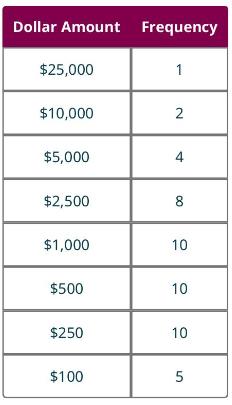
What is the probability that both punches are worth less than \(\$ 1,000\) ?Deal with the game "Punch a Bunch," which appears on the TV game show The Price Is Right. In this game, contestants have a chance to punch through up to 4 paper circles on a board; behind each circle is a card with a dollar
What is the probability that both punches are worth more than \(\$ 2,500\) ?Deal with the game "Punch a Bunch," which appears on the TV game show The Price Is Right. In this game, contestants have a chance to punch through up to 4 paper circles on a board; behind each circle is a card with a dollar
What is the probability that the second punch is worth more than the first punch, given that the first punch was worth \(\$ 250\) ?Deal with the game "Punch a Bunch," which appears on the TV game show The Price Is Right. In this game, contestants have a chance to punch through up to 4 paper circles
What is the probability that the second punch is worth more than the first punch, given that the first punch was worth \(\$ 1,000\) ?Deal with the game "Punch a Bunch," which appears on the TV game show The Price Is Right. In this game, contestants have a chance to punch through up to 4 paper
What is the probability that the second punch is worth less than the first punch, given that the first punch was worth \(\$ 250\) ?Deal with the game "Punch a Bunch," which appears on the TV game show The Price Is Right. In this game, contestants have a chance to punch through up to 4 paper circles
What is the probability that the second punch is worth less than the first punch, given that the first punch was worth \(\$ 1,000\) ?Deal with the game "Punch a Bunch," which appears on the TV game show The Price Is Right. In this game, contestants have a chance to punch through up to 4 paper
What is the probability that both punches are worth \(\$ 100\) ?Deal with the game "Punch a Bunch," which appears on the TV game show The Price Is Right. In this game, contestants have a chance to punch through up to 4 paper circles on a board; behind each circle is a card with a dollar amount
What is the probability that both punches are worth the same amount?Deal with the game "Punch a Bunch," which appears on the TV game show The Price Is Right. In this game, contestants have a chance to punch through up to 4 paper circles on a board; behind each circle is a card with a dollar amount
What is the probability that Team A wins the series given that Team B wins the first game?We consider two baseball teams playing a best-of-three series (meaning the first team to win two games wins the series). Team A is a little bit better than Team B, so we expect Team A will win \(55 \%\) of the
What is the probability that Team \(B\) wins the series given that Team \(B\) wins the first game?We consider two baseball teams playing a best-of-three series (meaning the first team to win two games wins the series). Team A is a little bit better than Team B, so we expect Team A will win \(55
What is the probability that Team B wins the series given that Team A wins the first game?We consider two baseball teams playing a best-of-three series (meaning the first team to win two games wins the series). Team A is a little bit better than Team B, so we expect Team A will win \(55 \%\) of the
What is the probability that Team A wins the series given that Team A wins the first game?We consider two baseball teams playing a best-of-three series (meaning the first team to win two games wins the series). Team A is a little bit better than Team B, so we expect Team A will win \(55 \%\) of the
Build a tree diagram that shows all possible outcomes of the series. Label the edges with appropriate probabilities.We consider two baseball teams playing a best-of-three series (meaning the first team to win two games wins the series). Team A is a little bit better than Team B, so we expect Team A
What is the probability that Team A wins the series?We consider two baseball teams playing a best-of-three series (meaning the first team to win two games wins the series). Team A is a little bit better than Team B, so we expect Team A will win \(55 \%\) of the time.
If instead Team \(A\) has a \(75 \%\) chance of winning each game, what is the probability that Team \(A\) wins the series?We consider two baseball teams playing a best-of-three series (meaning the first team to win two games wins the series). Team A is a little bit better than Team B, so we expect
If instead Team A has a \(90 \%\) chance of winning each game, what is the probability that Team A wins the series?We consider two baseball teams playing a best-of-three series (meaning the first team to win two games wins the series). Team A is a little bit better than Team B, so we expect Team A
A golfer practices putts from 1 foot, 2 feet, 3 feet, 4 feet, and 5 feet; "success" is defined as making the putt.Decide whether the described experiments are binomial experiments. For those that are not, explain why they aren't.
A game designer rolls a pair of dice 100 times and counts the number of times the sum is at least 10 .Decide whether the described experiments are binomial experiments. For those that are not, explain why they aren't.
A student who is completely unprepared for a multiple-choice pop quiz guesses on all 10 questions. There are 4 choices for each of the first 5 questions and 5 choices for each of the last 5 questions. "Success" is defined as answering the question correctly.Decide whether the described experiments
A baseball player is practicing pitching; he throws pitches until he gets 50 strikes.Decide whether the described experiments are binomial experiments. For those that are not, explain why they aren't.
A statistician stops 20 college students at random outside a dining hall and notes their class year.Decide whether the described experiments are binomial experiments. For those that are not, explain why they aren't.
An employee at a bowling alley watches each patron's first ball and counts how many are strikes over the course of his shift.Decide whether the described experiments are binomial experiments. For those that are not, explain why they aren't.
\(P(O=52)\)You have an 8-sided die with 4 faces colored orange, 3 colored red, and 1 colored yellow. You're going to roll the die 100 times: Let \(Y\) be the number of times a yellow face is showing, \(R\) be the number of times a red face is showing, and \(O\) be the number of times an orange face
\(P(R
\(P(Y \geq 10)\)You have an 8-sided die with 4 faces colored orange, 3 colored red, and 1 colored yellow. You're going to roll the die 100 times: Let \(Y\) be the number of times a yellow face is showing, \(R\) be the number of times a red face is showing, and \(O\) be the number of times an orange
\(P(O>55)\)You have an 8-sided die with 4 faces colored orange, 3 colored red, and 1 colored yellow. You're going to roll the die 100 times: Let \(Y\) be the number of times a yellow face is showing, \(R\) be the number of times a red face is showing, and \(O\) be the number of times an orange face
\(P(R=35)\)You have an 8-sided die with 4 faces colored orange, 3 colored red, and 1 colored yellow. You're going to roll the die 100 times: Let \(Y\) be the number of times a yellow face is showing, \(R\) be the number of times a red face is showing, and \(O\) be the number of times an orange face
\(P(Y
\(P(45
\(P(R \leq 30)\)You have an 8-sided die with 4 faces colored orange, 3 colored red, and 1 colored yellow. You're going to roll the die 100 times: Let \(Y\) be the number of times a yellow face is showing, \(R\) be the number of times a red face is showing, and \(O\) be the number of times an orange
\(P(Y \geq 20)\)You have an 8-sided die with 4 faces colored orange, 3 colored red, and 1 colored yellow. You're going to roll the die 100 times: Let \(Y\) be the number of times a yellow face is showing, \(R\) be the number of times a red face is showing, and \(O\) be the number of times an orange
\(P(O
\(P(\) Team A wins a single game against Team \(B)=51 \%\) best-of-5 series The following exercise are about series of games, where Team A faces Team B in a best-of series (like the World Series). Find the probability that Team A wins the series in each of the following scenarios.
\(P(\) Team \(A\) wins a single game against Team \(B)=51 \%\) best-of- 7 series The following exercise are about series of games, where Team A faces Team B in a best-of series (like the World Series). Find the probability that Team A wins the series in each of the following scenarios.
\(P(\) Team \(A\) wins a single game against Team \(B)=51 \%\) best-of- 15 series The following exercise are about series of games, where Team A faces Team B in a best-of series (like the World Series). Find the probability that Team A wins the series in each of the following scenarios.
\(P(\) Team A wins a single game against Team \(B)=51 \%\), best-of- 31 series The following exercise are about series of games, where Team A faces Team B in a best-of series (like the World Series). Find the probability that Team A wins the series in each of the following scenarios.
\(P(\) Team \(A\) wins a single game against Team \(B)=51 \%\), best-of-101 series The following exercise are about series of games, where Team A faces Team B in a best-of series (like the World Series). Find the probability that Team A wins the series in each of the following scenarios.
\(P(\) Team \(A\) wins a single game against Team \(B)=60 \%\), best-of-5 series The following exercise are about series of games, where Team A faces Team B in a best-of series (like the World Series). Find the probability that Team A wins the series in each of the following scenarios.
\(P(\) Team A wins a single game against Team \(B)=60 \%\), best-of-7 series The following exercise are about series of games, where Team A faces Team B in a best-of series (like the World Series). Find the probability that Team A wins the series in each of the following scenarios.
\(P(\) Team \(A\) wins a single game against Team \(B)=60 \%\), best-of-15 series The following exercise are about series of games, where Team A faces Team B in a best-of series (like the World Series). Find the probability that Team A wins the series in each of the following scenarios.
\(P(\) Team A wins a single game against Team \(B)=60 \%\), best-of-31 series The following exercise are about series of games, where Team A faces Team B in a best-of series (like the World Series). Find the probability that Team A wins the series in each of the following scenarios.
\(P(\) Team \(A\) wins a single game against Team \(B)=60 \%\), best-of-101 series The following exercise are about series of games, where Team A faces Team B in a best-of series (like the World Series). Find the probability that Team A wins the series in each of the following scenarios.
Give the table of the PDF for flipping a fair coin 5 times and counting the heads. Do the calculations without using technology.
Give the table of the CDF for flipping a fair coin 5 times and counting the heads. Do the calculations without using technology.
If a player bets \(\$ 1\) on red and wins, the player gets \(\$ 2\) back (the original \(\$ 1\) bet plus \(\$ 1\) winnings). What is the probability that the player wins more than they lose if the player bets on red on 5 consecutive spins?The following exercise are about the casino game roulette.
What is the probability that the player wins more than they lose if the player bets on red on 15 consecutive spins?The following exercise are about the casino game roulette. In this game, the dealer spins a marble around a wheel that contains 38 pockets that the marble can fall into. Each pocket
What is the probability that the player wins more than they lose if the player bets on red on 30 consecutive spins?The following exercise are about the casino game roulette. In this game, the dealer spins a marble around a wheel that contains 38 pockets that the marble can fall into. Each pocket
What is the probability that the player wins more than they lose if the player bets on red on 100 consecutive spins?The following exercise are about the casino game roulette. In this game, the dealer spins a marble around a wheel that contains 38 pockets that the marble can fall into. Each pocket
What is the probability that the player wins more than they lose if the player bets on red on 200 consecutive spins?The following exercise are about the casino game roulette. In this game, the dealer spins a marble around a wheel that contains 38 pockets that the marble can fall into. Each pocket
What is the probability that the player wins more than they lose if the player bets on red on 1,000 consecutive spins?The following exercise are about the casino game roulette. In this game, the dealer spins a marble around a wheel that contains 38 pockets that the marble can fall into. Each pocket
What is the probability that the player wins more than they lose if the player bets on red on 5,000 consecutive spins?The following exercise are about the casino game roulette. In this game, the dealer spins a marble around a wheel that contains 38 pockets that the marble can fall into. Each pocket
\(9: 4\)Find the probabilities of events with the given odds in favor.
\(2: 3\)Find the probabilities of events with the given odds in favor.
\(2: 3\)Find the probabilities of events with the given odds in favor.
\(5: 4\)Find the probabilities of events with the given odds in favor.
\(1: 50\)Find the probabilities of events with the given odds in favor.
\(7: 5\)Find the probabilities of events with the given odds in favor.
\(1: 7\)Find the probabilities of events with the given odds in favor.
\(10: 9\)Find the probabilities of events with the given odds in favor.
\(1: 8\)Find the probabilities of events with the given odds against.
\(2: 3\)Find the probabilities of events with the given odds against.
\(3: 2\)Find the probabilities of events with the given odds against.
\(5: 4\)Find the probabilities of events with the given odds against.
\(1: 50\)Find the probabilities of events with the given odds against.
\(7: 5\)Find the probabilities of events with the given odds against.
\(1: 7\)Find the probabilities of events with the given odds against.
\(10: 9\)Find the probabilities of events with the given odds against.
\(\frac{2}{7}\)Find the odds in favor of events with the given probabilities. Give your answer as a ratio of whole numbers. If neither of those two numbers is 1 , also give an answer as a ratio involving both 1 and a number greater than or equal to 1 (for example, the odds 5:2 and 3:8 can be
\(\frac{12}{17}\)Find the odds in favor of events with the given probabilities. Give your answer as a ratio of whole numbers. If neither of those two numbers is 1 , also give an answer as a ratio involving both 1 and a number greater than or equal to 1 (for example, the odds 5:2 and 3:8 can be
\(\frac{8}{9}\)Find the odds in favor of events with the given probabilities. Give your answer as a ratio of whole numbers. If neither of those two numbers is 1 , also give an answer as a ratio involving both 1 and a number greater than or equal to 1 (for example, the odds 5:2 and 3:8 can be
\(\frac{3}{8}\)Find the odds in favor of events with the given probabilities. Give your answer as a ratio of whole numbers. If neither of those two numbers is 1 , also give an answer as a ratio involving both 1 and a number greater than or equal to 1 (for example, the odds 5:2 and 3:8 can be
\(\frac{9}{25}\)Find the odds in favor of events with the given probabilities. Give your answer as a ratio of whole numbers. If neither of those two numbers is 1 , also give an answer as a ratio involving both 1 and a number greater than or equal to 1 (for example, the odds 5:2 and 3:8 can be
\(\frac{6}{7}\)Find the odds in favor of events with the given probabilities. Give your answer as a ratio of whole numbers. If neither of those two numbers is 1 , also give an answer as a ratio involving both 1 and a number greater than or equal to 1 (for example, the odds 5:2 and 3:8 can be
Showing 2800 - 2900
of 6887
First
22
23
24
25
26
27
28
29
30
31
32
33
34
35
36
Last
Step by Step Answers

 Get 50% OFF
Claim Now
Get 50% OFF
Claim Now