New Semester
Started
Get
50% OFF
Study Help!
--h --m --s
Claim Now
Question Answers
Textbooks
Find textbooks, questions and answers
Oops, something went wrong!
Change your search query and then try again
S
Books
FREE
Study Help
Expert Questions
Accounting
General Management
Mathematics
Finance
Organizational Behaviour
Law
Physics
Operating System
Management Leadership
Sociology
Programming
Marketing
Database
Computer Network
Economics
Textbooks Solutions
Accounting
Managerial Accounting
Management Leadership
Cost Accounting
Statistics
Business Law
Corporate Finance
Finance
Economics
Auditing
Tutors
Online Tutors
Find a Tutor
Hire a Tutor
Become a Tutor
AI Tutor
AI Study Planner
NEW
Sell Books
Search
Search
Sign In
Register
study help
mathematics
contemporary mathematics
Contemporary Mathematics 1st Edition OpenStax - Solutions
\(p\) : Tom Brady is a quarterback and \(q\) : Tom Brady does not play soccer.Answer the following:a. Write the conditional statement \(p \rightarrow q\) in words.b. Write the converse statement \(q \rightarrow p\) in words.c. Write the inverse statement \(\sim p \rightarrow \sim q\) in words.d.
\(p\) : Shakira does not sing opera and \(q\) : Shakira sings popular music.Answer the following:a. Write the conditional statement \(p \rightarrow q\) in words.b. Write the converse statement \(q \rightarrow p\) in words.c. Write the inverse statement \(\sim p \rightarrow \sim q\) in words.d.
\(p\) :The shape does not have three sides and \(q\) : The shape is not a triangle.Answer the following:a. Write the conditional statement \(p \rightarrow q\) in words.b. Write the converse statement \(q \rightarrow p\) in words.c. Write the inverse statement \(\sim p \rightarrow \sim q\) in
\(p\) : All birds can fly and \(q\) : Emus can fly.Answer the following:a. Write the conditional statement \(p \rightarrow q\) in words.b. Write the converse statement \(q \rightarrow p\) in words.c. Write the inverse statement \(\sim p \rightarrow \sim q\) in words.d. Write the contrapositive
\(p\) : Penguins cannot fly and \(q\) : Some birds can fly.Answer the following:a. Write the conditional statement \(p \rightarrow q\) in words.b. Write the converse statement \(q \rightarrow p\) in words.c. Write the inverse statement \(\sim p \rightarrow \sim q\) in words.d. Write the
\(p\) : Some superheroes do not wear capes and \(q\) : Spiderman is a superhero.Answer the following:a. Write the conditional statement \(p \rightarrow q\) in words.b. Write the converse statement \(q \rightarrow p\) in words.c. Write the inverse statement \(\sim p \rightarrow \sim q\) in words.d.
p: No Pokémon are little ponies and \(q\) : Bulbasaur is a Pokémon.Answer the following:a. Write the conditional statement \(p \rightarrow q\) in words.b. Write the converse statement \(q \rightarrow p\) in words.c. Write the inverse statement \(\sim p \rightarrow \sim q\) in words.d. Write the
\(p\) : Roses are red, and violets are blue and \(q\) : Sugar is sweet, and you are sweet too.Answer the following:a. Write the conditional statement \(p \rightarrow q\) in words.b. Write the converse statement \(q \rightarrow p\) in words.c. Write the inverse statement \(\sim p \rightarrow \sim
Write the hypothesis of the conditional statement, label it with a \(p\), and determine its truth value.Use the conditional statement: "If Clark Kent is Superman, then Lois Lane is not a reporter," to answer the following questions.
Write the conclusion of the conditional statement, label it with a \(q\), and determine its truth value.Use the conditional statement: "If Clark Kent is Superman, then Lois Lane is not a reporter," to answer the following questions.
Identify the following statement as the converse, inverse, or contrapositive, and determine its truth value: "If Clark Kent is not Superman, then Lois Lane is a reporter."Use the conditional statement: "If Clark Kent is Superman, then Lois Lane is not a reporter," to answer the following questions.
Identify the following statement as the converse, inverse, or contrapositive, and determine its truth value: "If Lois Lane is a reporter, then Clark Kent is not Superman."Use the conditional statement: "If Clark Kent is Superman, then Lois Lane is not a reporter," to answer the following questions.
Which form of the conditional is logically equivalent to the converse?Use the conditional statement: "If Clark Kent is Superman, then Lois Lane is not a reporter," to answer the following questions.
Write the hypothesis of the conditional statement, label it with a \(p\), and determine its truth value.Use the conditional statement: "If The Masked Singer is not a music competition, then Donnie Wahlberg was a member of New Kids on the Block," to answer the following questions.
Write the conclusion of the conditional statement, label it with a \(q\), and determine its truth value.Use the conditional statement: "If The Masked Singer is not a music competition, then Donnie Wahlberg was a member of New Kids on the Block," to answer the following questions.
Identify the following statement as the converse, inverse, or contrapositive, and determine its truth value: "If Donnie Wahlberg was a member of New Kids on the Block, then The Masked Singer is not a music competition."Use the conditional statement: "If The Masked Singer is not a music competition,
Identify the following statement as the converse, inverse, or contrapositive, and determine its truth value: "If The Masked Singer is a music competition, then Donnie Wahlberg was not a member of New Kids on the Block."Use the conditional statement: "If The Masked Singer is not a music competition,
Which form of the conditional is logically equivalent to the contrapositive, \(\sim q \rightarrow \sim p\) ?Use the conditional statement: "If The Masked Singer is not a music competition, then Donnie Wahlberg was a member of New Kids on the Block," to answer the following questions.
Write the hypothesis of the conditional statement, label it with a \(p\), and determine its truth value.Use the conditional statement: "If all whales are mammals, then no fish are whales," to answer the following questions.
Write the conclusion of the conditional statement, label it with a \(q\), and determine its truth value.Use the conditional statement: "If all whales are mammals, then no fish are whales," to answer the following questions.
Identify the following statement as the converse, inverse, or contrapositive, and determine its truth value: "If some fish are whales, then some whales are not mammals."Use the conditional statement: "If all whales are mammals, then no fish are whales," to answer the following questions.
Write the inverse in words and determine its truth value.Use the conditional statement: "If all whales are mammals, then no fish are whales," to answer the following questions.
Write the converse in words and determine its truth value.Use the conditional statement: "If all whales are mammals, then no fish are whales," to answer the following questions.
Write the hypothesis of the conditional statement, label it with a \(p\), and determine its truth value.Use the conditional statement: "If some parallelograms are rectangles, then some circles are not symmetrical," to answer the following questions.
Write the conclusion of the conditional statement, label it with a \(q\), and determine its truth value.Use the conditional statement: "If some parallelograms are rectangles, then some circles are not symmetrical," to answer the following questions.
Write the converse in words and determine its truth value.Use the conditional statement: "If some parallelograms are rectangles, then some circles are not symmetrical," to answer the following questions.
Write the contrapositive in words and determine its truth value.Use the conditional statement: "If some parallelograms are rectangles, then some circles are not symmetrical," to answer the following questions.
Write the inverse in words and determine its truth value.Use the conditional statement: "If some parallelograms are rectangles, then some circles are not symmetrical," to answer the following questions.
\(p: 7 \times 3=21\). What is the truth value of \(\sim p\) ?Find the truth value of each statement.
\(q\) : The sun revolves around the Earth. What is the truth value of \(\sim q\) ?Find the truth value of each statement.
\(\sim r\) : The acceleration of gravity is \(9.81 \mathrm{~m} / \mathrm{sec}^{2}\). What is the truth value of \(r\) ?Find the truth value of each statement.
\(s\) : Dan Brown is not the author of the book, The Davinci Code. What is the truth value of \(\sim(\sim s)\) ?Find the truth value of each statement.
\(t\) : Broccoli is a vegetable. What is the truth value of \(\sim(\sim t)\) ?Find the truth value of each statement.
\(\sim q\)Given \(p: 1+2=3, q\) : Five is an even number, and \(r\) : Seven is a prime number, find the truth value of each of the following statements.
\(p \wedge q\)Given \(p: 1+2=3, q\) : Five is an even number, and \(r\) : Seven is a prime number, find the truth value of each of the following statements.
\(p \vee q\)Given \(p: 1+2=3, q\) : Five is an even number, and \(r\) : Seven is a prime number, find the truth value of each of the following statements.
\(\sim p \vee \sim q\)Given \(p: 1+2=3, q\) : Five is an even number, and \(r\) : Seven is a prime number, find the truth value of each of the following statements.
\(p \wedge \sim q\)Given \(p: 1+2=3, q\) : Five is an even number, and \(r\) : Seven is a prime number, find the truth value of each of the following statements.
\(p \wedge r\)Given \(p: 1+2=3, q\) : Five is an even number, and \(r\) : Seven is a prime number, find the truth value of each of the following statements.
\(q \wedge r\)Given \(p: 1+2=3, q\) : Five is an even number, and \(r\) : Seven is a prime number, find the truth value of each of the following statements.
\(q \wedge \sim r\)Given \(p: 1+2=3, q\) : Five is an even number, and \(r\) : Seven is a prime number, find the truth value of each of the following statements.
\(q \vee \sim r\)Given \(p: 1+2=3, q\) : Five is an even number, and \(r\) : Seven is a prime number, find the truth value of each of the following statements.
\(\sim(p \wedge r)\)Given \(p: 1+2=3, q\) : Five is an even number, and \(r\) : Seven is a prime number, find the truth value of each of the following statements.
\(p \vee q \wedge r\)Given \(p: 1+2=3, q\) : Five is an even number, and \(r\) : Seven is a prime number, find the truth value of each of the following statements.
\(\sim p \vee(q \wedge r)\)Given \(p: 1+2=3, q\) : Five is an even number, and \(r\) : Seven is a prime number, find the truth value of each of the following statements.
\(\sim(q \wedge r) \vee \sim p\)Given \(p: 1+2=3, q\) : Five is an even number, and \(r\) : Seven is a prime number, find the truth value of each of the following statements.
\(q \vee r \vee p\)Given \(p: 1+2=3, q\) : Five is an even number, and \(r\) : Seven is a prime number, find the truth value of each of the following statements.
\(\sim q \wedge r \wedge p\)Given \(p: 1+2=3, q\) : Five is an even number, and \(r\) : Seven is a prime number, find the truth value of each of the following statements.
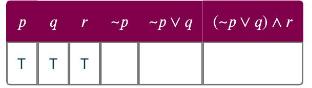
Complete the truth table to determine the truth value of the proposition in the last column. p q r -p -pVq (-pVq) Ar TT T
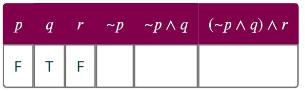
Complete the truth table to determine the truth value of the proposition in the last column. PqrP ~PAq (p^q) Ar FTF
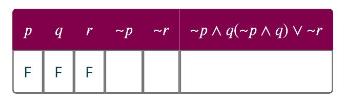
Complete the truth table to determine the truth value of the proposition in the last column. FFF Pqpq) V-r
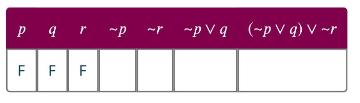
Complete the truth table to determine the truth value of the proposition in the last column. Par p ~ ~pvq (~pvq) V~r FF F
\(\sim r \wedge q \wedge p\)Given \(p\) : All triangles have three sides, \(q\) : Some rectangles are not square, and \(r\) : A pentagon has eight sides, determine the truth value of each compound statement by constructing a truth table.
\(\sim(q \wedge p) \vee r\)Given \(p\) : All triangles have three sides, \(q\) : Some rectangles are not square, and \(r\) : A pentagon has eight sides, determine the truth value of each compound statement by constructing a truth table.
\(\sim p \vee q \wedge r\)Given \(p\) : All triangles have three sides, \(q\) : Some rectangles are not square, and \(r\) : A pentagon has eight sides, determine the truth value of each compound statement by constructing a truth table.
\(\sim p \vee \sim q \vee r\)Given \(p\) : All triangles have three sides, \(q\) : Some rectangles are not square, and \(r\) : A pentagon has eight sides, determine the truth value of each compound statement by constructing a truth table.
\(\sim q \wedge q\)Construct a truth table to analyze all the possible outcomes for the following arguments.
\(\sim p \vee \sim q\)Construct a truth table to analyze all the possible outcomes for the following arguments.
\(\sim p \wedge \sim q\)Construct a truth table to analyze all the possible outcomes for the following arguments.
\(p \wedge q \vee r\)Construct a truth table to analyze all the possible outcomes for the following arguments.
\(\sim q \vee q\)Construct a truth table to determine the validity of each statement.
\(p \wedge \sim q\)Construct a truth table to determine the validity of each statement.
\(p \wedge q \vee \sim p\)Construct a truth table to determine the validity of each statement.
\((p \wedge q) \vee(\sim p \wedge \sim q)\)Construct a truth table to determine the validity of each statement.
If Layla has two weeks for vacation, then she will travel to Paris, France.Translate each compound statement into symbolic form.Given p: "Layla has two weeks for vacation," \(q\) : "Marcus is Layla's friend," \(r\) : "Layla will travel to Paris, France," and \(s\) : "Layla and Marcus will travel
Layla and Marcus will travel together to Niagara Falls, Ontario or Layla will travel to Paris, France.Translate each compound statement into symbolic form.Given p: "Layla has two weeks for vacation," \(q\) : "Marcus is Layla's friend," \(r\) : "Layla will travel to Paris, France," and \(s\) :
If Marcus is not Layla's friend, then they will not travel to Niagara Falls, Ontario together."Translate each compound statement into symbolic form.Given p: "Layla has two weeks for vacation," \(q\) : "Marcus is Layla's friend," \(r\) : "Layla will travel to Paris, France," and \(s\) : "Layla and
Layla and Marcus will travel to Niagara Falls, Ontario together if and only if Layla and Marcus are friends.Translate each compound statement into symbolic form.Given p: "Layla has two weeks for vacation," \(q\) : "Marcus is Layla's friend," \(r\) : "Layla will travel to Paris, France," and \(s\) :
If Layla does not have two weeks for vacation and Marcus is Layla's friend, then Marcus and Layla will travel together to Niagara Falls, Ontario.Translate each compound statement into symbolic form.Given p: "Layla has two weeks for vacation," \(q\) : "Marcus is Layla's friend," \(r\) : "Layla will
If Layla has two weeks for vacation and Marcus is not her friend, then she will travel to Paris, France.Translate each compound statement into symbolic form.Given p: "Layla has two weeks for vacation," \(q\) : "Marcus is Layla's friend," \(r\) : "Layla will travel to Paris, France," and \(s\) :
Jerry is a mouse and Tom is a cat.Translate each compound statement into symbolic form.Given \(p\) : "Tom is a cat," \(q\) : "Jerry is a mouse," \(r\) : "Spike is a dog," \(s\) : "Tom chases Jerry," and \(t\) : "Spike catches Tom."
If Tom chases Jerry, then Spike will catch Tom.Translate each compound statement into symbolic form.Given \(p\) : "Tom is a cat," \(q\) : "Jerry is a mouse," \(r\) : "Spike is a dog," \(s\) : "Tom chases Jerry," and \(t\) : "Spike catches Tom."
If Spike does not catch Tom, then Tom did not chase Jerry.Translate each compound statement into symbolic form.Given \(p\) : "Tom is a cat," \(q\) : "Jerry is a mouse," \(r\) : "Spike is a dog," \(s\) : "Tom chases Jerry," and \(t\) : "Spike catches Tom."
Tom is a cat and Spike is a dog, or Jerry is not a Mouse.Translate each compound statement into symbolic form.Given \(p\) : "Tom is a cat," \(q\) : "Jerry is a mouse," \(r\) : "Spike is a dog," \(s\) : "Tom chases Jerry," and \(t\) : "Spike catches Tom."
It is not the case that Tom is not a cat and Jerry is not a mouse.Translate each compound statement into symbolic form.Given \(p\) : "Tom is a cat," \(q\) : "Jerry is a mouse," \(r\) : "Spike is a dog," \(s\) : "Tom chases Jerry," and \(t\) : "Spike catches Tom."
Spike is not a dog and Jerry is a mouse if and only if Tom chases Jerry, but Spike does not catch Tom.Translate each compound statement into symbolic form.Given \(p\) : "Tom is a cat," \(q\) : "Jerry is a mouse," \(r\) : "Spike is a dog," \(s\) : "Tom chases Jerry," and \(t\) : "Spike catches Tom."
\(p \vee r\)Translate the symbolic form of each compound statement into words.Given \(p\) : "Tracy Chapman plays guitar," \(q:\) "Joan Jett plays guitar," \(r\) : "All rock bands include guitarists," and \(s\) : "Elton John plays the piano."
\(\sim s \rightarrow \sim q\)Translate the symbolic form of each compound statement into words.Given \(p\) : "Tracy Chapman plays guitar," \(q:\) "Joan Jett plays guitar," \(r\) : "All rock bands include guitarists," and \(s\) : "Elton John plays the piano."
\((p \wedge q) \leftrightarrow r\)Translate the symbolic form of each compound statement into words.Given \(p\) : "Tracy Chapman plays guitar," \(q:\) "Joan Jett plays guitar," \(r\) : "All rock bands include guitarists," and \(s\) : "Elton John plays the piano."
\(\sim r \wedge(q \vee s)\)Translate the symbolic form of each compound statement into words.Given \(p\) : "Tracy Chapman plays guitar," \(q:\) "Joan Jett plays guitar," \(r\) : "All rock bands include guitarists," and \(s\) : "Elton John plays the piano."
\(\sim(p \wedge \sim q)\)Translate the symbolic form of each compound statement into words.Given \(p\) : "Tracy Chapman plays guitar," \(q:\) "Joan Jett plays guitar," \(r\) : "All rock bands include guitarists," and \(s\) : "Elton John plays the piano."
\((q \rightarrow \sim r) \leftrightarrow(\sim p \vee \sim r)\)Translate the symbolic form of each compound statement into words.Given \(p\) : "Tracy Chapman plays guitar," \(q:\) "Joan Jett plays guitar," \(r\) : "All rock bands include guitarists," and \(s\) : "Elton John plays the piano."
\(t \rightarrow s\)Translate the symbolic form of each compound statement into words.Given \(p\) : "The median is the middle number," \(q\) : "The mode is the most frequent number," \(r\) : "The mean is the average number," \(s\) : “The median, mean, and mode are equal," and \(t\) :"The data set
\(p \wedge(q \wedge r)\)Translate the symbolic form of each compound statement into words.Given \(p\) : "The median is the middle number," \(q\) : "The mode is the most frequent number," \(r\) : "The mean is the average number," \(s\) : “The median, mean, and mode are equal," and \(t\) :"The data
\(\sim t \rightarrow \sim s\)Translate the symbolic form of each compound statement into words.Given \(p\) : "The median is the middle number," \(q\) : "The mode is the most frequent number," \(r\) : "The mean is the average number," \(s\) : “The median, mean, and mode are equal," and \(t\) :"The
\((r \wedge p) \leftrightarrow q\)Translate the symbolic form of each compound statement into words.Given \(p\) : "The median is the middle number," \(q\) : "The mode is the most frequent number," \(r\) : "The mean is the average number," \(s\) : “The median, mean, and mode are equal," and \(t\)
\((t \rightarrow \sim q) \vee(r \rightarrow s)\)Translate the symbolic form of each compound statement into words.Given \(p\) : "The median is the middle number," \(q\) : "The mode is the most frequent number," \(r\) : "The mean is the average number," \(s\) : “The median, mean, and mode are
\(\sim(q \vee r) \rightarrow t\)Translate the symbolic form of each compound statement into words.Given \(p\) : "The median is the middle number," \(q\) : "The mode is the most frequent number," \(r\) : "The mean is the average number," \(s\) : “The median, mean, and mode are equal," and \(t\)
\(p \rightarrow q \vee r\)Apply the proper dominance of connectives by adding parentheses to indicate the order in which the statement must be evaluated.
\(p \wedge q \leftrightarrow \sim r\)Apply the proper dominance of connectives by adding parentheses to indicate the order in which the statement must be evaluated.
\(p \vee r \vee \sim q\)Apply the proper dominance of connectives by adding parentheses to indicate the order in which the statement must be evaluated.
\(p \wedge \sim q \wedge r\)Apply the proper dominance of connectives by adding parentheses to indicate the order in which the statement must be evaluated.
\(p \wedge r \vee s \wedge t\)Apply the proper dominance of connectives by adding parentheses to indicate the order in which the statement must be evaluated.
\(q \rightarrow \sim r \leftrightarrow \sim p \vee \sim r\)Apply the proper dominance of connectives by adding parentheses to indicate the order in which the statement must be evaluated.
\(p \rightarrow r \vee s \leftrightarrow \sim t\)Apply the proper dominance of connectives by adding parentheses to indicate the order in which the statement must be evaluated.
\(\sim(t \wedge s) \vee(p \rightarrow q) \wedge \sim r\)Apply the proper dominance of connectives by adding parentheses to indicate the order in which the statement must be evaluated.
A loan used to finance a house is called a mortgage.Determine whether the sentence represents a logical statement. If it is a logical statement, determine whether it is true or false.
All odd numbers are divisible by 2 .Determine whether the sentence represents a logical statement. If it is a logical statement, determine whether it is true or false.
Please, bring me that notebook.Determine whether the sentence represents a logical statement. If it is a logical statement, determine whether it is true or false.
Robot, what's your function?Determine whether the sentence represents a logical statement. If it is a logical statement, determine whether it is true or false.
Showing 6300 - 6400
of 6887
First
55
56
57
58
59
60
61
62
63
64
65
66
67
68
69
Step by Step Answers

 Get 50% OFF
Claim Now
Get 50% OFF
Claim Now