New Semester
Started
Get
50% OFF
Study Help!
--h --m --s
Claim Now
Question Answers
Textbooks
Find textbooks, questions and answers
Oops, something went wrong!
Change your search query and then try again
S
Books
FREE
Study Help
Expert Questions
Accounting
General Management
Mathematics
Finance
Organizational Behaviour
Law
Physics
Operating System
Management Leadership
Sociology
Programming
Marketing
Database
Computer Network
Economics
Textbooks Solutions
Accounting
Managerial Accounting
Management Leadership
Cost Accounting
Statistics
Business Law
Corporate Finance
Finance
Economics
Auditing
Tutors
Online Tutors
Find a Tutor
Hire a Tutor
Become a Tutor
AI Tutor
AI Study Planner
NEW
Sell Books
Search
Search
Sign In
Register
study help
mathematics
introductory statistics exploring the world through data
Introductory Statistics Exploring The World Through Data 3rd Edition Robert Gould, Rebecca Wong, Colleen N. Ryan - Solutions
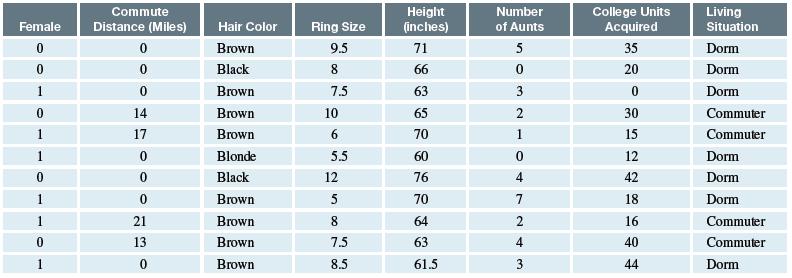
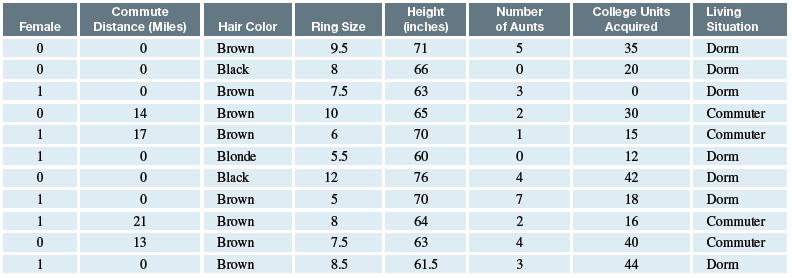
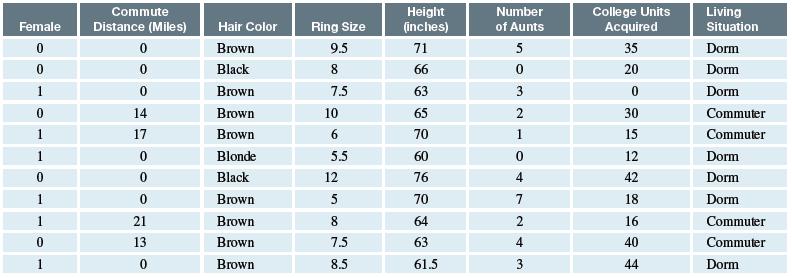
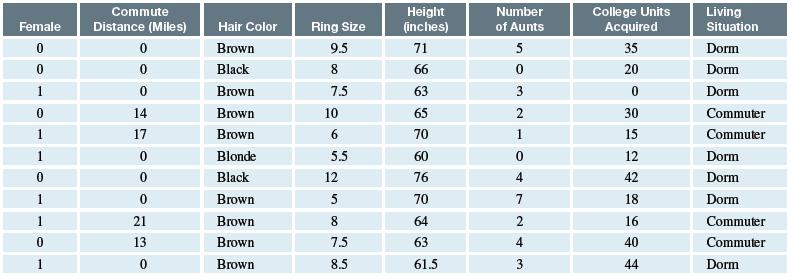
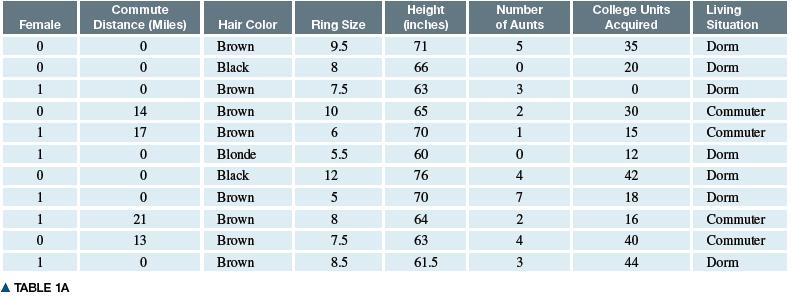
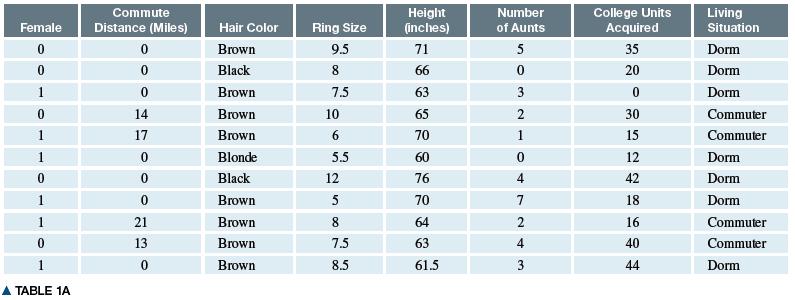
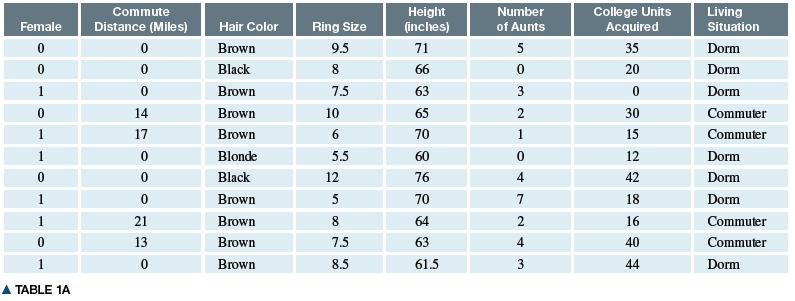
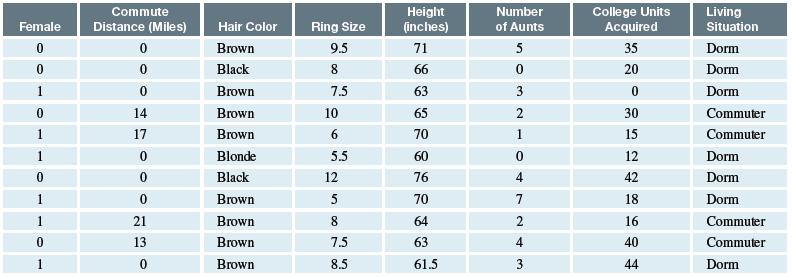
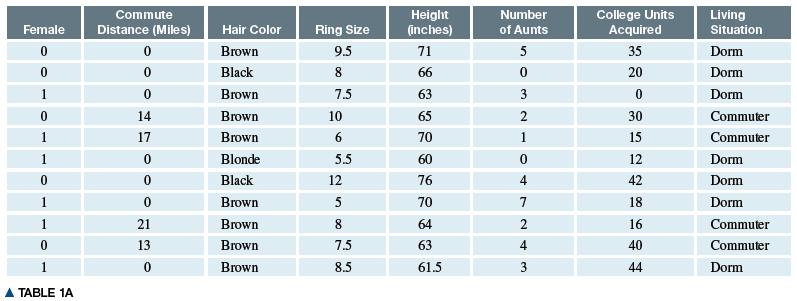
Students who have accumulated fewer than 30 units are called Freshmen.a. Create a new categorical variable, named Freshman, that classifies each student in Table 1A as a freshman (less than 30 units) or not a freshman. Call this variable Freshman. Report the coded values in a column in the same
Explain why the variable Female, in Table 1A, is categorical, even though its values are numbers. Often, it does not make sense, or is not even possible, to add the values of a categorical variable. Does it make sense for Male? If so, what does the sum represent? College Units Acquired Commute
Suppose you decided to code living situation using Dorm as the label for the column. How many ones and how many zeroes would there be?
What do the numbers 1 and 0 mean for the variable Female, in Table 1A (which is coded categorical data)? Often, it does not make sense, or is not even possible, to add a categorical variable. Does it make sense for Female? If so, what does the sum represent? College Units Acquired Commute Height
Give an example of another categorical variable we might have recorded for the students whose data are in Table 1A? College Units Acquired Commute Height (inches) Number Living Female Distance (Miles) Hair Color Ring Size of Aunts Situation Brown 9.5 71 5 35 Dorm Black 8 66 20 Dorm 1 Brown 7.5 63
Are the following variables, from Table 1A, numerical or categorical? Explain.a. Ring sizeb. Hair colorc. Height College Units Acquired Commute Height (inches) Number Living Situation Female Distance (Miles) Hair Color Ring Size of Aunts Brown 9.5 71 5 35 Dorm Black 8 66 20 Dorm 1 Brown 15 63 3
Are the following variables, from Table 1A, numerical or categorical? Explain.a. Living situationb. Commute distancec. Number of aunts College Units Acquired Commute Height (inches) Number Living Female Distance (Miles) Hair Color Ring Size of Aunts Situation 0. Brown 9.5 71 5 35 Dorm Black 8 66 20
Table 1A, there are observations on how many people? College Units Acquired Commute Height (inches) Number Living Female Distance (Miles) Hair Color Ring Size of Aunts Situation Brown 9.5 71 5 35 Dorm Black 8. 66 20 Dorm 1 Brown 7.5 63 3 Dorm 0. 14 Brown 10 65 2 30 Commuter 1 17 Brown 70 1 15
Give an example of another numerical variable we might have recorded for the students whose data are in Table 1A? College Units Acquired Commute Height (inches) Number Living Female Distance (Miles) Hair Color Ring Size of Aunts Situation Brown 9.5 71 5 35 Dorm Black 8 66 20 Dorm 1 Brown 7.5 63
In Table 1A, how many variables are there? Commute Distance (Miles) Height (inches) College Units Acquired Number Living Female Hair Color Ring Size of Aunts Situation Brown 9.5 71 5 35 Dorm Black 8 66 20 Dorm 1 Brown 7.5 63 3 Dorm 14 Brown 10 65 2 30 Commuter 1 17 Brown 6. 70 1 15 Commuter Blonde
Showing 700 - 800
of 710
1
2
3
4
5
6
7
8
Step by Step Answers

 Get 50% OFF
Claim Now
Get 50% OFF
Claim Now