New Semester
Started
Get
50% OFF
Study Help!
--h --m --s
Claim Now
Question Answers
Textbooks
Find textbooks, questions and answers
Oops, something went wrong!
Change your search query and then try again
S
Books
FREE
Study Help
Expert Questions
Accounting
General Management
Mathematics
Finance
Organizational Behaviour
Law
Physics
Operating System
Management Leadership
Sociology
Programming
Marketing
Database
Computer Network
Economics
Textbooks Solutions
Accounting
Managerial Accounting
Management Leadership
Cost Accounting
Statistics
Business Law
Corporate Finance
Finance
Economics
Auditing
Tutors
Online Tutors
Find a Tutor
Hire a Tutor
Become a Tutor
AI Tutor
AI Study Planner
NEW
Sell Books
Search
Search
Sign In
Register
study help
mathematics
linear algebra and its applications
Linear Algebra And Its Applications 6th Global Edition David Lay, Steven Lay, Judi McDonald - Solutions
The number of innings batted in the Major Leagues in the 2006 season was 43,257, and the number of earned runs scored was 21,722. What is the total number of earned runs scored for the season predicted by the model, and how does it compare with the actual number of earned runs scored?
Consider a pair of Ehrenfest urns labeled A and B. There are currently no molecules in urn A and 5 in urn B. What is the probability that the exact same situation will apply after a. 4 selections? b. 5 selections?
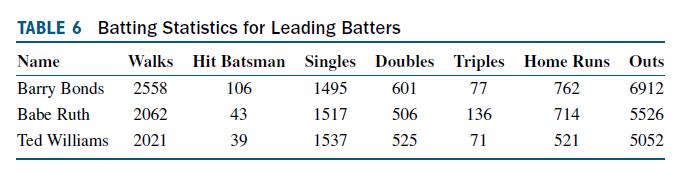
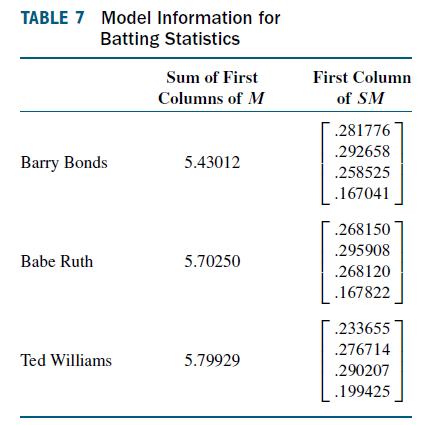
The sums of the first columns of M for the player data in Table 6 and the first columns of SM for the player data in Table 6 given in Table 7. Find and compare the offensive earned run averages of these players. Which batter does the model say was the best of these three? TABLE 6 Batting Statistics
Consider a pair of Ehrenfest urns with a total of 5 molecules divided between them.a. Find the transition matrix for the Markov chain that models the number of molecules in urn A, and show that this matrix is not regular.b. Assuming that the steady-state vector may be interpreted as occupation
Consider an unbiased random walk with reflecting boundaries on {1; 2; 3; 4}. Find the communication classes for this Markov chain and determine whether it is reducible or irreducible.
Reorder the states in the Markov chain in Exercise 2 to produce a transition matrix in canonical form.Data From Exercise 2In Exercises 1–6, consider a Markov chain with state space with {1; 2,......, n} and the given transition matrix. Identify the communication classes for each Markov chain as
Reorder the states in the Markov chain in Exercise 3 to produce a transition matrix in canonical form.Data From Exercise 3Consider a Markov chain with state space with {1; 2,......, n} and the given transition matrix. Identify the communication classes for each Markov chain as recurrent or
Consider an unbiased random walk on the set {1; 2; 3; 4}. What is the probability of moving from 2 to 3 in exactly 3 steps if the walk has a. Reflecting boundaries? b. Absorbing boundaries?
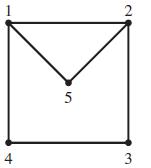
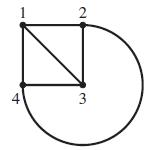
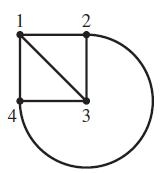
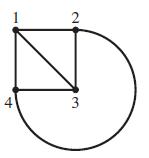
In Exercises 13 and 14, find the transition matrix for the simple random walk on the given graph. 4 5 2 3
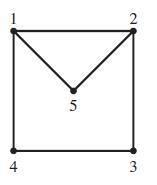
In Exercises 13 and 14, consider a simple random walk on the given graph. Show that the Markov chain is irreducible and calculate the mean return times for each state. 1 4 5 2 3
Consider a simple random walk on the following graph.a. Suppose that the walker begins in state 5. What is the expected number of visits to state 2 before the walker visits state 1?b. Suppose again that the walker begins in state 5. What is the expected number of steps until the walker reaches
Consider an unbiased random walk with reflecting boundaries on {1; 2; 3; 4}.a. Find the transition matrix for the Markov chain and show that this matrix is not regular.b. Assuming that the steady-state vector may be interpreted as occupation times for this Markov chain, in what state will this
Consider an unbiased random walk with absorbing boundaries on {1; 2; 3; 4}. Find the communication classes for this Markov chain and determine whether it is reducible or irreducible.
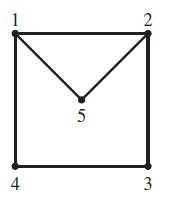
In Exercises 13 and 14, consider a simple random walk on the given graph. In the long run, what fraction of the time will the walk be at each of the various states? 2 3
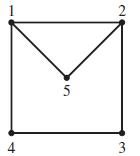
Consider a simple random walk on the following graph.a. Suppose that the walker begins in state 3. What is the expected number of visits to state 2 before the walker visits state 1?b. Suppose again that the walker begins in state 3. What is the expected number of steps until the walker reaches
In Exercises 13 and 14, consider a simple random walk on the given graph. In the long run, what fraction of the time will the walk be at each of the various states? 4 5 2 3
Consider a biased random walk on the set {1; 2; 3; 4} with probability p = .2 of moving to the left. What is the probability of moving from 2 to 3 in exactly 3 steps if the walk hasa. Reflecting boundaries? b. Absorbing boundaries?
Consider a biased random walk with reflecting boundaries on {1; 2; 3; 4} with probability p = .2 of moving to the left.a. Find the transition matrix for the Markov chain and show that this matrix is not regular.b. Assuming that the steady-state vector may be interpreted as occupation times for this
In Exercises 13 and 14, consider a simple random walk on the given graph. Show that the Markov chain is irreducible and calculate the mean return times for each state. 1 2 5 3
Exercises 14–18 show how the model for run production in the text can be used to determine baseball strategy. Suppose that you are managing a baseball team and have access to the matrices M and SM for your team. .06107 .35881 .41638 .16374
Consider the second columns of the matrices M and SM, which correspond to the “Runner on first, none out” state.a. What information does the sum of the second column of M give?b. What value can you calculate using the second column of SM?c. What would the calculation of expected runs scored
Reorder the states in the Markov chain in Exercise 4 to produce a transition matrix in canonical form.Data From Exercise 4Consider a Markov chain with state space with {1; 2,......, n} and the given transition matrix. Identify the communication classes for each Markov chain as recurrent or
Reorder the states in the Markov chain in Exercise 5 to produce a transition matrix in canonical form.Data From Exercise 5Consider a Markov chain with state space with {1; 2,......, n} and the given transition matrix. Identify the communication classes for each Markov chain as recurrent or
In Exercises 13 and 14, find the transition matrix for the simple random walk on the given graph. 4 2 3
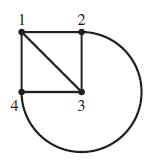
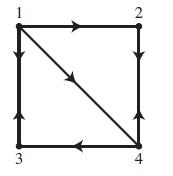
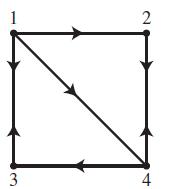
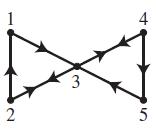
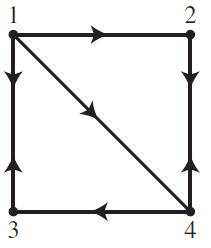
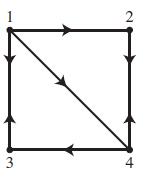
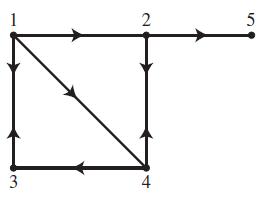
In Exercises 15 and 16, consider a simple random walk on the given directed graph. In the long run, what fraction of the time will the walk be at each of the various states? 1 3 نرا 2 4
In Exercises 15 and 16, consider a simple random walk on the given directed graph. Show that the Markov chain is irreducible and calculate the mean return times for each state. 1 3 2 4
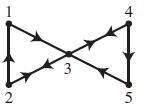
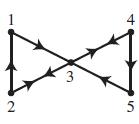
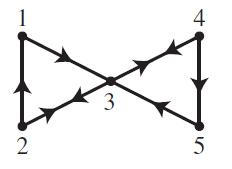
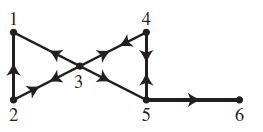
In Exercises 15 and 16, consider a simple random walk on the given directed graph. Show that the Markov chain is irreducible and calculate the mean return times for each state. 1 2 3 4 5
Consider a simple random walk on the following directed graph. Suppose that the walker starts at state 1.a. How many visits to state 2 does the walker expect to make before visiting state 3?b. How many steps does the walker expect to take before visiting state 3? 1 3 2 4
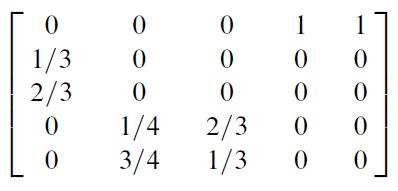
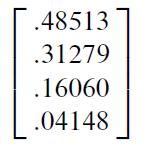
The sum of the column of M corresponding to the “Runner on second, none out” state is 4:53933, and the column of SM corresponding to the “Runner on second, none out” state isHow many earned runs do you expect your team to score if there is a runner on second and no outs?
In Exercises 15 and 16, find the transition matrix for the simple random walk on the given directed graph. 3 2 4
In Exercises 15 and 16, find the transition matrix for the simple random walk on the given directed graph. 1 2 3 4 5
In Exercises 15 and 16, consider a simple random walk on the given directed graph. In the long run, what fraction of the time will the walk be at each of the various states? 1 2 3 4 5
Reorder the states in the Markov chain in Exercise 6 to produce a transition matrix in canonical form.Data From Exercise 6In Exercises 1–6, consider a Markov chain with state space with {1; 2,......, n} and the given transition matrix. Identify the communication classes for each Markov chain as
Consider a simple random walk on the following directed graph. Suppose that the walker starts at state 4.a. How many visits to state 3 does the walker expect to make before visiting state 2?b. How many steps does the walker expect to take before visiting state 2? 1 2 3 4 5
The sum of the column of M corresponding to the “Bases empty, one out” state is 3:02622, and the column of SM corresponding to the “Bases empty, one out” state isHow many earned runs do you expect your team to score if the bases are empty and there is one out?
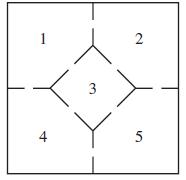
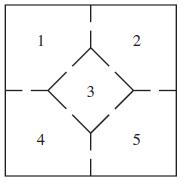
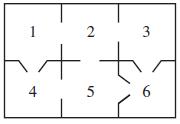
Consider the mouse in the following maze from Section 10.1, Exercise 17.The mouse must move into a different room at each time step and is equally likely to leave the room through any of the available doorways. If you go away from the maze for a while, what is the probability that the mouse will be
In Exercises 17 and 18, suppose a mouse wanders through the given maze. The mouse must move into a different room at each time step and is equally likely to leave the room through any of the available doorways.The mouse is placed in room 2 of the maze shown.a. Construct a transition matrix and an
Consider the mouse in the following maze from Section 10.1, Exercise 17.The mouse must move into a different room at each time step and is equally likely to leave the room through any of the available doorways. If you go away from the maze for a while, what is the probability that the mouse will be
Consider the mouse in the following maze from Section 10.1, Exercise 17.Data From Section 10.1 Exercise 17Suppose a mouse wanders through the given maze. The mouse must move into a different room at each time step and is equally likely to leave the room through any of the available doorways.The
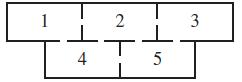
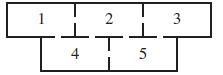
Consider the mouse in the following maze from Section 10.1, Exercise 18.If the mouse starts in room 2, how long on average will it take the mouse to return to room 2?Data From Section 10.1 Exercise 18The mouse is placed in room 3 of the maze shown below. 1 4 2 5 3
Consider the mouse in the following maze from Section 10.1, Exercise 18.What fraction of the time does it spend in room 3?Data From Section 10.1 Exercise 18The mouse is placed in room 3 of the maze shown below. 1 2 동물 4 5 3
Find the transition matrix for the Markov chain in Exercise 9 and reorder the states to produce a transition matrix in canonical form.Data From Exercise 9In Exercises 7–10, consider a simple random walk on the given directed graph. Identify the communication classes of this Markov chain as
Find the transition matrix for the Markov chain in Exercise 10 and reorder the states to produce a transition matrix in canonical form.Data From Exercise 10Consider a simple random walk on the given directed graph. Identify the communication classes of this Markov chain as recurrent or transient,
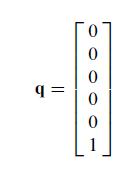
Consider the mouse in the following maze, which includes “one-way” doors, from Section 10.1, Exercise 19.Show thatis a steady-state vector for the associated Markov chain, and interpret this result in terms of the mouse’s travels through the maze.Data From in Section 10.1, Exercise 19.
Consider the mouse in the following maze from Section 10.1, Exercise 18.If the mouse starts in room 1, what is the probability that the mouse visits room 3 before visiting room 4?Data From Section 10.1 Exercise 18The mouse is placed in room 3 of the maze shown below. 1 4 2 5 3
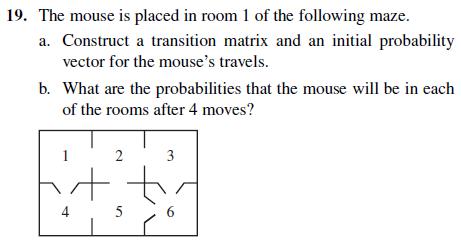
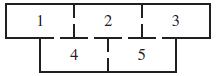
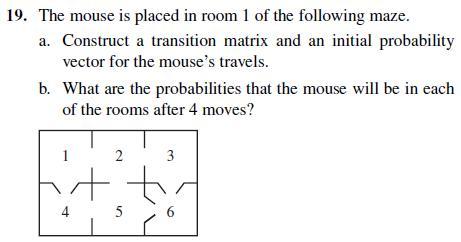
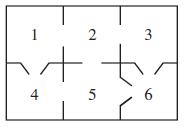
Consider the mouse in the following maze from Section 10.1, Exercise 19.Data From Section 10.1, Exercise 19 19. The mouse is placed in room 1 of the following maze. a. Construct a transition matrix and an initial probability vector for the mouse's travels. b. What are the probabilities that the
The mouse is placed in room 3 of the maze shown below.a. Construct a transition matrix and an initial probability vector for the mouse’s travels.b. What are the probabilities that the mouse will be in each of the rooms after 4 moves? 1 4 2 H ㅏ 5 3
Suppose that a runner for your team is on first base with no outs. You have to decide whether to tell the baserunner to attempt to steal second base. If the steal is successful, there will be a runner on second base and no outs. If the runner is caught stealing, the bases will be empty and there
Consider the mouse in the following maze from Section 10.1, Exercise 19.Data From Section 10.1 Exercise 19If the mouse starts in room 1, how many steps on average will it take the mouse to get to room 6? 1 4 2 + 5 3 6
In Exercises 19 and 20, suppose a mouse wanders through the given maze, some of whose doors are “one-way”: they are just large enough for the mouse to squeeze through in only one direction. The mouse still must move into a different room at each time step if possible. When faced with accessible
The mouse is placed in room 1 of the maze shown.a. Construct a transition matrix and an initial probability vector for the mouse’s travels.b. What are the probabilities that the mouse will be in each of the rooms after 3 moves? 1 4 3 2 5
In the previous exercise, let p be the probability that the baserunner steals second base successfully. For which values of p would you as manager call for an attempted steal?Data from previous exercise Suppose that a runner for your team is on first base with no outs. You have to decide
Consider the mouse in the following maze from Section 10.1, Exercise 20.a. Identify the communication classes of this Markov chain as recurrent or transient.b. Find the period of each communication class.c. Find the transition matrix for the Markov chain and reorder the states to produce a
Consider the mouse in the following maze, which includes “one-way” doors. 1 4 3 2 5
Mark each statement. Justify each answer. In each part, A represents an n x n matrix.(T/F) If A is an orthogonal matrix, then ΙΙAxΙΙ= ΙΙxΙΙ for all x in Rn.
In exercises 3–6, Find(a) The maximum value of Q(x) subject to the constraint xTx = 1, (b) A unit vector u where this maximum is attained, and (c) The maximum of Q(x) subject to the constraints xTx = 1 and xTu = 0..Q(x) = 5x12 +5x22+3x + 10x1 x1 + 4x1 x3 +
Find the matrix of the quadratic form. Assume x is in R3.a.b. 5x² + 3x² - 7x² - 4x1x2 + 6X1X3 − 2x2x3
Find the matrix of the quadratic form. Assume x is in R3.a.b. 5x² − 3x² + 7x² + 8x1x2 − 4X1 X3
Repeat Exercise 7 for the data in Exercise 2.Data From Exercise 7Let x1, x2 denote the variables for the two-dimensional data in Exercise 1. Find a new variable y of the form y1 = c1x1 + c2x2, with c21 + c22 = 1, such that y, has maxi- mum possible variance over the given data. How
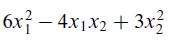
Then make a change of variable, x = Py that transform the quadratic form into one with no cross-product terms. Write the new quadratic form. Construct P using the methods of Section 7.1. 6x² - 4x1x2 + 3x2
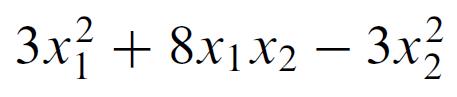
Then make a change of variable, x = Py that transform the quadratic form into one with no cross-product terms. Write the new quadratic form. Construct P using the methods of Section 7.1. 2 3x² + 8x1x₂ - 3x²
In Exercises 21–30, matrices are n x n and vectors are in Rn. Mark each statement True or False. Justify each answer.If A is symmetric and P is an orthogonal matrix, then the change of variable x = Py transforms xTAx into a quadratic form with no cross-product term.
If A is m x n, then the matrix G = ATA is called the Gram matrix of A. In this case, the entries of G are the inner products of the columns of A. (See Exercises 25 and 26.)Show that if an n x n matrix G is positive semidefinite and has rank r, then G is the Gram matrix of some r x n matrix A. This
In Exercises 25–32, mark each statement True or False. Justify each answer.(T/F) There are symmetric matrices that are not orthogonally diagonalizable.
Every complex number z can be written in polar form z = r (cosφ + i sinφ) where r is a nonnegative number and cosφ + i sinφ is a complex number of modulus 1.a. Prove that any n x n matrix A admits a polar decomposition of the form A = PQ, where P is an n x n positive semidefinite matrix with
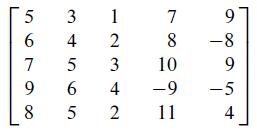
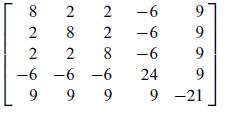
Compute the singular values of the 5 x 5 matrix in Exercise 10 in Section 2.3, and compute the condition number σ1 = σ5.Data From Exercise 10 in Section 2.3Unless otherwise specified, assume that all matrices in these exercises are n x n. Determine which of the matrices in are
Construct the pseudoinverse of A. Begin by using a matrix program to produce the SVD of A, or, if that is not available, begin with an orthogonal diagonalization of ATA. Use the, pseudoinverse to solve Ax = b, for b = (6,-1,-4,6), and let x̂ be the solution. Make a calculation to verify that x̂
Concern an m x n matrix A with a reduced sin- gular value decomposition, A = Ur DVrT, and the pseudoinverse A+ = Vr D–1UTr.Given any b in Rm, adapt Exercise 28 to show that A+b is the least-squares solution of minimum length.Data From Exercise 28Concern an m x n matrix A with a reduced sin-
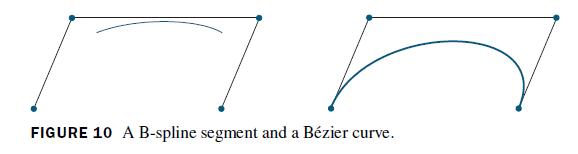
Let x.t / be a cubic Bézier curve determined by points p0, p1, p2, and p3.a. Compute the tangent vector x'(t). Determine how x'(0) and x'(1) are related to the control points, and give geometric descriptions of the directions of these tangent vectors. Is it possible to have x'(1) = 0?b. Compute
Show that if A is an n x n symmetric matrix, then (Ax) · y = x · (Ay) for all x, y in Rn.
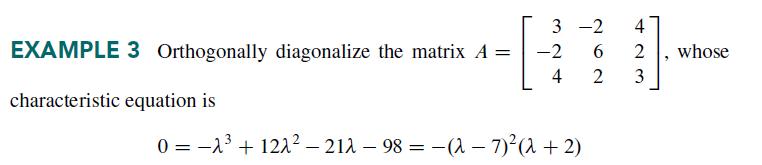
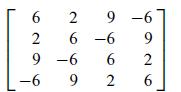
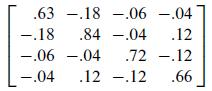
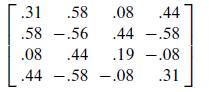
To practice the methods of this section, do not use an eigenvector routine from your matrix program. Instead, use the program to find the eigenvalues, and, for each eigenvalue λ, find an orthonormal basis for Nul(A – λI), as in Examples 2 and 3.Data From Section 7.1 Example 2 and 3 EXAMPLE 2 If
To practice the methods of this section, do not use an eigenvector routine from your matrix program. Instead, use the program to find the eigenvalues, and, for each eigenvalue λ, find an orthonormal basis for Nul(A – λI), as in Examples 2 and 3.Data From Section 7.1 Example 2 and 3 EXAMPLE 2 If
To practice the methods of this section, do not use an eigenvector routine from your matrix program. Instead, use the program to find the eigenvalues, and, for each eigenvalue λ, find an orthonormal basis for Nul(A – λI), as in Examples 2 and 3.Data From Section 7.1 Example 2 and 3 EXAMPLE 2 If
To practice the methods of this section, do not use an eigenvector routine from your matrix program. Instead, use the program to find the eigenvalues, and, for each eigenvalue λ, find an orthonormal basis for Nul(A – λI), as in Examples 2 and 3.Data From Section 7.1 Example 2 and 3 EXAMPLE 2 If
The parametric vector form of a B-spline curve was defined in the Practice Problems aswhere p0, p1, p2, and p3 are the control points.a. Show that for 0 ≤ t ≤ 1(x)t / is in the convex hull of the control points.b. Suppose that a B-spline curve x(t) is translated to x(t) + b (as in Exercise 1).
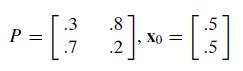
In Exercises 3 and 4, compute x3 in two ways: by computing x1 and x2, and by computing P3. P = .3 .7 2] . Xo = хо .8 .2 - .5 .5
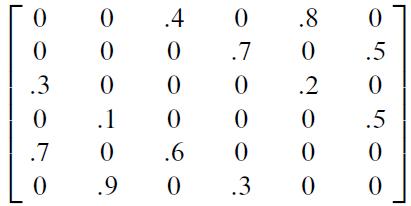
In Exercises 1–6, consider a Markov chain with state space {1,2,...........,n} and the given transition matrix. Find the communication classes for each Markov chain, and state whether the Markov chain is reducible or irreducible. 0 0 0 0 .3 0 .1 .7 0 0 .9 0 .4 0
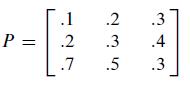
In Exercises 3 and 4, consider a Markov chain on {1; 2; 3} with the given transition matrix P. In each exercise, use two methods to find the probability that, in the long run, the chain is in state 1. First, raise P to a high power. Then directly compute the steadystate vector. P = .5 .3
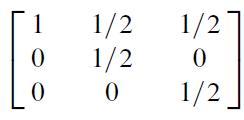
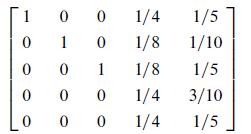
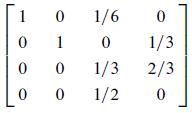
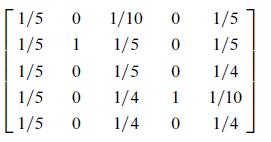
In Exercises 4–6, find the matrix A = limn→∞Sn for the Markov chain with the given transition matrix. Assume that the state space in each case is {1,2,................,n}. If reordering of states is necessary, list the order in which the states have been reordered. 1 0 0 0 0 0 Lo 1/4 1 0
In Exercises 4–6, find the matrix A = limn→∞Sn for the Markov chain with the given transition matrix. Assume that the state space in each case is {1,2,................,n}. If reordering of states is necessary, list the order in which the states have been reordered.
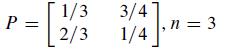
In Exercises 5 and 6, the transition matrix P for a Markov chain with states 0 and 1 is given. Assume that in each case the chain starts in state 0 at time n = 0. Find the probability that the chain will be in state 1 at time n. P 1/3 2/3 3/4 1/4 n = 3
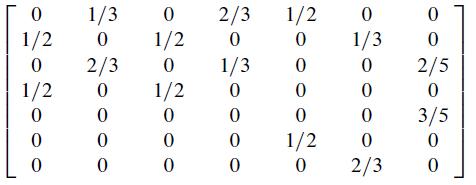
In Exercises 1–6, consider a Markov chain with state space with {1; 2,......, n} and the given transition matrix. Identify the communication classes for each Markov chain as recurrent or transient, and find the period of each communication class. 0 0 0 .3 0 .7 0 .4 0
In Exercises 1–6, justify the transition probabilities for the given initial states.Second and third bases occupied
In Exercises 1–6, justify the transition probabilities for the given initial states.First and third bases occupied
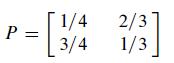
In Exercises 5 and 6, find the matrix to which Pn converges as n increases. P = 1/4 2/3] 3/4 1/3
In Exercises 4–6, find the matrix A = limn→∞Sn for the Markov chain with the given transition matrix. Assume that the state space in each case is {1,2,................,n}. If reordering of states is necessary, list the order in which the states have been reordered. 1/5 0 1/10 1/5 1 1/5 1/5 0
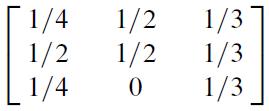
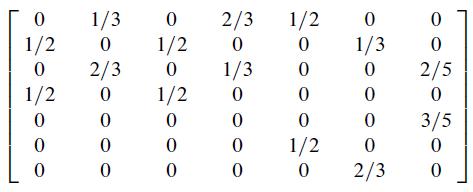
In Exercises 1–6, consider a Markov chain with state space {1, 2,...........,n} and the given transition matrix. Find the communication classes for each Markov chain, and state whether the Markov chain is reducible or irreducible. 0 1/2 0 1/3 0 2/3 1/2 0 0 0 0 0 0 0 0
In Exercises 1–6, justify the transition probabilities for the given initial states.First, second, and third bases occupied
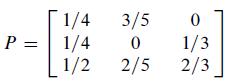
In Exercises 5 and 6, find the matrix to which Pn converges as n increases. P = 1/4 1/4 1/2 3/5 0 2/5 0 1/3 2/3
In Exercises 1–6, consider a Markov chain with state space with {1; 2,......, n} and the given transition matrix. Identify the communication classes for each Markov chain as recurrent or transient, and find the period of each communication class.
In Exercises 21–26, mark each statement True or False. Justify each answer.The probability that the Markov chain starting at state i is eventually absorbed by state j is the (j, i)-element of the matrix A = SM, where M is the fundamental matrix of the Markov chain and S is that portion of the
In Exercises 21–26, mark each statement True or False. Justify each answer.Transit times may be computed directly from the entries in the transition matrix.
In Exercises 21–26, mark each statement True or False. Justify each answer.If P is a regular stochastic matrix, then Pn approaches a matrix with equal columns as n increases.
Mark each statement True or False. Justify each answer.If the (i, j)- and (j, i)-entries in Pk are positive for some k, then the states i and j communicate with each other.
In Exercises 21–26, mark each statement True or False. Justify each answer.If two states of a Markov chain have different periods, then the Markov chain is reducible.
In Exercises 21–26, mark each statement True or False. Justify each answer.If {xn} is a Markov chain, then xn+1 must depend only on the transition matrix and xn.
In Exercises 21–26, mark each statement True or False. Justify each answer.The (j, i)-element in the fundamental matrix gives the expected number of visits to state i prior to absorption, starting at state j.
In Exercises 21–26, mark each statement True or False. Justify each answer.If its transition matrix is regular, then the steady-state vector gives information on long-run probabilities of the Markov chain.
Mark each statement True or False. Justify each answer.If a Markov chain is reducible, then it cannot have a regular transition matrix.
In Exercises 21–26, mark each statement True or False. Justify each answer.All of the states in an irreducible Markov chain are recurrent.
Showing 100 - 200
of 2241
1
2
3
4
5
6
7
8
9
10
11
12
13
14
15
Last
Step by Step Answers

 Get 50% OFF
Claim Now
Get 50% OFF
Claim Now