New Semester
Started
Get
50% OFF
Study Help!
--h --m --s
Claim Now
Question Answers
Textbooks
Find textbooks, questions and answers
Oops, something went wrong!
Change your search query and then try again
S
Books
FREE
Study Help
Expert Questions
Accounting
General Management
Mathematics
Finance
Organizational Behaviour
Law
Physics
Operating System
Management Leadership
Sociology
Programming
Marketing
Database
Computer Network
Economics
Textbooks Solutions
Accounting
Managerial Accounting
Management Leadership
Cost Accounting
Statistics
Business Law
Corporate Finance
Finance
Economics
Auditing
Tutors
Online Tutors
Find a Tutor
Hire a Tutor
Become a Tutor
AI Tutor
AI Study Planner
NEW
Sell Books
Search
Search
Sign In
Register
study help
mathematics
linear algebra and its applications
Linear Algebra And Its Applications 6th Global Edition David Lay, Steven Lay, Judi McDonald - Solutions
In matrices are n x n and vectors are in Rn. Justify each answer.(T/F) The expression ΙΙxΙΙ2 is not a quadratic form.
Let A be an n x n symmetric matrix. Use Exercise 21 and an eigenvector basis for Rn to give a second proof of the decomposition in Exercise 20(b).Data From Exercise 21Show that if v is an eigenvector of an n x n matrix A and v corresponds to a nonzero eigenvalue of A, then v is in Col A.Data From
A is an m x n matrix with a singular value decomposition A = UΣVT, where U is an m x m orthogonal matrix, Σ is an m x n "diagonal" matrix with r positive entries and no negative entries, and V is an n x n orthogonal matrix. Justify each answer.Show that if A is an n x n positive definite matrix,
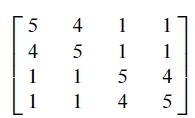
Orthogonally diagonalize the matrices in giving an orthogonal matrix P and a diagonal matrix D. To save you time, the eigenvalues in are the following: (17) –5, 5, 8; (18) 1, 2, 5; (19) 8, –1; (20) –3, 15; (21) 3, 5, 9; (22) 4, 6. 5 4 1 1 1 1 1 5 14 45 1 1 4 5
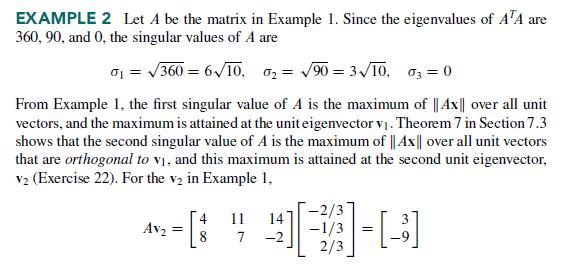
A is an m x n matrix with a singular value decomposition A = UΣVT, where U is an m x m orthogonal matrix, Σ is an m x n "diagonal" matrix with r positive entries and no negative entries, and V is an n x n orthogonal matrix. Justify each answer.Justify the statement in Example 2 that the second
In matrices are n x n and vectors are in Rn. Justify each answer.(T/F) The matrix of a quadratic form is a symmetric matrix.
Show that if v is an eigenvector of an n x n matrix A and v corresponds to a nonzero eigenvalue of A, then v is in Col A.
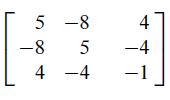
Orthogonally diagonalize the matrices in giving an orthogonal matrix P and a diagonal matrix D. To save you time, the eigenvalues in are the following: (17) –5, 5, 8; (18) 1, 2, 5; (19) 8, –1; (20) –3, 15; (21) 3, 5, 9; (22) 4, 6. 5-8 -8 5 4 -4 4 -4 -1
What is the largest possible value of the quadratic form 7x12 – 5x22 if xTx = 1?
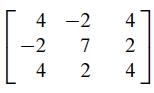
Orthogonally diagonalize the matrices in giving an orthogonal matrix P and a diagonal matrix D. To save you time, the eigenvalues in are the following: (17) –5, 5, 8; (18) 1, 2, 5; (19) 8, –1; (20) –3, 15; (21) 3, 5, 9; (22) 4, 6. 4-2 7 2 -2 4 4 2 4
A is an m x n matrix with a singular value decomposition A = UΣVT, where U is an m x m orthogonal matrix, Σ is an m x n "diagonal" matrix with r positive entries and no negative entries, and V is an n x n orthogonal matrix. Justify each answer.Show that if P is an orthogonal m x m matrix, then PA
Let A be an n x n symmetric matrix.a. Show that (Col A)⊥ = Nul A.b. Show that each y in Rn can be written in the form y = ŷ + z, with ŷ in Col A and z in Nul A.
Mark each statement. Justify each answer. In each part, A represents an n x n matrix.(T/F) A positive definite quadratic form can be changed into a negative definite form by a suitable change of variable x = Pu, for some orthogonal matrix P.
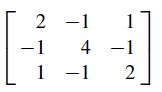
Orthogonally diagonalize the matrices in giving an orthogonal matrix P and a diagonal matrix D. To save you time, the eigenvalues in are the following: (17) –5, 5, 8; (18) 1, 2, 5; (19) 8, –1; (20) –3, 15; (21) 3, 5, 9; (22) 4, 6. 2 -1 1 -1 4 -1 -1 2
Then make a change of variable, x = Py that transform the quadratic form into one with no cross-product terms. Write the new quadratic form. 11x + 11x2 + 11x3 + 11x + 16xx 12XX4+ 12x2x3 + 16X3X4
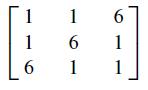
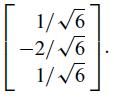
Orthogonally diagonalize the matrices in giving an orthogonal matrix P and a diagonal matrix D. To save you time, the eigenvalues in are the following: (17) –5, 5, 8; (18) 1, 2, 5; (19) 8, –1; (20) –3, 15; (21) 3, 5, 9; (22) 4, 6. 1 1 6 1 6 1 6 1 1
Then make a change of variable, x = Py that transform the quadratic form into one with no cross-product terms. Write the new quadratic form. 2x + 2x2 - 6x1x2 6X1X3 6X1X4 6X2X3- 6X2X4-2X3X4
Then make a change of variable, x = Py that transform the quadratic form into one with no cross-product terms. Write the new quadratic form. -3x - 7x2 - 10x3 - 10x + 4xx + 4x1x3+ 4X1X4 +6X3X4
Then make a change of variable, x = Py that transform the quadratic form into one with no cross-product terms. Write the new quadratic form. 4x + 4x + 4x + 4x + 8x1x2 + 8x3X4 - 6X1X4+ 6x2x3
A is an m x n matrix with a singular value decomposition A = UΣVT, where U is an m x m orthogonal matrix, Σ is an m x n "diagonal" matrix with r positive entries and no negative entries, and V is an n x n orthogonal matrix. Justify each answer.Show that the columns of V are eigenvectors of ATA,
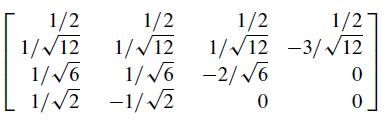
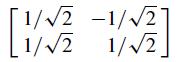
Determine which of the matrices in are orthogonal. If orthogonal, find the inverse. 1/2 1/2 1/√12 1/√12 1/√6 1/√6 1/√2 -1/√2 1/2 1/27 1/√12 -3/√12 -2/√6 0 0 0
Then make a change of variable, x = Py that transform the quadratic form into one with no cross-product terms. Write the new quadratic form. -2x² - 4x1x2 - 2x²
What is the largest possible value of the quadratic form 4x12 + 9x22 if x = (x1, x2) and xTx = 1, that is, if x12 + x22 = 1?
A is an m x n matrix with a singular value decomposition A = UΣVT, where U is an m x m orthogonal matrix, Σ is an m x n "diagonal" matrix with r positive entries and no negative entries, and V is an n x n orthogonal matrix. Justify each answer.Suppose A is square and invertible. Find a singular
Let A be an n x n symmetric matrix of rank r. Explain why the spectral decomposition of A represents A as the sum of r rank 1 matrices.
Let {u1..........un} be an orthonormal basis for Rn, and let λ1..........λn be any real scalars. Define A = λ1u1u1T+.............+ λnununTa. Show that A is symmetric.b. Show that λ1,..........λn are the eigenvalues of A.
Find(a) The maximum value of Q(x) subject to the constraint xTx = 1,(b) A unit vector u where this maximum is attained, and (c) The maximum of Q(x) subject to the constraints xTx = 1 and xTu = 0.x1x2 + 3x1x3 +30x1x4 +30x2x3 + 3x2x4 + x3x4
Convert the matrix of observations to mean deviation form, and construct the sample covariance matrix. 19 22 6 12 6 9 3 15 2 13 20 5
Let X denote a vector that varies over the columns of a p x N matrix of observations, and let P be a p x p orthogonal matrix. Show that the change of variable X = PY does not change the total variance of the data.
Find the change of variable x = Py that transforms the quadratic form xTAx into yTDy as shown. 5x² + 4x² + 3x² + 4x1x2 + 4x2x3 = 7y² + 4y² + y²
Let be any eigenvalue of a symmetric matrix A. Justify the statement made in this section that m ≤ λ ≤ M, where m and M are defined as in (2). Find an x such that λ = xTAx.
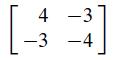
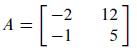
Determine which of the matrices in symmetric. 4 -3 -3 -4
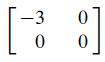
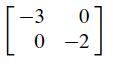
Find the singular values of the matrices. -3 0 0 0
Determine which of the matrices in symmetric. 4 3 3 -8
Convert the matrix of observations to mean deviation form, and construct the sample covariance matrix. 19 22 6 12 6 9 3 15 2 13 20 5
Mark each statement. Justify each answer. In each part, A represents an n x n matrix.(T/F) If A is orthogonally diagonalizable, then A is symmetric.
Find the singular values of the matrices. [! 0 -3
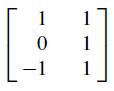
Find an SVD of matrix.One column of U can be 1 0 -1 1 1 1
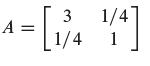
Compute the quadratic form xTAx, when and A || 3 [1³/4 1/14]
Find the matrix of the quadratic form. Assume x is in R2. a. 4x² - 6x1x2 + 5x2 b. 5x² + 4x1x₂
Mark each statement. Justify each answer. In each part, A represents an n x n matrix.(T/F) If A is an orthogonal matrix, then A is symmetric.
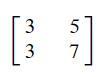
Determine which of the matrices in symmetric. 3 3 5 7
Find the matrix of the quadratic form. Assume x is in R2. a. 7x + 18x1x2 - 7x² b. 8x1x2
Find the change of variable x = Py that transforms the quadratic form xTAx into yT Dy as shown. 5x² + 5x² + 3x3 + 10x1x2 + 4x1x3+4x2x3 = 11y²+2y²
Find the singular values of the matrices 2 0 3 2
Find the singular values of the matrices 3 8 0 3
Find the principal components of the data for Exercise 1.Data From Exercise 1Convert the matrix of observations to mean deviation form, and construct the sample covariance matrix. 19 22 6 12 6 9 3 15 2 13 20 5
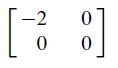
Find an SVD of matrix. -2 0 0 0
Find the principal components of the data for Exercise 2.Data From Exercise 2Convert the matrix of observations to mean deviation form, and construct the sample covariance matrix. 19 22 6 12 6 9 3 15 2 13 20 5
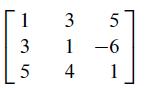
Determine which of the matrices in symmetric. 1 3 لا لا 5 3 لنا 5 1-6 4 1
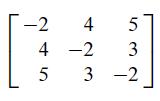
Determine which of the matrices in symmetric. -2 4 5 4 -2 3 نیا 5 in n 3 -2
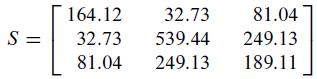
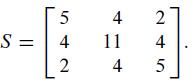
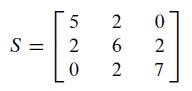
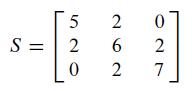
A Landsat image with three spectral components was made of Homestead Air Force Base in Florida (after the base was hit by Hurricane Andrew in 1992). The covariance matrix of the data is shown below. Find the first principal component of the data, and compute the percentage of the total variance
Find an SVD of matrix. -3 0-2
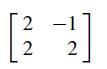
Find an SVD of matrix. 22 -1 2
Determine which of the matrices in are orthogonal. If orthogonal, find the inverse. [1//2 -1//2] [1/2 1/2
Find(a) The maximum value of Q(x) subject to the constraint xTx = 1, (b) A unit vector u where this maximum is attained, and (c) The maximum of Q(x) subject to the constraints xTx = 1 and xTu = 0.Q(x) = 5x21 + 4x22 + 3x23 + 4x1x2 + 4x2x3 (See Exercise 1).Data From
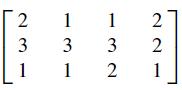
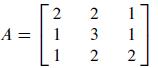
Determine which of the matrices in symmetric. 2 3 1 1 3 1 1 3 2 2 2 1
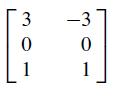
Find an SVD of matrix. 3 0 1 -3 0 1
Let x1, x2 denote the variables for the two-dimensional data in Exercise 1. Find a new variable y of the form y1 = c1x1 + c2x2, with c21 + c22 = 1, such that y, has maxi- mum possible variance over the given data. How much of the variance in the data is explained by y1?Data From Exercise
Mark each statement. Justify each answer. In each part, A represents an n x n matrix.(T/F) If P is an n x n matrix with orthogonal columns, then PT = P–.
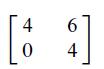
Find an SVD of matrix. 4 0 6 4
Mark each statement. Justify each answer. In each part, A represents an n x n matrix.(T/F) The principal axes of a quadratic form xTAx can be the columns of any matrix P that diagonalizes A.
Find (a) The maximum value of Q(x) subject to the constraint xTx = 1, (b) A unit vector u where this maximum is attained, and (c) The maximum of Q(x) subject to the constraints xTx = 1 and xTu = 0.Q(x) = x12 + x22 - 12x1x2
Let Q(x) = -3x12 - 4x22 + 4x1x2 - 4x2x3. Find a unit vector x in R3 at which Q(x) is maximized, subject to xTx = 1.
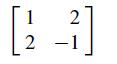
Determine which of the matrices in are orthogonal. If orthogonal, find the inverse. 1 2 2-1
Let A be the matrix of the quadratic formIt can be shown that the eigenvalues of A are 1, 7, and 13. Find an orthogonal matrix P such that the change of variable x = Py transforms xTAx into a quadratic form with no cross product a term. Give P and the new quadratic form. 7x² + 5x2 + 9x38x1x2 + 8x1
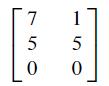
Find an SVD of matrix. 7 5 0 1 5 0
The covariance matrix below was obtained from a Landsat image of the Columbia River in Washington, using data from three spectral bands. Let x1, x2, x3 denote the spectral com- ponents of each pixel in the image. Find a new variable of the form y1 = c1x1 + c2x2 + c3x3 that has
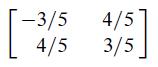
Determine which of the matrices in are orthogonal. If orthogonal, find the inverse. -3/5 [ 4/5 4/5 3/5
Mark each statement. Justify each answer. In each part, A represents an n x n matrix.(T/F) If every coefficient in a quadratic form is positive, then the quadratic form is positive definite.
Find (a) The maximum value of Q(x) subject to the constraint xTx = 1, (b) A unit vector u where this maximum is attained, and (c) The maximum of Q(x) subject to the constraints xTx = 1 and xTu = 0.Q(x) = 4x12 + 7x22 + 4x1x2
Repeat Exercise 9 withData From Exercise 9Suppose three tests are administered to a random sample of college students. Let X1,..., XN be observation vectors in R3 that list the three scores of each student, and for j = 1, 2, 3, let xj denote a student's score on the jth exam. Suppose the
Make the change of variable, x = Py, that transforms the quadratic form x12 + 12x1x2 + x22 into a quadratic form with no cross-product terms. Give P and the new quadratic form.
Let Q(x) = 4x12 + 7x22 + 4x23 - 4x1x2 + 8x1x3 + 4x2x3. Find a unit vector x in R3 at which Q(x) is maximized, subject to xTx = 1.
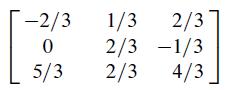
Determine which of the matrices in are orthogonal. If orthogonal, find the inverse. -2/3 0 5/3 1/3 2/3 2/3 -1/3 2/3 4/3
Suppose three tests are administered to a random sample of college students. Let X1,..., XN be observation vectors in R3 that list the three scores of each student, and for j = 1, 2, 3, let xj denote a student's score on the jth exam. Suppose the covariance matrix of the data is Let y be an
Mark each statement. Justify each answer. In each part, A represents an n x n matrix.(T/F) If xTAx > 0 for some x, then the quadratic form xTAx is positive definite.
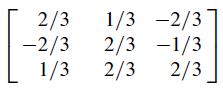
Determine which of the matrices in are orthogonal. If orthogonal, find the inverse. 2/3 -2/3 1/3 1/3 -2/37 2/3 -1/3 2/3 2/3
Mark each statement. Justify each answer. In each part, A represents an n x n matrix.(T/F) By a suitable change of variable, any quadratic form can be changed into one with no cross-product term.
Find the maximum value of Q(x) = 8x12 + 6x22 - 2x1x2 subject to the constraint x12 + x22 = 1.
Mark each statement. Justify each answer. In each part, A represents an n x n matrix.(T/F) The largest value of a quadratic form xTAx, for ΙΙxΙΙ = 1, is the largest entry on the diagonal of A.
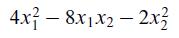
Then make a change of variable, x = Py that transform the quadratic form into one with no cross-product terms. Write the new quadratic form. 4x7-8x1x2 - 2x2
Find the maximum value of Q(x) = -5x12 + 7x22 2x1x2 subject to the constraint x12 + x22 = 1.
Mark each statement. Justify each answer. In each part, A represents an n x n matrix.(T/F) The maximum value of a positive definite quadratic form xTAx is the greatest eigenvalue of A.
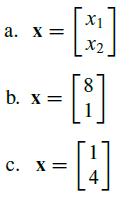
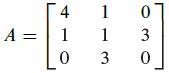
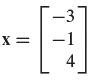
Compute the quadratic form xTAx, for anda.b.c. A = = 4 1 0 1 1 3 0 3 0 نیا
Let P4 have the inner product as in Example 5, and let p0. p1, p2 be the orthogonal polynomials from that example. Using your matrix program, apply the Gram-Schmidt process to the set {p0. p1. p2, t3, t4) to create an orthogonal basis for P4. EXAMPLE 5 Let V be P4 with the inner product in
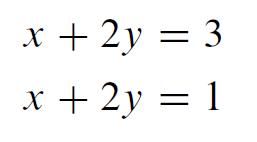
Describe all least-squares solutions of the system x + 2y = 3 x + 2y = 1
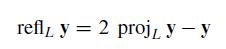
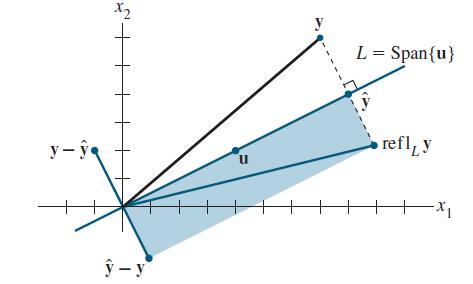
Given u ≠ 0 in Rn, let L = Span {u}. For y in Rn, the reflection of y in L is the point reflL, y defined by See the figure, which shows that reflL ŷ = projL, y and ŷ - y. Show that the mapping y ↦ reflL, y is a linear transformation.The reflection of y in a line through the origin. refl, y
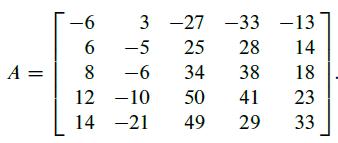
LetConstruct a matrix N whose columns form a basis for Nul A, and construct a matrix R whose rows form a basis for Row A. Perform a matrix computation with N and R that illustrates a fact from Theorem 3. A = 3 -27 -33 -13 25 28 14 -5 -6 34 38 18 41 23 29 33 -6 6 8 12 -10 14 -21 50 49
Given u ≠ 0 in Rn, let L = Span {u}. Show that the mapping x ↦ projL, x is a linear transformation.
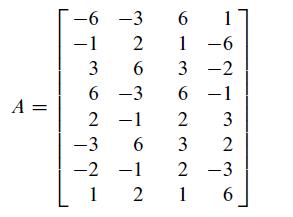
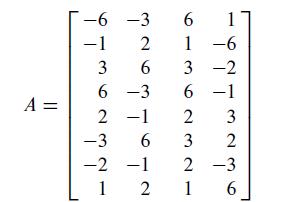
Show that the columns of the matrix A are orthogonal by making an appropriate matrix calculation. State the calculation you use. A= -6 -1 3 6 2 -3 -2 -3 6 1 ܚܐ ܝ ܗ ܚ ܠ ܗ ܠ ܝ 1 2 1 -6 3-2 6-1 2 3 3 2 2-3 1 6
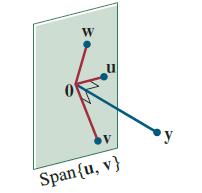
Suppose y is orthogonal to u and v. Show that y is orthogonal to every w in Span {u, v}. W Span{u, v} y
Let U be the matrix in Exercise 37. Find the distance from b = (1, 1, 1, 1, -1, -1, -1, -1) to Col U.Data from in Exercise 37Let U be the 8 × 4 matrix in Exercise 43 in Section 6.2. Find the closest point to y = (1, 1, 1, 1, 1, 1, 1, 1) in Col U. Write the keystrokes or commands you use to solve
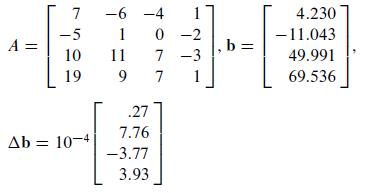
Solve A x = b and A(Δx) Δb, and show a that the inequality (2) holds in each case. A = 7 -5 10 19 Ab = 10-4 -6 1 11 7 9 7 -4 .27 7.76 -3.77 3.93 0-2 -3 |, b = 4.230 -11.043 49.991 69.536
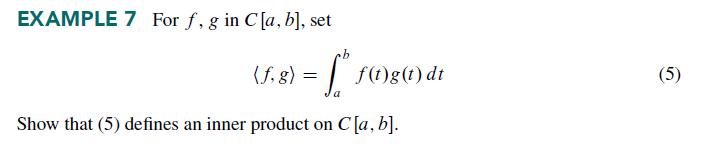
Let V be the space C[0, 2π] with the inner product of Example 7. Use the Gram-Schmidt process to create an orthogonal basis for the subspace spanned by {1, cost, cos2t, cos3t}. Use a matrix program or computational program to compute the appropriate definite integrals. EXAMPLE 7 For f, g in C[a,
Solve A x = b and A(Δx) Δb, and show a that the inequality (2) holds in each case. 4.5 .001 4 = [ 16 ]-=[-₁509]. A = [-] A b Δb : -1.407 -.003 3.1 1.1
Show that the orthogonal projection of a vector y onto a line L through the origin in R2 does not depend on the choice of the nonzero u in L used in the formula for ŷ. To do this, suppose y and u are given ŷ and has been computed by formula (2) in this section. Replace u in that formula
Concern the (real) Schur factorization of an n x n matrix A in the form A = URUT, where U is an orthogonal matrix and R is an n x n upper triangular matrix.1a. Let A be an n x n diagonalizable matrix such that A = PDP–1 for some invertible matrix P and some diagonal matrix D. Show that P
Solve A x = b and A(Δx) Δb, and show a that the inequality (2) holds in each case. A = 4.5 [is] [t 31] b = [1 1.6 1.1 343]. Ab = [0 19.249 6.843 .001 -.003
LetDescribe the set H of vectorsthat are orthogonal to v. a - [8]. b V =
Showing 600 - 700
of 2241
1
2
3
4
5
6
7
8
9
10
11
12
13
14
15
Last
Step by Step Answers

 Get 50% OFF
Claim Now
Get 50% OFF
Claim Now