New Semester
Started
Get
50% OFF
Study Help!
--h --m --s
Claim Now
Question Answers
Textbooks
Find textbooks, questions and answers
Oops, something went wrong!
Change your search query and then try again
S
Books
FREE
Study Help
Expert Questions
Accounting
General Management
Mathematics
Finance
Organizational Behaviour
Law
Physics
Operating System
Management Leadership
Sociology
Programming
Marketing
Database
Computer Network
Economics
Textbooks Solutions
Accounting
Managerial Accounting
Management Leadership
Cost Accounting
Statistics
Business Law
Corporate Finance
Finance
Economics
Auditing
Tutors
Online Tutors
Find a Tutor
Hire a Tutor
Become a Tutor
AI Tutor
AI Study Planner
NEW
Sell Books
Search
Search
Sign In
Register
study help
mathematics
precalculus 1st
Precalculus 1st Edition Jay Abramson - Solutions
For the following exercises, let f(x) = cos x.Graph h(x) = x + sin x on [−100, 100]. Did the graph appear as predicted in the previous exercise?
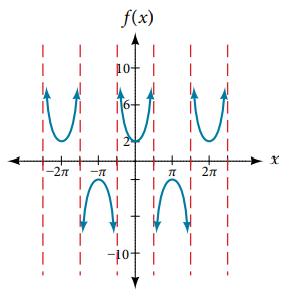
For the following exercises, find an equation for the graph of each function. -2π -TT f(x) 10+ -10- T 1 2π X
For the following exercises, find the function if sin t = x/x + 1.sec t
For the following exercises, suppose sin t = x/x + 1,csc t
For the following exercises, let f(x) = cos x.Graph f(x) = x sin x on [0, 2π] and verbalize how the graph varies from the graph of f(x) = sin x.
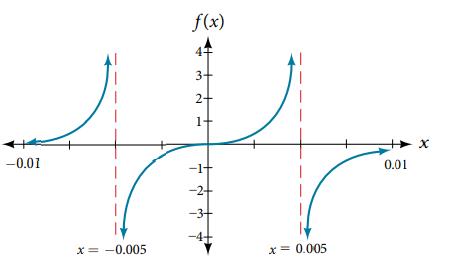
For the following exercises, find an equation for the graph of each function. -0.01 x= -0.005 f(x) 4+ 3+ - -14 x = 0.005 0.01 X
For the following exercises, find the function if sin t = x/x + 1.cot t
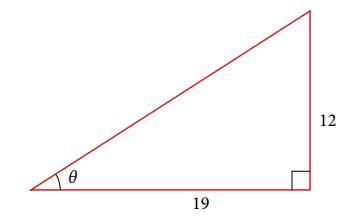
For the following exercises, suppose sin t = x/x + 1,Given Figure 2,find the measure of angle θ to three decimal places. Answer in radians. Ꮎ 19 12
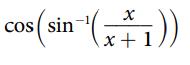
For the following exercises, find the function if sin t = x/x + 1. os (sin-¹ (x + 1))
For the following exercises, let f(x) = cos x.Graph f(x) = x sin x on the window [−10, 10] and explain what the graph shows.
For the following exercises, use a graphing calculator to graph two periods of the given function. Note: most graphing calculators do not have a cosecant button; therefore, you will need to input csc x as 1/sin x.f(x) = |csc(x)|
For the following exercises, determine whether the equation is true or false.arcsin (sin 5π/6)) = 5π/6
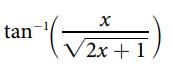
For the following exercises, find the function if sin t = x/x + 1. tan V2x + 1
For the following exercises, let f(x) = cos x.Graph f(x) = sin x/x on the window [−5π, 5π] and explain what the graph shows.
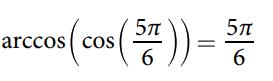
For the following exercises, determine whether the equation is true or false. 5π arccos (cos (57)). = 5% 6 6
For the following exercises, use a graphing calculator to graph two periods of the given function. Note: most graphing calculators do not have a cosecant button; therefore, you will need to input csc x as 1/sin x.f(x) = |cot(x)|
For the following exercises, let f(x) = cos x.A Ferris wheel is 25 meters in diameter and boarded from a platform that is 1 meter above the ground. The six o’clock position on the Ferris wheel is level with the loading platform.The wheel completes 1 full revolution in 10 minutes. The function
For the following exercises, find the function if sin t = x/x + 1.Graph y = sin−1 x and state the domain and range of the function.
For the following exercises, use a graphing calculator to graph two periods of the given function. Note: most graphing calculators do not have a cosecant button; therefore, you will need to input csc x as 1/sin x.f(x) = 2csc(x)
For the following exercises, find the function if sin t = x/x + 1.Graph y = arccos x and state the domain and range of the function.
For the following exercises, use a graphing calculator to graph two periods of the given function. Note: most graphing calculators do not have a cosecant button; therefore, you will need to input csc x as 1/sin x.f(x) = csc(x)/sec(x)
For the following exercises, find the function if sin t = x/x + 1.Graph one cycle of y = tan−1 x and state the domain and range of the function.
For the following exercises, use a graphing calculator to graph two periods of the given function. Note: most graphing calculators do not have a cosecant button; therefore, you will need to input csc x as 1/sin x.Graph f(x) = 1 + sec2 (x) − tan2 (x). What is the function shown in the graph?
For the following exercises, find the function if sin t = x/x + 1.For what value of x does sin x = sin−1 x? Use a graphing calculator to approximate the answer.
For the following exercises, use a graphing calculator to graph two periods of the given function. Note: most graphing calculators do not have a cosecant button; therefore, you will need to input csc x as 1/sin x.f(x) = sec(0.001x)
For the following exercises, use a graphing calculator to graph two periods of the given function. Note: most graphing calculators do not have a cosecant button; therefore, you will need to input csc x as 1/sin x.f(x) = cot(100πx)
For the following exercises, find the function if sin t = x/x + 1.For what value of x does cos x = cos−1 x? Use a graphing calculator to approximate the answer.
For the following exercises, use a graphing calculator to graph two periods of the given function. Note: most graphing calculators do not have a cosecant button; therefore, you will need to input csc x as 1/sin x.f(x) = sin2 x + cos2 x
For the following exercises, use a graphing calculator to graph two periods of the given function. Note: most graphing calculators do not have a cosecant button; therefore, you will need to input csc x as 1/sin x.The function f(x) = 20tan (π/10 x) marks the distance in the movement of a light
For the following exercises, find the function if sin t = x/x + 1.Suppose you drive 0.6 miles on a road so that the vertical distance changes from 0 to 150 feet. What is the angle of elevation of the road?
For the following exercises, use a calculator to evaluate each expression. Express answers to the nearest hundredth.cos−1(0.8)
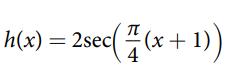
For the following exercises, sketch two periods of the graph for each of the following functions. Identify the stretching factor, period, and asymptotes. 2sec ( 7 (x + 1)) h(x) = 2sec(
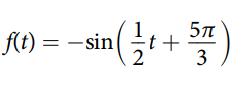
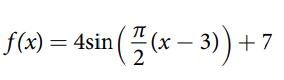
For the following exercises, graph one full period of each function, starting at x = 0. For each function, state the amplitude, period, and midline. State the maximum and minimum y-values and their corresponding x-values on one period for x > 0. State the phase shift and vertical translation, if
For the following exercises, use this scenario: The population of a city has risen and fallen over a 20-year interval. Its population may be modeled by the following function: y = 12,000 + 8,000sin(0.628x), where the domain is the years since 1980 and the range is the population of the city.Graph
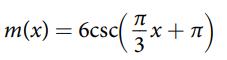
For the following exercises, sketch two periods of the graph for each of the following functions. Identify the stretching factor, period, and asymptotes. m(x) = 6csc(x+1) 3
For the following exercises, use this scenario: The population of a city has risen and fallen over a 20-year interval. Its population may be modeled by the following function: y = 12,000 + 8,000sin(0.628x), where the domain is the years since 1980 and the range is the population of the city.What
For the following exercises, graph one full period of each function, starting at x = 0. For each function, state the amplitude, period, and midline. State the maximum and minimum y-values and their corresponding x-values on one period for x > 0. State the phase shift and vertical translation, if
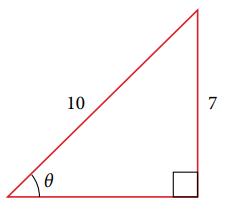
For the following exercises, find the angle θ in the given right triangle. Round answers to the nearest hundredth. Ө 10 7
For the following exercises, find the period and horizontal shift of each function.n(x) = 4csc (5π/3 x − 20π/3)
For the following exercises, sketch two periods of the graph for each of the following functions. Identify the stretching factor, period, and asymptotes.j(x) = tan (π/2 x)
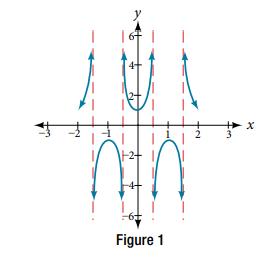
For the following exercises, find the period and horizontal shift of each function.Write the equation for the graph in Figure 1 in terms of the secant function and give the period and phase shift. Figure 1 3 X
For the following exercises, use this scenario: The population of a city has risen and fallen over a 20-year interval. Its population may be modeled by the following function: y = 12,000 + 8,000sin(0.628x), where the domain is the years since 1980 and the range is the population of the city.Over
For the following exercises, graph one full period of each function, starting at x = 0. For each function, state the amplitude, period, and midline. State the maximum and minimum y-values and their corresponding x-values on one period for x > 0. State the phase shift and vertical translation, if
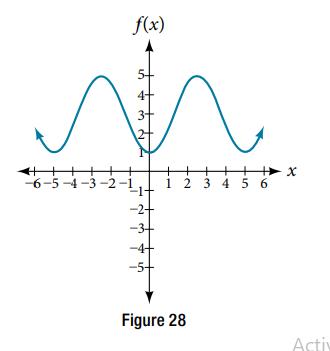
For the following exercises, sketch two periods of the graph for each of the following functions. Identify the stretching factor, period, and asymptotes. (-x) = (x) en
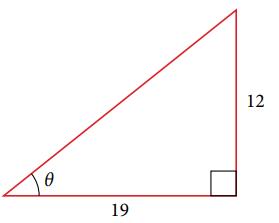
For the following exercises, find the angle θ in the given right triangle. Round answers to the nearest hundredth. Ө 19 12
For the following exercises, use this scenario: The population of a city has risen and fallen over a 20-year interval. Its population may be modeled by the following function: y = 12,000 + 8,000sin(0.628x), where the domain is the years since 1980 and the range is the population of the city.What is
For the following exercises, find the period and horizontal shift of each function.If tan x = 3, find tan(−x).
For the following exercises, graph one full period of each function, starting at x = 0. For each function, state the amplitude, period, and midline. State the maximum and minimum y-values and their corresponding x-values on one period for x > 0. State the phase shift and vertical translation, if
For the following exercises, find the exact value, if possible, without a calculator. If it is not possible, explain why.sin−1 (cos(π))
For the following exercises, sketch two periods of the graph for each of the following functions. Identify the stretching factor, period, and asymptotes.f(x) = 4tan(x)
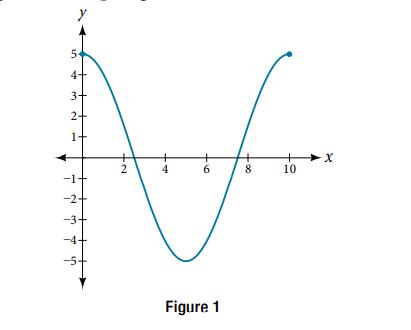
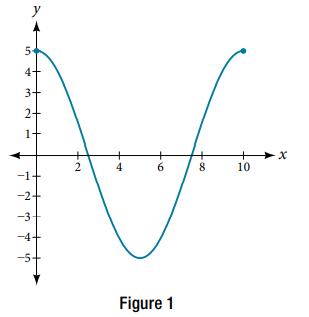
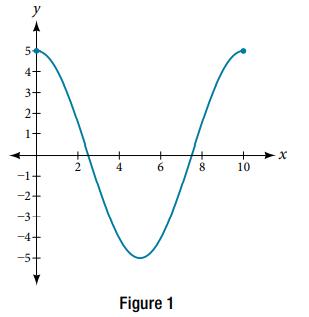
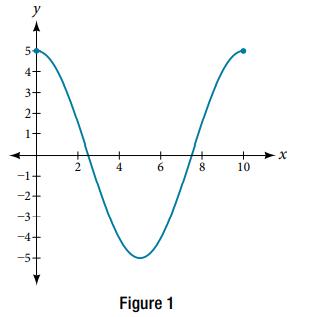
For the following exercises, suppose a weight is attached to a spring and bobs up and down, exhibiting symmetry.Suppose the graph of the displacement function is shown in Figure 1, where the values on the x-axis represent the time in seconds and the y-axis represents the displacement in inches.
For the following exercises, find the period and horizontal shift of each function.If sec x = 4, find sec(−x).
For the following exercises, graph one full period of each function, starting at x = 0. For each function, state the amplitude, period, and midline. State the maximum and minimum y-values and their corresponding x-values on one period for x > 0. State the phase shift and vertical translation, if
For the following exercises, find the exact value, if possible, without a calculator. If it is not possible, explain why.tan−1 (sin(π))
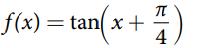
For the following exercises, sketch two periods of the graph for each of the following functions. Identify the stretching factor, period, and asymptotes. E|4 f(x) =tan(x+ 4)
For the following exercises, suppose a weight is attached to a spring and bobs up and down, exhibiting symmetry.At time = 0, what is the displacement of the weight? y 5- 4- 3 2+ 1- -1- -2- -3- -4- نیا 2 4 6 Figure 1 8 00 10 x
For the following exercises, graph one full period of each function, starting at x = 0. For each function, state the amplitude, period, and midline. State the maximum and minimum y-values and their corresponding x-values on one period for x > 0. State the phase shift and vertical translation, if
For the following exercises, graph the functions on the specified window and answer the questions.Graph m(x) = sin(2x) + cos(3x) on the viewing window [−10, 10] by [−3, 3]. Approximate the graph’s period.
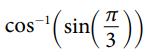
For the following exercises, find the exact value, if possible, without a calculator. If it is not possible, explain why. -¹(sin()) 3 COST
For the following exercises, sketch two periods of the graph for each of the following functions. Identify the stretching factor, period, and asymptotes.f(x) = πtan(πx − π) − π
For the following exercises, suppose a weight is attached to a spring and bobs up and down, exhibiting symmetry.At what time does the displacement from the equilibrium point equal zero? y 5- 4- 3 2+ 1- -1- -2- -3- -4- نیا 2 4 6 Figure 1 8 00 10 x
For the following exercises, graph one full period of each function, starting at x = 0. For each function, state the amplitude, period, and midline. State the maximum and minimum y-values and their corresponding x-values on one period for x > 0. State the phase shift and vertical translation, if
For the following exercises, graph the functions on the specified window and answer the questions.Graph n(x) = 0.02sin(50πx) on the following domains in x: [0, 1] and [0, 3]. Suppose this function models sound waves. Why would these views look so different?
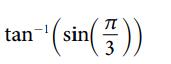
For the following exercises, find the exact value, if possible, without a calculator. If it is not possible, explain why. tan-(sin( in())
For the following exercises, sketch two periods of the graph for each of the following functions. Identify the stretching factor, period, and asymptotes.f(x) = 2csc(x)
For the following exercises, suppose a weight is attached to a spring and bobs up and down, exhibiting symmetry.What is the time required for the weight to return to its initial height of 5 inches? In other words, what is the period for the displacement function?
For the following exercises, graph one full period of each function, starting at x = 0. For each function, state the amplitude, period, and midline. State the maximum and minimum y-values and their corresponding x-values on one period for x > 0. State the phase shift and vertical translation, if
For the following exercises, graph the functions on the specified window and answer the questions.Graph f(x) = sin x/x on [−0.5, 0.5] and explain any observations.
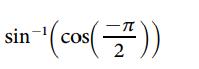
For the following exercises, find the exact value, if possible, without a calculator. If it is not possible, explain why. sin-¹(cos())
For the following exercises, sketch two periods of the graph for each of the following functions. Identify the stretching factor, period, and asymptotes.f(x) = −1/4 csc(x)
For the following exercises, find the exact value without the aid of a calculator. sin−1 (1)
For the following exercises, graph one full period of each function, starting at x = 0. For each function, state the amplitude, period, and midline. State the maximum and minimum y-values and their corresponding x-values on one period for x > 0. State the phase shift and vertical translation, if
For the following exercises, let f(x) = 3/5 cos(6x).What is the largest possible value for f(x)?
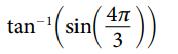
For the following exercises, find the exact value, if possible, without a calculator. If it is not possible, explain why. tan (sin( 4π
For the following exercises, sketch two periods of the graph for each of the following functions. Identify the stretching factor, period, and asymptotes.f(x) = 4sec(3x)
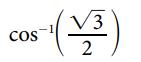
For the following exercises, find the exact value without the aid of a calculator. COS اسکان
For the following exercises, let f(x) = 3/5 cos(6x).What is the smallest possible value for f(x)?
For the following exercises, graph one full period of each function, starting at x = 0. For each function, state the amplitude, period, and midline. State the maximum and minimum y-values and their corresponding x-values on one period for x > 0. State the phase shift and vertical translation, if
For the following exercises, graph one full period of each function, starting at x = 0. For each function, state the amplitude, period, and midline. State the maximum and minimum y-values and their corresponding x-values on one period for x > 0. State the phase shift and vertical translation, if
For the following exercises, graph one full period of each function, starting at x = 0. For each function, state the amplitude, period, and midline. State the maximum and minimum y-values and their corresponding x-values on one period for x > 0. State the phase shift and vertical translation, if
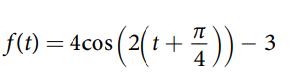
For the following exercises, find the amplitude, period, phase shift, and midline.Water is pumped into a storage bin and empties according to a periodic rate. The depth of the water is 3 feet at its lowest at 2:00 a.m. and 71 feet at its highest, which occurs every 5 hours. Write a cosine function
For the following exercises, use this scenario: The population of a city has risen and fallen over a 20-year interval. Its population may be modeled by the following function: y = 12,000 + 8,000sin(0.628x), where the domain is the years since 1980 and the range is the population of the city.What is
For the following exercises, sketch two periods of the graph for each of the following functions. Identify the stretching factor, period, and asymptotes.f(x) = 2tan(4x − 32)
For the following exercises, use a calculator to evaluate each expression. Express answers to the nearest hundredth.arccos (3/5)
For the following exercises, graph one full period of each function, starting at x = 0. For each function, state the amplitude, period, and midline. State the maximum and minimum y-values and their corresponding x-values on one period for x > 0. State the phase shift and vertical translation, if
For the following exercises, find the amplitude, period, phase shift, and midline.The outside temperature over the course of a day can be modeled as a sinusoidal function. Suppose you know the temperature is 68°F at midnight and the high and low temperatures during the day are 80°F and 56°F,
For the following exercises, graph two full periods. Identify the period, the phase shift, the amplitude, and asymptotes.f(x) = −csc(2x + π)
For the following exercises, rewrite each expression such that the argument x is positive.cos(−x) + tan(−x)sin(−x)
For the following exercises, use a calculator to evaluate each expression. Express answers to the nearest hundredth.arcsin(0.23)
For the following exercises, find the amplitude, period, phase shift, and midline.y = 8sin (7π/6 x + 7π/2) + 6
For the following exercises, graph two full periods. Identify the period, the phase shift, the amplitude, and asymptotes.f(x) = 2/3 csc (1/2 x)
For the following exercises, rewrite each expression such that the argument x is positive.cot(−x)cos(−x) + sin(−x)
For the following exercises, use a calculator to evaluate each expression. Express answers to the nearest hundredth.cos−1(−0.4)
For the following exercises, graph two full periods of each function and state the amplitude, period, and midline. State the maximum and minimum y-values and their corresponding x-values on one period for x > 0. Round answers to two decimal places if necessary.y = 5sin(5x + 20) − 2
For the following exercises, find the amplitude, period, phase shift, and midline.y = sin (π/6 x + π) − 3
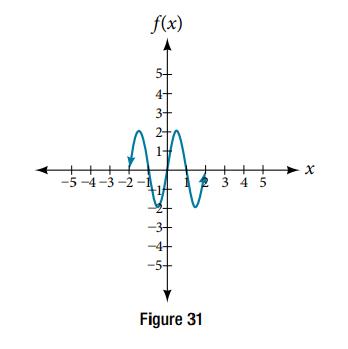
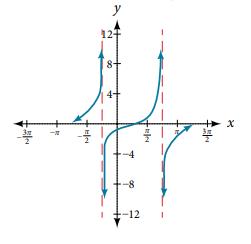
For the following exercises, determine the amplitude, period, and midline of the graph, and then find a formula for the function.Give in terms of a tangent function. 127 00 X + 마이 키 à - 시 -12
For the following exercises, graph two full periods. Identify the period, the phase shift, the amplitude, and asymptotes.f(x) = 8sec (1/4 x)
For the following exercises, find the period and horizontal shift of each of the functions.If xsin x = 2, find (−x)sin(−x).
For the following exercises, evaluate the expressions.tan−1 (−1/√3)
For the following exercises, graph two full periods of each function and state the amplitude, period, and midline. State the maximum and minimum y-values and their corresponding x-values on one period for x > 0. Round answers to two decimal places if necessary.y = 2sin(3x − 21) + 4
Showing 5800 - 5900
of 8578
First
52
53
54
55
56
57
58
59
60
61
62
63
64
65
66
Last
Step by Step Answers

 Get 50% OFF
Claim Now
Get 50% OFF
Claim Now