New Semester
Started
Get
50% OFF
Study Help!
--h --m --s
Claim Now
Question Answers
Textbooks
Find textbooks, questions and answers
Oops, something went wrong!
Change your search query and then try again
S
Books
FREE
Study Help
Expert Questions
Accounting
General Management
Mathematics
Finance
Organizational Behaviour
Law
Physics
Operating System
Management Leadership
Sociology
Programming
Marketing
Database
Computer Network
Economics
Textbooks Solutions
Accounting
Managerial Accounting
Management Leadership
Cost Accounting
Statistics
Business Law
Corporate Finance
Finance
Economics
Auditing
Tutors
Online Tutors
Find a Tutor
Hire a Tutor
Become a Tutor
AI Tutor
AI Study Planner
NEW
Sell Books
Search
Search
Sign In
Register
study help
mathematics
precalculus
Calculus Early Transcendentals 8th edition James Stewart - Solutions
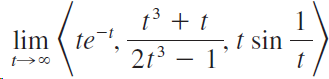
Find the limit. t3 + t 1 t sin lim ( te, 213 – 1
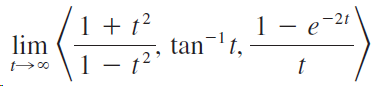
Find the limit. 1 + t? lim 2t tan't, - 12 1 - t 00
Find the limit. sin Tt -k In t i + vt + 8 j + lim t - 1
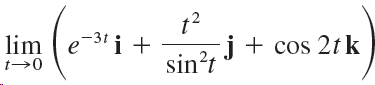
Find the limit. j + cos 2t k sin?t lim (e-3i i + -3' i
Find the domain of the vector function.r(t) = cos t i + ln t j + 1/t - 2k
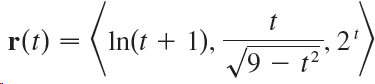
Find the domain of the vector function. r(t) = ( In(t + 1), · V9 – t2 2'
A solid has the following properties. When illuminated by rays parallel to the z-axis, its shadow is a circular disk. If the rays are parallel to the y-axis, its shadow is a square. If the rays are parallel to the x-axis, its shadow is an isosceles triangle. (In Exercise 12.1.48 you were asked to
Find an equation of the largest sphere that passes through the point (-1, 1, 4) and is such that each of the points (x, y, z) inside the sphere satisfies the condition x? + y? + z? < 136 + 2(x + 2y + 3z)
A plane is capable of flying at a speed of 180 km/h in still air. The pilot takes off from an airfield and heads due north according to the plane’s compass. After 30 minutes of flight time, the pilot notices that, due to the wind, the plane has actually traveled 80 km at an angle 5° east of
Let L be the line of intersection of the planes cx + y + z = c and x - cy + cz = -1, where c is a real number.(a) Find symmetric equations for L.(b) As the number c varies, the line L sweeps out a surface S. Find an equation for the curve of intersection of S with the horizontal plane z = t (the
Let B be a solid box with length L, width W, and height H. Let S be the set of all points that are a distance at most 1 from some point of B. Express the volume of S in terms of L, W, and H.
Each edge of a cubical box has length 1 m. The box contains nine spherical balls with the same radius r. The center of one ball is at the center of the cube and it touches the other eight balls. Each of the other eight balls touches three sides of the box. Thus the balls are tightly packed in the
A surface consists of all points P such that the distance from P to the plane y = 1 is twice the distance from P to the point (0, -1, 0). Find an equation for this surface and identify it.
An ellipsoid is created by rotating the ellipse 4x2 + y2 = 16 about the x-axis. Find an equation of the ellipsoid.
Identify and sketch the graph of each surface.x = y2 + z2 - 2y - 4z + 5
Identify and sketch the graph of each surface.4x2 + 4y2 - 8y + z2 = 0
Identify and sketch the graph of each surface.y2 + z2 − 1 + x2
Identify and sketch the graph of each surface.-4x2 + y2 - 4z2 = 4
Identify and sketch the graph of each surface.4x - y + 2z = 4
Identify and sketch the graph of each surface.x2 = y2 + 4z2
Identify and sketch the graph of each surface.y = z2
Identify and sketch the graph of each surface.x = z
Identify and sketch the graph of each surface.x = 3
Find the distance between the planes 3x + y - 4z = 2 and 3x + y - 4z = 24.
(a) Find an equation of the plane that passes through the points A(2, 1, 1), B(-1, -1, 10), and C(1, 3, -4).(b) Find symmetric equations for the line through B that is perpendicular to the plane in part (a).(c) A second plane passes through (2, 0, 4) and has normal vector (2, -4, -3). Show that the
Find an equation of the plane through the line of intersection of the planes x - z = 1 and y + 2z = 3 and perpendicular to the plane x + y - 2z = 1.
(a) Show that the planes x + y - z = 1 and 2x - 3y + 4z = 5 are neither parallel nor perpendicular.(b) Find, correct to the nearest degree, the angle between these planes.
Determine whether the lines given by the symmetric equationsx - 1/2 = y - 2/3 = z - 3/4 and x + 1/6 = y - 3/-1 = z + 5/2 are parallel, skew, or intersecting.
Find the distance from the origin to the linex = 1 + t, y = 2 - t, z = -1 + 2t.
Find the point in which the line with parametric equations x = 2 - t, y = 1 + 3t, z = 4t intersects the plane 2x - y + z = 2.
Find an equation of the plane.The plane through (1, 2, -2) that contains the line x = 2t, y = 3 - t, z = 1 + 3t
Find an equation of the plane.The plane through (3, -1, 1), (4, 0, 2), and (6, 3, 1)
Find an equation of the plane.The plane through (2, 1, 0) and parallel to x + 4y - 3z = 1
Find parametric equations for the line.The line through (-2, 2, 4) and perpendicular to the plane 2x - y + 5z = 12
Find parametric equations for the line.The line through (1, 0, -1) and parallel to the line 1/3 (x - 4) = 1/2y = z + 2
Find parametric equations for the line.The line through (4, 21, 2) and (1, 1, 5)
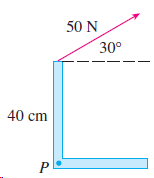
Find the magnitude of the torque about P if a 50-N force is applied as shown. 50 N 30° 40 cm Pl
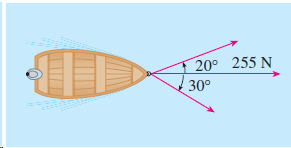
A boat is pulled onto shore using two ropes, as shown in the diagram. If a force of 255 N is needed, find the magnitude of the force in each rope. 20° 255 N 30°
A constant force F = 3i + 5j + 10k moves an object along the line segment from (1, 0, 2) to (5, 3, 8). Find the work done if the distance is measured in meters and the force in newtons.
(a) Find a vector perpendicular to the plane through the points A(1, 0, 0), B(2, 0, -1), and C(1, 4, 3).(b) Find the area of triangle ABC.
Given the points A(1, 0, 1), B(2, 3, 0), C(-1, 1, 4), and D(0, 3, 2), find the volume of the parallelepiped with adjacent edges AB, AC, and AD.
Find the acute angle between two diagonals of a cube.
Show that if a, b, and c are in V3, then(a x b) • [(b x c) x (c x a)] = [a • (b x c)]2
Suppose that u • (v x w) = 2. Find(a) (u x v) • w (b) u • (w x v)(c) v • (u x w) (d) (u x v) • v
Find two unit vectors that are orthogonal to both j + 2k and i - 2j + 3k.
Find the values of x such that the vectors (3, 2, x) and (2x, 4, x) are orthogonal.
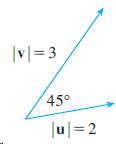
If u and v are the vectors shown in the figure, find u • v and |u x v|. Is u x v directed into the page or out of it? |v|= 3 45° |u|=2
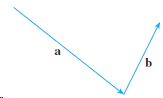
Copy the vectors in the figure and use them to draw each of the following vectors.(a) a + b (b) a - b (c) -1/2a (d) 2a + b a
(a) Find an equation of the sphere that passes through the point (6, -2, 3) and has center (-1, 2, 1).(b) Find the curve in which this sphere intersects the yz-plane.(c) Find the center and radius of the spherex2 + y2 + z2 - 8x + 2y + 6z + 1 = 0
Determine whether the statement is true or false. If it is true, explain why. If it is false, explain why or give an example that disproves the statement.If u and v are in V3, then |u • v | < |u| |v|.
Determine whether the statement is true or false. If it is true, explain why. If it is false, explain why or give an example that disproves the statement.If u • v = 0 and u x v = 0, then u = 0 or v = 0.
Determine whether the statement is true or false. If it is true, explain why. If it is false, explain why or give an example that disproves the statement.If u x v = 0, then u = 0 or v = 0.
Determine whether the statement is true or false. If it is true, explain why. If it is false, explain why or give an example that disproves the statement.If u • v = 0, then u = 0 or v = 0.
Determine whether the statement is true or false. If it is true, explain why. If it is false, explain why or give an example that disproves the statement.In R3 the graph of y = x2 is a paraboloid.
Determine whether the statement is true or false. If it is true, explain why. If it is false, explain why or give an example that disproves the statement.The set of points h(x, y, z) |x2 + y2 = 1} is a circle.
Determine whether the statement is true or false. If it is true, explain why. If it is false, explain why or give an example that disproves the statement.A linear equation Ax + By + Cz + D = 0 represents a line in space.
Determine whether the statement is true or false. If it is true, explain why. If it is false, explain why or give an example that disproves the statement.The vector (3, -1, 2) is parallel to the plane 6x - 2y + 4z = 1
Determine whether the statement is true or false. If it is true, explain why. If it is false, explain why or give an example that disproves the statement.For any vectors u and v in V3, (u + v) x v = u x v.
Determine whether the statement is true or false. If it is true, explain why. If it is false, explain why or give an example that disproves the statement.For any vectors u and v in V3, (u x v) • u = 0.
Determine whether the statement is true or false. If it is true, explain why. If it is false, explain why or give an example that disproves the statement.For any vectors u, v, and w in V3, u x (v x w) = (u x v) x w
Determine whether the statement is true or false. If it is true, explain why. If it is false, explain why or give an example that disproves the statement.For any vectors u, v, and w in V3, u • (v x w) = (u x v) • w
Determine whether the statement is true or false. If it is true, explain why. If it is false, explain why or give an example that disproves the statement.For any vectors u, v, and w in V3, (u + v) x w = u x w + v x w
Determine whether the statement is true or false. If it is true, explain why. If it is false, explain why or give an example that disproves the statement.For any vectors u and v in V3 and any scalar k, k(u x v) = (ku) x v
Determine whether the statement is true or false. If it is true, explain why. If it is false, explain why or give an example that disproves the statement.For any vectors u and v in V3 and any scalar k, k(u • v) = (ku) • v
Determine whether the statement is true or false. If it is true, explain why. If it is false, explain why or give an example that disproves the statement.For any vectors u and v in V3, |u x v| = |v x u|.
Determine whether the statement is true or false. If it is true, explain why. If it is false, explain why or give an example that disproves the statement.For any vectors u and v in V3, u x v = v x u.
Determine whether the statement is true or false. If it is true, explain why. If it is false, explain why or give an example that disproves the statement.For any vectors u and v in V3, u • v = v • u.
Determine whether the statement is true or false. If it is true, explain why. If it is false, explain why or give an example that disproves the statement.For any vectors u and v in V3, |u x v| = |u||v|.
Determine whether the statement is true or false. If it is true, explain why. If it is false, explain why or give an example that disproves the statement.For any vectors u and v in V3, |u • v | = |u||v|.
Determine whether the statement is true or false. If it is true, explain why. If it is false, explain why or give an example that disproves the statement.For any vectors u and v in V3, |u + v | = |u| + |v|.
Determine whether the statement is true or false. If it is true, explain why. If it is false, explain why or give an example that disproves the statement.If u = (u1, u2) and v = (v1, v2) , then u • v = (u1v1, u2v2).
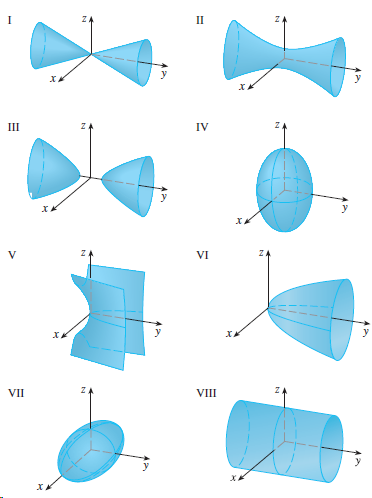
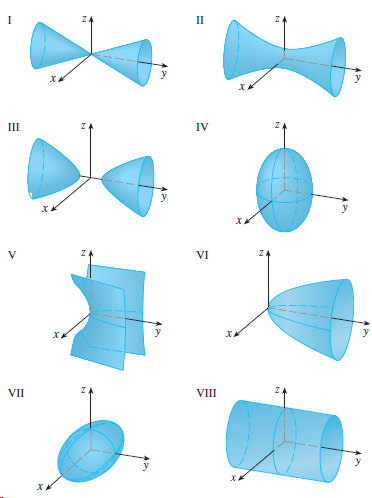
Match the equation with its graph (labeled I–VIII). Give reasons for your choice.y = x2 - z2 п XA Ш IV VI хи х. VII VIII
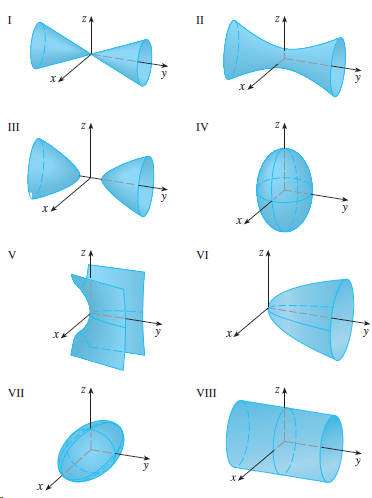
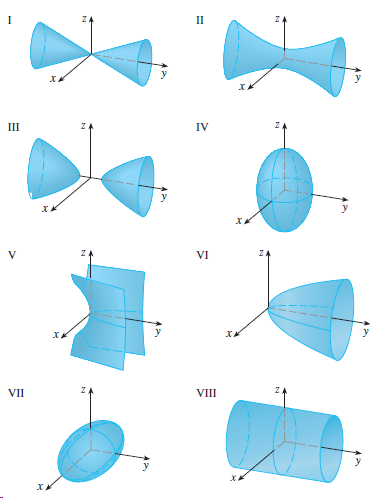
Match the equation with its graph (labeled I–VIII). Give reasons for your choice.x2 + 2z2 = 1 п XA Ш IV VI хи х. VII VIII
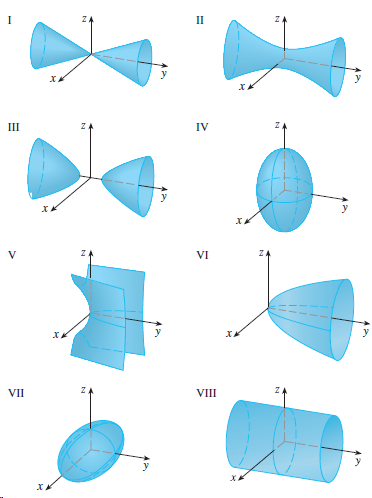
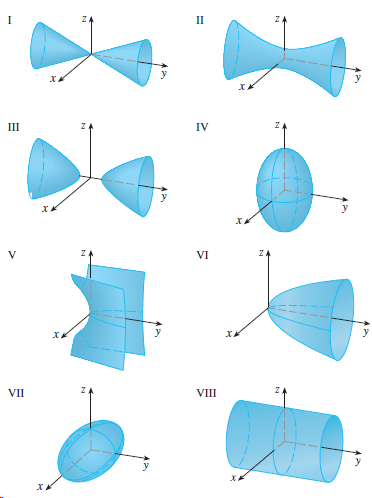
Match the equation with its graph (labeled I–VIII). Give reasons for your choice.y2 = x2 + 2z2 п XA Ш IV VI хи х. VII VIII
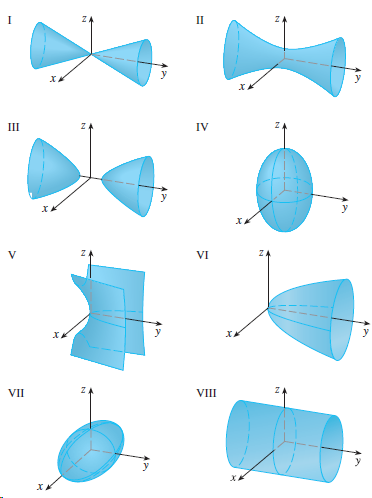
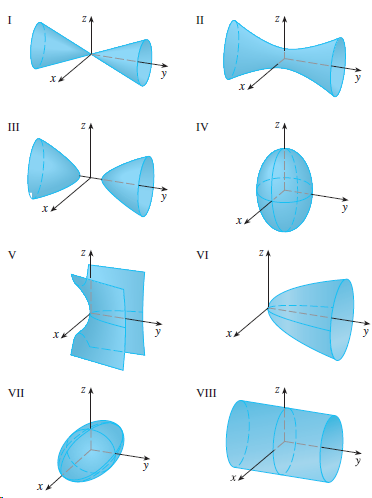
Match the equation with its graph (labeled I–VIII). Give reasons for your choice.y = 2x2 + z2 п XA Ш IV VI хи х. VII VIII
Match the equation with its graph (labeled I–VIII). Give reasons for your choice.2x2 + y2 - z2 = 1 п XA Ш IV VI хи х. VII VIII
Match the equation with its graph (labeled I–VIII). Give reasons for your choice.9x2 + 4y2 + z2 = 1 п XA Ш IV VI хи х. VII VIII
Match the equation with its graph (labeled I–VIII). Give reasons for your choice.x2 - y2 + z2 − 1 п XA Ш IV VI хи х. VII VIII
Match the equation with its graph (labeled I–VIII). Give reasons for your choice.x2 + 4y2 + 9z2 = 1 п XA Ш IV VI хи х. VII VIII
Use traces to sketch and identify the surface.x = y2 - z2
Use traces to sketch and identify the surface.y = z2 - x2
Use traces to sketch and identify the surface.3x2 - y2 + 3z2 = 0
Use traces to sketch and identify the surface.x2/9 + y2/25 + z2/4 = 1
Use traces to sketch and identify the surface.3x2 + y + 3z2 = 0
Use traces to sketch and identify the surface.9y2 + 4z2 = x2 + 36
Use traces to sketch and identify the surface.z2 - 4x2 - y2 = 4
Use traces to sketch and identify the surface.x2 = 4y2 + z2
Use traces to sketch and identify the surface.4x2 + 9y2 + 9z2 = 36
Use traces to sketch and identify the surface.x = y2 + 4z2
(a) Find and identify the traces of the quadric surface 2x2 - y2 + z2 = 1 and explain why the graph looks like the graph of the hyperboloid of two sheets in Table 1.(b) If the equation in part (a) is changed to x2 - y2 - z2 = 1, what happens to the graph? Sketch the new graph.
(a) Find and identify the traces of the quadric surface x2 + y2 - z2 = 1 and explain why the graph looks like the graph of the hyperboloid of one sheet in Table 1. (b) If we change the equation in part (a) to x2 - y2 + z2 = 1, how is the graph affected? (c) What if we change the equation
Describe and sketch the surface.z = sin y
Describe and sketch the surface.xy = 1
Describe and sketch the surface.y = z2
Describe and sketch the surface.z = 1 - y2
Describe and sketch the surface.4x2 + y2 = 4
Describe and sketch the surface.x2 + z2 = 1
(a) Sketch the graph of y = ex as a curve in R2.(b) Sketch the graph of y = ex as a surface in R3.(c) Describe and sketch the surface z = ey.
(a) What does the equation y = x2 represent as a curve in R2?(b) What does it represent as a surface in R3?(c) What does the equation z = y2 represent?
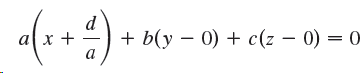
If a, b, and c are not all 0, show that the equation ax + by + cz + d = 0 represents a plane and (a, b, c) is a normal vector to the plane. Suppose a ≠ 0 and rewrite the equation in the form + b(y – 0) + c(z – 0) = 0
Showing 16100 - 16200
of 29454
First
155
156
157
158
159
160
161
162
163
164
165
166
167
168
169
Last
Step by Step Answers

 Get 50% OFF
Claim Now
Get 50% OFF
Claim Now