New Semester
Started
Get
50% OFF
Study Help!
--h --m --s
Claim Now
Question Answers
Textbooks
Find textbooks, questions and answers
Oops, something went wrong!
Change your search query and then try again
S
Books
FREE
Study Help
Expert Questions
Accounting
General Management
Mathematics
Finance
Organizational Behaviour
Law
Physics
Operating System
Management Leadership
Sociology
Programming
Marketing
Database
Computer Network
Economics
Textbooks Solutions
Accounting
Managerial Accounting
Management Leadership
Cost Accounting
Statistics
Business Law
Corporate Finance
Finance
Economics
Auditing
Tutors
Online Tutors
Find a Tutor
Hire a Tutor
Become a Tutor
AI Tutor
AI Study Planner
NEW
Sell Books
Search
Search
Sign In
Register
study help
mathematics
precalculus
Calculus Early Transcendentals 8th edition James Stewart - Solutions
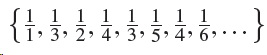
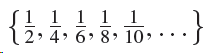
Determine whether the sequence converges or diverges. If it converges, find the limit. S1 1 1 1 1 1 1 1 lI> 3, 2, 4, 3, 5, 4, 6,** } d..
Determine whether the sequence converges or diverges. If it converges, find the limit. {0, 1, 0, 0, 1, 0, 0, 0, 1, . . . }
Determine whether the sequence converges or diverges. If it converges, find the limit. п — Vn + IVn +3 а, — п —
Determine whether the sequence converges or diverges. If it converges, find the limit. an = arctan (ln n)
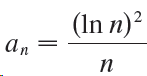
Determine whether the sequence converges or diverges. If it converges, find the limit. (In n)? an п
Determine whether the sequence converges or diverges. If it converges, find the limit. In(2n? + 1) – lIn(n² + 1)
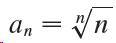
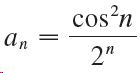
Determine whether the sequence converges or diverges. If it converges, find the limit. п an
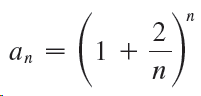
Determine whether the sequence converges or diverges. If it converges, find the limit. п an п
Determine whether the sequence converges or diverges. If it converges, find the limit.
Determine whether the sequence converges or diverges. If it converges, find the limit. an = n sin(1/n)
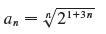
Determine whether the sequence converges or diverges. If it converges, find the limit. an V2'+3n
Determine whether the sequence converges or diverges. If it converges, find the limit.
Determine whether the sequence converges or diverges. If it converges, find the limit. = In(n + 1) – In n an
Determine whether the sequence converges or diverges. If it converges, find the limit.{n2e-n}
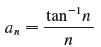
Determine whether the sequence converges or diverges. If it converges, find the limit. -1 tan'n an
Determine whether the sequence converges or diverges. If it converges, find the limit. {sin n}
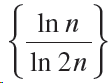
Determine whether the sequence converges or diverges. If it converges, find the limit. In n In 2n
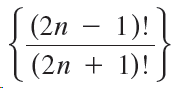
Determine whether the sequence converges or diverges. If it converges, find the limit. 1)! (2n (2п + 1)!
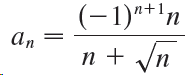
Determine whether the sequence converges or diverges. If it converges, find the limit.
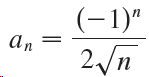
Determine whether the sequence converges or diverges. If it converges, find the limit.
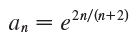
Determine whether the sequence converges or diverges. If it converges, find the limit. ,2n/(n+2) An
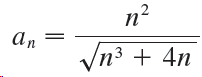
Determine whether the sequence converges or diverges. If it converges, find the limit. п? an Уп3 + 4n
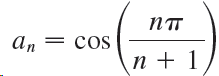
Determine whether the sequence converges or diverges. If it converges, find the limit. пт An cos п+1
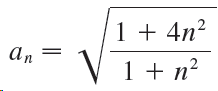
Determine whether the sequence converges or diverges. If it converges, find the limit. 1 + 4n? an 1 + n?
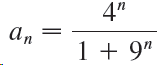
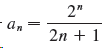
Determine whether the sequence converges or diverges. If it converges, find the limit. 4" 1 + 9"
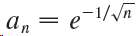
Determine whether the sequence converges or diverges. If it converges, find the limit. а, — е Vп
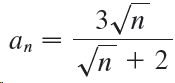
Determine whether the sequence converges or diverges. If it converges, find the limit. 3. An 'п +2
Determine whether the sequence converges or diverges. If it converges, find the limit.an = 3n7-n
Determine whether the sequence converges or diverges. If it converges, find the limit.an = 2 + (0.86)n
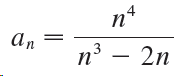
Determine whether the sequence converges or diverges. If it converges, find the limit. п an п3 — 2п
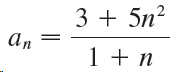
Determine whether the sequence converges or diverges. If it converges, find the limit. 3 + 5n? an п
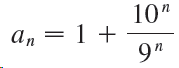
Calculate, to four decimal places, the first ten terms of the sequence and use them to plot the graph of the sequence by hand. Does the sequence appear to have a limit? If so, calculate it. If not, explain why. 10" an = 1 + 9"
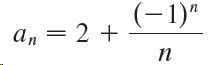
Calculate, to four decimal places, the first ten terms of the sequence and use them to plot the graph of the sequence by hand. Does the sequence appear to have a limit? If so, calculate it. If not, explain why.
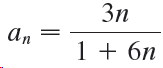
Calculate, to four decimal places, the first ten terms of the sequence and use them to plot the graph of the sequence by hand. Does the sequence appear to have a limit? If so, calculate it. If not, explain why. Зп An 1 + бn
Find a formula for the general term an of the sequence, assuming that the pattern of the first few terms continues.{1, 0, -1, 0, 1, 0, -1, 0, . . .}
Find a formula for the general term an of the sequence, assuming that the pattern of the first few terms continues.{5, 8, 11, 14, 17, . . .}
Find a formula for the general term an of the sequence, assuming that the pattern of the first few terms continues. |{-3, 2, –3. §. – 4. ..} 4 8 _ 16 16
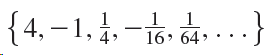
Find a formula for the general term an of the sequence, assuming that the pattern of the first few terms continues. |{4, –1, , 4,–16 64 .. 4>
Find a formula for the general term an of the sequence, assuming that the pattern of the first few terms continues. 2> 4, 6> 8, 10:
List the first five terms of the sequence. = An An-1 ај 3D 2, а, —D 1, a2 = 1, an+1
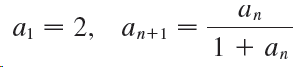
List the first five terms of the sequence. ал a¡ = 2, an+1 1 + an
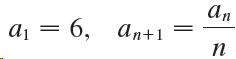
List the first five terms of the sequence. ал 6, An+1 ат п
List the first five terms of the sequence. 5an - 3 ај 3D 1, аn+1
List the first five terms of the sequence.
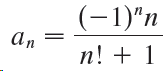
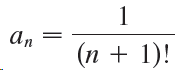
List the first five terms of the sequence. An (п + 1)!
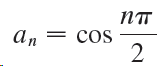
List the first five terms of the sequence. пт cos an
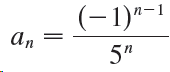
List the first five terms of the sequence. (–1)"-1 ал 5"
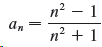
List the first five terms of the sequence. п? — 1 an п? + 1
List the first five terms of the sequence.
Find an equation of the hyperbola with foci (0, ±4) and asymptotes y = ±3x.
Find an equation of the parabola with focus (2, 1) and directrix x = -4.
Find an equation of the ellipse with foci (±4, 0) and vertices (±5, 0).
Find the length of the curve. r = sin'(0/3), 0< 0 < T
Find the length of the curve. T< 0 < 2m r = 1/0,
Find the length of the curve. x = 2 + 3t, y= cosh 3t, 0
Find the area of the region that lies inside the curve r = 2 + cos 2θ but outside the curve r = 2 + sin θ.
Find the points of intersection of the curves r = cot θ and r = 2 cos θ.
Find the area enclosed by the inner loop of the curve r = 1 - 3 sin θ.
Find the area enclosed by the curve in Exercise 29.Exercise 29At what points does the curvehave vertical or horizontal tangents? Use this information to help sketch the curve. x = 2a cos t y = 2a sin t – a sin 2t a cos 21
At what points does the curvehave vertical or horizontal tangents? Use this information to help sketch the curve. y = 2a sin t – a sin 2t x = 2a cos t – a cos 2t
Find the area enclosed by the loop of the curve in Exercise 27.Use a graph to estimate the coordinates of the lowest point on the curve x = t3 - 3t, y = t2 + t + 1. Then use calculus to find the exact coordinates
Find dy/dx and d2y/dx2.x = 1 + t2, y = t - t3
Find dy/dx and d2y/dx2.x = t + sin t, y = t - cos t
Sketch the polar curve.r = 3/2 - 2 cos θ
Sketch the polar curve.r = 2 cos(θ/2)
Sketch the polar curve.r = 3 + cos 3θ
Sketch the polar curve.r = cos 3θ
Sketch the polar curve.r = sin 4θ
Sketch the polar curve.r = 1 + sin θ
Sketch the region consisting of points whose polar coordinates satisfy 1
Determine whether the statement is true or false. If it is true, explain why. If it is false, explain why or give an example that disproves the statement. A hyperbola never intersects its directrix.
Determine whether the statement is true or false. If it is true, explain why. If it is false, explain why or give an example that disproves the statement. A tangent line to a parabola intersects the parabola only once.
Determine whether the statement is true or false. If it is true, explain why. If it is false, explain why or give an example that disproves the statement. The graph of y2 = 2y + 3x is a parabola.
Determine whether the statement is true or false. If it is true, explain why. If it is false, explain why or give an example that disproves the statement. The parametric equations x = t2, y = t4 have the same graph as x = t3, y = t6.
Determine whether the statement is true or false. If it is true, explain why. If it is false, explain why or give an example that disproves the statement. The equations r = 2, x2 + y2 = 4, and x = 2 sin 3t, y = 2 cos 3t (0 < t < 2π) all have the same graph.
Determine whether the statement is true or false. If it is true, explain why. If it is false, explain why or give an example that disproves the statement. The polar curvesr = 1 - sin 2θ r = sin 2θ - 1have the same graph.
Determine whether the statement is true or false. If it is true, explain why. If it is false, explain why or give an example that disproves the statement. If a point is represented by (x, y) in Cartesian coordinates (where x ≠ 0) and (r, θ) in polar coordinates, then = tan-1 (y/x).
Determine whether the statement is true or false. If it is true, explain why. If it is false, explain why or give an example that disproves the statement. The length of the curve
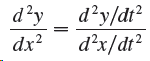
Determine whether the statement is true or false. If it is true, explain why. If it is false, explain why or give an example that disproves the statement.If x = f (t) and y = g(t) are twice differentiable, then d’y_ d²y/dt² d²x/dt? dx? .2
Determine whether the statement is true or false. If it is true, explain why. If it is false, explain why or give an example that disproves the statement.If the parametric curve x = f (t), y = g(t) satisfies g'(1) = 0, then it has a horizontal tangent when t = 1.
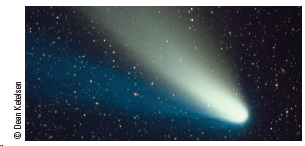
Comet Hale-Bopp, discovered in 1995, has an elliptical orbit with eccentricity 0.9951. The length of the orbit’s major axis is 356.5 AU. Find a polar equation for the orbit of this comet. How close to the sun does it come? O Dean Ketelsen
The orbit of Halley’s comet, last seen in 1986 and due to return in 2061, is an ellipse with eccentricity 0.97 and one focus at the sun. The length of its major axis is 36.18 AU. [An astronomical unit (AU) is the mean distance between the earth and the sun, about 93 million miles.] Find a polar
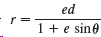
Show that a conic with focus at the origin, eccentricity e, and directrix y = d has polar equation ed 1+ e sine
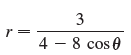
(a) Find the eccentricity, (b) Identify the conic, (c) Give an equation of the directrix, and (d) Sketch the conic. 3 r = 4 - 8 cos 0
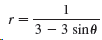
(a) Find the eccentricity, (b) Identify the conic, (c) Give an equation of the directrix, and (d) Sketch the conic. 3 - 3 sine
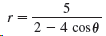
(a) Find the eccentricity, (b) Identify the conic, (c) Give an equation of the directrix, and (d) Sketch the conic. 2 - 4 cos e
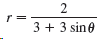
(a) Find the eccentricity, (b) Identify the conic, (c) Give an equation of the directrix, and (d) Sketch the conic. 2 3 + 3 sine
(a) Find the eccentricity, (b) Identify the conic, (c) Give an equation of the directrix, and (d) Sketch the conic. 2 + sine
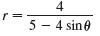
(a) Find the eccentricity, (b) Identify the conic, (c) Give an equation of the directrix, and (d) Sketch the conic. 4 5 - 4 sine
Write a polar equation of a conic with the focus at the origin and the given data.Hyperbola, eccentricity 2, directrix r = -2 sec θ
Write a polar equation of a conic with the focus at the origin and the given data.Parabola, vertex (3, π/2)
Write a polar equation of a conic with the focus at the origin and the given data.Ellipse, eccentricity 0.6, directrix r = 4 csc θ
Write a polar equation of a conic with the focus at the origin and the given data.Ellipse, eccentricity 2/3, vertex (2, π)
Write a polar equation of a conic with the focus at the origin and the given data.Hyperbola, eccentricity 3, directrix x = 3
Write a polar equation of a conic with the focus at the origin and the given data.Hyperbola, eccentricity 1.5, directrix y = 2
Write a polar equation of a conic with the focus at the origin and the given data.Parabola, directrix x = -3
Write a polar equation of a conic with the focus at the origin and the given data.Ellipse, eccentricity 1/2, directrix x = 4
(a) Calculate the surface area of the ellipsoid that is generated by rotating an ellipse about its major axis.(b) What is the surface area if the ellipse is rotated about its minor axis?
(a) If an ellipse is rotated about its major axis, find the volume of the resulting solid.(b) If it is rotated about its minor axis, find the resulting volume.
Show that if an ellipse and a hyperbola have the same foci, then their tangent lines at each point of intersection are perpendicular.
Showing 16600 - 16700
of 29454
First
160
161
162
163
164
165
166
167
168
169
170
171
172
173
174
Last
Step by Step Answers

 Get 50% OFF
Claim Now
Get 50% OFF
Claim Now