New Semester
Started
Get
50% OFF
Study Help!
--h --m --s
Claim Now
Question Answers
Textbooks
Find textbooks, questions and answers
Oops, something went wrong!
Change your search query and then try again
S
Books
FREE
Study Help
Expert Questions
Accounting
General Management
Mathematics
Finance
Organizational Behaviour
Law
Physics
Operating System
Management Leadership
Sociology
Programming
Marketing
Database
Computer Network
Economics
Textbooks Solutions
Accounting
Managerial Accounting
Management Leadership
Cost Accounting
Statistics
Business Law
Corporate Finance
Finance
Economics
Auditing
Tutors
Online Tutors
Find a Tutor
Hire a Tutor
Become a Tutor
AI Tutor
AI Study Planner
NEW
Sell Books
Search
Search
Sign In
Register
study help
mathematics
precalculus
Calculus Early Transcendentals 8th edition James Stewart - Solutions
Show that the tangent vector to a curve defined by a vector function r(t) points in the direction of increasing t.
If u(t) = r(t)? [r'(t) X r''(t)], show that u'(t) = r(t) ? [r'(t) X r-(t)]
If a curve has the property that the position vector r(t) is always perpendicular to the tangent vector r'(t), show that the curve lies on a sphere with center the origin.
Find an expression for d/dt [u(t) • (v(t) X w(t))].
Show that if r is a vector function such that r'' exists, then d/dt [r(t) X r'(t)] = r(t) X r''(t)
If r is the vector function in Exercise 51, show thatr'(t) + ω2r(t) = 0.
If r(t) = a cos ωt + b sin ωt, where a and b are constant vectors, show that r(t) x r'(t) = ωa X b.
If r(t) = u(t) X v(t), where u and v are the vector functions in Exercise 49, find r'(2).
Find f'(2), where f (t) = u(t) ? v(t), u(2) = (1, 2, -1), u'(2) = (3, 0, 4), and v(t) = (t, t2, t3).
If u and v are the vector functions in Exercise 47, use Formula 5 of Theorem 3 to find [u(t) × v(t)] dt
If u(t) = (sin t, cos t, t) and v(t) = (t, cos t, sin t), use Formula 4 of Theorem 3 to find [u(t) · v(t)] dt [(1)A
Prove Formula 6 of Theorem 3.
Prove Formula 5 of Theorem 3.
Prove Formula 3 of Theorem 3.
Prove Formula 1 of Theorem 3.
Find r(t) if r'(t) = t i + et j + tet k and r(0) = i + j + k.
Find r(t) if r'(t) = 2ti + 3t2j + √t k and r(1) = i + j.
Evaluate the integral. 1 k dt 1 – t2 , 2t te2 i +
Evaluate the integral. | (sec?t i + t(t? + 1)' j + t² In t k) dt
Evaluate the integral.
Evaluate the integral. k dt j+ t? + 1 t + 1 t2 + 1
Evaluate the integral. ( (21/2 i + (t + 1)Vi k) đi
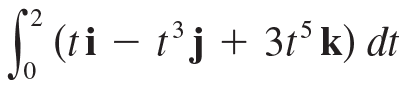
Evaluate the integral. t³j + 3t° k) dt | (ti –
At what point do the curves r1(t) = (t, 1 - t, 3 + t2) and r2(s) = (3 - s, s - 2, s2) intersect? Find their angle of intersection correct to the nearest degree.
The curves r1(t) = (t, t2, t3)and r2(t) = (sin t, sin 2t, t) intersect at the origin. Find their angle of intersection correct to the nearest degree.
(a) Find the point of intersection of the tangent lines to the curve r(t) = (in πt, 2 sin πt, cos πt) at the points where t = 0 and t = 0.5.(b) Illustrate by graphing the curve and both tangent lines.
Find parametric equations for the tangent line to the curve with the given parametric equations at the specified point. Illustrate by graphing both the curve and the tangent line on a common screen.x = t cos t, y = t, z = t sin t; (-π, π, 0)
Find parametric equations for the tangent line to the curve with the given parametric equations at the specified point. Illustrate by graphing both the curve and the tangent line on a common screen.x = 2 cos t, y = 2 sin t, z = 4 cos 2t; (√3 , 1, 2)
Find parametric equations for the tangent line to the curve with the given parametric equations at the specified point. Illustrate by graphing both the curve and the tangent line on a common screen.x = t, y = e-t, z = 2t - t 2; (0, 1, 0)
Find a vector equation for the tangent line to the curve of intersection of the cylinders x2 + y2 = 25 and y2 + z2 = 20 at the point (3, 4, 2).
Find parametric equations for the tangent line to the curve with the given parametric equations at the specified point.x = e-t cos t, y = e-t sin t, z = e-t; (1, 0, 1)
Find parametric equations for the tangent line to the curve with the given parametric equations at the specified point.x = √t2 + 3, y = ln(t2 + 3), z = t; (2, ln 4, 1)
Find parametric equations for the tangent line to the curve with the given parametric equations at the specified point.x = ln(t + 1), y = t cos 2t, z = 2t; (0, 0, 1)
Find parametric equations for the tangent line to the curve with the given parametric equations at the specified point.x = t2 + 1, y = 4√t , z = et2-t; (2, 4, 1)
If r(t) = (e2, e-2t, te2t) find Ts0d, r''(0), and r'(t)? r''(t).
If r(t) = (t, t2, t3), find r'(t), T(1), r'(t), and r''(t) x r'(t).
Find the unit tangent vector T(t) at the point with the given value of the parameter t.r(t) = sin2 t i + cos2 t j + tan2 t k, t = π/4
Find the unit tangent vector T(t) at the point with the given value of the parameter t.r(t) = cos t i + 3t j + 2 sin 2t k, t = 0
Find the unit tangent vector T(t) at the point with the given value of the parameter t.r(t) = (tan-1 t, 2e2t, 8tet), t = 0
Find the unit tangent vector T(t) at the point with the given value of the parameter t.r(t) = (t2 - 2t, 1 + 3t, 1/3 t3 + 1/2t2) , t = 2
Find the derivative of the vector function.r(t) = t a x (b + t c)
Find the derivative of the vector function.r(t) = a + t b + t2 c
Find the derivative of the vector function.r(t) = sin2at i + tebt j + cos2ct k
Find the derivative of the vector function.r(t) = t sin t i + et cos t j + sin t cos t k
Find the derivative of the vector function.r(t) = 1/1+ t i + t/1 + t j + t2/1 + t k
Find the derivative of the vector function.r(t) = t2i + cos(t2) j + sin2tk
Find the derivative of the vector function.r(t) = (e-t, t - t3, ln t)
Find the derivative of the vector function.r(t) = (√t - 2 , 3, 1/t2)
(a) Sketch the plane curve with the given vector equation.(b) Find r'(t).(c) Sketch the position vector r(t) and the tangent vector r'(t) for the given value of t.r(t) = (cos t + 1) i + (sin t - 1) j, t = -π/3
(a) Sketch the plane curve with the given vector equation.(b) Find r'(t).(c) Sketch the position vector r(t) and the tangent vector r'(t) for the given value of t.r(t) = 4 sin t i - 2 cos t j, t = 3π/4
(a) Sketch the plane curve with the given vector equation.(b) Find r'(t).(c) Sketch the position vector r(t) and the tangent vector r'(t) for the given value of t.r(t) = eti + 2t j, t = 0
(a) Sketch the plane curve with the given vector equation.(b) Find r'(t).(c) Sketch the position vector r(t) and the tangent vector r'(t) for the given value of t.r(t) = e2t i + etj, t = 0
(a) Sketch the plane curve with the given vector equation.(b) Find r'(t).(c) Sketch the position vector r(t) and the tangent vector r'(t) for the given value of t.r(t) = (t2, t3), t = 1
(a) Sketch the plane curve with the given vector equation.(b) Find r'(t).(c) Sketch the position vector r(t) and the tangent vector r'(t) for the given value of t.r(t) = (t - 2, t2 + 1), t = -1
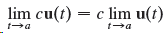
Suppose u and v are vector functions that possess limits as t → a and let c be a constant. Prove the following properties of limits.(a)(b)(c)(d) lim [u(t) + v(t)] = lim u(t) + lim v(t) %3| lim cu(t) = c lim u(t)
The view of the trefoil knot shown in Figure 8 is accurate, but it doesn’t reveal the whole story. Use the parametric equationsx = (2 + cos 1.5t) cos ty = (2 + cos 1.5t) sin tz = sin 1.5tto sketch the curve by hand as viewed from above, with gaps indicating where the curve passes over itself.
Two particles travel along the space curves r1 (t) = (t, t2, t3) r2 (t) = (1 + 2t, 1 + 6t, 1 + 14t)Do the particles collide? Do their paths intersect?
If two objects travel through space along two different curves, it’s often important to know whether they will collide. (Will a missile hit its moving target? Will two aircraft collide?) The curves might intersect, but we need to know whether the objects are in the same position at the same time.
Try to sketch by hand the curve of intersection of the parabolic cylinder y = x2 and the top half of the ellipsoid x2 + 4y2 + 4z2 = 16. Then find parametric equations for this curve and use these equations and a computer to graph the curve.
Try to sketch by hand the curve of intersection of the circular cylinder x2 + y2 = 4 and the parabolic cylinder z = x2.Then find parametric equations for this curve and use these equations and a computer to graph the curve.
Find a vector function that represents the curve of intersection of the two surfaces.The semiellipsoid x2 + y2 + 4z2 = 4, y > 0, and the cylinder x2 + z2 = 1
Find a vector function that represents the curve of intersection of the two surfaces.The hyperboloid z = x2 - y2 and the cylinder x2 + y2 = 1
Find a vector function that represents the curve of intersection of the two surfaces.The paraboloid z = 4x2 + y2 and the parabolic cylinder y = x2
Find a vector function that represents the curve of intersection of the two surfaces.The cone z = √x2 + y2 and the plane z = 1 + y
Find a vector function that represents the curve of intersection of the two surfaces.The cylinder x2 + y2 = 4 and the surface z = xy
Show that the curve with parametric equations x = t2, y = 1 - 3t, z = 1 + t3 passes through the points (1, 4, 0) and (9, -8, -8) but not through the point (4, 7, -6).
Graph the curve with parametric equationsx = √1 - 0.25 cos2 10t cos ty = √1 - 0.25 cos2 10t sin tz = 0.5 cos 10tExplain the appearance of the graph by showing that it lies on a sphere.
Graph the curve with parametric equationsx = (1 + cos 16t) cos ty = (1 + cos 16t) sin tz = 1 + cos 16tExplain the appearance of the graph by showing that it lies on a cone.
Graph the curve with parametric equations x = sin t, y = sin 2t, z = cos 4t. Explain its shape by graphing its projections onto the three coordinate planes.
Use a computer to graph the curve with the given vector equation. Make sure you choose a parameter domain and viewpoints that reveal the true nature of the curve.r(t) = (cos 2t, cos 3t, cos 4t)
Use a computer to graph the curve with the given vector equation. Make sure you choose a parameter domain and viewpoints that reveal the true nature of the curve.r(t) = (cos(8 cos t) sin t, sin(8 cos t) sin t, cos t)
Use a computer to graph the curve with the given vector equation. Make sure you choose a parameter domain and viewpoints that reveal the true nature of the curve.r(t) = (sin 3t cos t, 1/4t, sin 3t sin t)
Use a computer to graph the curve with the given vector equation. Make sure you choose a parameter domain and viewpoints that reveal the true nature of the curve.r(t) = (tet, e-t, t)
Use a computer to graph the curve with the given vector equation. Make sure you choose a parameter domain and viewpoints that reveal the true nature of the curve.r(t) = (cos t sin 2t, sin t sin 2t, cos 2t)
At what points does the helix r(t) = k(in t, cos t, t) intersect the sphere x2 + y2 + z2 = 5?
At what points does the curve r(t) = t i + (2t - t2) k intersect the paraboloid z = x2 + y2?
Find three different surfaces that contain the curve r(t) = t2 i + ln tj + (1/t) k.
Find three different surfaces that contain the curve r(t) = 2t i + et j + e2t k.
Show that the curve with parametric equations x = sin t, y = cos t, z = sin2t is the curve of intersection of the surfaces z = x2 and x2 + y2 = 1. Use this fact to help sketch the curve.
Show that the curve with parametric equations x = t cos t, y = t sin t, z = t lies on the cone z2 = x2 + y2, and use this fact to help sketch the curve.
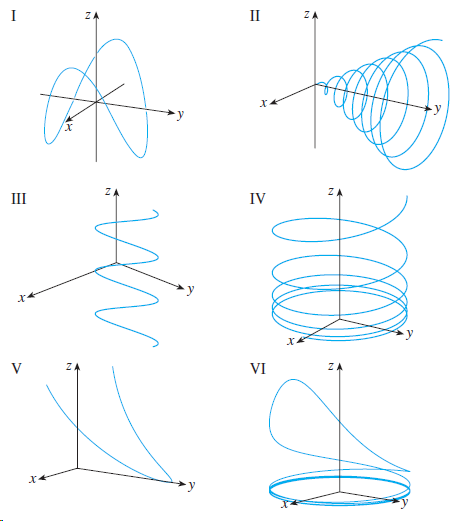
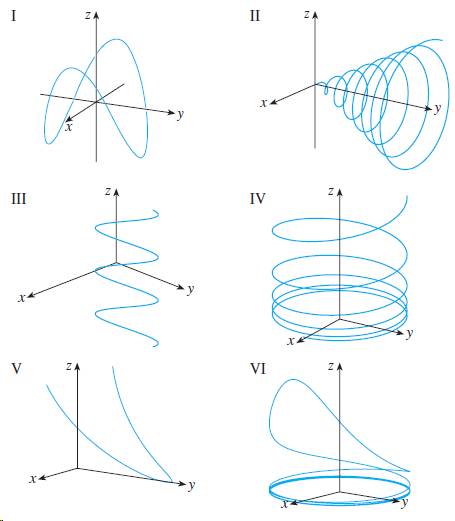
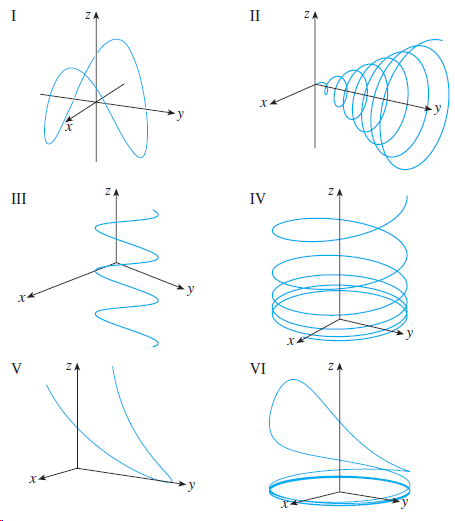
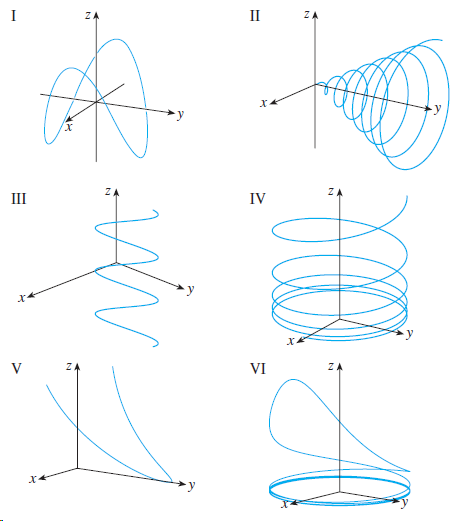
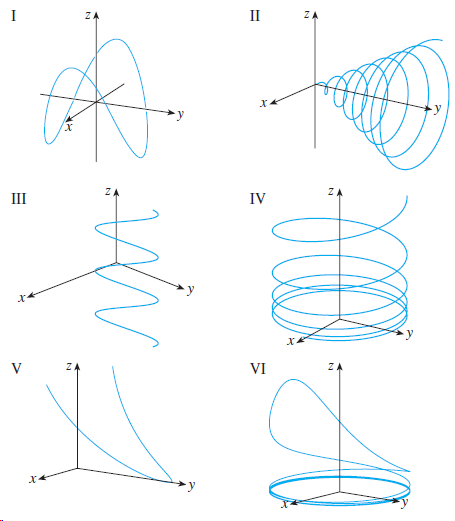
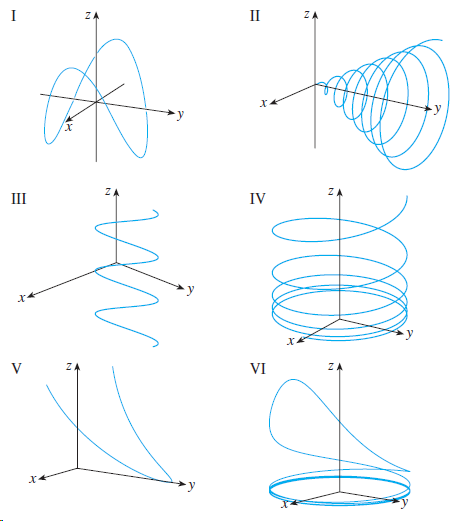
Match the parametric equations with the graphs (labeled I–VI). Give reasons for your choices.x = cos2 t, y = sin2 t, z = t I IV
Match the parametric equations with the graphs (labeled I–VI). Give reasons for your choices.x = cos 8t, y = sin 8t, z = e0.8t, t > 0 I IV
Match the parametric equations with the graphs (labeled I–VI). Give reasons for your choices.x = cos t, y = sin t, z = cos 2t I IV
Match the parametric equations with the graphs (labeled I–VI). Give reasons for your choices.x = t, y = 1/(1 + t2), z = t2 I IV
Match the parametric equations with the graphs (labeled I–VI). Give reasons for your choices.x = cos t, y = sin t, z = 1/(1 + t 2) I IV
Match the parametric equations with the graphs (labeled I–VI). Give reasons for your choices.x = t cos t, y = t, z = t sin t, t > 0 I IV
Find a vector equation and parametric equations for the line segment that joins P to Q.P(a, b, c), Q(u, v, w)
Find a vector equation and parametric equations for the line segment that joins P to Q.P(0, -1, 1), Q(1/2, 1/3, 1/4)
Find a vector equation and parametric equations for the line segment that joins P to Q.P(-1, 2, -2), Q(-3, 5, 1)
Find a vector equation and parametric equations for the line segment that joins P to Q.P(2, 0, 0), Q(6, 2, -2)
Draw the projections of the curve on the three coordinate planes. Use these projections to help sketch the curve.r(t) = (t, t, t2)
Draw the projections of the curve on the three coordinate planes. Use these projections to help sketch the curve.r(t) = (t, sin t, 2 cos t)
Sketch the curve with the given vector equation. Indicate with an arrow the direction in which t increases.r(t) = cos t i - cos t j + sin t k
Sketch the curve with the given vector equation. Indicate with an arrow the direction in which t increases.r(t) = t2 i + t4 j + t6 k
Sketch the curve with the given vector equation. Indicate with an arrow the direction in which t increases.r(t) = 2 cos t i + 2 sin tj + k
Sketch the curve with the given vector equation. Indicate with an arrow the direction in which t increases.r(t) = (3, t, 2 - t2)
Sketch the curve with the given vector equation. Indicate with an arrow the direction in which t increases.r(t) = (sin πt, t, cos πt)
Sketch the curve with the given vector equation. Indicate with an arrow the direction in which t increases.r(t) = (t, 2 - t, 2t)
Sketch the curve with the given vector equation. Indicate with an arrow the direction in which t increases.r(t) = (t2 - 1, t)
Sketch the curve with the given vector equation. Indicate with an arrow the direction in which t increases.r(t) = (sin t, t)
Showing 16000 - 16100
of 29454
First
154
155
156
157
158
159
160
161
162
163
164
165
166
167
168
Last
Step by Step Answers

 Get 50% OFF
Claim Now
Get 50% OFF
Claim Now


![[u(t) × v(t)] dt](https://dsd5zvtm8ll6.cloudfront.net/si.question.images/images/question_images/1552/7/5/3/8215c8d249d8320b1552736579965.jpg)
![[u(t) · v(t)] dt [(1)A](https://dsd5zvtm8ll6.cloudfront.net/si.question.images/images/question_images/1552/7/5/3/7785c8d247296eb81552736537111.jpg)





![lim [u(t) + v(t)] = lim u(t) + lim v(t) %3|](https://dsd5zvtm8ll6.cloudfront.net/si.question.images/images/question_images/1552/7/4/1/1905c8cf3466e06d1552723949690.jpg)