New Semester
Started
Get
50% OFF
Study Help!
--h --m --s
Claim Now
Question Answers
Textbooks
Find textbooks, questions and answers
Oops, something went wrong!
Change your search query and then try again
S
Books
FREE
Study Help
Expert Questions
Accounting
General Management
Mathematics
Finance
Organizational Behaviour
Law
Physics
Operating System
Management Leadership
Sociology
Programming
Marketing
Database
Computer Network
Economics
Textbooks Solutions
Accounting
Managerial Accounting
Management Leadership
Cost Accounting
Statistics
Business Law
Corporate Finance
Finance
Economics
Auditing
Tutors
Online Tutors
Find a Tutor
Hire a Tutor
Become a Tutor
AI Tutor
AI Study Planner
NEW
Sell Books
Search
Search
Sign In
Register
study help
mathematics
precalculus
Calculus Early Transcendentals 8th edition James Stewart - Solutions
An important problem in thermodynamics is to find the work done by an ideal Carnot engine. A cycle consists of alternating expansion and compression of gas in a piston.The work done by the engine is equal to the area of the region R enclosed by two isothermal curves xy = a, xy = b and two adiabatic
Use the given transformation to evaluate the integral.where R is the region bounded by the curves xy = 1, xy = 2, xy2 = 1, xy2 = 2; u = xy, v = xy2.Illustrate by using a graphing calculator or computer to draw R.
Use the given transformation to evaluate the integral.where R is the region bounded by the ellipse x2 - xy + y2 = 2; (x² Sa Cx? - ху + у?) ӑл, y²) dA, JJR x = /2 u – V2/3 v, y = /2 u + 2/3 v
Use the given transformation to evaluate the integral.where R is the region bounded by the ellipse 9x2 + 4y2 = 36; x = 2u, y = 3v SlRx² dA, JJR
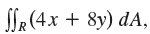
Use the given transformation to evaluate the integral.where R is the parallelogram with vertices (-1, 3), (1, -3), (3, -1), and (1, 5); x = 1/4 (u + v), y = 1/4(v - 3u) R (4x + 8y) dA,
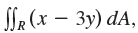
Use the given transformation to evaluate the integral.where R is the triangular region with vertices (0, 0), (2, 1), and (1, 2); x = 2u + v, y = u + 2v Sie (x — Зу) dA, JJR
A region R in the xy-plane is given. Find equations for a transformation T that maps a rectangular region S in the uv-plane onto R, where the sides of S are parallel to the u- and v-axes.R is bounded by the hyperbolas y = 1/x, y = 4/x and the lines y = x, y = 4x in the first quadrant
A region R in the xy-plane is given. Find equations for a transformation T that maps a rectangular region S in the uv-plane onto R, where the sides of S are parallel to the u- and v-axes.R lies between the circles x2 + y2 = 1 and x2 + y2 = 2 in the first quadrant
A region R in the xy-plane is given. Find equations for a transformation T that maps a rectangular region S in the uv-plane onto R, where the sides of S are parallel to the u- and v-axes.R is the parallelogram with vertices (0, 0), (4, 3), (2, 4), (-2, 1)
A region R in the xy-plane is given. Find equations for a transformation T that maps a rectangular region S in the uv-plane onto R, where the sides of S are parallel to the u- and v-axes.R is bounded by y = 2x - 1, y = 2x + 1, y = 1 - x,y = 3 - x
Find the image of the set S under the given transformation.S is the disk given by u2 + v2 < 1; x = au, y = bv
Find the image of the set S under the given transformation.S is the triangular region with vertices (0, 0), (1, 1), (0, 1); x = u2, y = v
Find the image of the set S under the given transformation.S is the square bounded by the lines u = 0, u = 1, v = 0, v = 1; x = v, y = u(1 + v2)
Find the image of the set S under the given transformation.S = {(u, v) | 0 < u < 3, 0 < v < 2};x = 2u + 3v, y = u - v
Find the Jacobian of the transformation.x = u + vw, y = v + wu, z = w + uv
Find the Jacobian of the transformation.x = uv, y = vw, z = wu
Find the Jacobian of the transformation.x = peq, y = qep
Find the Jacobian of the transformation.x = s cos t, y = s sin t
Find the Jacobian of the transformation.x = u2 + uv, y = uv2
Find the Jacobian of the transformation.x = 2u + v, y = 4u - v
Show that(The improper triple integral is defined as the limit of a triple integral over a solid sphere as the radius of the sphere increases indefinitely.) /x² + y² + z² e(x²+y²+z?) dx dy dz = 2
Use a graphing device to draw a silo consisting of a cylinder with radius 3 and height 10 surmounted by a hemisphere.
Evaluate the integral by changing to spherical coordinates. /4-x2 4–x² (2+v4-x²_y2 4-x2 J2-V4-x2-y2 (x² + y? + z?)³/2 dz dy dx
Evaluate the integral by changing to spherical coordinates. (x²z + y°z + z³) dz dx dy Va2-y? Va²–x²–y² Vaz-х2—у2 Va2-y2
Evaluate the integral by changing to spherical coordinates. С1 с T-x 2-х*-у? ху dz dy dx ну
Use cylindrical or spherical coordinates, whichever seems more appropriate.(a) Find the volume enclosed by the torus p = sin Ф.(b) Use a computer to draw the torus.
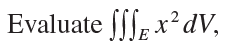
Use cylindrical or spherical coordinates, whichever seems more appropriate.where E lies above the paraboloid z = x2 + y2 and below the plane z = 2y. Use either the Table of Integrals (on Reference Pages 6–10) or a computer algebra system to evaluate the integral. Evaluate [[e xex?+y?+z² dV,
Use cylindrical or spherical coordinates, whichever seems more appropriate.A solid right circular cone with constant density has base radius a and height h.(a) Find the moment of inertia of the cone about its axis.(b) Find the moment of inertia of the cone about a diameter of its base.
Use cylindrical or spherical coordinates, whichever seems more appropriate.A solid cylinder with constant density has base radius a and height h.(a) Find the moment of inertia of the cylinder about its axis.(b) Find the moment of inertia of the cylinder about a diameter of its base.
Use cylindrical or spherical coordinates, whichever seems more appropriate.Find the volume of the smaller wedge cut from a sphere of radius a by two planes that intersect along a diameter at an angle of π/6.
Use cylindrical or spherical coordinates, whichever seems more appropriate.Find the volume and centroid of the solid E that lies above the cone z = √x2 + y2 and below the sphere x2 + y2 + z2 = 1.
Use spherical coordinates.Find the mass and center of mass of a solid hemisphere of radius a if the density at any point is proportional to its distance from the base.
Use spherical coordinates.(a) Find the centroid of a solid homogeneous hemisphere of radius a.(b) Find the moment of inertia of the solid in part (a) about a diameter of its base.
Use spherical coordinates.Let H be a solid hemisphere of radius a whose density at any point is proportional to its distance from the center of the base.(a) Find the mass of H.(b) Find the center of mass of H.(c) Find the moment of inertia of H about its axis.
Use spherical coordinates.(a) Find the centroid of the solid in Example 4. (Assume constant density K.)(b) Find the moment of inertia about the z-axis for this solid.
Use spherical coordinates.Find the volume of the solid that lies within the sphere x2 + y2 + z2 = 4, above the xy-plane, and below the cone z = √x2 + y2.
Use spherical coordinates.Find the average distance from a point in a ball of radius a to its center.
Use spherical coordinates.where E lies above the cone z = √x2 + y2 and between the spheres x2 + y2 + z2 = 1 and x2 + y2 + z2 = 4. Evaluate f[, Vx? + y² + z?
Use spherical coordinates.where E is the portion of the unit ball x2 + y2 + z2 < 1 that lies in the first octant. Evaluate [[e xex?+y?+z² dV,
Use spherical coordinates.where E is the solid hemisphere x2 + y2 + z2 < 9, y > 0.
Use spherical coordinates.where E lies between the spheres x2 + y2 + z2 = 4 and x2 + y2 + z2 = 9. Evaluate |, (x² + y²) dV,
Use spherical coordinates.where B is the ball with center the origin and radius 5. Evaluate fff, (x? + y² + z²)°dV,
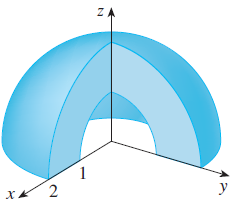
Set up the triple integral of an arbitrary continuous function f (x, y, z) in cylindrical or spherical coordinates over the solid shown. ZA х. к
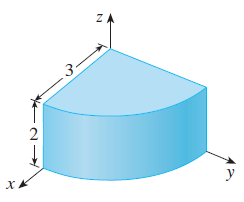
Set up the triple integral of an arbitrary continuous function f (x, y, z) in cylindrical or spherical coordinates over the solid shown. ZA хи
Sketch the solid whose volume is given by the integral and evaluate the integral.
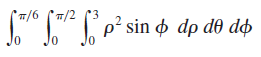
Sketch the solid whose volume is given by the integral and evaluate the integral. (3 "п/6 (п/2 " p² sin o dp dº dộ
(a) Find inequalities that describe a hollow ball with diameter 30 cm and thickness 0.5 cm. Explain how you have positioned the coordinate system that you have chosen.(b) Suppose the ball is cut in half. Write inequalities that describe one of the halves.
A solid lies above the cone z = √x2 + y2 and below the sphere x2 + y2 + z2 = z. Write a description of the solid in terms of inequalities involving spherical coordinates.
Sketch the solid described by the given inequalities.p < 2, p < csc Ф
Write the equation in spherical coordinates.(a) z = x2 + y2 (b) z = x2 - y2
Write the equation in spherical coordinates.(a) x2 + y2 + z2 = 9 (b) x2 - y2 - z2 = 1
Identify the surface whose equation is given.p = cos Ф
Identify the surface whose equation is given.p cos Ф = 1
Describe in words the surface whose equation is given.p2 - 3p + 2 = 0
Describe in words the surface whose equation is given.Ф = π/3
Change from rectangular to spherical coordinates.(a) (1, 0, √3)(b) (√3 , -1, 2√3)
Change from rectangular to spherical coordinates.(a) (0, -2, 0) (b) (-1, 1, -√2)
Plot the point whose spherical coordinates are given. Then find the rectangular coordinates of the point.(a) (2, π/2, π/2) (b) (4, -π/4, π/3)
Plot the point whose spherical coordinates are given. Then find the rectangular coordinates of the point.(a) (6, π/3, π/6) (b) (3, π/2, 3π/4)
When studying the formation of mountain ranges, geologists estimate the amount of work required to lift a mountain from sea level. Consider a mountain that is essentially in the shape of a right circular cone. Suppose that the weight density of the material in the vicinity of a point P is g(P) and
Evaluate the integral by changing to cylindrical coordinates. /9-х2 (9—х2-у2 '3 Vx? + y² dz dy dx -3 Jo 0.
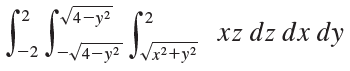
Evaluate the integral by changing to cylindrical coordinates. V4-y2 '2 xz dz dx dy -2 J-/4-y² J/x²+y²
Use cylindrical coordinates.Find the mass of a ball B given by x2 + y2 + z2 < a2 if the density at any point is proportional to its distance from the z-axis.
Use cylindrical coordinates.Find the mass and center of mass of the solid S bounded by the paraboloid z = 4x2 + 4y2 and the plane z = a (a > 0) if S has constant density K.
Use cylindrical coordinates.(a) Find the volume of the solid that the cylinder r = a cos θ cuts out of the sphere of radius a centered at the origin.(b) Illustrate the solid of part (a) by graphing the sphere and the cylinder on the same screen.
Use cylindrical coordinates.(a) Find the volume of the region E that lies between the paraboloid z = -4 - x2 - y2 and the cone z = 2√x2 + y2.(b) Find the centroid of E (the center of mass in the case where the density is constant).
Use cylindrical coordinates.Find the volume of the solid that lies between the paraboloid z = x2 + y2 and the sphere x2 + y2 + z2 = 2.
Use cylindrical coordinates.Find the volume of the solid that lies within both the cylinder x2 + y2 = 1 and the sphere x2 + y2 + z2 = 4.
Use cylindrical coordinates.Find the volume of the solid that is enclosed by the cone z = √x2 + y2 and the sphere x2 + y2 + z2 = 2.
Use cylindrical coordinates.Use cylindrical coordinates.where E is the solid that lies within the cylinder x2 + y2 = 1, above the plane z = 0, and below the cone z2 = 4x2 + 4y2. Evaluate [[e x dV,
Use cylindrical coordinates.where E is the solid that lies between the cylinders x2 + y2 − 1 and x2 + y2 = 16, above the xy-plane, and below the plane z = y + 4. Evaluate f[f, (x – y) dV,
Use cylindrical coordinates.where E is the solid in the first octant that lies under the paraboloid z = 4 - x2 - y2. Evaluate ffl, (x + y + z) dV,
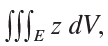
Use cylindrical coordinates.Evaluatewhere E is enclosed by the paraboloid z = x2 + y2 and the plane z = 4. AP SIIE z dV,
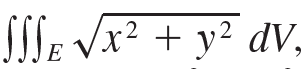
Use cylindrical coordinates.Evaluate where E is the region that lies inside the cylinder x2 + y2 = 16 and between the planes z = -5 and z = 4. SLE Vx² + y² dV,
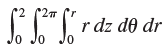
Sketch the solid whose volume is given by the integral and evaluate the integral. r dz de dr 1o Jo LII
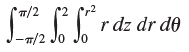
Sketch the solid whose volume is given by the integral and evaluate the integral. 7/2 r dz dr de J-m/2 Jo Jo
Use a graphing device to draw the solid enclosed by the paraboloids z = x2 + y2 and z = 5 - x2 - y2.
A cylindrical shell is 20 cm long, with inner radius 6 cm and outer radius 7 cm. Write inequalities that describe the shell in an appropriate coordinate system. Explain how you have positioned the coordinate system with respect to the shell.
Sketch the solid described by the given inequalities.0 < θ < π/2, r < z < 2
Sketch the solid described by the given inequalities.r2 < z < 8 - r2
Write the equations in cylindrical coordinates.(a) 2x2 + 2y2 - z2 = 4(b) 2x - y + z = 1
Write the equations in cylindrical coordinates.(a) x2 - x + y2 + z2 = 1(b) z = x2 - y2
Identify the surface whose equation is given. r = 2 sinθ
Identify the surface whose equation is given.r2 + z2 = 4
Describe in words the surface whose equation is given.θ = π/6
Describe in words the surface whose equation is given.r = 2
Change from rectangular to cylindrical coordinates.(a) (-√2 , √2 , 1) (b) (2, 2, 2)
Change from rectangular to cylindrical coordinates.(a) (-1, 1, 1)(b) (-2, 2√3 , 3)
Plot the point whose cylindrical coordinates are given. Then find the rectangular coordinates of the point.(a) (√2 , 3π/4, 2) (b) (1, 1, 1)
Plot the point whose cylindrical coordinates are given. Then find the rectangular coordinates of the point.(a) (4, π/3, -2) (b) (2, -π/2, 1)
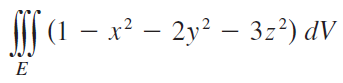
(a) Find the region E for which the triple integralis a maximum.(b) Use a computer algebra system to calculate the exact maximum value of the triple integral in part (a). | (1 – x² – 2y² – 3z²) dV
The average value of a function f (x, y, z) over a solid region E is defined to bewhere V(E) is the volume of E. For instance, if p is a density function, then pave is the average density of E.Find the average height of the points in the solid hemispherex2 + y2 + z2 < 1, z > 0. 1 fave V(E) J]
The average value of a function f (x, y, z) over a solid region E is defined to bewhere V(E) is the volume of E. For instance, if p is a density function, then pave is the average density of E.Find the average value of the function f (x, y, z) = xyz over the cube with side length L that lies in the
Suppose X, Y, and Z are random variables with joint density function f (x, y, z) = Ce-(0.5x+0.2y+0.1z) if x > 0, y > 0, z > 0,and f (x, y, z) = 0 otherwise.(a) Find the value of the constant C.(b) Find P(X < 1, Y < 1).(c) Find P(X < 1, Y < 1, Z < 1).
The joint density function for random variables X, Y, and Z is f (x, y, z) = Cxyz if 0 < x < 2, 0 < y < 2, 0 < z < 2, and f (x, y, z) = 0 otherwise.(a) Find the value of the constant C.(b) Find P(X < 1, Y < 1, Z < 1).(c) Find P(X + Y + Z < 1).
If E is the solid of Exercise 18 with density function p(x, y, z) = x2 + y2, find the following quantities, correct to three decimal places.(a) The mass(b) The center of mass(c) The moment of inertia about the z-axis
Let E be the solid in the first octant bounded by the cylinder x2 + y2 = 1 and the planes y = z, x = 0, and z = 0 with the density function p(x, y, z) = 1 + x + y + z. Use a computer algebra system to find the exact values of the following quantities for E.(a) The mass(b) The center of mass(c) The
Set up, but do not evaluate, integral expressions for (a) the mass, (b) the center of mass, and (c) the moment of inertia about the z-axis.The solid of Exercise 21; p(x, y, z) = √x2 + y2
Assume that the solid has constant density k.Find the moment of inertia about the z-axis of the solid cone √x2 + y2 < z < h.
Assume that the solid has constant density k.Find the moment of inertia about the z-axis of the solid cylinder x2 + y2 < a2, 0 < z < h.
Showing 17800 - 17900
of 29454
First
172
173
174
175
176
177
178
179
180
181
182
183
184
185
186
Last
Step by Step Answers

 Get 50% OFF
Claim Now
Get 50% OFF
Claim Now


















![1 fave V(E) J] F(x, y, z) dV](https://dsd5zvtm8ll6.cloudfront.net/si.question.images/images/question_images/1553/1/8/9/9805c93cc5c560761553172746426.jpg)


