New Semester
Started
Get
50% OFF
Study Help!
--h --m --s
Claim Now
Question Answers
Textbooks
Find textbooks, questions and answers
Oops, something went wrong!
Change your search query and then try again
S
Books
FREE
Study Help
Expert Questions
Accounting
General Management
Mathematics
Finance
Organizational Behaviour
Law
Physics
Operating System
Management Leadership
Sociology
Programming
Marketing
Database
Computer Network
Economics
Textbooks Solutions
Accounting
Managerial Accounting
Management Leadership
Cost Accounting
Statistics
Business Law
Corporate Finance
Finance
Economics
Auditing
Tutors
Online Tutors
Find a Tutor
Hire a Tutor
Become a Tutor
AI Tutor
AI Study Planner
NEW
Sell Books
Search
Search
Sign In
Register
study help
mathematics
precalculus
Calculus Early Transcendentals 8th edition James Stewart - Solutions
Use Green’s Theorem to evaluate the line integral along the given positively oriented curve.ʃC (y + e√x) dx + (2x + cos y2) dy, C is the boundary of the region enclosed by the parabolas y = x2 and x = y2
Use Green’s Theorem to evaluate the line integral along the given positively oriented curve.ʃC (x2 + y2) dx + (x2 - y2) dy, C is the triangle with vertices (0, 0), (2, 1), and (0, 1)
Use Green’s Theorem to evaluate the line integral along the given positively oriented curve.ʃC (x2 + y2) dx + (x2 - y2) dy, C is the triangle with vertices (0, 0), (2, 1), and (0, 1)
Evaluate the line integral by two methods: (a) directly and (b) using Green’s Theorem.ʃC yex dx + 2ex dy, C is the rectangle with vertices (0, 0), (3, 0), (3, 4), and (0, 4)
Evaluate the line integral by two methods: (a) directly and (b) using Green’s Theorem.∮c x2y2 dx + xy dy, C consists of the arc of the parabola y = x2 from (0, 0) to (1, 1) and the line segments from (1, 1) to (0, 1) and from (0, 1) to (0, 0)
Evaluate the line integral by two methods: (a) directly and (b) using Green’s Theorem.∮c xy dx + x2y3 dy, C is the triangle with vertices (0, 0), (1, 0), and (1, 2)
Evaluate the line integral by two methods: (a) directly and (b) using Green’s Theorem.∮c y dx - x dy, C is the circle with center the origin and radius 4
Determine whether or not the given set is (a) open, (b) connected, and (c) simply-connected.{(x, y) | (x, y) ≠ (2, 3)}
Determine whether or not the given set is (a) open, (b) connected, and (c) simply-connected.{(x, y) | 1 < x2 9+ y2 < 4, y > 0
Determine whether or not the given set is (a) open, (b) connected, and (c) simply-connected.{(x, y) | 1 < |x| < 2}
Determine whether or not the given set is (a) open, (b) connected, and (c) simply-connected.{(x, y) | 0 < y < 3}
Use Exercise 29 to show that the line integral ∫C y dx + x dy + xyz dz is not independent of path.
Let F = ∇f , where f (x, y) = sin(x - 2y). Find curves C1 and C2 that are not closed and satisfy the equation. F· dr = 1 (a) (b) |F· dr = 0
If F(x, y) = sin y i + (1 + x cos y) j, use a plot to guess whether F is conservative. Then determine whether your guess is correct.
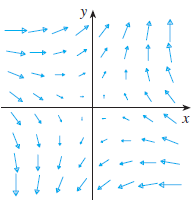
Is the vector field shown in the figure conservative?Explain. УА х
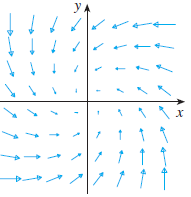
Is the vector field shown in the figure conservative?Explain. y. х
Find the work done by the force field F in moving an object from P to Q.F(x, y) = (2x + y) i + x j; P(1, 1), Q(4, 3)
Find the work done by the force field F in moving an object from P to Q.F(x, y) = x3 i + y3 j; P(1, 0), Q(2, 2)
Suppose an experiment determines that the amount of work required for a force field F to move a particle from the point (1, 2) to the point (5, -3) along a curve C1 is 1.2 J and the work done by F in moving the particle along another curve C2 between the same two points is 1.4 J. What can you say
Suppose you’re asked to determine the curve that requires the least work for a force field F to move a particle from one point to another point. You decide to check first whether F is conservative, and indeed it turns out that it is. How would you reply to the request?
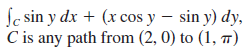
Show that the line integral is independent of path and evaluate the integral. Se sin y dx + (x cos y – sin y) dy, C is any path from (2, 0) to (1, 77)
(a) Find a function f such that F = ∇f and (b) use part (a) to evaluate ∫C F • dr along the given curve C.F(x, y, z) = sin y i + (x cos y + cos z) j - y sin z k, C: r(t) = sin t i + t j + 2t k, 0 < t < π/2
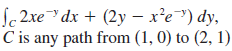
Show that the line integral is independent of path and evaluate the integral.
(a) Find a function f such that F = ∇f and (b) use part (a) to evaluate ∫C F • dr along the given curve C.F(x, y, z) = yzexz i + exz j + xyexz k, C: r(t) = (t2 + 1) i + (t2 - 1) j + (t2 - 2t) k, 0 < t < 2
(a) Find a function f such that F = ∇f and (b) use part (a) to evaluate ∫C F • dr along the given curve C.F(x, y, z) = (y2z + 2xz2) i + 2xyz j + (xy2 + 2x2z) k, C: x = √t , y = t + 1, z = t2, 0 < t < 1
(a) Find a function f such that F = ∇f and (b) use part (a) to evaluate ∫C F • dr along the given curve C.F(x, y, z) = yz i + xz j + (xy + 2z) k, C is the line segment from (1, 0, -2) to (4, 6, 3)
(a) Find a function f such that F = ∇f and (b) use part (a) to evaluate ∫C F • dr along the given curve C.
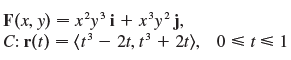
(a) Find a function f such that F = ∇f and (b) use part (a) to evaluate ∫C F • dr along the given curve C. F(x, y) = x²y³ i + x³y² j, C: r(t) = (t – 2t, t³ + 2t), .3,,2 0
(a) Find a function f such that F = ∇f and (b) use part (a) to evaluate ∫C F • dr along the given curve C. F(x, y) = (3 + 2xy³) i + 2x²yj, Cis the arc of the hyperbola y = 1/x from (1, 1) to (4,)
The figure shows the vector field F(x, y) = (2xy, x2)and three curves that start at (1, 2) and end at (3, 2).(a) Explain why ∫C F • dr has the same value for all three curves.(b) What is this common value?
Determine whether or not F is a conservative vector field. If it is, find a function f such that F = ∇f.F(x, y) = y2exy i + (1 + xy)exy j
Determine whether or not F is a conservative vector field. If it is, find a function f such that F = ∇f.F(x, y) = (ln y + y/x) i + (ln x + x/y) j
Determine whether or not F is a conservative vector field. If it is, find a function f such that F = ∇f.F(x, y) = (y2 cos x + cos y) i + (2y sin x - x sin y) j
Determine whether or not F is a conservative vector field. If it is, find a function f such that F = ∇f.F(x, y) = (2xy + y-2) i + (x2 - 2xy-3) j, y > 0
Determine whether or not F is a conservative vector field. If it is, find a function f such that F = ∇f.F(x, y) = (yex + sin y) i + (ex + x cos y) j
Determine whether or not F is a conservative vector field. If it is, find a function f such that F = ∇f.F(x, y) = yex i + (ex + ey) j
Determine whether or not F is a conservative vector field. If it is, find a function f such that F = ∇f.F(x, y) = (y2 - 2x) i + 2xy j
Determine whether or not F is a conservative vector field. If it is, find a function f such that F = ∇f.F(x, y) = (xy + y2) i + (x2 + 2xy) j
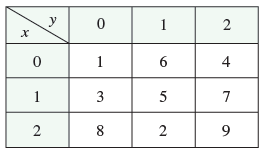
A table of values of a function f with continuous gradient is given. Find ʃC ∇f • dr, where C has parametric equationsx = t2 + 1 y = t3 + t 0 < t < 1 х 4 1 2. 2. 3. 2.
The figure shows a curve C and a contour map of a function f whose gradient is continuous.find SeVf• dr.
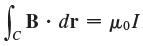
Experiments show that a steady current I in a long wire produces a magnetic field B that is tangent to any circle that lies in the plane perpendicular to the wire and whose center is the axis of the wire (as in the figure). Ampère’s Law relates the electric current to its magnetic effects and
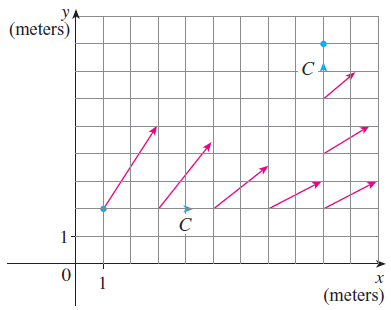
An object moves along the curve C shown in the figure from (1, 2) to (9, 8). The lengths of the vectors in the force field F are measured in newtons by the scales on the axes. Estimate the work done by F on the object. (meters) CA х (meters)
If C is a smooth curve given by a vector function r(t), a < t < b, show that r- dr = {[Ir(b)P° – |r(a)|]
If C is a smooth curve given by a vector function r(t), a < t < b, and v is a constant vector, show that v. dr - v: [r(ь) — r(а)] [r(b) – r(a)] Ус
The base of a circular fence with radius 10 m is given by x = 10 cos t, y = 10 sin t. The height of the fence at position (x, y) is given by the function h(x, y) = 4 + 0.01(x2 - y2), so the height varies from 3 m to 5 m. Suppose that 1 L of paint covers 100 m2. Sketch the fence and determine how
(a) Show that a constant force field does zero work on a particle that moves once uniformly around the circle x2 + y2 = 1.(b) Is this also true for a force field F(x) = kx, where k is a constant and x = (x, y)?
Suppose there is a hole in the can of paint in Exercise 45 and 9 lb of paint leaks steadily out of the can during the man’s ascent. How much work is done?
A 160-lb man carries a 25-lb can of paint up a helical staircase that encircles a silo with a radius of 20 ft. If the silo is 90 ft high and the man makes exactly three complete revolutions climbing to the top, how much work is done by the man against gravity?
An object with mass m moves with position function r(t) = a sin t i + b cos t j + ct k, 0 < t < π/2. Find the work done on the object during this time period.
The position of an object with mass m at time t is r(t) = at2 i + bt3 j, 0 < t < 1.(a) What is the force acting on the object at time t?(b) What is the work done by the force during the time interval 0 < t < 1?
The force exerted by an electric charge at the origin on a charged particle at a point (x, y, z) with position vector r = (x, y, z) is F(r) = Kr/|r|3 where K is a constant. (See Example 16.1.5.) Find the work done as the particle moves along a straight line from (2, 0, 0) to (2, 1, 5).
Find the work done by the force field F(x, y, z) = (x - y2 , y - z2, z - x2) on a particle that moves along the line segment from (0, 0, 1) to (2, 1, 0).
Find the work done by the force field F(x, y) = x2 i + yex j on a particle that moves along the parabola x = y2 + 1 from (1, 0) to (2, 1).
Find the work done by the force fieldF(x, y) = x i + ( y + 2) jin moving an object along an arch of the cycloidr(t) = (t - sin t) i + (1 - cos t) j 0 < t < 2π
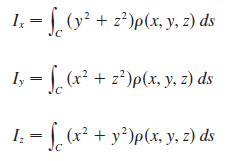
If a wire with linear density p(x, y, z) lies along a space curve C, its moments of inertia about the x-, y-, and z-axes are defined asFind the moments of inertia for the wire in Exercise 35. I, = [ (v² + z°)p(x, y, 2) ds I, = [, (x² + z²)p(x, y, z) ds I: = |, (x² + y²)p(x, y, z) ds
If a wire with linear density p(x, y) lies along a plane curve C, its moments of inertia about the x- and y-axes are defined asFind the moments of inertia for the wire in Example 3. 1. - [y°p(x, y) ds I, = x*p(x, y) ds %3D
Find the mass and center of mass of a wire in the shape of the helix x = t, y = cos t, z = sin t, 0 < t < 2π, if the density at any point is equal to the square of the distance from the origin.
(a) Write the formulas similar to Equations 4 for the center of mass (x, y, z) of a thin wire in the shape of a space curve C if the wire has density function p(x, y, z).(b) Find the center of mass of a wire in the shape of the helix x = 2 sin t, y = 2 cos t, z = 3t, 0 < t < 2π, if the
A thin wire has the shape of the first-quadrant part of the circle with center the origin and radius a. If the density function is p(x, y) = kxy, find the mass and center of mass of the wire.
A thin wire is bent into the shape of a semicircle x2 + y2 = 4, x > 0. If the linear density is a constant k, find the mass and center of mass of the wire.
(a) Find the work done by the force field F(x, y) = x2 i + xy j on a particle that moves once around the circle x2 + y2 = 4 oriented in the counterclockwisedirection.(b) Use a computer algebra system to graph the force field and circle on the same screen. Use the graph to explain your answer to
Find the exact value of ʃC x3y2z ds, where C is the curve with parametric equations x = e2-t cos 4t, y = e2-t sin 4t, z = e2-t, 0 < t < 2π.
Use a graph of the vector field F and the curve C to guess whether the line integral of F over C is positive, negative, or zero. Then evaluate the line integral.F(x, y) = x/√x2 + y2 i + y/√x2 + y2 j, C is the parabola y = 1 + x2 from (-1, 2) to (1, 2)
Use a graph of the vector field F and the curve C to guess whether the line integral of F over C is positive, negative, or zero. Then evaluate the line integral.F(x, y) = (x - y) i + xy j, C is the arc of the circle x2 + y2 = 4 traversed counterclockwise from (2, 0) to (0, -2)
Evaluate the line integral ʃC F • dr, where C is given by the vector function r(t).F(x, y, z) = x i + y j + xy k, r(t) = cos t i + sin t j + t k, 0 < t < π
Evaluate the line integral ʃC F • dr, where C is given by the vector function r(t).F(x, y, z) = sin x i + cos y j + xz k, r(t) = t3 i - t2 j + t k, 0 < t < 1
Evaluate the line integral ʃC F • dr, where C is given by the vector function r(t).F(x, y, z) = (x + y2) i + xzj + (y + z) k, r(t) = t2 i + t3 j - 2t k, 0 < t < 2
Evaluate the line integral ʃC F • dr, where C is given by the vector function r(t).F(x, y) = xy2 i - x2 j, r(t) = t3 i + t2 j, 0 < t < 1
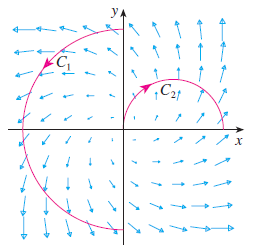
The figure shows a vector field F and two curves C1 and C2. Are the line integrals of F over C1 and C2 positive, negative, or zero? Explain. ул ¡C2}
Evaluate the line integral, where C is the given curve.ʃC (y + z) dx + (x + z) dy + (x + y) dz, C consists of line segments from (0, 0, 0) to (1, 0, 1) and from (1, 0, 1) to (0, 1, 2)
Evaluate the line integral, where C is the given curve.ʃC z2 dx + x2 dy + y2 dz, C is the line segment from (1, 0, 0) to (4, 1, 2)
Evaluate the line integral, where C is the given curve.ʃC y dx + z dy + x dz, C: x = √t , y = t, z = t2, 1 < t < 4
Evaluate the line integral, where C is the given curve.ʃC xyeyz dy, C: x = t, y = t2, z = t3, 0 < t < 1
Evaluate the line integral, where C is the given curve.ʃC (x2 + y2 + z2)ds, C: x = t, y = cos 2t, z = sin 2t, 0 < t < 2π
Evaluate the line integral, where C is the given curve.ʃC xeyz ds, C is the line segment from (0, 0, 0) to (1, 2, 3)
Evaluate the line integral, where C is the given curve.ʃC y2z ds, C is the line segment from (3, 1, 2) to (1, 2, 5)
Evaluate the line integral, where C is the given curve.ʃC x2y ds, C: x = cos t, y = sin t, z = t, 0 < t < ∇/2
Evaluate the line integral, where C is the given curve.ʃC x2 dx + y2 dy, C consists of the arc of the circle x2 + y2 = 4 from (2, 0) to (0, 2) followed by the line segment from (0, 2) to (4, 3)
Evaluate the line integral, where C is the given curve.ʃC (x + 2y) dx + x2 dy, C consists of line segments from (0, 0) to (2, 1) and from (2, 1) to (3, 0)
Evaluate the line integral, where C is the given curve.ʃC ex dx, C is the arc of the curve x = y3 from (-1, -1) to (1, 1)
Evaluate the line integral, where C is the given curve.ʃC (x2y + sin x) dy, C is the arc of the parabola y = x2 from (0, 0) to (π, π2)
Evaluate the line integral, where C is the given curve.ʃC xey ds, C is the line segment from (2, 0) to (5, 4)
Evaluate the line integral, where C is the given curve.ʃC xy4 ds, C is the right half of the circle x2 + y2 = 16
Evaluate the line integral, where C is the given curve.ʃC (x/y) ds, C: x = t3, y = t4, 1 < t < 2
(a) Sketch the vector field F(x, y) = i + x j and then sketch some flow lines. What shape do these flow lines appear to have?(b) If parametric equations of the flow lines are x = x(t), y = y(t), what differential equations do these functions satisfy? Deduce that dyydx = x.(c) If a particle starts
The flow lines (or streamlines) of a vector field are the paths followed by a particle whose velocity field is the given vector field. Thus the vectors in a vector field are tangent to the flow lines.(a) Use a sketch of the vector field F(x, y) = x i - y j to draw some flow lines. From your
At time t = 1, a particle is located at position (1, 3). If it moves in a velocity fieldF(x, y) = (xy - 2, y2 - 10)find its approximate location at time t = 1.05.
A particle moves in a velocity field V(x, y) = (x2, x + y2). If it is at position (2, 1) at time t = 3, estimate its location at time t = 3.01.
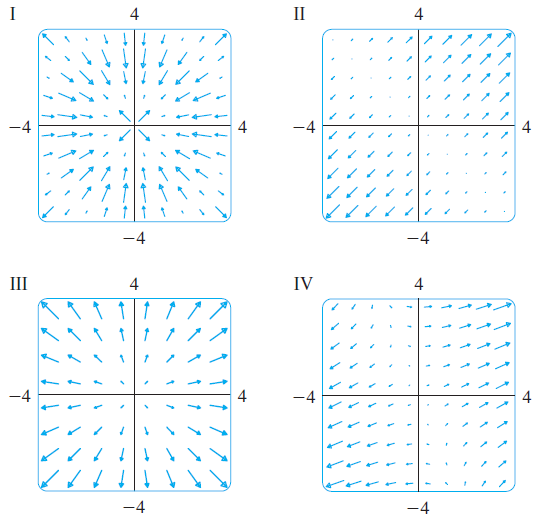
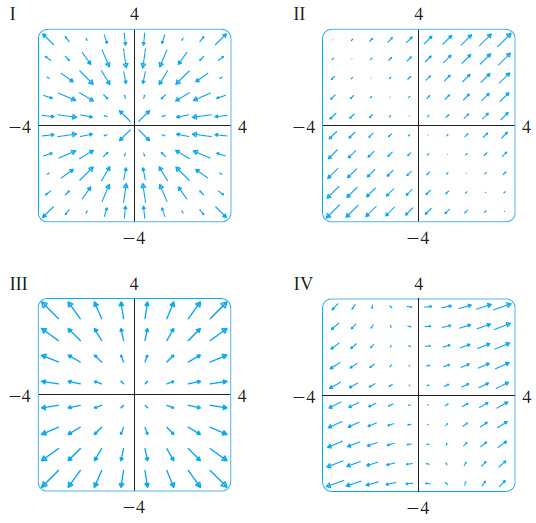
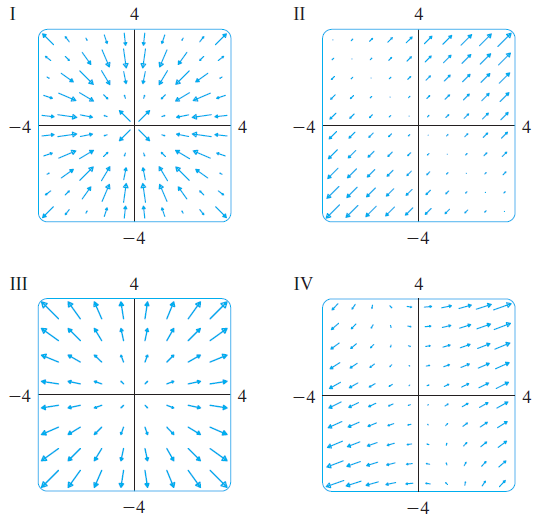
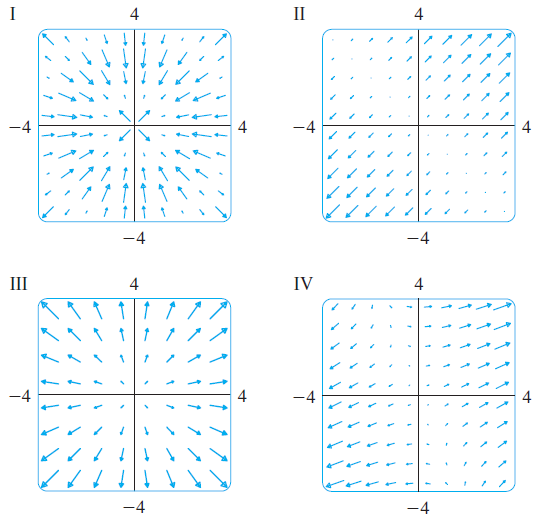
Match the functions f with the plots of their gradient vector fields labeled I–IV. Give reasons for your choices.f (x, y) = sin√x2 + y2 II 4 4 4 4 -4 -4 -4 -4 Ш IV 4 4 -4 -4 4 -4 -4 4-
Match the functions f with the plots of their gradientvector fields labeled I–IV. Give reasons for your choices.f (x, y) = (x + y)2 II 4 4 4 4 -4 -4 -4 -4 Ш IV 4 4 -4 -4 4 -4 -4 4-
Match the functions f with the plots of their gradient vector fields labeled I–IV. Give reasons for your choices.f(x, y) = x(x + y) II 4 4 4 4 -4 -4 -4 -4 Ш IV 4 4 -4 -4 4 -4 -4 4-
Match the functions f with the plots of their gradient vector fields labeled I–IV. Give reasons for your choices.f (x, y) = x2 + y2 II 4 4 4 4 -4 -4 -4 -4 Ш IV 4 4 -4 -4 4 -4 -4 4-
Plot the gradient vector field of f together with a contour map of f. Explain how they are related to each other.f (x, y) = ln(1 + x2 + 2y2)
Plot the gradient vector field of f together with a contour map of f. Explain how they are related to each other.f (x, y) = cos x - 2 sin y
Find the gradient vector field ∇f of f and sketch it.f (x, y) = 1/2 (x2 - y2)
Find the gradient vector field ∇f of f and sketch it.f (x, y) = 1/2(x - y)2
Find the gradient vector field of f .f (x, y, z) = x2yey/z
Find the gradient vector field of f .f (x, y, z) = √x2 1 y2 + z2
Find the gradient vector field of f .f (s, t) = √2s + 3t
Find the gradient vector field of f .f (x, y) = y sin(xy)
Showing 17600 - 17700
of 29454
First
170
171
172
173
174
175
176
177
178
179
180
181
182
183
184
Last
Step by Step Answers

 Get 50% OFF
Claim Now
Get 50% OFF
Claim Now







![r- dr = {[Ir(b)P° – |r(a)|]](https://dsd5zvtm8ll6.cloudfront.net/si.question.images/images/question_images/1553/2/7/8/1165c9524a4b33a91553260891887.jpg)
![v. dr - v: [r(ь) — r(а)] [r(b) – r(a)] Ус](https://dsd5zvtm8ll6.cloudfront.net/si.question.images/images/question_images/1553/2/7/7/5785c95228a746f81553260352642.jpg)