New Semester
Started
Get
50% OFF
Study Help!
--h --m --s
Claim Now
Question Answers
Textbooks
Find textbooks, questions and answers
Oops, something went wrong!
Change your search query and then try again
S
Books
FREE
Study Help
Expert Questions
Accounting
General Management
Mathematics
Finance
Organizational Behaviour
Law
Physics
Operating System
Management Leadership
Sociology
Programming
Marketing
Database
Computer Network
Economics
Textbooks Solutions
Accounting
Managerial Accounting
Management Leadership
Cost Accounting
Statistics
Business Law
Corporate Finance
Finance
Economics
Auditing
Tutors
Online Tutors
Find a Tutor
Hire a Tutor
Become a Tutor
AI Tutor
AI Study Planner
NEW
Sell Books
Search
Search
Sign In
Register
study help
mathematics
precalculus
Calculus Early Transcendentals 8th edition James Stewart - Solutions
Find the shortest distance from the point (2, 0, -3) to the plane x + y + z = 1.
If a function of one variable is continuous on an interval and has only one critical number, then a local maximum has to be an absolute maximum. But this is not true for functions of two variables. Show that the functionf (x, y) = 3xey - x3 - e3yhas exactly one critical point, and that f has a
For functions of one variable it is impossible for a continuous function to have two local maxima and no local minimum. But for functions of two variables such functions exist. Show that the functionf(x, y) = 2(x2 - 1)2 - (x2y - x - 1)2has only two critical points, but has local maxima at both of
Find the absolute maximum and minimum values of f on the set D.f (x, y) = x3 - 3x - y3 + 12y, D is the quadrilateral whose vertices are (-2, 3), (2, 3), (2, 2), and (-2, -2)
Find the absolute maximum and minimum values of f on the set D.f (x, y) = 2x3 + y4, D = {(x, y) | x2 + y2 < 1}
Find the absolute maximum and minimum values of f on the set D.f (x, y) = xy2, D = {(x, y) | x > 0, y > 0, x2 + y2 < 3}
Find the absolute maximum and minimum values of f on the set D.f (x, y) = x + y - xy, D is the closed triangular region with vertices (0, 0), (0, 2), and (4, 0)
Find the absolute maximum and minimum values of f on the set D.f (x, y) = x2 + y2 - 2x, D is the closed triangular region with vertices (2, 0), (0, 2), and (0, -2)
Use a graphing device as in Example 4 (or Newton’s method or solve numerically using a calculator or computer) to find the critical points of f correct to three decimal places. Then classify the critical points and find the highest or lowest points on the graph, if any.f(x, y) = 20e-x2-y2 sin 3x
Use a graphing device as in Example 4 (or Newton’s method or solve numerically using a calculator or computer) to find the critical points of f correct to three decimal places. Then classify the critical points and find the highest or lowest points on the graph, if any.f(x, y) = x4 + y3 - 3x2 +
Use a graphing device as in Example 4 (or Newton’s method or solve numerically using a calculator or computer) to find the critical points of f correct to three decimal places. Then classify the critical points and find the highest or lowest points on the graph, if any.f(x, y) = y6 - 2y4 + x2 -
Use a graphing device as in Example 4 (or Newton’s method or solve numerically using a calculator or computer) to find the critical points of f correct to three decimal places. Then classify the critical points and find the highest or lowest points on the graph, if any.f(x, y) = x4 + y4 - 4x2y +
Use a graph or level curves or both to estimate the local maximum and minimum values and saddle point(s) of the function. Then use calculus to find these values precisely. f(x, y) = sin x + sin y + cos(x + y), 0 < x< T/4, 0 < y< T/4
Use a graph or level curves or both to estimate the local maximum and minimum values and saddle point(s) of the function. Then use calculus to find these values precisely. f(x, y) = sin x + sin y + sin(x + y), 0 < x< 27, 0 < y< 2m
Use a graph or level curves or both to estimate the local maximum and minimum values and saddle point(s) of the function. Then use calculus to find these values precisely.f (x, y) = (x - y)e-x2-y2
Use a graph or level curves or both to estimate the local maximum and minimum values and saddle point(s) of the function. Then use calculus to find these values precisely.f (x, y) = x2 + y2 + x-2y-2
Show that f (x, y) = x2ye-x2-y2 has maximum values at (±1, 1/√2) and minimum values at (±1, -1/√2). Show also that f has infinitely many other critical points and D = 0 at each of them. Which of them give rise to maximum values? Minimum values? Saddle points?
Show that f (x, y) = x2 + 4y2 - 4xy + 2 has an infinite number of critical points and that D = 0 at each one. Then show that f has a local (and absolute) minimum at each critical point.
Find the local maximum and minimum values and saddle point(s) of the function. If you have three-dimensional graphing software, graph the function with a domain and viewpoint that reveal all the important aspects of the function.f (x, y) = y2 - 2y cos x, -1 < x < 7
Find the local maximum and minimum values and saddle point(s) of the function. If you have three-dimensional graphing software, graph the function with a domain and viewpoint that reveal all the important aspects of the function.f (x, y) = (x2 + y2)e2x
Find the local maximum and minimum values and saddle point(s) of the function. If you have three-dimensional graphing software, graph the function with a domain and viewpoint that reveal all the important aspects of the function.f (x, y) = xy + e2xy
Find the local maximum and minimum values and saddle point(s) of the function. If you have three-dimensional graphing software, graph the function with a domain and viewpoint that reveal all the important aspects of the function.f (x, y) = xye-(x2+y2)/2
Find the local maximum and minimum values and saddle point(s) of the function. If you have three-dimensional graphing software, graph the function with a domain and viewpoint that reveal all the important aspects of the function.f (x, y) = ex cos y
Find the local maximum and minimum values and saddle point(s) of the function. If you have three-dimensional graphing software, graph the function with a domain and viewpoint that reveal all the important aspects of the function.f (x, y) = y cos x
Find the local maximum and minimum values and saddle point(s) of the function. If you have three-dimensional graphing software, graph the function with a domain and viewpoint that reveal all the important aspects of the function.f (x, y) = x4 - 2x2 + y3 - 3y
Find the local maximum and minimum values and saddle point(s) of the function. If you have three-dimensional graphing software, graph the function with a domain and viewpoint that reveal all the important aspects of the function.f (x, y) = x3 + y3 - 3x2 - 3y2 - 9x
Find the local maximum and minimum values and saddle point(s) of the function. If you have three-dimensional graphing software, graph the function with a domain and viewpoint that reveal all the important aspects of the function.f (x, y) = x3 - 3x + 3xy2
Find the local maximum and minimum values and saddle point(s) of the function. If you have three-dimensional graphing software, graph the function with a domain and viewpoint that reveal all the important aspects of the function.f (x, y) = 2 - x4 + 2x2 - y2
Find the local maximum and minimum values and saddle point(s) of the function. If you have three-dimensional graphing software, graph the function with a domain and viewpoint that reveal all the important aspects of the function.f (x, y) = x2 + y4 + 2xy
Find the local maximum and minimum values and saddle point(s) of the function. If you have three-dimensional graphing software, graph the function with a domain and viewpoint that reveal all the important aspects of the function.f (x, y) = y(ex - 1)
Find the local maximum and minimum values and saddle point(s) of the function. If you have three-dimensional graphing software, graph the function with a domain and viewpoint that reveal all the important aspects of the function.f (x, y) = (x - y)(1 - xy)
Find the local maximum and minimum values and saddle point(s) of the function. If you have three-dimensional graphing software, graph the function with a domain and viewpoint that reveal all the important aspects of the function.f (x, y) = xy - 2x - 2y - x2 - y2
Find the local maximum and minimum values and saddle point(s) of the function. If you have three-dimensional graphing software, graph the function with a domain and viewpoint that reveal all the important aspects of the function.f (x, y) = x2 + xy + y2 + y
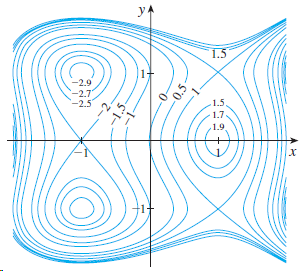
Use the level curves in the figure to predict the location of the critical points of f and whether f has a saddle point or a local maximum or minimum at each critical point. Explain your reasoning. Then use the Second Derivatives Test to confirm your predictions.f (x, y) = 3x - x3 - 2y3 + y4 1.5
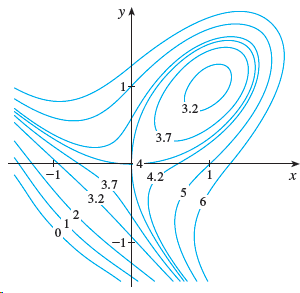
Use the level curves in the figure to predict the location of the critical points of f and whether f has a saddle point or a local maximum or minimum at each critical point. Explain your reasoning. Then use the Second Derivatives Test to confirm your predictions.f (x, y) = 4 + x3 + y3 - 3xy y 3.2-
Suppose (0, 2) is a critical point of a function t with continuous second derivatives. In each case, what can you say about t?(a) txx(0, 2) = -1, gxy(0, 2) = 6, gyy(0, 2) = 1(b) txx(0, 2) = -1, gxy(0, 2) = 2, gyy(0, 2) = -8(c) txx(0, 2) = -4, gxy(0, 2) = 6, gyy(0, 2) = 9
Suppose (1, 1) is a critical point of a function f with continuous second derivatives. In each case, what can you say about f ?(a) fxx(1, 1) = 4, fx y(1, 1) = 1, fyy(1, 1) = 2(b) fxx(1, 1) = 4, fx y(1, 1) = 3, fyy(1, 1) = 2
Show that if z = f (x, y) is differentiable at x0 = (x0, y0), then f(x) – f(xo) – Vf(xo)· (x – xo) х — Хо lim х—Хо |x - xo|
Suppose that the directional derivatives of f (x, y) are known at a given point in two nonparallel directions given by unit vectors u and v. Is it possible to find ∇f at this point? If so, how would you do it?
(a) Show that the function f (x, y) = 3√xy is continuous and the partial derivatives fx and fy exist at the origin but the directional derivatives in all other directions do not exist.(b) Graph f near the origin and comment on how the graph confirms part (a).
(a) Two surfaces are called orthogonal at a point of intersection if their normal lines are perpendicular at that point. Show that surfaces with equations F(x, y, z) = 0 and G(x, y, z) = 0 are orthogonal at a point P where ∇F ≠ 0 and ∇G ≠ 0 if and only ifFxGx + FyGy + FzGz = 0 at P(b)
(a) The plane y + z = 3 intersects the cylinder x2 + y2 = 5 in an ellipse. Find parametric equations for the tangent line to this ellipse at the point (1, 2, 1).(b) Graph the cylinder, the plane, and the tangent line on the same screen.
Find parametric equations for the tangent line to the curve of intersection of the paraboloid z = x2 + y2 and the ellipsoid 4x2 + y2 + z2 = 9 at the point (-1, 1, 2).
Show that the pyramids cut off from the first octant by any tangent planes to the surface xyz = 1 at points in the first octant must all have the same volume.
Show that the sum of the x-, y-, and z-intercepts of any tangent plane to the surface √x + √y + √z = √c is a constant.
At what points does the normal line through the point (1, 2, 1) on the ellipsoid 4x2 + y2 + 4z2 = 12 intersect the sphere x2 + y2 + z2 = 102?
Where does the normal line to the paraboloid z = x2 + y2 at the point (1, 1, 2) intersect the paraboloid a second time?
Show that every normal line to the sphere x2 + y2 + z2 = r2 passes through the center of the sphere.
Show that every plane that is tangent to the cone x2 + y2 = z2 passes through the origin.
Show that the ellipsoid 3x2 + 2y2 + z2 = 9 and the sphere x2 + y2 + z2 - 8x - 6y - 8z + 24 = 0 are tangent to each other at the point (1, 1, 2). (This means that they have a common tangent plane at the point.)
Are there any points on the hyperboloid x2 - y2 - z2 = 1 where the tangent plane is parallel to the plane z = x + y?
At what point on the ellipsoid x2 + y2 + 2z2 = 1 is the tangent plane parallel to the plane x + 2y + z = 1?
Show that the equation of the tangent plane to the elliptic paraboloid z/c = x2/a2 + y2/b2 at the point (x0, y0, z0) can be written as2xx0/a2 + 2yy0/b2 + z+z0/c
Find the equation of the tangent plane to the hyperboloid x2/a2 + y2/b2 + z2/c2 = 1 at (x0, y0, z0) and express it in a form similar to the one in Exercise 51.
Show that the equation of the tangent plane to the ellipsoid x2/a2 + y2/b2 + z2/c2 = 1 at the point (x0, y0, z0) can be written asxx0/a2 + yy0/b2 + zz0/c2 = 1
If g(x, y) = x2 + y2 - 4x, find the gradient vector ∇g(1, 2) and use it to find the tangent line to the level curve g(x, y) = 1 at the point (1, 2). Sketch the level curve, the tangent line, and the gradient vector.
If f(x, y) = xy, find the gradient vector ∇f(3, 2) and use it to find the tangent line to the level curve f (x, y) = 6 at the point (3, 2). Sketch the level curve, the tangent line, and the gradient vector.
Use a computer to graph the surface, the tangent plane, and the normal line on the same screen. Choose the domain carefully so that you avoid extraneous vertical planes. Choose the viewpoint so that you get a good view of all three objects.xyz = 6, (1, 2, 3)
Use a computer to graph the surface, the tangent plane, and the normal line on the same screen. Choose the domain carefully so that you avoid extraneous vertical planes. Choose the viewpoint so that you get a good view of all three objects.xy + yz + zx = 3, (1, 1, 1)
Find equations of (a) the tangent plane and (b) the normal line to the given surface at the specified point. x4 + y4 + z4 = 3x2y2z2, (1, 1, 1)
Find equations of (a) the tangent plane and (b) the normal line to the given surface at the specified point. x + y + z = exyz, (0, 0, 1)
Find equations of (a) the tangent plane and (b) the normal line to the given surface at the specified point.xy + yz + zx = 5, (1, 2, 1)
Find equations of (a) the tangent plane and (b) the normal line to the given surface at the specified point.xy2z 3 = 8, (2, 2, 1)
Find equations of (a) the tangent plane and (b) the normal line to the given surface at the specified point.x = y2 + z2 + 1, (3, 1, -1)
Find equations of (a) the tangent plane and (b) the normal line to the given surface at the specified point.2(x - 2)2 + (y - 1)2 + (z - 3)2 = 10, (3, 3, 5)
(a) If u = (a, b) is a unit vector and f has continuous second partial derivatives, show that Du2 f = fxxa2 + 2fxyab + fyyb2(b) Find the second directional derivative of f (x, y) = xe2y in the direction of v = (4, 6).
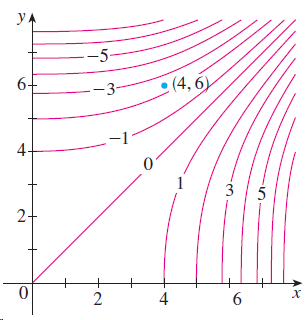
Sketch the gradient vector = f (4, 6) for the function f whose level curves are shown. Explain how you chose the direction and length of this vector. УА --5- (4, 6) --3- 4. 35 х 4 2.
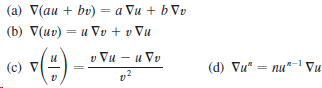
Show that the operation of taking the gradient of a function has the given property. Assume that u and v are differentiable functions of x and y and that a, b are constants. (a) V(au + bv) = a Vu + b Vv (b) V(uv) = u Vv + v Vu v Vu – u Vv %3D (d) Vu" = nu"- Vu (c) V
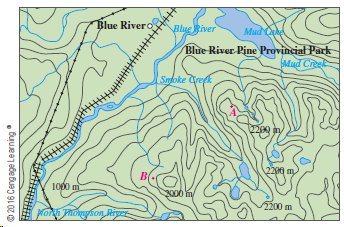
Shown is a topographic map of Blue River Pine Provincial Park in British Columbia. Draw curves of steepest descent from point A (descending to Mud Lake) and from point B. Blue Rivero Blue iver Mud Blue River Pine Provincial Park Mud Creek Safoke Creek 220 m 1000 m 3000 im/ 2200 m Noni Phonykon
Suppose you are climbing a hill whose shape is given by the equation z = 1000 - 0.005x2 - 0.01y2, where x, y, and z are measured in meters, and you are standing at a point with coordinates (60, 40, 966). The positive x-axis points east and the positive y-axis points north.(a) If you walk due south,
The temperature at a point (x, y, z) is given byT(x, y, z) = 200e-x2-3y2-9z2where T is measured in 8C and x, y, z in meters.(a) Find the rate of change of temperature at the point P(2, -1, 2) in the direction toward the point (3, -3, 3).(b) In which direction does the temperature increase fastest
The temperature T in a metal ball is inversely proportional to the distance from the center of the ball, which we take to be the origin. The temperature at the point (1, 2, 2) is 120o.(a) Find the rate of change of T at (1, 2, 2) in the direction toward the point (2, 1, 3).(b) Show that at any
Near a buoy, the depth of a lake at the point with coordinates (x, y) is z = 200 + 0.02x2 - 0.001y3, where x, y, and z are measured in meters. A fisherman in a small boat starts at the point (80, 60) and moves toward the buoy, which is located at (0, 0). Is the water under the boat getting deeper
Find all points at which the direction of fastest change of the function f (x, y) = x2 + y2 - 2x - 4y is i + j.
Find the directions in which the directional derivative of f(x, y) = x2 + xy3 at the point (2, 1) has the value 2.
(a) Show that a differentiable function f decreases most rapidly at x in the direction opposite to the gradient vector, that is, in the direction of 2=f (x).(b) Use the result of part (a) to find the direction in which the function f (x, y) = x4y - x2y3 decreases fastest at the point (2, -3).
Find the maximum rate of change of f at the given point and the direction in which it occurs.f (p, q, r) = arctan(pqr), (1, 2, 1)
Find the maximum rate of change of f at the given point and the direction in which it occurs.f (x, y, z) = x/(y + z), (8, 1, 3)
Find the maximum rate of change of f at the given point and the direction in which it occurs.f (x, y, z) = x ln(yz), (1, 2, 1/2)
Find the maximum rate of change of f at the given point and the direction in which it occurs.f (x, y) = sin(xy), (1, 0)
Find the maximum rate of change of f at the given point and the direction in which it occurs.f (s, t) = test, (0, 2)
Find the maximum rate of change of f at the given point and the direction in which it occurs.f (x, y) = 4y√x , (4, 1)
Find the directional derivative of f(x, y, z) = xy2z3 at P(2, 1, 1) in the direction of Q(0, -3, 5).
Find the directional derivative of f (x, y) = √xy at P(2, 8) in the direction of Q(5, 4).
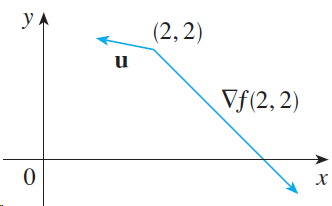
Use the figure to estimate Du f (2, 2). ул (2, 2) Vf(2, 2) х
Find the directional derivative of the function at the given point in the direction of the vector v.h(r, s, t) = ln(3r + 6s + 9t), (1, 1, 1), v = 4i + 12j + 6k
Find the directional derivative of the function at the given point in the direction of the vector v.f(x, y, z) = xy2 tan-1z, (2, 1, 1), v = (1, 1, 1)
Find the directional derivative of the function at the given point in the direction of the vector v.f(x, y, z) = x2y + y2z, (1, 2, 3), v = (2, -1, 2)
Find the directional derivative of the function at the given point in the direction of the vector v.g(u, v) = u2e-v, (3, 0), v = 3i + 4j
Find the directional derivative of the function at the given point in the direction of the vector v.g(s, t) = √(t , s2, 4), v = 2i - j
Find the directional derivative of the function at the given point in the direction of the vector v.f (x, y) = x/x2 + y2 , (1, 2), v = (3, 5)
(a) Find the gradient of f .(b) Evaluate the gradient at the point P.(c) Find the rate of change of f at P in the direction of the vector u. f(x, y, z) = y²eye, P(0, 1, – 1), u= (13 13 13/ xyz
(a) Find the gradient of f .(b) Evaluate the gradient at the point P.(c) Find the rate of change of f at P in the direction of the vector u. (0. §. –}) 3 f(x, y, z) = x²yz – xyz², P(2, – 1, 1), u =
(a) Find the gradient of f .(b) Evaluate the gradient at the point P.(c) Find the rate of change of f at P in the direction of the vector u. f(x, y) = x² In y, P(3, 1), 12 13 13 J u =
(a) Find the gradient of f .(b) Evaluate the gradient at the point P.(c) Find the rate of change of f at P in the direction of the vector u. и 3D+ f (x, у) — х/у, Р(2, 1),
A table of values for the wind-chill index W = f (T, v) is given in Exercise 14.3.3 on page 923. Use the table to estimate the value of Du f (-20, 30), where u = (i + j)/√2.
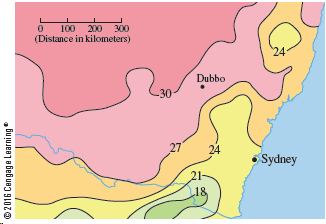
The contour map shows the average maximum temperature for November 2004 (in 8C). Estimate the value of the directional derivative of this temperature function at Dubbo, New South Wales, in the direction of Sydney. What are the units? 100 200 300 (Distance in kilometers) Dubbo -30 27 24 Sydney
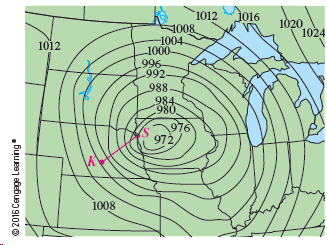
Level curves for barometric pressure (in millibars) are shown for 6:00 am on a day in November. A deep low with pressure 972 mb is moving over northeast Iowa. The distance along the red line from K (Kearney, Nebraska) to S (Sioux City, Iowa) is 300 km. Estimate the value of the directional
Equation 6 is a formula for the derivative dy/dx of a function defined implicitly by an equation F(x, y) = 0, provided that F is differentiable and Fy ≠ 0. Prove that if F has continuous second derivatives, then a formula for the second derivative of y is F„F; – 2F„F,F,+ F„F? d²y F} dx?
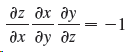
Suppose that the equation F(x, y, z) = 0 implicitly defines each of the three variables x, y, and z as functions of the other two:z = f (x, y), y = g(x, z), x = h( y, z). If F is differentiable and Fx, Fy, and Fz are all nonzero, show that дz дх ду -1 дх ду дг
Showing 18200 - 18300
of 29454
First
176
177
178
179
180
181
182
183
184
185
186
187
188
189
190
Last
Step by Step Answers

 Get 50% OFF
Claim Now
Get 50% OFF
Claim Now