New Semester
Started
Get
50% OFF
Study Help!
--h --m --s
Claim Now
Question Answers
Textbooks
Find textbooks, questions and answers
Oops, something went wrong!
Change your search query and then try again
S
Books
FREE
Study Help
Expert Questions
Accounting
General Management
Mathematics
Finance
Organizational Behaviour
Law
Physics
Operating System
Management Leadership
Sociology
Programming
Marketing
Database
Computer Network
Economics
Textbooks Solutions
Accounting
Managerial Accounting
Management Leadership
Cost Accounting
Statistics
Business Law
Corporate Finance
Finance
Economics
Auditing
Tutors
Online Tutors
Find a Tutor
Hire a Tutor
Become a Tutor
AI Tutor
AI Study Planner
NEW
Sell Books
Search
Search
Sign In
Register
study help
mathematics
precalculus
Precalculus Concepts Through Functions A Unit Circle Approach To Trigonometry 5th Edition Michael Sullivan - Solutions
Problems 66 – 75. The purpose of these problems is to keep the material fresh in your mind so that you are better prepared for later sections, a final exam, or subsequent courses such as calculus.Solve: |(5x − 7) − 5|≤ 0.05
Problems 66 – 75. The purpose of these problems is to keep the material fresh in your mind so that you are better prepared for later sections, a final exam, or subsequent courses such as calculus.Solve: x( x − 7) = 18
Problems 66 – 7. The purpose of these problems is to keep the material fresh in your mind so that you are better prepared for later sections, a final exam, or subsequent courses such as calculus.The slope m of the tangent line to the graph of f (x) = 3x4 − 7x2 + 2 at any number x is given by m
Problems 71–80 are based on previously learned material. The purpose of these problems is to keep the material fresh in your mind so that you are better prepared for later sections, a final exam, or subsequent courses such as calculus.Write the equation 100 = a0.2x in logarithmic form.
Problems 66 – 75. The purpose of these problems is to keep the material fresh in your mind so that you are better prepared for later sections, a final exam, or subsequent courses such as calculus.Solve the inequality: x + 1 x² - 9 -2 ≤0
Problems 70–79. The purpose of these problems is to keep the material fresh in your mind so that you are better prepared for later sections, a final exam, or subsequent courses such as calculus.If F(x) = −x3/3 + 3x + C and [ a, b] = [1, 2], find F (b) − F(a) .
Problems 71–80. The purpose of these problems is to keep the material fresh in your mind so that you are better prepared for later sections, a final exam, or subsequent courses such as calculus.Approximate the average rate of change for g(x) = e2x + 3 ln x on the interval [1, 3]. Round to three
Problems 69–78. The purpose of these problems is to keep the material fresh in your mind so that you are better prepared for later sections, a final exam, or subsequent courses such as calculus.The normal line to a graph at a point is the line perpendicular to the tangent line of the graph at the
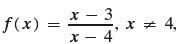
Problems 69–78. The purpose of these problems is to keep the material fresh in your mind so that you are better prepared for later sections, a final exam, or subsequent courses such as calculus.The functionis one-to-one. Find its inverse function. f(x) = x - 3 x 4 , x = 4,
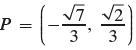
Problems 66 – 75. The purpose of these problems is to keep the material fresh in your mind so that you are better prepared for later sections, a final exam, or subsequent courses such as calculus.is the point on the unit circle that corresponds to a real number t. Find the exact values of the six
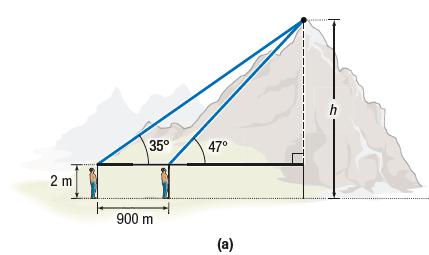
Solve Example 6 using right triangle geometry. Comment on which solution, using the Law of Sines or using right triangles, you prefer. Give reasons.Data from example 6To measure the height of a mountain, a surveyor takes two sightings of the peak at a distance 900 meters apart on a direct line to
When two sinusoidal waves travel through the same medium, a third wave is formed that is the sum of the two original waves. If the two waves have slightly different frequencies, the sum of the waves results in an interference pattern known as a beat. Musicians use this idea when tuning an
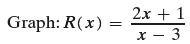
Problems 70–79 are based on previously learned material. The purpose of these problems is to keep the material fresh in your mind so that you are better prepared for later sections, a final exam, or subsequent courses such as calculus. Graph: R(x) 2x + 1 x - 3
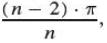
(a) Show that the area of a regular dodecagon (12-sided polygon) is given bywhere a is the length of one of the sides and r is the radius of the inscribed circle.(b) Given that each interior angle of a regular n-sided polygon (n ≥ 3) measuresgeneralize these formulas for any regular polygon. π K
Problems 66 – 75. The purpose of these problems is to keep the material fresh in your mind so that you are better prepared for later sections, a final exam, or subsequent courses such as calculus.Without graphing, determine whether the quadratic function f (x) = −3x2 + 12x + 5 has a maximum
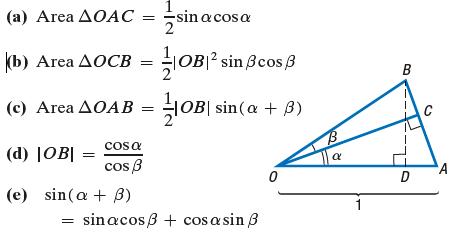
Refer to the figure. If OA = 1, show that: (a) Area AOAC [(b) Area AOCB = = |OB|² sin ßcos ß (c) Area AOAB = |OB| sin(a + 3) (d) |OB| (e) cosa cos ß sin a cosa sin(a + 3) = sinacos/ß + cosa sin 3 0 R 1 B D A
Graph y = x sin x, y = x2 sin x, and y = x3 sin x for x > 0. What patterns do you observe?
In Problems 47–52, the function d models the distance (in meters) of the bob of a pendulum of mass m (in kilograms) from its rest position at time t (in seconds). The bob is released from the left of its rest position and represents a negative direction.(a) Describe the motion of the object. Be
Graph y = 1/sin x, y= 1/x2 sin x, and y = 1/x3 sin x for x > 0. What patterns do you observe?
There is a Heron-type formula that can be used to find the area of a general quadrilateral.where a, b, c, and d are the side lengths,θ is half the sum of two opposite angles, and s is half the perimeter. Show that if a triangle is considered a quadrilateral with one side equal to 0,
Problems 66 – 75. The purpose of these problems is to keep the material fresh in your mind so that you are better prepared for later sections, a final exam, or subsequent courses such as calculus.Establish the identity: cscθ − sinθ= cosθ cotθ
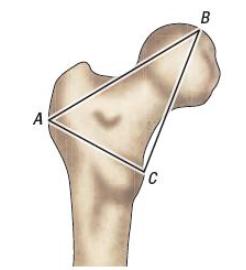
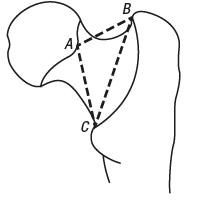
Like the Purkait triangle in Problem 53, the metric triangle is located at the proximal end of the femur and has been used to identify the sex of fragmented skeletal remains. See the figure.(a) If A̅C̅ = 48.8 mm, B̅C̅= 62.2 mm, and C = 89°, find the length of A̅B̅.(b) If A̅B̅ 80 mm
Problems 66 – 75 are based on previously learned material. The purpose of these problems is to keep the material fresh in your mind so that you are better prepared for later sections, a final exam, or subsequent courses such as calculus.Find the domain of f (x) = ln(x2 − 25) + 3.
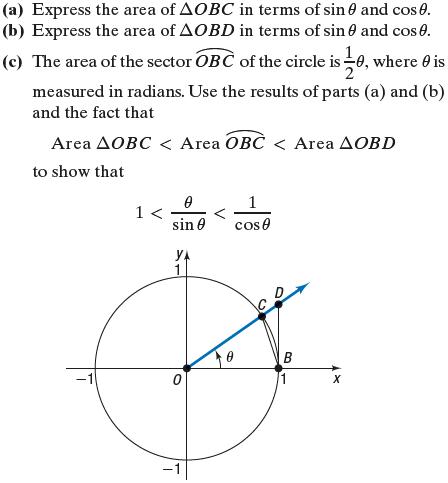
Refer to the figure, in which a unit circle is drawn. The line segment DB is tangent to the circle and θ is acute. (a) Express the area of AOBC in terms of sin (b) Express the area of AOBD in terms of sin (c) The area of the sector OBC of the circle is 10, where is measured in radians. Use the
Problems 69–78 are based on previously learned material. The purpose of these problems is to keep the material fresh in your mind so that you are better prepared for later sections, a final exam, or subsequent courses such as calculus.Write as a single logarithm: log7 x + 3 log7 y − log7(x + y)
Problems 66 – 75 are based on previously learned material. The purpose of these problems is to keep the material fresh in your mind so that you are better prepared for later sections, a final exam, or subsequent courses such as calculus.A rectangle has a diagonal of length 12. Express the
Problems 71–80 are based on previously learned material. The purpose of these problems is to keep the material fresh in your mind so that you are better prepared for later sections, a final exam, or subsequent courses such as calculus.Solve: 3x3 + 4x2 − 27x − 36 = 0
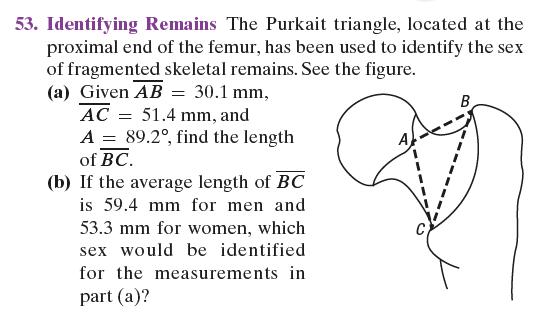
The Purkait triangle, located at the proximal end of the femur, has been used to identify the sex of fragmented skeletal remains. See the figure.(a) Given A̅B̅ = 30.1 mm, A̅C̅ = 51.4 mm, and A = 89.2°, find the length of B̅C̅.(b) If the average length of BC is 59.4 mm for men and 53.3 mm for
Problems 70–79 are based on previously learned material. The purpose of these problems is to keep the material fresh in your mind so that you are better prepared for later sections, a final exam, or subsequent courses such as calculus.Solve 4x = 3x+1. Express the solution in exact form.
Problems 69–78 are based on previously learned material. The purpose of these problems is to keep the material fresh in your mind so that you are better prepared for later sections, a final exam, or subsequent courses such as calculus.Solve: log(x + 1) + log(x − 2) = 1
Problems 66 – 75 are based on previously learned material. The purpose of these problems is to keep the material fresh in your mind so that you are better prepared for later sections, a final exam, or subsequent courses such as calculus.List all potential rational zeros of P( x) = 2x3 − 5x2 +
Problems 71–80 are based on previously learned material. The purpose of these problems is to keep the material fresh in your mind so that you are better prepared for later sections, a final exam, or subsequent courses such as calculus.Find the exact distance between P1 = (−1, −7) and
A clock signal is a non-sinusoidal signal used to coordinate actions of a digital circuit. Such signals oscillate between two levels, high and low, “instantaneously” at regular intervals. The most common clock signal has the form of a square wave and can be approximated by the sum of simple
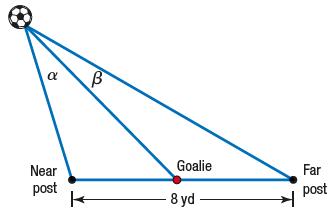
A soccer goal is 8 yards wide. Suppose a goalie is standing on her line in the center of her goal as a striker from the opposing team moves the ball towards her. The near post angle,α, is formed by rays extending from the ball to the near post and the goalie. Similarly, the far post angle, β, is
A triangular plot of land has one side along a straight road measuring 200 feet. A second side makes a 50° angle with the road, and the third side makes a 43° angle with the road. How long are the other two sides?
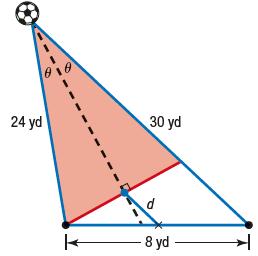
In soccer, a defending goalkeeper wants to take up a position which bisects the angle that needs to be covered. See the figure. The keeper stands square to the ball—that is, perpendicular to the line of bisection—at a point where the area covered (shaded) lies completely outside the goal. How
Graph y = 2 sin x + cos(2x) by adding y coordinates.
Two runners in a marathon determine that the angles of elevation of a news helicopter covering the race are 38° and 45°. If the helicopter is 1700 feet directly above the finish line, how far apart are the runners?
Both the sawtooth and square waves are examples of non-sinusoidal waves. Another type of non-sinusoidal wave is illustrated by the functionGraph the function for −5π ≤ x ≤ 5. 1 + 1/cos(3x) + 1/cos (5x) + 25 49 f(x) = 1.6+ cosx + -cos(7x)
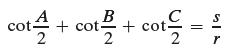
Show that B S cot 4+ cot2 + cot= 2 2 r
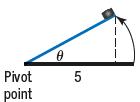
A box sitting on a flat surface has a coefficient of static friction of μs = 0.3. If one end of the surface is raised, static friction prevents the box from sliding until the force of static friction is overcome. The critical angle at which the box begins to slide, θc, can be found from the
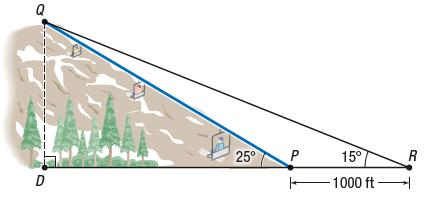
Use the figure in Problem 39 to find the height QD of the mountain. ه اسر D la 25° P |- 15° - - 1000 ft ------ -| R
At 10 am on April 26, 2023, a building 300 feet high cast a shadow 50 feet long. What was the angle of elevation of the Sun?
In Problems 27 – 38, two sides and an angle are given. Determine whether the given information results in one triangle, two triangles, or no triangle at all. Solve any resulting triangle(s). b = 4, c = 5, B = 40°
A triangle has vertices A(0, 0), B(1, 0), and C, where C is the point on the unit circle corresponding to an angle of 105° when it is drawn in standard position. Find the area of the triangle. State the answer in complete simplified form with a rationalized denominator.
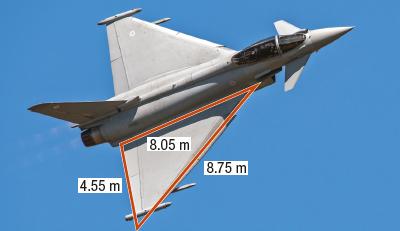
The Eurofighter Typhoon has a canard delta wing design that contains a large triangular main wing. Use the dimensions shown to approximate the area of one of the main wings. 4.55 m 8.05 m 8.75 m
In Problems 33–44, solve each triangle.B = 35°, C = 65°, a = 15
In Problems 27 – 38, two sides and an angle are given. Determine whether the given information results in one triangle, two triangles, or no triangle at all. Solve any resulting triangle(s).a = 7, c = 3, C = 12°
Once the box begins to slide and accelerate, kinetic friction acts to slow the box with a coefficient of kinetic friction μk = 0.1. The raised end of the surface can be lowered to a point where the box continues sliding but does not accelerate. The critical angle at which this happens,θc', can be
In Problems 33–44, solve each triangle.a = 4, c = 5, B = 55°
In Problems 33–44, solve each triangle.c = 8, A = 38°, B = 52°
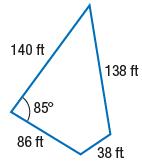
A lot for sale in a subdivision has the shape of the quadrilateral shown in the figure. Find the area of the lot to the nearest square foot. 140 ft 85⁰ 86 ft 138 ft 38 ft
In Problems 40 and 41, the displacement d (in feet) of an object from its rest position at time t (in seconds) is given.(a) Describe the motion of the object.(b) What is the maximum displacement from its rest position?(c) What is the time required for one oscillation?(d) What is the frequency?d(t)
n Problems 33–44, solve each triangle.a = 20, A = 73°, C = 17°
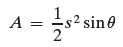
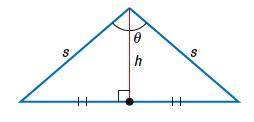
Show that the area A of an isosceles triangle whose equal sides are of length s, and where θ is the angle between them, is A = 2 s² sin 0
A cone-shaped tent is made from a circular piece of canvas 24 feet in diameter by removing a sector with central angle 100° and connecting the ends. What is the surface area of the tent?
In Problems 40 and 41, the displacement d (in feet) of an object from its rest position at time t (in seconds) is given.(a) Describe the motion of the object.(b) What is the maximum displacement from its rest position?(c) What is the time required for one oscillation?(d) What is the frequency?d(t)
In Problems 33–44, solve each triangle.A = 10°, a = 3, b = 10
An object of mass m = 40 grams attached to a coiled spring with damping factor b = 0.75 gram/second is pulled down a distance a = 15 centimeters from its rest position and then released. Assume that the positive direction of the motion is up and the period is T = 5 seconds under simple harmonic
In Problems 33–44, solve each triangle.A = 65°, B = 72°, b = 7
In Problems 33–44, solve each triangle.b = 5, c = 12, A = 60°
(a) Graph f(x) = 3 sin(2x) + 2 and g(x) = 7/2 on the same Cartesian plane for the interval [0, π]. (b) Solve f(x) = g(x) on the interval [0, π], and label the points of intersection on the graph drawn in part (a). (c) Solve f(x) > g(x) on the interval [0, π]. (d) Shade the
(a) Graph f(x) = 2 cos x/2 + 3 and g(x) = 4 on the same Cartesian plane for the interval [0, 4π]. (b) Solve f(x) = g(x) on the interval [0, 4π], and label the points of intersection on the graph drawn in part (a). (c) Solve f(x) < g(x) on the interval [0, 4π]. (d) Shade the
(a) Graph f(x) = -4 cos x and g(x) = 2 cos x + 3 on the same Cartesian plane for the interval [0, 2π]. (b) Solve f(x) = g(x) on the interval [0, 2π], and label the points of intersection on the graph drawn in part (a). (c) Solve f(x) > g(x) on the interval [0, 2π]. (d) Shade
(a) Graph f(x) = 2 sin x and g(x) = -2 sin x + 2 on the same Cartesian plane for the interval [0, 2π]. (b) Solve f(x) = g(x) on the interval [0, 2π], and label the points of intersection on the graph drawn in part (a). (c) Solve f(x) > g(x) on the interval [0, 2π]. (d) Shade
The amplitude A and period T of f (x) = 5 sin(4x) are____ and _____.
Write the formula for the distance d from P1 = (x1, y1) to P2 = (x2 , y2).
The difference formula for the sine function is sin(A − B) = ______.
Approximate the angular speed of the second hand on a clock in rad/sec.?
In Problems 19 – 26, solve each triangle. B = 20º, C = 70°, а = 1 с a
Write an equation for a sine function with period 12 and amplitude 7.
If three sides of a triangle are known, the Law of_____ is used to solve the triangle.
Approximate sin−1 0.76. Express the answer in degrees.
In Problems 19–28, find the exact value of each expression. Do not use a calculator.1 − cos2 20° − cos2 70°
In Problems 19 – 26, solve each triangle.A = 110°, C = 30°, c = 3
In Problems 17 – 28, find the area of each triangle. Round answers to two decimal places.a = 12, b = 35, c = 37
In Problems 21–25, find the area of each triangle.a = 4, b = 2, c = 5
f (x) = 4 tan x(a) Solve f(x) = -4. (b) For what values of x is f(x) 2
In Problems 49–74, establish each identity. cos(π + 0) = -cose
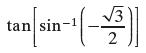
In Problems 15–29, find the exact value, if any, of each composite function. If there is no value, say it is “not defined.” Do not use a calculator. an[sin-¹- √√3 2
Show that sin 40 cos²0 = 1 16 cos (20) cos(40) + 2 cos(60). 32 32 - - 16
In Problems 21–30, use Half-angle Formulas to find the exact value of each expression. sec 15TT 8
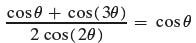
In Problems 25–42, establish each identity. cose + cos (30) 2 cos(20) = cos 0
In Problems 15–20 establish each identity. sin (a + 3) tana + tan 3 cos a cos
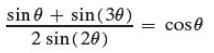
In Problems 25–42, establish each identity. sin + sin (30) 2 sin (20) cose
In Problems 9–20, use the information given about the angle θ, 0 ≤ θ (a) sin(20) (b) cos(20) (c) sin (d) cos 2 (e) tan(20) (f) tan-
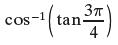
In Problems 15–29, find the exact value, if any, of each composite function. If there is no value, say it is “not defined.” Do not use a calculator. 3π n³7) -1 COS tan-
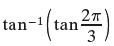
In Problems 15–29, find the exact value, if any, of each composite function. If there is no value, say it is “not defined.” Do not use a calculator. 27 π 3 tan-1tan:
In Problems 17–32, solve each triangle.a = 4, b = 3, c = 6
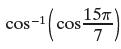
In Problems 15–29, find the exact value, if any, of each composite function. If there is no value, say it is “not defined.” Do not use a calculator. 15T cos-¹ cos- 08-¹1/0 7
In Problems 17–24, express each sum or difference as a product of sines and/or cosines. sin (40) sin(20) -
In Problems 9–20, use the information given about the angle θ, 0 ≤ θ (a) sin(20) (b) cos(20) (c) sin (d) cos 2 (e) tan(20) (f) tan-
In Problems 15–20 establish each identity. tan+cot = 2 csc (20)
In Problems 21–30, use Half-angle Formulas to find the exact value of each expression.sin195°
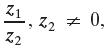
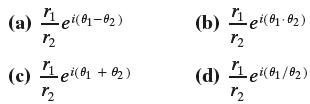
Ifare complex numbers, thenequals: Z1 = ₁e¹1 and Z₂ = reifr
True or False The polar coordinates of a point are unique.
In Problems 10–12, perform the given operation, whereWrite the answer in polar form and in exponential form. = 2(cos. COS 17π 36 z = + i sin 17T 36 and w= = 3( cos 11TT 90 11π + i sin- 90
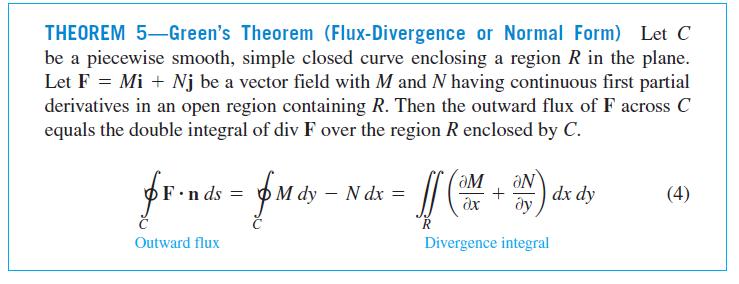
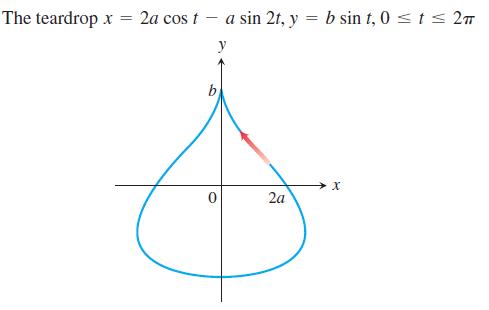
Use the Green’s Theorem area formula in Exercises 16.4 to find the areas of the regions enclosed by the curves THEOREM 5-Green's Theorem (Flux-Divergence or Normal Form) Let C be a piecewise smooth, simple closed curve enclosing a region R in the plane. Let F = Mi + Nj be a vector field with M
State Kepler’s laws.
In Problems 17–24, express each sum or difference as a product of sines and/or cosines. sin (40) + sin(20)
Showing 2400 - 2500
of 29454
First
18
19
20
21
22
23
24
25
26
27
28
29
30
31
32
Last
Step by Step Answers

 Get 50% OFF
Claim Now
Get 50% OFF
Claim Now