New Semester
Started
Get
50% OFF
Study Help!
--h --m --s
Claim Now
Question Answers
Textbooks
Find textbooks, questions and answers
Oops, something went wrong!
Change your search query and then try again
S
Books
FREE
Study Help
Expert Questions
Accounting
General Management
Mathematics
Finance
Organizational Behaviour
Law
Physics
Operating System
Management Leadership
Sociology
Programming
Marketing
Database
Computer Network
Economics
Textbooks Solutions
Accounting
Managerial Accounting
Management Leadership
Cost Accounting
Statistics
Business Law
Corporate Finance
Finance
Economics
Auditing
Tutors
Online Tutors
Find a Tutor
Hire a Tutor
Become a Tutor
AI Tutor
AI Study Planner
NEW
Sell Books
Search
Search
Sign In
Register
study help
mathematics
precalculus
Calculus Early Transcendentals 8th edition James Stewart - Solutions
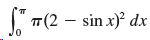
Each integral represents the volume of a solid. Describe the solid. T(2 – sin x) dx
Set up, but do not evaluate, an integral for the volume of the solid obtained by rotating the region bounded by the given curves about the specified axis. y = √x, y = x2; about y = 2
Set up, but do not evaluate, an integral for the volume of the solid obtained by rotating the region bounded by the given curves about the specified axis. y = cos?x, |x| < T/2, y = ; about x = - п/2 T,
Find the area of the region bounded by the given curves. y = √x, y = x2, x = 2
Find the area of the region bounded by the given curves. y = sin (πx/2), y = x2 - 2x
Find the area of the region bounded by the given curves.y = 1 - 2x2, y = |x|
Find the area of the region bounded by the given curves.y = x2, y = 4x - x2
(a) Find the average value of f on the given interval.(b) Find c such that fave − f (c).(c) Sketch the graph of f and a rectangle whose area is the same as the area under the graph of f. f(x) = 2xe*, [0, 2]
(a) Find the average value of f on the given interval.(b) Find c such that fave − f (c).(c) Sketch the graph of f and a rectangle whose area is the same as the area under the graph of f. f(x) = 1/x, [1,3]
Find the average value of the function on the given interval. h(u) = (In u)/u, [1,5]
Find the average value of the function on the given interval. [0, п] h(x) = cos*x sin x,
Find the average value of the function on the given interval. f(x) = x²/(x³ + 3)², [-1, 1]
Find the average value of the function on the given interval. sin t cos t, [0, п/2] f(t) = e
Find the average value of the function on the given interval. [1, 3] g(t): V3 + t?
Find the average value of the function on the given interval. g(x) — 3 сos x, [-т/2, п/2] TT
Find the average value of the function on the given interval. f(x) = Vx, [0, 4]
Find the average value of the function on the given interval. — Зх? + 8х, Г-1, 2] f(x)
The Great Pyramid of King Khufu was built of limestone in Egypt over a 20-year time period from 2580 bc to 2560 bc. Its base is a square with side length 756 ft and its height when built was 481 ft. (It was the tallest man made structure in the world for more than 3800 years.) The density of the
Suppose that when launching an 800-kg roller coaster car an electromagnetic propulsion system exerts a force of 5.7x2 + 1.5x newtons on the car at a distance x meters along the track. Use Exercise 31(a) to find the speed of the car when it has traveled 60 meters.
In a steam engine the pressure P and volume V of steam satisfy the equation PV1.4 − k, where k is a constant. (This is true for adiabatic expansion, that is, expansion in which there is no heat transfer between the cylinder and its surroundings.) Use Exercise 29 to calculate the work done by the
Suppose that for the tank in Exercise 23 the pump breaks down after 4.7 x 10⁵ J of work has been done. What is the depth of the water remaining in the tank?
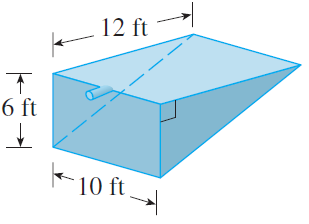
A tank is full of water. Find the work required to pump the water out of the spout. In Exercises 25 and 26 use the fact that water weighs 62.5 lb/ft3. 12 ft 6 ft 10 ft
Show how to approximate the required work by a Riemann sum. Then express the work as an integral and evaluate it.A spherical water tank, 24 ft in diameter, sits atop a 60 ft tower. The tank is filled by a hose attached to the bottom of the sphere. If a 1.5 horsepower pump is used to deliver water
Show how to approximate the required work by a Riemann sum. Then express the work as an integral and evaluate it.A leaky 10-kg bucket is lifted from the ground to a height of 12 m at a constant speed with a rope that weighs 0.8 kg/m.Initially the bucket contains 36 kg of water, but the water leaks
Show how to approximate the required work by a Riemann sum. Then express the work as an integral and evaluate it.A thick cable, 60 ft long and weighing 180 lb, hangs from a winch on a crane. Compute in two different ways the work done if the winch winds up 25 ft of the cable.(a) Follow the method
A spring has a natural length of 40 cm. If a 60-N force is required to keep the spring compressed 10 cm, how much work is done during this compression? How much work is required to compress the spring to a length of 25 cm?
How much work is done when a hoist lifts a 200-kg rock to a height of 3 m?
Let T be the triangular region with vertices (0, 0), (1, 0), and (1, 2), and let V be the volume of the solid generated when T is rotated about the line x = a, where a . 1. Express a in terms of V.
The region bounded by the given curves is rotated about the specified axis. Find the volume of the resulting solid by any method. |х3 (у — 1);, х — у 3D 1; about x 3D —1
The region bounded by the given curves is rotated about the specified axis. Find the volume of the resulting solid by any method. 1 x = (y – 3), x = 4; about y
The region bounded by the given curves is rotated about the specified axis. Find the volume of the resulting solid by any method. y? – x? = 1, y= 2; about the y-axis
The region bounded by the given curves is rotated about the specified axis. Find the volume of the resulting solid by any method. у — х? 3D 1, у- about the x-aхis 2;
The region bounded by the given curves is rotated about the specified axis. Find the volume of the resulting solid by any method. у%3D — х? + бх — 8, у %3D 0; about the x-axis
The region bounded by the given curves is rotated about the specified axis. Find the volume of the resulting solid by any method. y = -x? + 6x – 8, y= 0; about the y-axis
Use a graph to estimate the x-coordinates of the points of intersection of the given curves. Then use this information and your calculator to estimate the volume of the solid obtained by rotating about the y-axis the region enclosed by these curves. y = esinx y = x² – 4x + 5
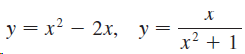
Use a graph to estimate the x-coordinates of the points of intersection of the given curves. Then use this information and your calculator to estimate the volume of the solid obtained by rotating about the y-axis the region enclosed by these curves. у3 х? — 2х, у%3 y = х2 + 1
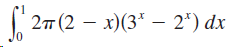
Each integral represents the volume of a solid. Describe the solid. | 27 (2 – x)(3* – 2*) dx
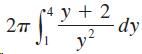
Each integral represents the volume of a solid. Describe the solid. (4 y + 2 2т .2 dy y?
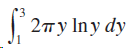
Each integral represents the volume of a solid. Describe the solid. 2ту Inydy л
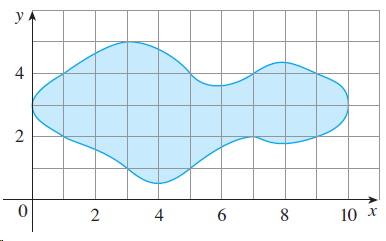
If the region shown in the figure is rotated about the y-axis to form a solid, use the Midpoint Rule with n = 5 to estimate the volume of the solid. 2 10 х 4. 2. 4.
(a) Set up an integral for the volume of the solid obtained by rotating the region bounded by the given curve about the specified axis.(b) Use your calculator to evaluate the integral correct to five decimal places. y = cos*x, y = -cos*x, - T/2 < x < T/2; about x = T
(a) Set up an integral for the volume of the solid obtained by rotating the region bounded by the given curve about the specified axis.(b) Use your calculator to evaluate the integral correct to five decimal places. tan x, y = 0, x = T/4; about x = ™, п/2
(a) Set up an integral for the volume of the solid obtained by rotating the region bounded by the given curve about the specified axis.(b) Use your calculator to evaluate the integral correct to five decimal places.
Use the method of cylindrical shells to find the volume generated by rotating the region bounded by the given curves about the specified axis. x = 2y?, x = y² + 1; about y :-2
Use the method of cylindrical shells to find the volume generated by rotating the region bounded by the given curves about the specified axis. х — 2у*, у > 0, х — 2; about y 3 2
Use the method of cylindrical shells to find the volume generated by rotating the region bounded by the given curves about the specified axis. y = /x, x= 2y; about x = 5
Use the method of cylindrical shells to find the volume generated by rotating the region bounded by the given curves about the specified axis. у %3D 4х — х?, у %3 3; about x
Use the method of cylindrical shells to find the volume generated by rotating the region bounded by the given curves about the specified axis. y = 4 – 2x, y=0, x = 0; about x = –1
Use the method of cylindrical shells to find the volume generated by rotating the region bounded by the given curves about the specified axis. 3 y = x', y = 8, x = 0; about x = 3
Use the method of cylindrical shells to find the volume of the solid obtained by rotating the region bounded by the given curves about the x-axis. x + y = 4, x = y² – 4y + 4
Use the method of cylindrical shells to find the volume of the solid obtained by rotating the region bounded by the given curves about the x-axis. x = 1 + (y – 2)², x = 2
Use the method of cylindrical shells to find the volume of the solid obtained by rotating the region bounded by the given curves about the x-axis. х%3D —Зу? + 12у — 9, х%— 0
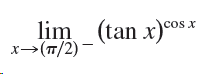
Evaluate the limit. lim (tan x)° x→(T/2)- cos x
Use the method of cylindrical shells to find the volume of the solid obtained by rotating the region bounded by the given curves about the x-axis. x2, y = 8, У — х3/2 у %3D 8, х%3D 0
Use the method of cylindrical shells to find the volume of the solid obtained by rotating the region bounded by the given curves about the x-axis. Jx, x= 0, y = 2
Use the method of cylindrical shells to find the volume of the solid obtained by rotating the region bounded by the given curves about the x-axis. ху — 1, х%3D 0, у%3D 1, у%3 3 y = 1, y= 3 I|
Use the method of cylindrical shells to find the volume generated by rotating the region bounded by the given curves about the y-axis. у 3 х*, у3 бх — 2х? 2 2.x2
Use the method of cylindrical shells to find the volume generated by rotating the region bounded by the given curves about the y-axis. у3 4х — х, у —х .2 У
Use the method of cylindrical shells to find the volume generated by rotating the region bounded by the given curves about the y-axis. у — х, у — 0, х— 1, х— 2 .3
Use the method of cylindrical shells to find the volume generated by rotating the region bounded by the given curves about the y-axis. 3 y = x, y = 0, x= 1
Find the volume of the described solid S.The solid S is bounded by circles that are perpendicular to the x-axis, intersect the x-axis, and have centers on the parabola y = }(1 – x²), –1
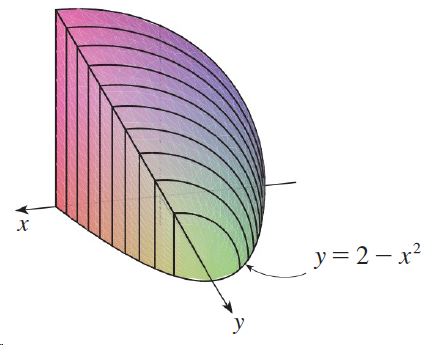
Find the volume of the described solid S.The base of S is the region enclosed by y = 2 - x2 and the x-axis. Cross-sections perpendicular to the y-axis are quarter-circles. х у%3D2— х?
Find the volume of the described solid S.The base of S is the same base as in Exercise 58, but crosssections perpendicular to the x-axis are isosceles triangles with height equal to the base.
Find the volume of the described solid S.The base of S is the region enclosed by the parabola y = 1 - x2 and the x-axis. Cross-sections perpendicular to the y-axis are squares.
Find the volume of the described solid S.The base of S is the same base as in Exercise 56, but cross-sections perpendicular to the x-axis are squares.
Find the volume of the described solid S.The base of S is the triangular region with vertices (0, 0), (1, 0), and (0, 1). Cross-sections perpendicular to the y-axis are equilateral triangles.
Find the volume of the described solid S.The base of S is an elliptical region with boundary curve 9x2 + 4y2 = 36. Cross-sections perpendicular to the x-axis are isosceles right triangles with hypotenuse in the base.
Find the volume of the described solid S.A tetrahedron with three mutually perpendicular faces and three mutually perpendicular edges with lengths 3 cm, 4 cm, and 5 cm
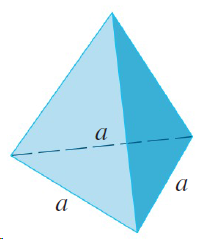
Find the volume of the described solid S.A pyramid with height h and base an equilateral triangle with side a (a tetrahedron) а a a
Find the volume of the described solid S.A pyramid with height h and rectangular base with dimensions b and 2b
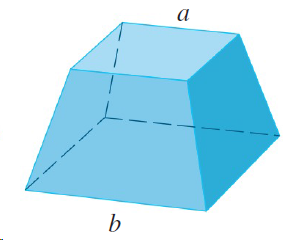
Find the volume of the described solid S.A frustum of a pyramid with square base of side b, square top of side a, and height hWhat happens if a − b? What happens if a − 0? а
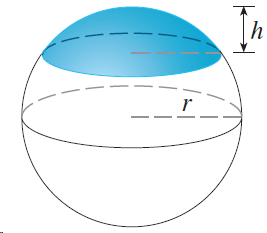
Find the volume of the described solid S.A cap of a sphere with radius r and height h h r
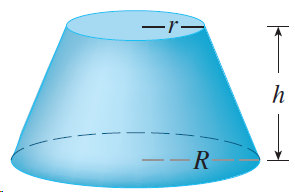
Find the volume of the described solid S.A frustum of a right circular cone with height h, lower base radius R, and top radius r -r- --R
Find the volume of the described solid S.A right circular cone with height h and base radius r
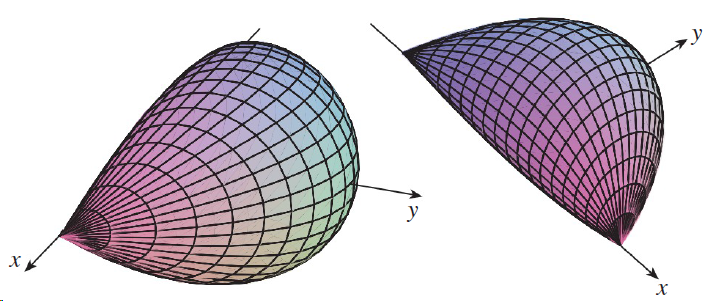
(a) A model for the shape of a bird’s egg is obtained by rotating about the x-axis the region under the graph ofUse a CAS to find the volume of such an egg.(b) For a red-throated loon, a = -0.06, b = 0.04, c = 0.1, and d = 0.54. Graph f and find the volume of an egg of this species. f(x) =
Each integral represents the volume of a solid. Describe the solid. dx -В- ]ак (3 – т
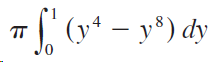
Each integral represents the volume of a solid. Describe the solid. y*) dy TT
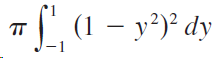
Each integral represents the volume of a solid. Describe the solid. -[а - уз)? y?)² dy *1 т -1
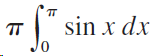
Each integral represents the volume of a solid. Describe the solid. sin x dx т т
Use a computer algebra system to find the exact volume of the solid obtained by rotating the region bounded by the given curves about the specified line. y = x, y = xe'¬/2; about y = 3
Use a computer algebra system to find the exact volume of the solid obtained by rotating the region bounded by the given curves about the specified line. sin?x, y = 0, 0
Use a graph to find approximate x-coordinates of the points of intersection of the given curves. Then use your calculator to find (approximately) the volume of the solid obtained by rotating about the x-axis the region bounded by these curves. .2 y = arctan x² y = 1 + xe¯*',
Use a graph to find approximate x-coordinates of the points of intersection of the given curves. Then use your calculator to find (approximately) the volume of the solid obtained by rotating about the x-axis the region bounded by these curves. In(x6 + 2), у 3D у3 — х3 - х3
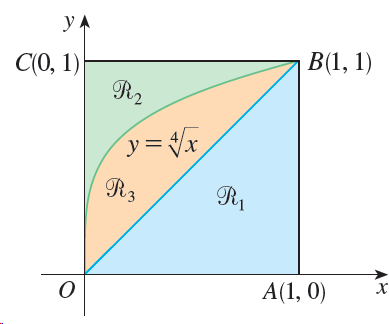
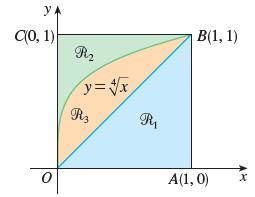
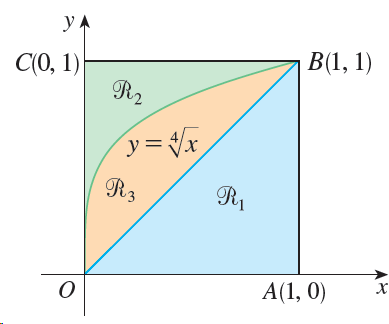
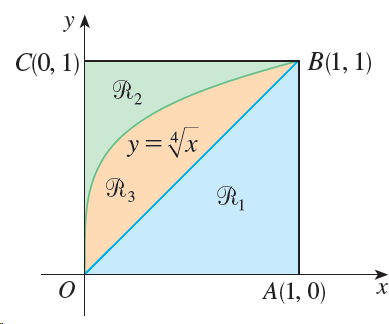
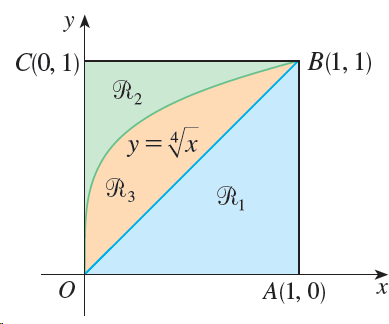
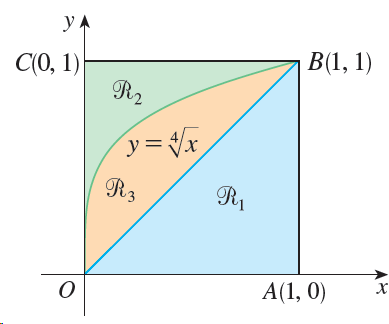
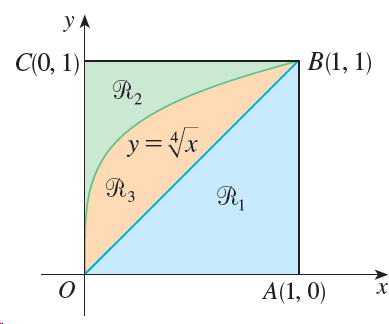
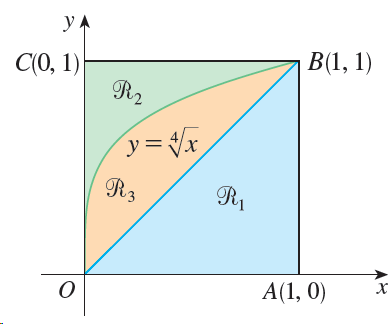
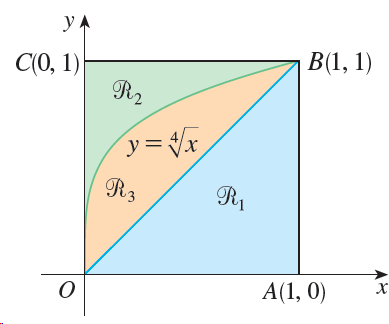
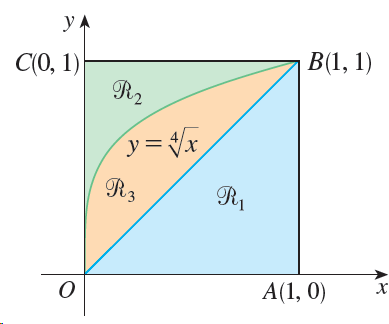
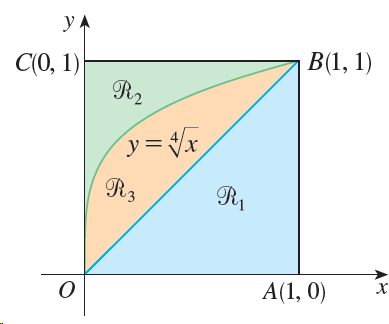
Refer to the figure and find the volume generated by rotating the given region about the specified line.R3 about OA y B(1, 1) C(0, 1) R2 y= Vr R3 Rr х A(1, 0)
Refer to the figure and find the volume generated by rotating the given region about the specified line.R3 about AB B(1, 1) CO, 1) R2 A(1, 0)
Refer to the figure and find the volume generated by rotating the given region about the specified line.R3 about OC y B(1, 1) C(0, 1) R2 y= Vr R3 Rr х A(1, 0)
Refer to the figure and find the volume generated by rotating the given region about the specified line.R3 about OA y B(1, 1) C(0, 1) R2 y= Vr R3 Rr х A(1, 0)
Refer to the figure and find the volume generated by rotating the given region about the specified line.R2 about BC y B(1, 1) C(0, 1) R2 y= Vr R3 Rr х A(1, 0)
Refer to the figure and find the volume generated by rotating the given region about the specified line.R2 about AB y B(1, 1) C(0, 1) R2 y= Vr R3 Rr х A(1, 0)
Refer to the figure and find the volume generated by rotating the given region about the specified line.R2 about OC y B(1, 1) C(0, 1) R2 y= Vr R3 Rr х A(1, 0)
Refer to the figure and find the volume generated by rotating the given region about the specified line.R2 about OA y B(1, 1) C(0, 1) R2 y= Vr R3 Rr х A(1, 0)
Refer to the figure and find the volume generated by rotating the given region about the specified line.R1 about BC y B(1, 1) C(0, 1) R2 y= Vr R3 Rr х A(1, 0)
Refer to the figure and find the volume generated by rotating the given region about the specified line.R1 about AB y B(1, 1) C(0, 1) R2 y= Vr R3 Rr х A(1, 0)
Refer to the figure and find the volume generated by rotating the given region about the specified line.R1 about OC y B(1, 1) C(0, 1) R2 y= Vr R3 Rr х A(1, 0)
Find the volume of the solid obtained by rotating the region bounded by the given curves about the specified line. Sketch the region, the solid, and a typical disk or washer. 1 у %3 х, у 3D 0, х — 2, х %— 4; about x
Find the volume of the solid obtained by rotating the region bounded by the given curves about the specified line. Sketch the region, the solid, and a typical disk or washer. = y°, x = 1 – y²; about x = 3
Find the volume of the solid obtained by rotating the region bounded by the given curves about the specified line. Sketch the region, the solid, and a typical disk or washer. ху — 1, у %3 0, х —D 1, х — 2; about x 1
Find the volume of the solid obtained by rotating the region bounded by the given curves about the specified line. Sketch the region, the solid, and a typical disk or washer. about x — 2 у 3 х*, у — 0, х —D 1;
Find the volume of the solid obtained by rotating the region bounded by the given curves about the specified line. Sketch the region, the solid, and a typical disk or washer. sin x, y = cos x, 0
Find the volume of the solid obtained by rotating the region bounded by the given curves about the specified line. Sketch the region, the solid, and a typical disk or washer. = 1 sec x, y = 3; about y y = 1 +
Showing 23100 - 23200
of 29454
First
225
226
227
228
229
230
231
232
233
234
235
236
237
238
239
Last
Step by Step Answers

 Get 50% OFF
Claim Now
Get 50% OFF
Claim Now



![f(x) = 2xe*, [0, 2]](https://dsd5zvtm8ll6.cloudfront.net/si.question.images/images/question_images/1551/2/0/8/2235c758f1fac76d1551190940764.jpg)
![f(x) = 1/x, [1,3]](https://dsd5zvtm8ll6.cloudfront.net/si.question.images/images/question_images/1551/2/0/8/0915c758e9b9d3f61551190808671.jpg)
![h(u) = (In u)/u, [1,5]](https://dsd5zvtm8ll6.cloudfront.net/si.question.images/images/question_images/1551/2/0/8/0165c758e50b92511551190733844.jpg)
![[0, п] h(x) = cos*x sin x,](https://dsd5zvtm8ll6.cloudfront.net/si.question.images/images/question_images/1551/2/0/8/0065c758e463df7a1551190723307.jpg)
![f(x) = x²/(x³ + 3)², [-1, 1]](https://dsd5zvtm8ll6.cloudfront.net/si.question.images/images/question_images/1551/2/0/7/9935c758e39eefd51551190711066.jpg)
![sin t cos t, [0, п/2] f(t) = e](https://dsd5zvtm8ll6.cloudfront.net/si.question.images/images/question_images/1551/2/0/7/9825c758e2e87bfc1551190699633.jpg)
![[1, 3] g(t): V3 + t?](https://dsd5zvtm8ll6.cloudfront.net/si.question.images/images/question_images/1551/2/0/7/9685c758e2029c371551190685245.jpg)
![g(x) — 3 сos x, [-т/2, п/2] TT](https://dsd5zvtm8ll6.cloudfront.net/si.question.images/images/question_images/1551/2/0/7/8735c758dc1c2d191551190590869.jpg)
![f(x) = Vx, [0, 4]](https://dsd5zvtm8ll6.cloudfront.net/si.question.images/images/question_images/1551/2/0/7/8465c758da696a131551190563679.jpg)
![— Зх? + 8х, Г-1, 2] f(x)](https://dsd5zvtm8ll6.cloudfront.net/si.question.images/images/question_images/1551/2/0/7/8165c758d88c6bdb1551190533852.jpg)




























![dx -В- ]ак (3 – т](https://dsd5zvtm8ll6.cloudfront.net/si.question.images/images/question_images/1550/9/3/2/8455c715b6d2d7691550915561985.jpg)