New Semester
Started
Get
50% OFF
Study Help!
--h --m --s
Claim Now
Question Answers
Textbooks
Find textbooks, questions and answers
Oops, something went wrong!
Change your search query and then try again
S
Books
FREE
Study Help
Expert Questions
Accounting
General Management
Mathematics
Finance
Organizational Behaviour
Law
Physics
Operating System
Management Leadership
Sociology
Programming
Marketing
Database
Computer Network
Economics
Textbooks Solutions
Accounting
Managerial Accounting
Management Leadership
Cost Accounting
Statistics
Business Law
Corporate Finance
Finance
Economics
Auditing
Tutors
Online Tutors
Find a Tutor
Hire a Tutor
Become a Tutor
AI Tutor
AI Study Planner
NEW
Sell Books
Search
Search
Sign In
Register
study help
mathematics
precalculus
Calculus Early Transcendentals 8th edition James Stewart - Solutions
Find the volume of the solid obtained by rotating the region bounded by the given curves about the specified line. Sketch the region, the solid, and a typical disk or washer.about y = -3 y = x', y = 1, x = 2;
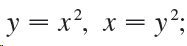
Find the volume of the solid obtained by rotating the region bounded by the given curves about the specified line. Sketch the region, the solid, and a typical disk or washer.about y = 1 у 3D х?, х %3D у?; 2.
Find the volume of the solid obtained by rotating the region bounded by the given curves about the specified line. Sketch the region, the solid, and a typical disk or washer.about the y-axis x = 2 - y, x = y*;
Find the volume of the solid obtained by rotating the region bounded by the given curves about the specified line. Sketch the region, the solid, and a typical disk or washer.about the y-axis y = 6 – x², y = 2; ||
Find the volume of the solid obtained by rotating the region bounded by the given curves about the specified line. Sketch the region, the solid, and a typical disk or washer.about the y-axis — х*, у %3D х, х> 0; уз
Find the volume of the solid obtained by rotating the region bounded by the given curves about the specified line. Sketch the region, the solid, and a typical disk or washer.about the y-axis 2х 3D у?, х — 0, у — 4;
Find the volume of the solid obtained by rotating the region bounded by the given curves about the specified line. Sketch the region, the solid, and a typical disk or washer.about the y-axis х 3 2Vy, х %3D 0, у %3D9;
Find the volume of the solid obtained by rotating the region bounded by the given curves about the specified line. Sketch the region, the solid, and a typical disk or washer.about the y-axis y = e*, y = 0, x = – 1, x = 1;
Find the volume of the solid obtained by rotating the region bounded by the given curves about the specified line. Sketch the region, the solid, and a typical disk or washer.about the y-axis У3 Vx - 1, у%3 0. х%3D5:
Find the volume of the solid obtained by rotating the region bounded by the given curves about the specified line. Sketch the region, the solid, and a typical disk or washer.about the y-axis у%3D 1/х, у — 0, х %3D 1, х %3D4B ||
Find the volume of the solid obtained by rotating the region bounded by the given curves about the specified line. Sketch the region, the solid, and a typical disk or washer.about the y-axis у 3 х + 1, у — 0, х%3D 0, х — 2; 0, х 3D 0, х — 2;B
The rates at which rain fell, in inches per hour, in two different locations t hours after the start of a storm are given by andCompute the area between the graphs for 0 < t < 2 and interpret your result in this context. f(t) = 0.73t³ – 2t2 + t + 0.6 I| g(t) = 0.17t? –- 0.5t
In Example 5, we modeled a measles pathogenesis curve by a function f. A patient infected with the measles virus who has some immunity to the virus has a pathogenesis curve that can be modeled by, for instance,(a) If the same threshold concentration of the virus is required for infectiousness to
If the birth rate of a population is b(t) = 2200e0.024t people per year and the death rate is d(t) = 1460e0.018t people per year, find the area between these curves for 0 < t < 10. What does this area represent?
Graph the region between the curves and use your calculator to compute the area correct to five decimal places. y = cos x, y = x + 2 sin4x
Graph the region between the curves and use your calculator to compute the area correct to five decimal places. y = tan2x, y = √x
Graph the region between the curves and use your calculator to compute the area correct to five decimal places. y = e1-x2, y = x4
Graph the region between the curves and use your calculator to compute the area correct to five decimal places. y = 2/1 + x4, y = x2
Use a graph to find approximate x-coordinates of the points of intersection of the given curves. Then find (approximately) the area of the region bounded by the curves. y = 1.3x, y = 2√x
Use a graph to find approximate x-coordinates of the points of intersection of the given curves. Then find (approximately) the area of the region bounded by the curves. y = 3x2 - 2x, y = x3 - 3x + 4
Use a graph to find approximate x-coordinates of the points of intersection of the given curves. Then find (approximately) the area of the region bounded by the curves.y = x/(x2 + 1)2, y = x5, x > 0
Use a graph to find approximate x-coordinates of the points of intersection of the given curves. Then find (approximately) the area of the region bounded by the curves.y = x sin (x2), y = x4, x > 0
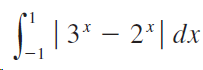
Evaluate the integral and interpret it as the area of a region. Sketch the region. 3* – 2* | dx L 1
Use calculus to find the area of the triangle with the given vertices. (2, 0), (0, 2), (-1, 1)
Sketch the region enclosed by the given curves and find its area.y = ln x/x, y = (ln x)2/x
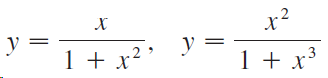
Sketch the region enclosed by the given curves and find its area. х y : 1 + x³
Sketch the region enclosed by the given curves and find its area. х х y = 19 — х2 y = V1 + x? х>0
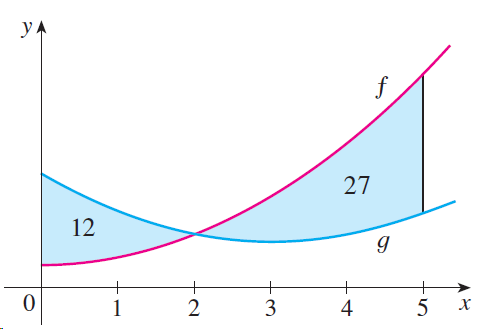
The graphs of two functions are shown with the areas of the regions between the curves indicated.(a) What is the total area between the curves for 0 < x < 5?(b) What is the value of J [S(x) – g(x)] dx? 27 12 + + + 3 4
Sketch the region enclosed by the given curves and find its area. у — x*, у — 2х*, х+ у— 3, х>0
Sketch the region enclosed by the given curves and find its area. х > 0 у — х, у 3 1/х, у—+х,
Sketch the region enclosed by the given curves and find its area.y = sinh x, y = e-x, x = 0, x = 2
Sketch the region enclosed by the given curves and find its area.y = cos x, y = 1 - cos x, 0 < x < π
Sketch the region enclosed by the given curves and find its area. y=x², 0
Sketch the region enclosed by the given curves and find its area. ytan x, y = 2 sin x, /3 x /3
Sketch the region enclosed by the given curves and find its area.x = y4, y = √2 - x, y = 0
Sketch the region enclosed by the given curves and find its area.y = cos πx, y = 4x2 - 1
Sketch the region enclosed by the given curves and find its area. y = √x - 1, x - y = 1
Sketch the region enclosed by the given curves and find its area.x = 2y2, x = 4 + y2
Sketch the region enclosed by the given curves and find its area.y = cos x, y = 2 - cos x, 0 < x < 2π
Sketch the region enclosed by the given curves and find its area. y = sec?x, y= 8 cos x,
Sketch the region enclosed by the given curves and find its area.y = x2, y = 4x - x2
Sketch the region enclosed by the given curves and find its area.y = 12 - x2, y = x2 - 6
Sketch the region enclosed by the given curves. Decide whether to integrate with respect to x or y. Draw a typical approximating rectangle and label its height and width. Then find the area of the region.4x + y2 = 12, x = y
Sketch the region enclosed by the given curves. Decide whether to integrate with respect to x or y. Draw a typical approximating rectangle and label its height and width. Then find the area of the region. х —1- у, х —у? — 1
Sketch the region enclosed by the given curves. Decide whether to integrate with respect to x or y. Draw a typical approximating rectangle and label its height and width. Then find the area of the region. у— 2x/п, х> 0 у 3 sin x,
Sketch the region enclosed by the given curves. Decide whether to integrate with respect to x or y. Draw a typical approximating rectangle and label its height and width. Then find the area of the region. y= 1/x², x= 2 y = 1/x, %3D
Sketch the region enclosed by the given curves. Decide whether to integrate with respect to x or y. Draw a typical approximating rectangle and label its height and width. Then find the area of the region.y = x2 - 4x, y = 2x
Sketch the region enclosed by the given curves. Decide whether to integrate with respect to x or y. Draw a typical approximating rectangle and label its height and width. Then find the area of the region.
Sketch the region enclosed by the given curves. Decide whether to integrate with respect to x or y. Draw a typical approximating rectangle and label its height and width. Then find the area of the region. у — sin x, у —D х, х— п/2, х— т
Sketch the region enclosed by the given curves. Decide whether to integrate with respect to x or y. Draw a typical approximating rectangle and label its height and width. Then find the area of the region.y = ex, y = x2 - 1, x = -1, x = 1
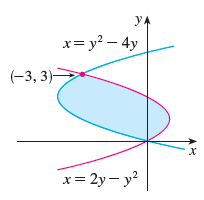
Find the area of the shaded region. УА 4y (-3, 3) х х%3D2у — у?
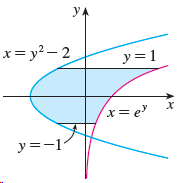
Find the area of the shaded region. Ул x= y? – 2 y=1 (x= e y=-1
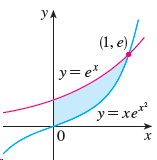
Find the area of the shaded region. ул П.o (1, e) y= e* у-хе У3х х
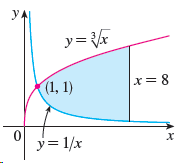
Find the area of the shaded region. yA y= {k (1, 1) х—8 х y= 1/x
Evaluate 1 Vn n + 2 In Vn + n lim Vn + 1
Given the point (a, b) in the first quadrant, find the downward-opening parabola that passes through the point (a, b) and the origin such that the area under the parabola is a minimum.
A circular disk of radius r is used in an evaporator and is rotated in a vertical plane. If it is to be partially submerged in the liquid so as to maximize the exposed wetted area of the disk, show that the center of the disk should be positioned at a height r/√1 + π2 above the surface of the
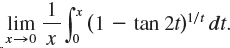
Evaluate | (1 – tan 21)'/' dt. lim х—0 х Jо
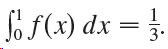
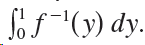
Suppose f is continuous, f (0) = 0, f (1) − 1, f'(x) > 0, andFind the value of the integral
Evaluate :(e)-(4) - (A)- -() 9. 9. 3 п lim
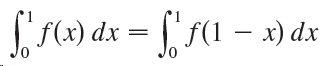
If f is continuous on [0, 1], prove that f(x) dx = f(1 – x) dx
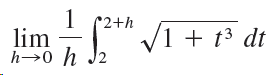
Find *2+h lim h→0 h J2 V1 + t3 dt
If f' is continuous on [a, b], show that f(x)f'(x) dx = [f(b)]² – [f(a)I²
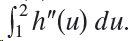
Suppose h is a function such that
If f is a continuous function such thatfor all x, find an explicit formula for f (x). х F() dt = (x – 1)e²* + f(t) dt Se , 2x
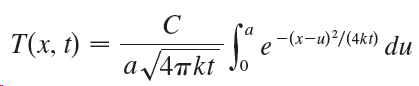
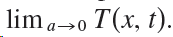
Suppose that the temperature in a long, thin rod placed along the x-axis is initially C/(2a) if |x | < a and 0 if |x | > a. It can be shown that if the heat diffusivity of the rod is k, then the temperature of the rod at the point x at time t isTo find the temperature distribution that
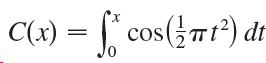
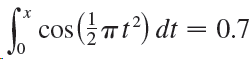
The Fresnel function was introduced in Section 5.3. Fresnel also used the functionin his theory of the diffraction of light waves.(a) On what intervals is C increasing?(b) On what intervals is C concave upward?(c) Use a graph to solve the following equation correct to two decimal
Let r(t) be the rate at which the world's oil is consumed, where t is measured in years starting at t = 0 on January 1, 2000, and r(t) is measured in barrels per year. What does ∫80 r(t) dt represent?
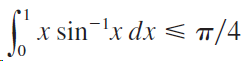
Use the properties of integrals to verify the inequality. x sin 'x dx
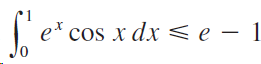
Use the properties of integrals to verify the inequality. e* cos x dx
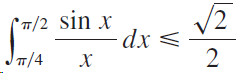
Use the properties of integrals to verify the inequality. /2 dx < *T/2 sin x T/4 х VI
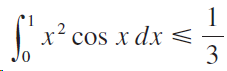
Use the properties of integrals to verify the inequality. x² cos x dx< 3 VI
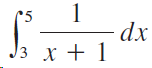
Use Property 8 of integrals to estimate the value of the integral. *5 - dx Јз х+ 1
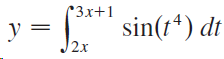
Find the derivative of the function. sin(t*) dt *3x+1 y = 2x
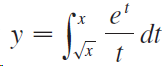
Find the derivative of the function. e' dt х y
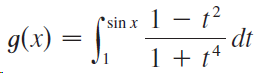
Find the derivative of the function.
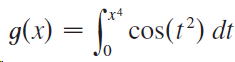
Find the derivative of the function. g(x) | cos(r*) dt ||
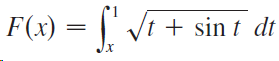
Find the derivative of the function. F(x) = [ -Vt + sin t dt
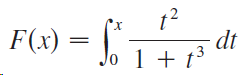
Find the derivative of the function. F(x) = |* dt .3 Jo 1 + t³
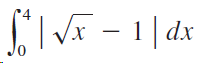
Evaluate the integral, if it exists. Vx – 1| dx
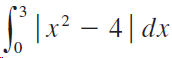
Evaluate the integral, if it exists. x² – 4| dx '3
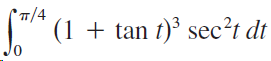
Evaluate the integral, if it exists. *T/4 (1 + tan t)³ sec?t dt
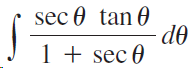
Evaluate the integral, if it exists. sec 0 tan 0 do 1 + sec 0
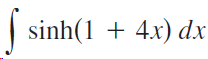
Evaluate the integral, if it exists. sinh(1 + 4x) dx
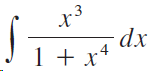
Evaluate the integral, if it exists. x3 -dx- 1 + x4
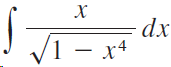
Evaluate the integral, if it exists. х dx 1 — х4
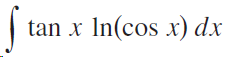
Evaluate the integral, if it exists. tan x In(cos xr) dx
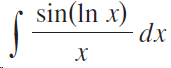
Evaluate the integral, if it exists. sin(ln x) dx
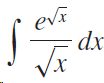
Evaluate the integral, if it exists. evi dx х
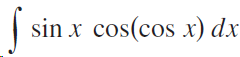
Evaluate the integral, if it exists. sin x cos(cos x) dx
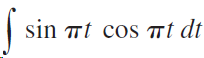
Evaluate the integral, if it exists. sin Tt cos TTt dt
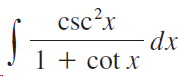
Evaluate the integral, if it exists. csc?x csc-x dx 1 + cot x
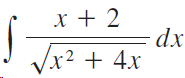
Evaluate the integral, if it exists. х+2 dx 4x х
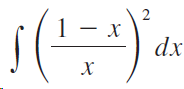
Evaluate the integral, if it exists. 2 - х dx х
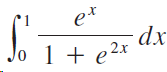
Evaluate the integral, if it exists. e* dx lo 1 + e2x
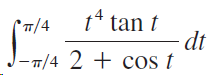
Evaluate the integral, if it exists. t* tan t °T/4 dt J-7/4 2 + cos t t
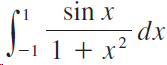
Evaluate the integral, if it exists. sin x dx 2 -1 1 + x²
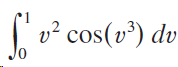
Evaluate the integral, if it exists. v? cos(v³) dv
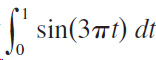
Evaluate the integral, if it exists. | sin(37t) di Jo
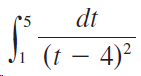
Evaluate the integral, if it exists. dt (5 (t – 4)?
Showing 23200 - 23300
of 29454
First
226
227
228
229
230
231
232
233
234
235
236
237
238
239
240
Last
Step by Step Answers

 Get 50% OFF
Claim Now
Get 50% OFF
Claim Now
















![J [S(x) – g(x)] dx?](https://dsd5zvtm8ll6.cloudfront.net/si.question.images/images/question_images/1550/8/5/9/6295c703d6ddd01b1550842344554.jpg)












![f(x)f'(x) dx = [f(b)]² – [f(a)I²](https://dsd5zvtm8ll6.cloudfront.net/si.question.images/images/question_images/1550/8/4/4/8535c7003b5814ba1550827568095.jpg)