New Semester
Started
Get
50% OFF
Study Help!
--h --m --s
Claim Now
Question Answers
Textbooks
Find textbooks, questions and answers
Oops, something went wrong!
Change your search query and then try again
S
Books
FREE
Study Help
Expert Questions
Accounting
General Management
Mathematics
Finance
Organizational Behaviour
Law
Physics
Operating System
Management Leadership
Sociology
Programming
Marketing
Database
Computer Network
Economics
Textbooks Solutions
Accounting
Managerial Accounting
Management Leadership
Cost Accounting
Statistics
Business Law
Corporate Finance
Finance
Economics
Auditing
Tutors
Online Tutors
Find a Tutor
Hire a Tutor
Become a Tutor
AI Tutor
AI Study Planner
NEW
Sell Books
Search
Search
Sign In
Register
study help
mathematics
precalculus
Calculus Early Transcendentals 8th edition James Stewart - Solutions
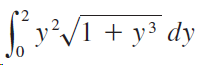
Evaluate the integral, if it exists. y²/1 + y³ dy
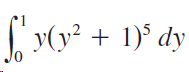
Evaluate the integral, if it exists. y(y² + 1)* dy
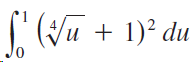
Evaluate the integral, if it exists. [ (и + 1)? du
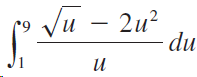
Evaluate the integral, if it exists. - 2u? du Vu 1
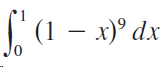
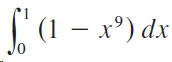
Evaluate the integral, if it exists. |(1 - x)° dx
Evaluate the integral, if it exists. - x°) dx
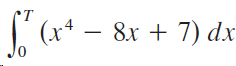
Evaluate the integral, if it exists. *т [ («* — 8х + 7) ах
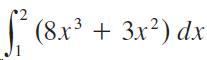
Evaluate the integral, if it exists. | (8х3 + 3х?) dx
If f is the function in Exercise 9, find g''(4).
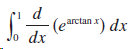
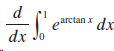
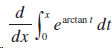
Evaluate:(a)(b)(c) (earctan x) dx Jo dx arctan x dx dx Jo
If ∫60 f(x) dx = 10 and ∫40 f(x) dx = 7, find ∫64 f (x) dx.
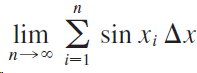
Express as a definite integral on the interval [0, π] and then evaluate the integral. lim 2 sin x; Ax i=1
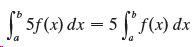
If f is continuous on [a, b], then (" f(x |" 5f(x) dx = 5
If f and g are continuous on [a, b], then 9, SLS)g(x)] dx• g(x) dx %3| f(x) dx
A particle is moving with the given data. Find the position of the particle.a(t) = t2 - 4t + 6, s(0) = 0, s(1) = 20
A particle is moving with the given data. Find the position of the particle.a(t) = 3 cos t - 2 sin t, s(0) = 0, v(0) = 4
A particle is moving with the given data. Find the position of the particle.a (t) = 2t + 1, s(0) = 3, v(0) = - 2
A particle is moving with the given data. Find the position of the particle.v(t) t2 - 3 √t, s(4) = 8
Draw a graph of f and use it to make a rough sketch of the antiderivative that passes through the origin. f(x) = /x+ – 2x² + 2 – 2, -3
Draw a graph of f and use it to make a rough sketch of the antiderivative that passes through the origin. sin x -2n
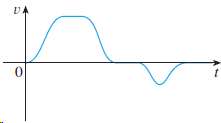
The graph of the velocity function of a particle is shown in the figure. Sketch the graph of a position function.
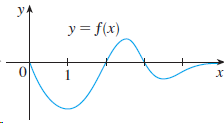
The graph of a function is shown in the figure. Make a rough sketch of an antiderivative F, given that F(0) = 1. y y = f(x)
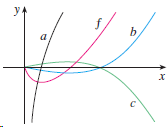
The graph of a function f is shown. Which graph is an antiderivative of f and why? y.
Given that the graph of f passes through the point (2, 5) and that the slope of its tangent line at (x, f(x)) is 3 - 4x, find f (1).
Find f. f'''(x) = cos x, f(0) = 1, f' (0) = 2, f''(0) = 3
Find f. f''(x) x-2, x > 0, f(1) = 0, f(2) = 2
Find f. f'' (t) = 3√t - cos t, f(0) = 2, f(1) = 2
Find f. f'' (x) = ex - 2 sin x, f(0) = 3, f (π/2) = 0
Find f. f'' (x) = x3 + sinh x, f(0) = 1, f(2) = 2.6
Find f. f'' (x) = 4 + 6x + 24x2, f(0) = 3, f(1) = 10
Find f. f''(t) = t2 + 1/t2, t > 0, f(2) = 3, f'(1) = 2
Find f. f'' (θ) = sin θ + cosθ, f(0) = 3, f' (0) = 4
Find f. f'' (x) = 8x3 + 5, f(1) = 0, f'(1) = 8
Find f. f''(x) = - 2 + 12x - 12x2, f(0) = 4, f' (0) = 12
Find f. f' (t) 3t - 3/t, f(1) = 2, f(-1) = 1
Find f. f' (x) 5x2/3, f(8) = 21
Find f. f''' (t) = √t - 2 cos t
Find f. f''' (t) = 12 + sin t
Find f. f'' (x) = 1/x2
Find the most general antiderivative of the function. f(x) = 2x + 4sinh x
A car dealer sells a new car for $18,000. He also offers to sell the same car for payments of $375 per month for five years. What monthly interest rate is this dealer charging?To solve this problem you will need to use the formula for the present value A of an annuity consisting of n equal payments
Of the infinitely many lines that are tangent to the curve y = 2sin x and pass through the origin, there is one that has the largest slope. Use Newton’s method to find the slope of that line correct to six decimal places.
Use Newton’s method to find the coordinates of the inflection point of the curve y = x2 sin x, 0 < x < π , correct to six decimal places.
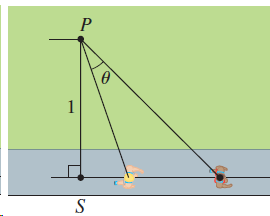
An observer stands at a point P, one unit away from a track. Two runners start at the point S in the figure and run along the track. One runner runs three times as fast as the other. Find the maximum value of the observer’s angle of sight θ between the runners. P
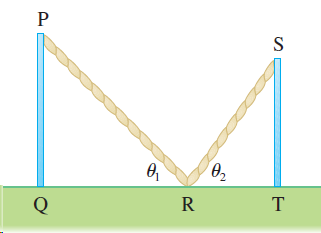
Two vertical poles PQ and ST are secured by a rope PRS going from the top of the first pole to a point R on the ground between the poles and then to the top of the second pole as in the figure. Show that the shortest length of such a rope occurs when θ1 = θ2. в. R
A company operates 16 oil wells in a designated area. Each pump, on average, extracts 240 barrels of oil daily. The company can add more wells but every added well reduces the average daily ouput of each of the wells by 8 barrels. How many wells should the company add in order to maximize daily
Suppose the refinery in Exercise 51 is located 1 km north of the river. Where should P be located?
Use the asymptotic behavior of f (x) = sin x + e-x to sketch its graph without going through the curvesketching procedure of this section.
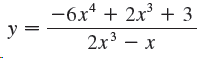
Find an equation of the slant asymptote. Do not sketch the curve. -6x* + 2x' + 3 2x3 — х y = 2x3 -X-
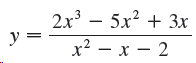
Find an equation of the slant asymptote. Do not sketch the curve. 2х3 2x3 — 5х? + 3x y = x — х — 2
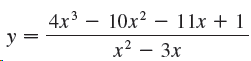
Find an equation of the slant asymptote. Do not sketch the curve. 4x3 — 10х2 — 11х + 1 - 10x? y = x² – 3x
A model for the concentration at time t of a drug injected into the bloodstream iswhere a, b, and K are positive constants and b > a. Sketch the graph of the concentration function. What does the graph tell us about how the concentration varies as time passes? C(t) = K(e¯at – e-b)
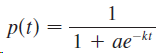
A model for the spread of a rumor is given by the equationwhere p(t) is the proportion of the population that knows the rumor at time t and a and k are positive constants.(a) When will half the population have heard the rumor?(b) When is the rate of spread of the rumor greatest?(c) Sketch the graph
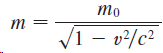
In the theory of relativity, the mass of a particle iswhere m0 is the rest mass of the particle, m is the mass when the particle moves with speed v relative to the observer, and c is the speed of light. Sketch the graph of m as a function of v. то V1 - в°/с? т
Use the guidelines of this section to sketch the curve. y = ln x/x2
Use the guidelines of this section to sketch the curve.y = ln(1 + x3)
Use the guidelines of this section to sketch the curve. y = ln (sin x)
Use the guidelines of this section to sketch the curve. y = ex/x2
Use the guidelines of this section to sketch the curve. y = (1 + ex )-2
Use the guidelines of this section to sketch the curve. y = e2x - ex
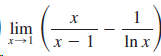
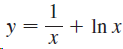
Use the guidelines of this section to sketch the curve. + In x х
Use the guidelines of this section to sketch the curve. y = arctan (ex)
Use the guidelines of this section to sketch the curve. y = sin x/2 + cos x
Use the guidelines of this section to sketch the curve. 2sinx, 0
Use the guidelines of this section to sketch the curve. y = x tan x, -7/2
Use the guidelines of this section to sketch the curve. y = x + cos x
Use the guidelines of this section to sketch the curve. y = x - 3x1/3
If f'' is continuous, show that
Suppose f is a positive function. If lim x→a f(x) = 0 and lim x →∞ g(x) = ∞ show thatThis shows that 0∞ is not an indeterminate form. lim [f(x)]o = 0
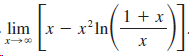
Evaluate lim x - x²In
A metal cable has radius r and is covered by insulation so that the distance from the center of the cable to the exterior of the insulation is R. The velocity v of an electrical impulse in the cable is where c is a positive constant. Find the following limits and interpret your answers.(a)(b) lim v
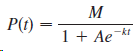
Some populations initally grow exponentially but eventually level off. Equations of the formwhere M, A, and k are positive constants, are called logistic equations and are often used to model such populations. (We will investigate these in detail in Chapter 9.) Here M is called the carrying
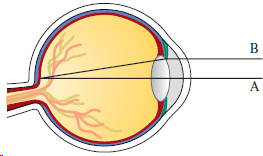
Light enters the eye through the pupil and strikes the retina, where photo receptor cells sense light and color. W. Stanley Stiles and B. H. Crawford studied the phenomenon in which measured brightness decreases as light enters farther from the center of the pupil. (See the figure.)A light beam A
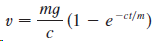
If an object with mass m is dropped from rest, one model for its speed v after t seconds, taking air resistance into account, iswhere t is the acceleration due to gravity and c is a positive constant. (In Chapter 9 we will be able to deduce this equation from the assumption that the air resistance
Investigate the family of curves f (x) = ex - cx. In particular, find the limits as x → ± ∞ and determine the values of c for which f has an absolute minimum. What happens to the minimum points as c increases?
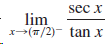
What happens if you try to use 1’Hospital’s Rule to find the limit? Evaluate the limit using another method. sec x lim /2) х— (п- tan x
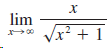
What happens if you try to use 1’Hospital’s Rule to find the limit? Evaluate the limit using another method. х lim x² + 1
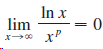
Prove that for any number p > 0. This shows that the logarithmic function approaches infinity more slowly than any power of x. In x lim %3D х— 00
Prove that for any positive integer n. This shows that the exponential function approaches infinity faster than any power of x.
Use a graph to estimate the value of the limit. Then use 1’Hospital’s Rule to find the exact value. 5* – 4* lim x0 3* - 2*
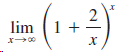
Use a graph to estimate the value of the limit. Then use 1’Hospital’s Rule to find the exact value. 2 lim (1 + X-
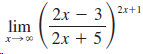
Find the limit. Use 1’Hospital’s Rule where appropriate. If there is a more elementary method, consider using it. If 1’Hospital’s Rule doesn’t apply, explain why. 2х — 3 2x+1 2x – 3 lim 2x + 5
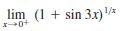
Find the limit. Use 1’Hospital’s Rule where appropriate. If there is a more elementary method, consider using it. If 1’Hospital’s Rule doesn’t apply, explain why. 1/x lim (1 + sin 3x)/* x0+
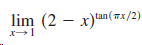
Find the limit. Use 1’Hospital’s Rule where appropriate. If there is a more elementary method, consider using it. If 1’Hospital’s Rule doesn’t apply, explain why. lim (2 – x)tan( #x/2)
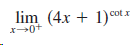
Find the limit. Use 1’Hospital’s Rule where appropriate. If there is a more elementary method, consider using it. If 1’Hospital’s Rule doesn’t apply, explain why. lim (4x + 1)ot x cot x
Find the limit. Use 1’Hospital’s Rule where appropriate. If there is a more elementary method, consider using it. If 1’Hospital’s Rule doesn’t apply, explain why. lim x'
Find the limit. Use 1’Hospital’s Rule where appropriate. If there is a more elementary method, consider using it. If 1’Hospital’s Rule doesn’t apply, explain why. lim x /x
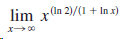
Find the limit. Use 1’Hospital’s Rule where appropriate. If there is a more elementary method, consider using it. If 1’Hospital’s Rule doesn’t apply, explain why. - (In´ lim rin 2)/(1 + In x)
Find the limit. Use 1’Hospital’s Rule where appropriate. If there is a more elementary method, consider using it. If 1’Hospital’s Rule doesn’t apply, explain why. lim x(1-x) х х
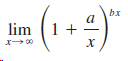
Find the limit. Use 1’Hospital’s Rule where appropriate. If there is a more elementary method, consider using it. If 1’Hospital’s Rule doesn’t apply, explain why. bx lim (1+ х— о
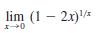
Find the limit. Use 1’Hospital’s Rule where appropriate. If there is a more elementary method, consider using it. If 1’Hospital’s Rule doesn’t apply, explain why. lim (1 – 2x)/* 1/x
Find the limit. Use 1’Hospital’s Rule where appropriate. If there is a more elementary method, consider using it. If 1’Hospital’s Rule doesn’t apply, explain why. lim xv
Find the limit. Use 1’Hospital’s Rule where appropriate. If there is a more elementary method, consider using it. If 1’Hospital’s Rule doesn’t apply, explain why. lim [In(x' – 1) - In(x³ – 1)]
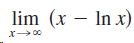
Find the limit. Use 1’Hospital’s Rule where appropriate. If there is a more elementary method, consider using it. If 1’Hospital’s Rule doesn’t apply, explain why. lim lim (x – In x)
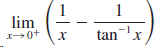
Find the limit. Use 1’Hospital’s Rule where appropriate. If there is a more elementary method, consider using it. If 1’Hospital’s Rule doesn’t apply, explain why. lim tan tan х х
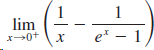
Find the limit. Use 1’Hospital’s Rule where appropriate. If there is a more elementary method, consider using it. If 1’Hospital’s Rule doesn’t apply, explain why. lim e* - 1
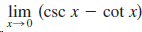
Find the limit. Use 1’Hospital’s Rule where appropriate. If there is a more elementary method, consider using it. If 1’Hospital’s Rule doesn’t apply, explain why. – cot x) lim (csc x l
Find the limit. Use l’Hospital’s Rule where appropriate. If there is a more elementary method, consider using it. If 1’Hospital’s Rule doesn’t apply, explain why. х lim In x
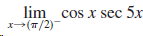
Find the limit. Use 1’Hospital’s Rule where appropriate. If there is a more elementary method, consider using it. If 1’Hospital’s Rule doesn’t apply, explain why. lim cos x sec 5x x>(T/2)
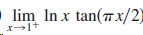
Find the limit. Use 1’Hospital’s Rule where appropriate. If there is a more elementary method, consider using it. If 1’Hospital’s Rule doesn’t apply, explain why. lim In x tan(7x/2)
Showing 23300 - 23400
of 29454
First
227
228
229
230
231
232
233
234
235
236
237
238
239
240
241
Last
Step by Step Answers

 Get 50% OFF
Claim Now
Get 50% OFF
Claim Now


![9, SLS)g(x)] dx• g(x) dx %3| f(x) dx](https://dsd5zvtm8ll6.cloudfront.net/si.question.images/images/question_images/1550/7/4/5/1205c6e7e2030c971550727832204.jpg)







![lim [f(x)]o = 0](https://dsd5zvtm8ll6.cloudfront.net/si.question.images/images/question_images/1549/6/6/5/3085c5e041c403ef1549647996635.jpg)









![lim [In(x' – 1) - In(x³ – 1)]](https://dsd5zvtm8ll6.cloudfront.net/si.question.images/images/question_images/1552/5/9/0/5755c8aa6efa37171552616523628.jpg)