New Semester
Started
Get
50% OFF
Study Help!
--h --m --s
Claim Now
Question Answers
Textbooks
Find textbooks, questions and answers
Oops, something went wrong!
Change your search query and then try again
S
Books
FREE
Study Help
Expert Questions
Accounting
General Management
Mathematics
Finance
Organizational Behaviour
Law
Physics
Operating System
Management Leadership
Sociology
Programming
Marketing
Database
Computer Network
Economics
Textbooks Solutions
Accounting
Managerial Accounting
Management Leadership
Cost Accounting
Statistics
Business Law
Corporate Finance
Finance
Economics
Auditing
Tutors
Online Tutors
Find a Tutor
Hire a Tutor
Become a Tutor
AI Tutor
AI Study Planner
NEW
Sell Books
Search
Search
Sign In
Register
study help
physics
fundamentals momentum heat
Fundamentals Of Momentum Heat And Mass Transfer 6th Edition James Welty, Gregory L. Rorrer, David G. Foster - Solutions
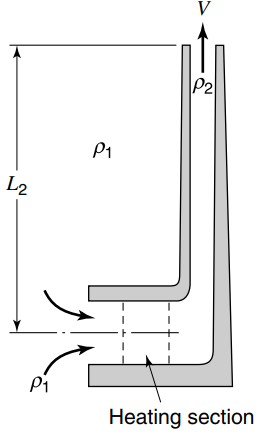
A fluid of density Ï1enters a chamber where the fluid is heated so that the density decreases to Ï2The fluid then escapes through a vertical chimney that has a height L. Neglecting friction and treating the flow processes as in-compressible except for the heating, determine
Water in an open cylindrical tank 15 ft in diameter discharges into the atmosphere through a nozzle 2 in. in diameter. Neglecting friction and the unsteadiness of the flow, find the time required for the water in the tank to drop from a level of 28 ft above the nozzle to the 4-ft level.
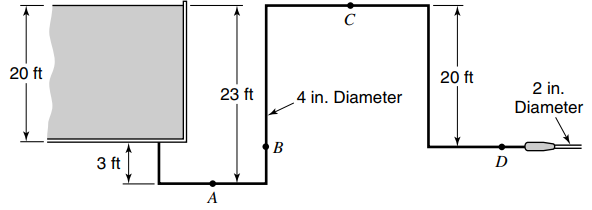
Assume that the level of water in the tank remains the same and that there is no friction loss in the pipe, entrance, or nozzle. Determinea. The volumetric discharge rate from the nozzleb. The pressure and velocity at points A, B, C, and D 20 ft 20 ft 2 in. Diameter 23 ft 4 in. Diameter B 3 ft
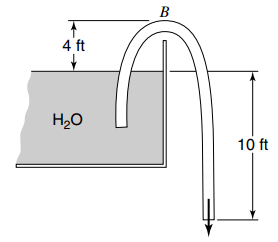
In Problem 6.31, find the rate of discharge if the frictional head loss in the pipe is 3.2 v2/g where v is the flow velocity in the pipe.Data From Problem 6.31Referring to the figure, assume the flow to be friction less in the siphon. Find the rate of discharge in cubic feet per second, and the
Referring to the figure, assume the flow to be friction less in the siphon. Find the rate of discharge in cubic feet per second, and the pressure head at B if the pipe has a uniform diameter of 1 in. How long will it take for the water level to decrease by 3 ft? The tank diameter is 10 ft. B 4 ft
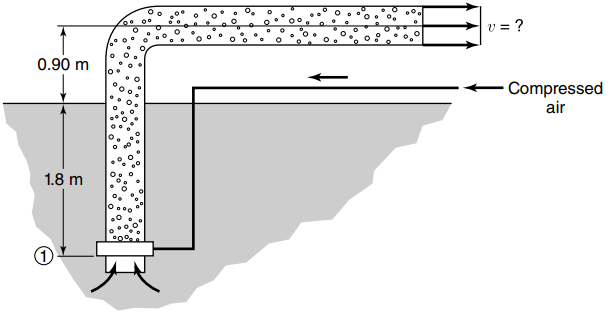
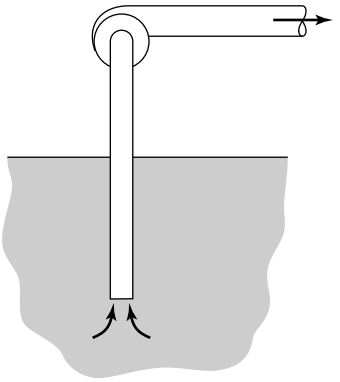
Rework Problem 6.28 with the assumption that the momentum of the incoming air at section (1) is zero. Determine the exit velocity, v, and the magnitude of the pressure drop at section (1). Data From Problem 6.28The figure illustrates the operation of an air lift pump. Compressed air is forced
The figure illustrates the operation of an air lift pump. Compressed air is forced into a perforated chamber to mix with the water so that the specific gravity of the air€“water mixture above the air inlet is 0.5. Neglecting any pressure drop across section (1), compute the discharge
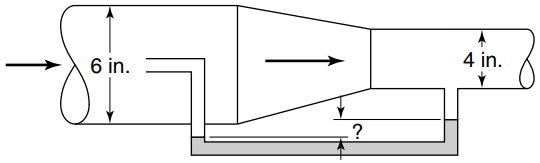
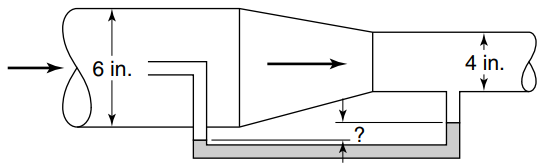
Water flows through the pipe contraction shown at a rate of 1 ft3/s. Calculate the differential manometer reading in inches of mercury, assuming no energy loss in the flow. Be sure to give the correct direction of the manometer reading. 4 in. 6 in. .?
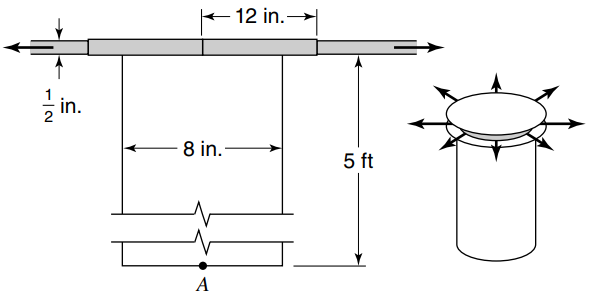
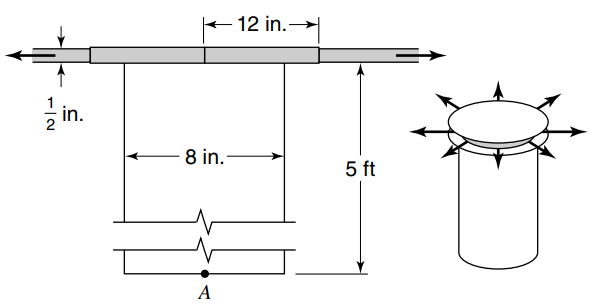
Water flows steadily up the vertical pipe and is then deflected to flow outward with a uniform radial velocity. If friction is neglected, what is the flow rate of water through the pipe if the pressure at A is 10 psig? - 12 in.→ z in. 8 in. 5 ft
A liquid is heated in a vertical tube of constant diameter, 15 m long. The flow is upward. At the entrance the average velocity is 1 m/s, the pressure 340,000 Pa, and the density is 1001 kg/m3. If the increase in internal energy is 200,000 J/kg, find the heat added to the fluid.
A 1968 Volkswagen sedan is driving over a 7300-ft-high mountain pass at a speed of v m/s into a headwind of W m/s. Compute the gage pressure in mPa at a point on the auto where the velocity relative to the auto is v - W m/s. The local air density is 0.984 kg/m3.
Residential water use, exclusive of fire protection, runs about 80 gallons per person per day. If the water is delivered to a residence at 60 psig, estimate the monthly energy required to pump the water from atmospheric pressure to the delivery pressure. Neglect line losses and elevation changes.
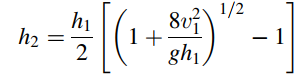
The solution to 5.22 isShow that Bernoulli's equation applied between sections 1 and 2 does not give this result. Derive all expressions for the change in total head across a hydraulic jump. 1/2 hị h2 2 ghi,
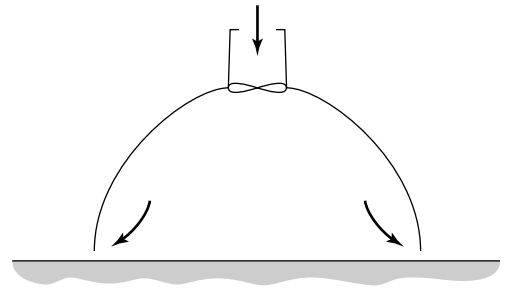
An €œair cushion€ vehicle is designed to traverse terrain while floating on a cushion of air. Air, supplied by a compressor, escapes through the clearing between the ground and the skirt of the vehicle. If the skirt has a rectangular shape 39 m, the vehicle mass is 8100 kg and
Multnomah Falls in Oregon has a sheer drop of 165 m. Estimate the change in water temperature caused by this drop.
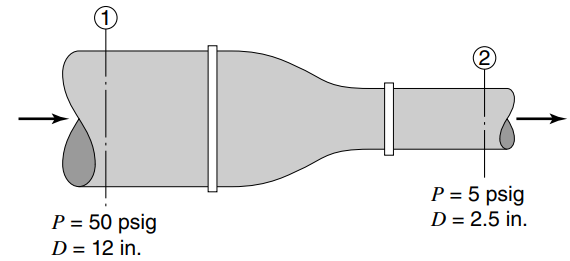
Determine the head loss between stations (1) and (2) in Problem 5.7.Data From Problem 5.7Oil (sp. gr. = 0.8) flows smoothly through the circular reducing section shown at 3 ft3/s. If the entering and leaving velocity profiles are uniform, estimate the force that must be applied to the reducer to
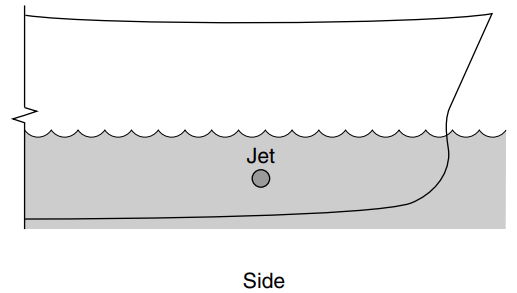
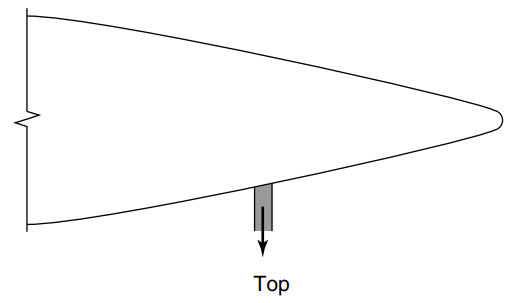
In order to maneuver a large ship while docking, pumps are used to issue a jet of water perpendicular to the bow of the ship as shown in the figure. The pump inlet is located far enough away from the outlet that the inlet and outlet do not interact. The inlet is also vertical so that the net thrust
Using the data of Problem 6.27, determine the velocity head of the fluid leaving the impeller. What pressure rise would result from such a velocity head?Data From Problem 6.27Water flows through the pipe contraction shown at a rate of 1 ft3/s. Calculate the differential manometer reading in inches
In the previous problem, determine the flow rate at which the pump inlet pressure is equal to the vapor pressure of the water. Assume that friction causes a head loss of 4 ft. The vapor pressure of water at 59°F is 0.247 psi.Data From Problem 6.15The pump shown in the figure delivers water at
The pump shown in the figure delivers water at 59°F at a rate of 550 gal/min. The inlet pipe has an inside diameter of 5.95 in. and it is 10 ft long. The inlet pipe is submerged 6 ft into the water and is vertical. Estimate the pressure inside the pipe at the pump inlet.
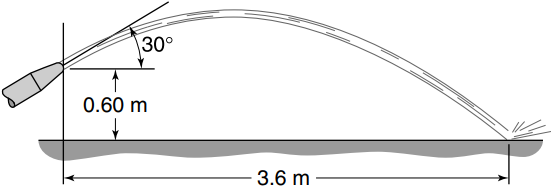
Water is discharged from a 1.0-cm-diameter nozzle that is inclined at a 30° angle above the horizontal. If the jet strikes the ground at a horizontal distance of 3.6 m and a vertical distance of 0.6 m from the nozzle as shown, what is the rate of flow in cubic meters per second? What is the
An automobile is driving into a 45-mph headwind at 40 mph. If the barometer reads 29 in. Hg and the temperature is 40°F, what is the pressure at a point on the auto where the wind velocity is 120 fps with respect to the auto?
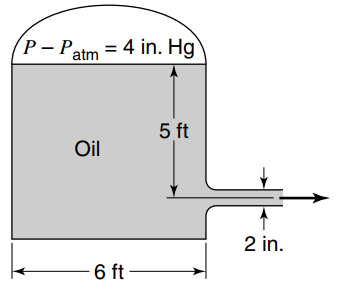
The pressurized tank shown has a circular cross section of 6 ft in diameter. Oil is drained through a nozzle 2 in. in diameter in the side of the tank. Assuming that the air pressure is maintained constant, how long does it take to lower the oil surface in the tank by 2 ft? The specific gravity of
A Venturi meter with an inlet diameter of 0.6 m is designed to handle 6 m3/s of standard air. What is the required throat diameter if this flow is to give a reading of 0.10 m of alcohol in a differential manometer connected to the inlet and the throat? The specific gravity of alcohol may be taken
In Problem 6.26, compute the upward force on the device from water and air. Use the results of Problem 6.26 as well as any other data given in that problem that you may need. Explain why you cannot profitably use Bernoulli's equation here for a force calculation.Data From Problem 6.26Water flows
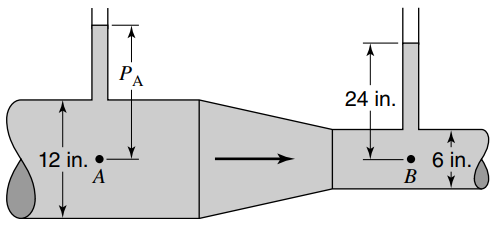
A liquid flows from A to B in a horizontal pipe line shown at a rate of 3 ft3/s with a friction loss of 0.45 ft of flowing fluid. For a pressure head at B of 24 in., what will be the pressure head at A? PA 24 in. 6 in. B 12 in.
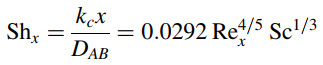
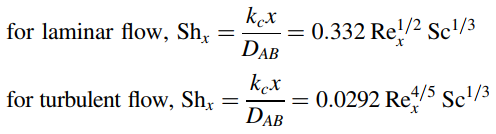
For fully developed turbulent flow over a flat plate of length L, the local Sherwood number at position x(0 < x ‰¤ L) is estimated byDevelop an expression for the average Sh over length L of the flat plate, assuming fully developed turbulent flow where the contribution to mass
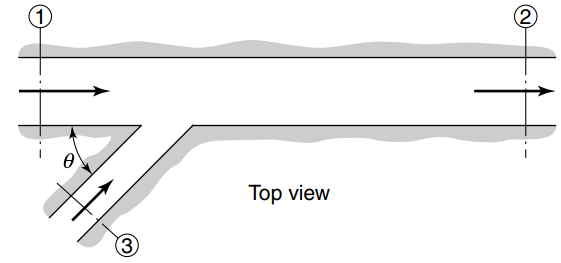
Find the change in temperature between stations (1) and (2) in terms of the quantities A1, A3, v1, v3, cv, and θ. The internal energy is given by cvT . The fluid is water and T1= T3, P1= P3. Top view (3
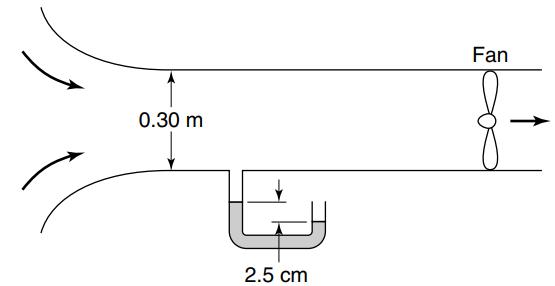
A fan draws air from the atmosphere through a 0.30-m diameter round duct that has a smoothly rounded entrance. A differential manometer connected to an opening in the wall of the duct shows a vacuum pressure of 2.5 cm of water. The density of air is 1.22 kg/m3. Determine the volume rate of air flow
During the test of a centrifugal pump, a Bourdon pressure gage just outside the casing of the 12-in.-diameter suction pipe reads -6 psig (i.e., vacuum). On the 10-in.-diameter discharge pipe, another gage reads 40 psig. The discharge pipe is 5 ft above the suction pipe. The discharge of water
Boundary-layer analysis for fluid flow over a flat plate predicts the following relationships between the local Sherwood (Shx), Reynolds (Re), and Schmidt (Sc) numbers:with the transition beginning at Rex = 2.0 × 10⁵. Determine what percentage of the mass transfer occurs within the
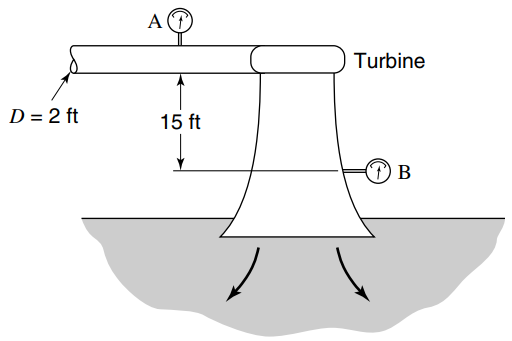
During the flow of 200 ft3/s of water through the hydraulic turbine shown, the pressure indicated by gage A is 12 psig. What should gage B read if the turbine is delivering 600 hp at 82% efficiency? Gage B is designed to measure the total pressure - that is, P + Ïv2/2 for an
Water flows through a 2-in.-diameter horizontal pipe at a flow rate of 35 gal/min. The heat transfer to the pipe can be neglected, and frictional forces result in a pressure drop of 10 psi. What is the temperature change of the water?
Air at 70°F, Flows into a 10-ft3 reservoir at a velocity of 110 fps. If the reservoir pressure is 14 psig and the reservoir temperature 70°F, find the rate of temperature increase in the reservoir. Assume the incoming air is at reservoir pressure and flows through a 8-in.-diameter pipe.
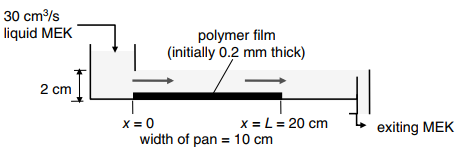
In a manufacturing process, an organic solvent (methyl ethyl ketone, MEK) is used to dissolve a thin coating of a polymer film away from a nonporous flat surface of length 20 cm and width 10 cm, as shown in the figure (above right). The thickness of the polymer film is initially uniform at
Sea water, p = 1025 kg/m3, flows through a pump at 0:21 m3/s. The pump inlet is 0.25 m in diameter. At the inlet the pressure is -0.15 m of mercury. The pump outlet, 0.152 m in diameter, is 1.8 m above the inlet. The outlet pressure is 175 kPa. If the inlet and exit temperature are equal, how much
The velocity profile in the annular control volume of Example 3 is approximately linear, varying from a velocity of zero at the outer boundary to a value of ωd/2 at the inner boundary. Develop an expression for the fluid velocity, v(r), where r is the distance from the center of the shaft.
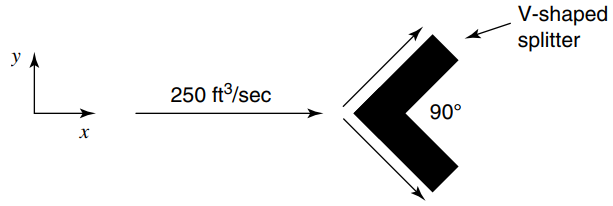
A water jet at 60°F with a flow rate of 250 ft3/s and a velocity of 75 ft/s hits a stationary V-shaped splitter such that half of the fluid is directed upward and the other half is directed downward as shown in the figure. Both of these streams have a final velocity of 75 ft/s. Assume steady,
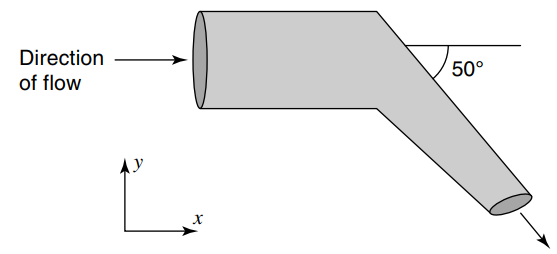
Benzene is flowing at steady state through the nozzle shown below at 80°F and at a constant flow rate of 3 ft3/sec. Note that the nozzle exit is at an angle of 50 degrees as shown. At the inlet the diameter is 5 in. and the liquid is at a pressure of 500 lbf/ft2. At the outlet, the diameter is
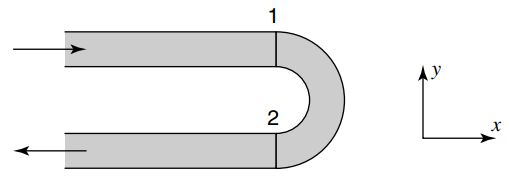
Water at 100°C flows through a 10 cm diameter pipe that has a 180 degree vertical turn as shown in the figure below. The volumetric flow rate is constant at 0.2 m3/s. The absolute pressure at position 1 is 64,000 Pa, and the absolute pressure at position 2 is 33,000 Pa. The weight of the fluid
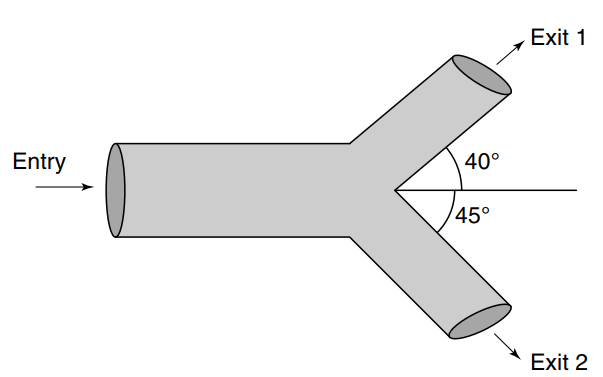
The horizontal Y-fitting (see figure on the next page) splits 80°F water into two equal parts. The first part goes through Exit 1 and the second part goes through Exit 2 (as shown in the figure). The volumetric flow rate at the entrance is 8 ft3/sec, and the gage pressures at the three
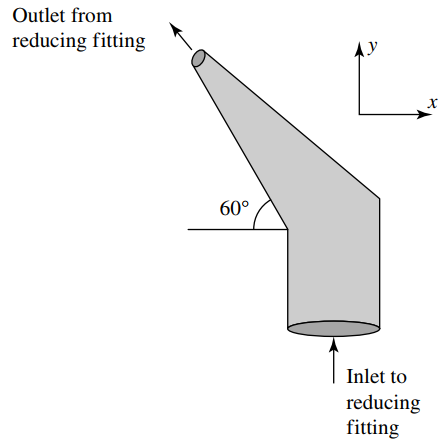
You have been given a project where you must attach a particular reducing pipe fitting into a Freon-12 delivery system. Freon-12 is a potentially hazardous material so you must be certain that the reducing pipe fitting is attached properly and will withstand the force due to the reduction in pipe
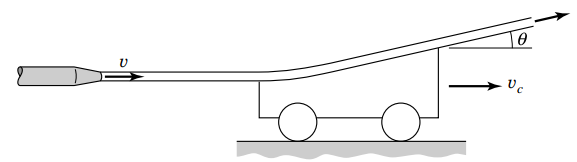
The illustration above (next column) shows a vane with a turning angle θ that moves with a steady speed vc. The vane receives a jet that leaves a fixed nozzle with speed v.a. Assume that the vane is mounted on rails as shown in the sketch. Show that the power transmitted to the cart is maximum
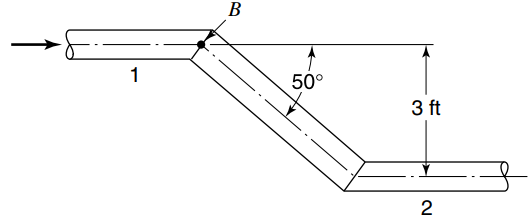
Water flows at 30 gal/min through the 0.75-in.-diameter double-pipe bend. The pressures are p1= 30 lbf/in.2and p2= 24 lbf/in.2. Compute the torque T at point B necessary to keep the pipe from rotating. B 1 50° 3 ft 2
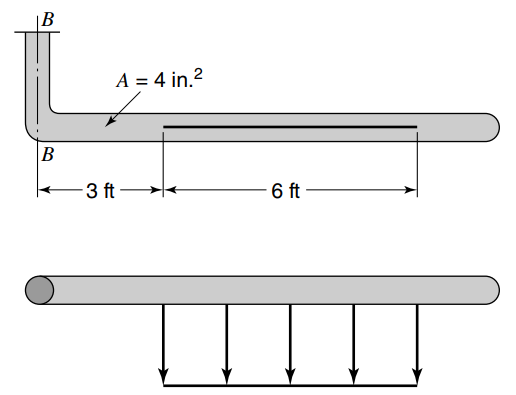
The pipe shown below has a slit of thickness 1/4 in. so shaped that a sheet of water of uniform thickness 1/4 in. issues out radially from the pipe. The velocity is constant along the pipe as shown and a flow rate of 8 ft3/s enters at the top. Find the moment on the tube about the axis BB from the
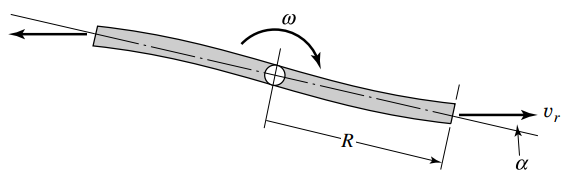
A lawn sprinkler consists of two sections of curved pipe rotating about a vertical axis as shown. The sprinkler rotates with an angular velocity ω, and the effective discharge area is A, the water is discharged at a rate Q = 2vPrA, where vris the velocity of the water relative to the
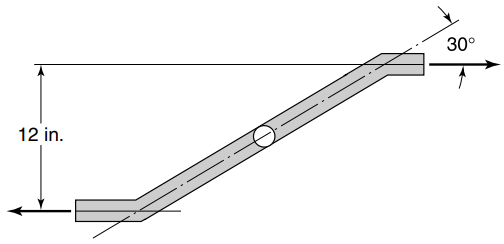
A water sprinkler consists of two 1/2-in. diameter jets at the ends of a rotating hollow rod as shown. If the water leaves at 20 fps, what torque would be necessary to hold the sprinkler in place? 30° 12 in.
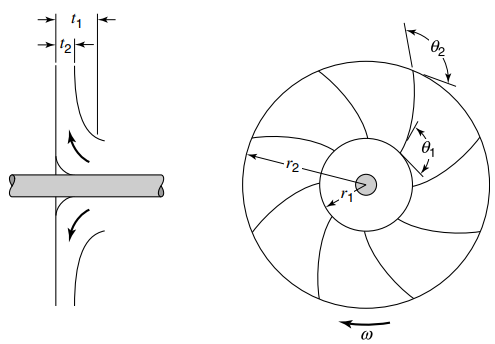
In Problem 5-27 determinea. The angle θ1such that the entering flow is parallel to the vanesb. The axial load on the shaft if the shaft diameter is 1 in. and the pressure at the pump inlet is atmosphericData From Problem 5.27Sea water, Ï = 64 lbm/ft3, flows through the impeller of a
Sea water, Ï = 64 lbm/ft3, flows through the impeller of a centrifugal pump at the rate of 800 gal/min. Determine the torque exerted on the impeller by the fluid and the power required to drive the pump. Assume that the absolute velocity of the water entering the impeller is radial. The
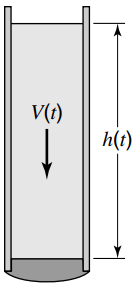
A liquid column of height h is confined in a vertical tube of cross-sectional area A by a stopper. At t = 0, the stopper is suddenly removed, exposing the bottom of the liquid to atmospheric pressure. Using a control-volume analysis of mass and vertical momentum, derive the differential equation
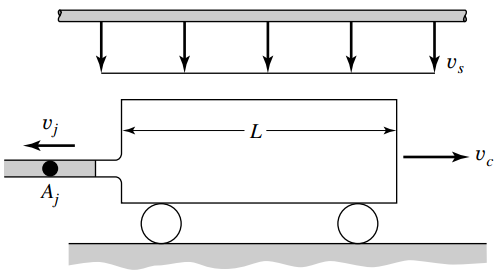
An open tank L ft long as shown below travels to the right at a velocity vcfps. A jet of area Ajexhausts fluid of density r at a velocity vjfps relative to the car. The tank car, at the same time, collects fluids from an overhead sprinkler that directs fluid downward with velocity vs. Assuming that
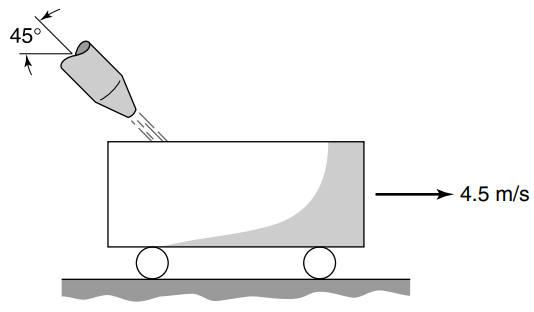
An open tank car as shown travels to the right at a uniform velocity of 4.5 m/s. At the instant shown the car passes under a jet of water issuing from a stationary 0.1-m-diameter pipe with a velocity of 20 m/s. What force is exerted on the tank by the water jet? 45° 4.5 m/s
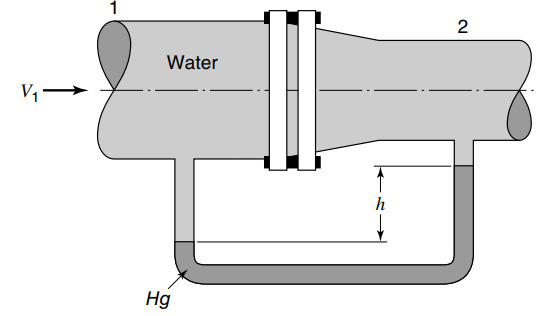
For the pipe-flow-reducing section D1= 8 cm, D2= 5 cm, and p2= 1 atm. If v1= 5 m/s and the manometer reading is h = 58 cm, estimate the total force resisted by the flange bolts. Water Hg
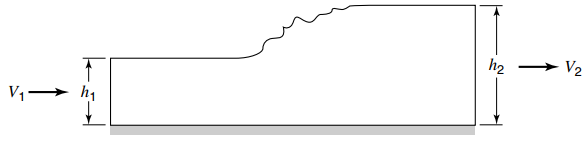
As can often be seen in a kitchen sink when the faucet is running, a high-speed channel flow (v1, h1) may €œjump€ to a low-speed, low-energy condition (v2, h2). The pressure at sections 1 and 2 is approximately hydro static, and wall friction is negligible. Use the continuity
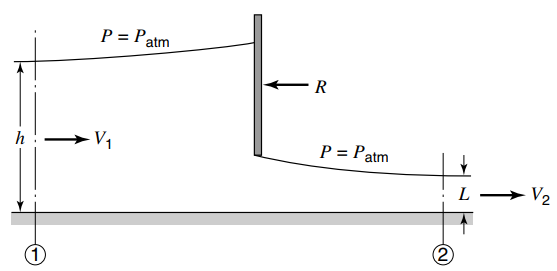
A liquid of density r flows through a sluice gate as shown. The upstream and downstream flows are uniform and parallel, so that the pressure variations at stations 1 and 2 may be considered hydro static.a. Determine the velocity at station 2.b. Determine the force per unit width, R, necessary
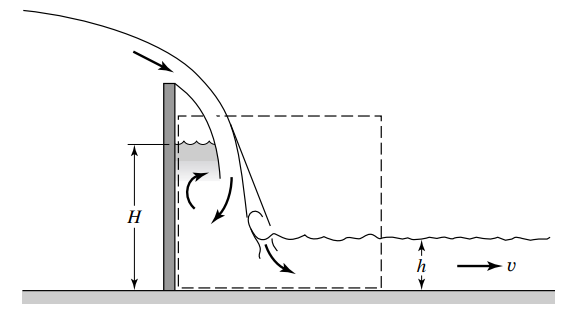
A dam discharge into a channel of constant width as shown. It is observed that a region of still water backs up behind the jet to a height H. The velocity and height of the flow in the channel are given as v and h, respectively, and the density of the water is r. Using the momentum theorem and the
Water flows in a pipe at 3 m/s. A valve at the end of the pipe is suddenly closed. Determine the pressure rise in the pipe.
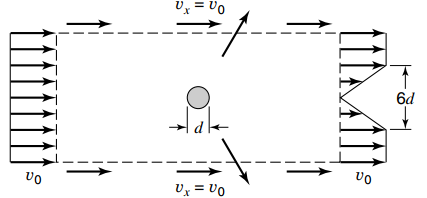
The pressure on the control volume illustrated below is constant. The x components of velocity are as illustrated. Determine the force exerted on the cylinder by the fluid. Assume in-compressible flow. Vx = Vo 6d lale vo Ux = Vo
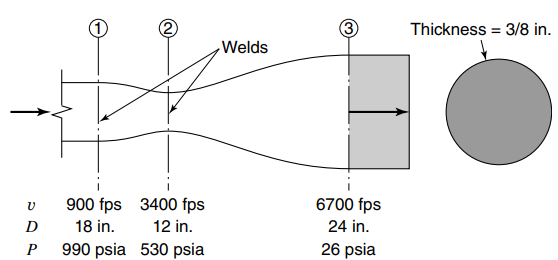
The rocket nozzle shown below consists of three welded sections. Determine the axial stress at junctions 1 and 2 when the rocket is operating at sea level. The mass flow rate is 770 lbm/s. 3 Thickness = 3/8 in. Welds 6700 fps 900 fps 3400 fps 24 in. 18 in. 12 in. 26 psia 990 psia 530 psia
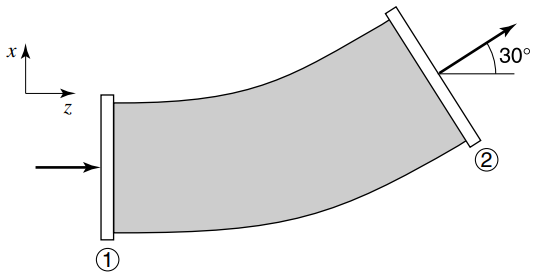
Water flows steadily through the horizontal 30° pipe bend shown below. At station 1, the diameter is 0.3 m, the velocity is 12 m/s, and the pressure is 128 kPa gage. At station 2, the diameter is 0.38 m and the pressure is 145 kPa gage. Determine the forces Fxand Fznecessary to hold the pipe
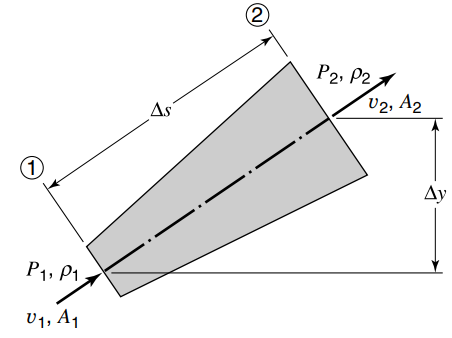
Consider the differential control volume shown below. By applying the conservation of mass and the momentum theorem, show that dP + pv dv + g dy = 0 Р2, Р2я V2, A2 Дs (1) Ду P1, P1 V1, A1
If the shock-wave velocity in Problem 5-13 is approximated by the speed of sound, determine the pressure change causing a velocity change of 10 fps ina. Air at standard conditionsb. WaterData From Problem 5.13The shock wave illustrated below is moving to the right at vw fps. The properties in front
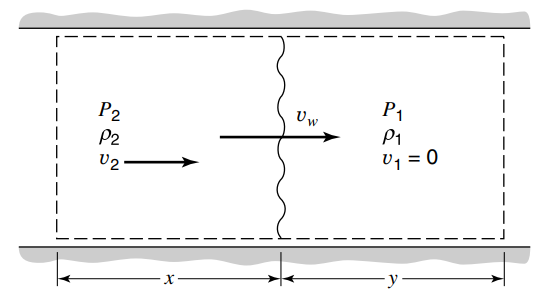
The shock wave illustrated below is moving to the right at vwfps. The properties in front and in back of the shock are not a function of time. By using the illustrated control volume, show that the pressure difference across the shock isP2 - P1 = p1 vw v2 P1 Uw P2 P1 P2 V1 = 0 U2
A plate moves perpendicularly toward a discharging jet at the rate of 5 fps. The jet discharges water at the rate of 3 ft3/s and a speed of 30 fps. Find the force of the fluid on the plate and compare it with what it would be if the plate were stationary. Assume friction less flow.
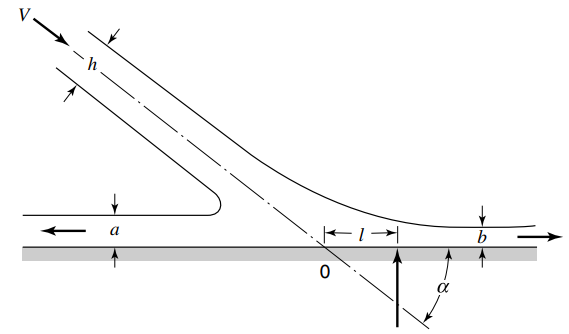
A steady, in-compressible, friction less, two-dimensional jet of fluid with breadth h, velocity v, and unit width impringes on a flat plate held at an angle a to its axis. Gravitational forces are to be neglected.a. Determine the total force on the plate, and the breadths a, b, of the two
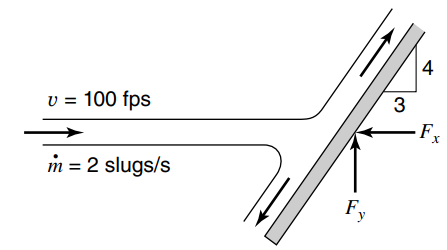
If the plate shown is inclined at an angle as shown, what are the forces Fxand Fynecessary to maintain its position? The flow is friction less. 4 3 v = 100 fps - Fx m = 2 slugs/s Fy
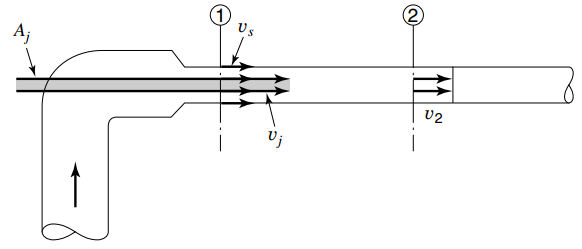
A water jet pump has an area Aj= 0.06 ft2and a jet velocity vj= 90 fps, which entrains a secondary stream of water having a velocity vs= 10 fps in a constant-area pipe of total area A = 0.6 ft2. At section 2, the water is thoroughly mixed. Assuming one dimensional flow and neglecting wall shear a.
At the end of a water pipe of 3-in. diameter is a nozzle that discharges a jet having a diameter of 1 1/2 in into the open atmosphere. The pressure in the pipe is 60 psig (pounds per square inch gage), and the rate of discharge is 400 gal/min. What are the magnitude and direction of the force
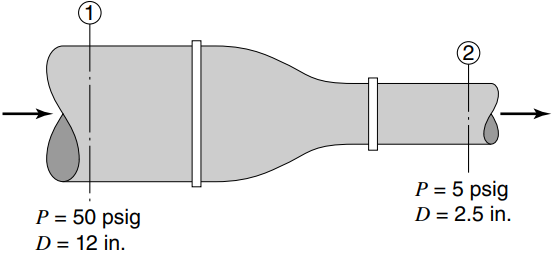
Oil (sp. gr. = 0.8) flows smoothly through the circular reducing section shown at 3 ft3/s. If the entering and leaving velocity profiles are uniform, estimate the force that must be applied to the reducer to hold it in place. P = 5 psig D = 2.5 in. P = 50 psig D = 12 in.
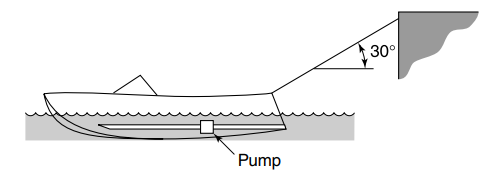
The pump in the boat shown pumps 6 ft3/s of water through a submerged water passage, which has an area of 0.25 ft2at the bow of the boat and 0.15 ft2at the stern. Determine the tension in the restraining rope, assuming that the inlet and exit pressures are equal. 30° Pump
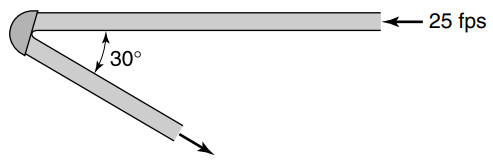
a. Determine the magnitude of the x and y components of the force exerted on the fixed blade shown by a 3-ft3/s jet of water flowing at 25 fps.b. If the blade is moving to the right at 15 fps, find the magnitude and velocity of the water jet leaving the blade. + 25 fps 30°
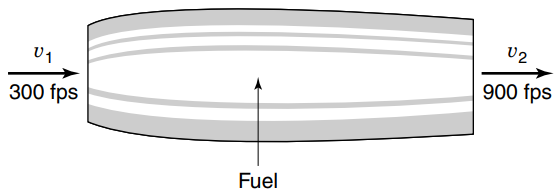
A stationary jet engine is shown. Air with a density of 0.0805 lb/ft3enters as shown. The inlet and outlet cross sectional areas are both 10.8 ft2. The mass of fuel consumed is 2% of the mass of air entering the test section. For these conditions, calculate the thrust developed by the engine
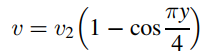
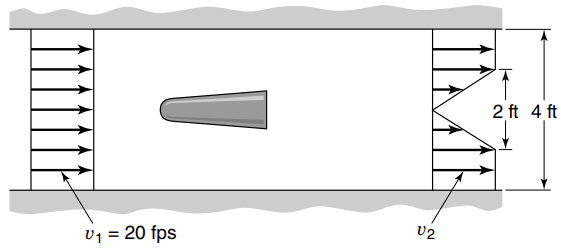
Rework Problem 5-1 if the exit velocity profile is given bywhen y is measure vertically from the center line of the water tunnel.Data From Problem 5.1A two-dimensional object is placed in a 4-ft-wide water tunnel as shown. The upstream velocity, v1 is uniform across the cross section. For the
If, in the system for Problem 5-1, the total drag on the object is measured to be 800 N/m of length normal to the direction of flow, and frictional forces at the walls are neglected, find the pressure difference between inlet and outlet sections.Data From Problem 5.1A two-dimensional object is
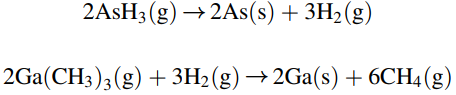
A horizontal chemical vapor deposition (CVD) reactor similar to the configuration shown in Example 3, Figure 28.6 will be used for growth of gallium arsenide (GaAs) thin films. In this process, arsine vapor, trimethylgallium vapor, and H2gas are fed into the reactor. Inside the reactor, the silicon
A two-dimensional object is placed in a 4-ft-wide water tunnel as shown. The upstream velocity, v1is uniform across the cross section. For the downstream velocity profile as shown, find the value of v2. 2 ft 4 ft U2 v1 = 20 fps
A well-mixed tank initially contains pure water. The tank has inlet and outlet ports both with a diameter of 1 cm, and the inlet port is 20 cm above the outlet port. Into the tank through the inlet port flows a 10% solution of sodium sulfate dissolved in water with a velocity of 0.1 m/sec that has
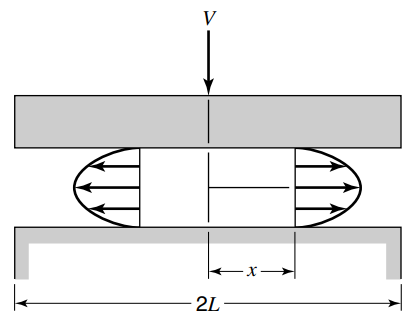
Rework Problem 4.14 if the plates are circular and have radius L.Data From Problem 4.14Two very long parallel plates of length 2L are separated a distance b. The upper plate moves downward at a constant rate V. A fluid fills the space between the plates. Fluid is squeezed out between the plates.
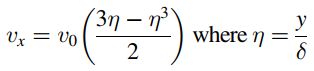
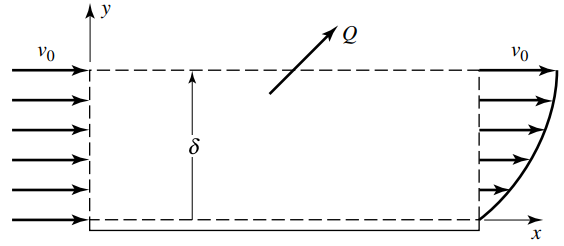
An in-compressible fluid flows past a flat plate, as in the figure below, with a uniform inlet profile and a polynomial exit profileCompute the volume flow Q across the top surface of the control volume. The plate has width b into the paper. (3η- y where n Ux 2 АУ Vo
The velocity profile in circular pipe is given by v = vmax(1 - r/R)1/7, where R is the radius of the pipe. Find the average velocity in the pipe in terms of vmax.
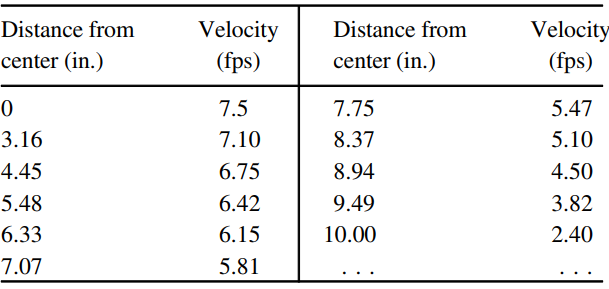
The velocities in a circular duct of 20-in. diameter were measured as follows:Find (a) the average velocity; (b) the flow rate in cubic feet per second. Velocity Distance from Velocity Distance from (fps) center (in.) (fps) center (in.) 7.5 7.75 5.47 3.16 7.10 8.37 5.10 4.45 6.75 8.94 4.50 5.48
Using the velocity vector of the previous problem, determine (a) the equation of the streamline passing through point (2, 1); (b) the volume of flow that crosses a plane surface connecting points (1, 0) and (2, 2).
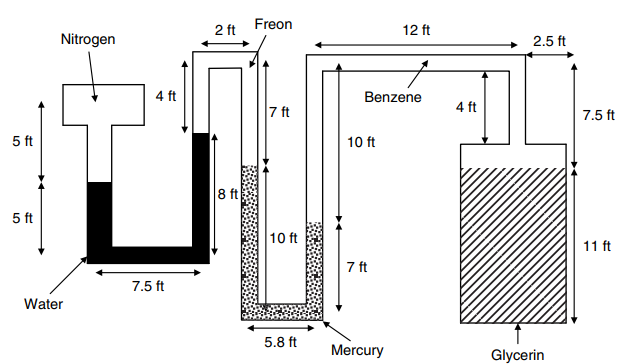
If the nitrogen tank in the figure below is at a pressure of 4500 lbf/ft2and the entire system is at 100°F, calculate the pressure at the bottom of the tank of glycerin. Freon 2 ft 12 ft Nitrogen 2.5 ft Benzene 4 ft 4 ft 7 ft 7.5 ft 5 ft 10 ft 8 ft 5 ft 10 ft 11 ft 7 ft 7.5 ft Water 5.8 ft
The maximum blood pressure in the upper arm of a healthy person is about 120 mm Hg (this is a gauge pressure). If a vertical tube open to the atmosphere is connected to the vein in the arm of a person, determine how high the blood will rise in the tube. Take the density of the blood to be both
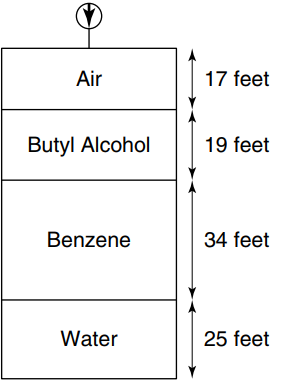
A large industrial waste collection tank contains butyl alcohol, benzene, and water at 80°F that have separated into three distinct phases as shown in the figure. The diameter of the circular tank is 10 feet and its total depth is 95 feet. The gauge at the top of the tank reads 2116 lbf/ft3.
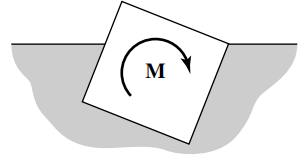
A cubical piece of wood with an edge L in length floats in the water. The specific gravity of the wood is 0.90. What moment M is required to hold the cube in the position shown? The right hand edge of the block is flush with the water. M
The float in a toilet tank is a sphere of radius R and is made of a material with density p. An upward buoyant force F is required to shut the ballcock valve. The density of water is designated pw. Develop an expression for x, the fraction of the float submerged, in terms of R, p, F, g, and pw.
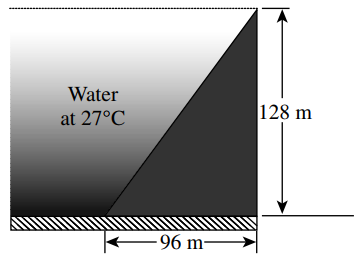
The dam shown below is 100 m wide. Determine the magnitude and location of the force on the inclined surface. Water 128 m at 27°C –96 m–
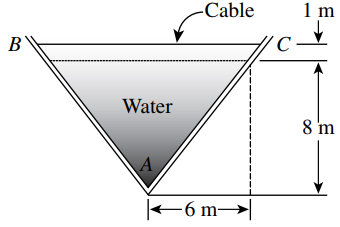
The figure below shows an open triangular channel in which the two sides, AB and AC, are held together by cables, spaced 1 m apart, between B and C. Determine the cable tension. -Cable Water 8 m +6 m–
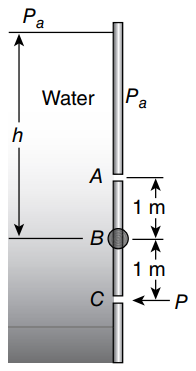
The circular gate ABC has a 1 m radius and is hinged at B. Neglecting atmospheric pressure, determine the force P just sufficient to keep the gate from opening when h = 12 m. Pa Pa Water 1 m B 1 m -E> E-
A watertight bulkhead 22 ft high forms a temporary dam for some construction work. The top 12 ft behind the bulkhead consists of sea water with a density of 2 slugs/ft3, but the bottom 10 ft begin a mixture of mud and water can be considered a fluid of density 4 slugs/ft3. Calculate the total
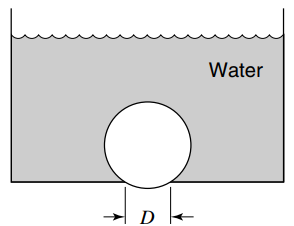
It is desired to use a 0.75-m diameter beach ball to stop a drain in a swimming pool. Obtain an expression that relates the drain diameter D and the minimum water depth h for which the ball will remain in place. Water D
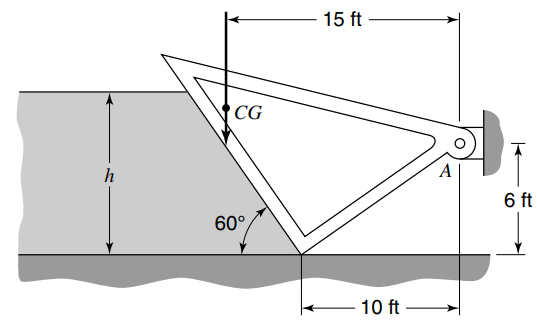
A dam spillway gate holds back water of depth h. The gate weights 500 1b/ft and is hinged at A. At what depth of water will the gate rise and permit water to flow under it? 15 ft CG 6 ft 60°, 10 ft
A rectangular block of concrete 3 ft × 3 ft × 6 in. has its 6- in. side half buried at the bottom of a lake 23 ft deep. What force is required to lift the block free of the bottom? What force is required to maintain the block in this position? (Concrete weights 150 1b/ft3.)
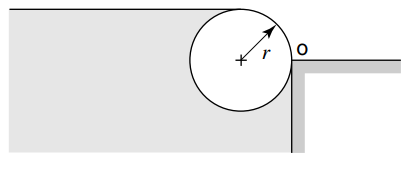
A circular log of radius r is to be used as a barrier as shown in the figure below. If the point of contact is at O, determine the required density of the log.
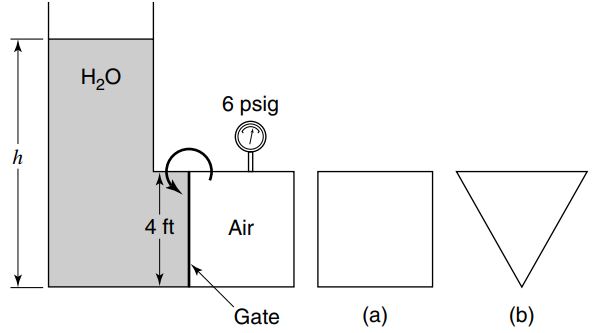
Find the minimum value of h for which the gate shown will rotate counterclockwise if the gate cross section is (a) rectangular, 4 ft × 4 ft; (b) triangular, 4 ft at the base × 4 ft high. Neglect bearing friction. H2O 6 psig 4 ft Air (a) (b) Gate
Glass viewing windows are to be installed in an aquarium. Each window is to be 0.6 m in diameter and to be centered 2 m below the surface level. Find the force and location of the force acting on the window.
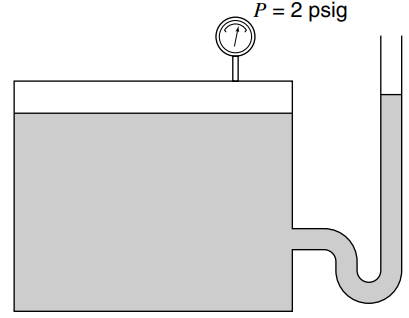
The tank is accelerated upward at a uniform rate. Does the manometer level go up or down? P = 2 psig
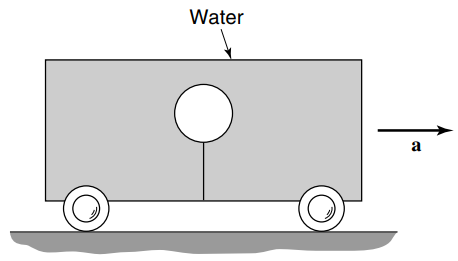
The car shown in the figure is accelerated to the right at a uniform rate. What way will the balloon move relative to the car? Water a
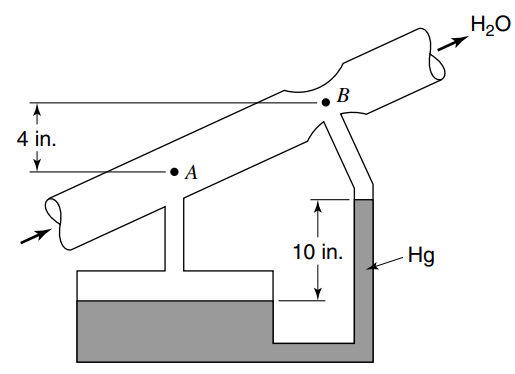
A differential manometer is used to measure the pressure change caused by a flow constriction in a piping system as shown. Determine the pressure difference between points A and B in psi. Which section has the higher pressure? H20 B 4 in. ► A 10 in. Hg
Showing 800 - 900
of 972
1
2
3
4
5
6
7
8
9
10
Step by Step Answers

 Get 50% OFF
Claim Now
Get 50% OFF
Claim Now