New Semester
Started
Get
50% OFF
Study Help!
--h --m --s
Claim Now
Question Answers
Textbooks
Find textbooks, questions and answers
Oops, something went wrong!
Change your search query and then try again
S
Books
FREE
Study Help
Expert Questions
Accounting
General Management
Mathematics
Finance
Organizational Behaviour
Law
Physics
Operating System
Management Leadership
Sociology
Programming
Marketing
Database
Computer Network
Economics
Textbooks Solutions
Accounting
Managerial Accounting
Management Leadership
Cost Accounting
Statistics
Business Law
Corporate Finance
Finance
Economics
Auditing
Tutors
Online Tutors
Find a Tutor
Hire a Tutor
Become a Tutor
AI Tutor
AI Study Planner
NEW
Sell Books
Search
Search
Sign In
Register
study help
physics
fundamentals momentum heat
Fundamentals Of Momentum Heat And Mass Transfer 6th Edition James Welty, Gregory L. Rorrer, David G. Foster - Solutions
In a biofuels plant a shell-and-tube heat exchanger is used to cool a stream of 100% carbon dioxide off-gas from a beer column from 77°C to 27°C (350 to 300 K) at 1 atm total system pressure. The total molar flow rate of CO2 gas is 36 kgmol/h (806.4 m3/h at STP). Liquid water will be used as the
In a biofuels plant, a shell-and-tube heat exchanger is used to cool a hot stream of 100% carbon dioxide off-gas from a beer column from 77°C to 27°C (350 to 300 K) at 1.2 atm total system pressure. The total molar flow rate of CO2 gas is 360 kgmol/hr. Liquid water will be used as the cooling
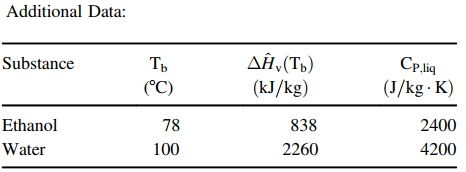
In a biofuels plant distillation tower, a single-pass shell- and-tube heat exchanger is used to condense saturated ethanol vapor to saturated ethanol liquid using water as the tube-side cooling fluid. The process is carried out at 1 atm total system pressure. The ethanol vapor flow rate into the
Saturated steam at 373 K is to be condensed in a shell- and-tube exchanger; it is to enter as steam at 373 K and leave as condensate at approximately 373 K. If the NTU rating for the condenser is given by the manufacturer as 1.25 in. this service for a circulating water flow of 0.07 kg/s, and
Water flowing at a rate of 3.8 kg/s is heated from 38°C to 55°C in the tubes of a shell-and-tube heat exchanger. The shell side is one-pass with water flowing at 1.9 kg/s, entering at 94°C. The overall heat-transfer coefficient is 1420 W/m2 · K. The average water velocity in the 1.905-cm-ID
Compressed air is used in a heat-pump system to heat water, which is subsequently used to warm a house. The house demand is 95,000 Btu/h. Air enters the exchanger at 200°F and leaves at 120°F, and water enters and leaves the exchanger at 90°F and 125°F, respectively. Choose from the following
A condenser unit is of a shell-and-tube configuration with steam condensing at 85°C in the shell. The coefficient on the condensate side is 10,600 W/m2 · K. Water at 20°C enters the tubes, which make two passes through the single-shell unit. The water leaves the unit at a temperature of 38°C.
A shell-and-tube exchanger having one shell pass and eight tube passes is to heat kerosene from 80°F to 130°F. The kerosene enters at a rate of 2500 lbm/h. Water entering at 200°F and at a rate of 900 lbm/h is to flow on the shell side. The overall heat-transfer coefficient if 260 Btu/h ft2 °F.
A shell-and-tube heat exchanger is used to cool oil (CH = 2.2kJ/kg · K) from 110°C to 65°C. The heat exchanger has two shell passes and four tube passes. The coolant (Cc = 4.20 kJ/kg · K) enters the shell at 20°C and leaves the shell at 42°C. For an overall tube-side heat-transfer coefficient
Consider the exchanger in Problem 22.9. After 4 years of operation, the outlet of the oil reaches 28°C instead of 30°C with all other conditions remaining the same. Determine the fouling resistance on the oil side of the exchanger.Data From Problem 22.9A shell-and-tube heat exchanger is used for
A shell-and-tube heat exchanger is used for the heating of oil from 20°C to 30°C ; the oil flow rate is 12 kg/s (Cpo = 2.2 kJ/kg · K). The heat exchanger has one shell pass and two tube passes. Hot water (Cpw = 4.18 kJ/kg · K) enters the shell at 75°C and leaves the shell at 55°C. The
Water enters a counter flow, double-pipe heat exchanger at a rate of 150 lbm/min and is heated from 60°F to 140°F by an oil with a specific heat of 0.45 Btu/lbm °F. The oil enters at 240°F and leaves at 80°F. The overall heat-transfer coefficient is 150 Btu/h ft2 °F.a. What heat-transfer
A double-pipe, counter current heat exchanger is used to cool saturated steam at 2 bar (Ts = 120°C) to a saturated liquid. At this temperature and pressure, the inlet volumetric flow rate of steam is 2.42 m3/m, the density of steam is 1.13 kg/m3, and the enthalpy of vaporization of steam is 2201.6
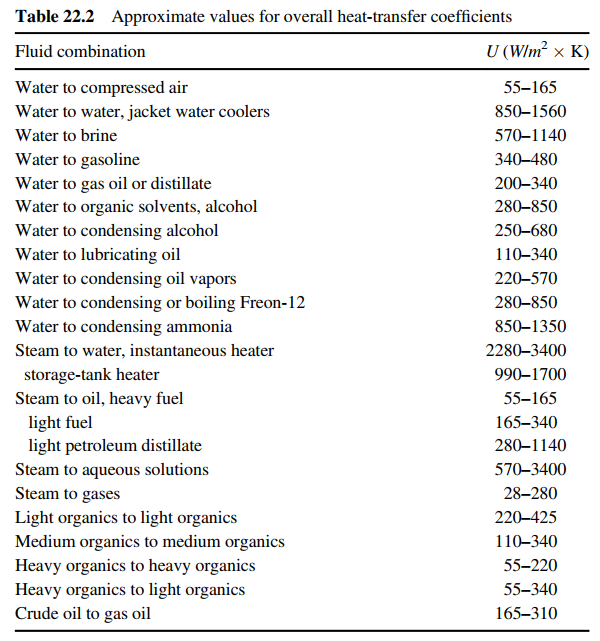
As part of a food-processing operation, a single-pass, counter current, shell-and-tube heat exchanger must be designed to warm up a stream of liquid glycerin. The heat exchanger must be constructed of 0.75-in, outer diameter. gage 12 (relatively thick-walled) stainless steel tubes (k = 43 W/m · K)
A double-pipe, countercurrent heat exchanger is used to cool a hot liquid stream of biodiesel from 60°C to 35°C. Biodiesel flows on the shell side with a volumetric flow rate of 3 m3/h; water is used on the tube side. The entrance and exit temperatures for cooling water flow are 10°C and 30°C,
Water at 50°F is available for cooling at a rate of 400 Ibm/h. It enters a double-pipe heat exchanger with a total area of 18 ft2. Oil, with cp = 0.45 Btu/1bm, °F, enters the exchanger at 250°F. The exiting water temperature is limited at 212°F, and the oil must leave the exchanger at no more
Air at 203 kPa and 290 K flows in a long rectangular duct with dimensions 10 cm by 20 cm. A 2.5-m length of this duct is maintained at 395 K, and the average exit air temperature from this section is 300 K. Calculate the air flow rate and the total heat transfer.
An oil having a specific heat of 1880 J/kg · K enters a single-pass counter flow heat exchanger at a rate of 2 kg/s and a temperature of 400 K. It is to be cooled to 350 K. Water is available to cool the oil at a rate of 2 kg/s and a temperature of 280 K. Determine the surface area required if the
A single tube-pass heat exchanger is to be designed to heat water by condensing steam in the shell. The water is to pass through the smooth horizontal tubes in turbulent flow, and the steam is to be condensed dropwise in the shell. The water flow rate, the initial and final water temperatures, the
A vertical flat surface 2 ft high is maintained at 60°F. If saturated ammonia at 85°F is adjacent to the surface, what heat- transfer coefficient will apply to the condensation process? What total heat transfer will occur?
Given the conditions of Problem 21.16, what height of vertical wall will cause the film at the bottom of the tube to be turbulent?
If eight tubes of the size designated in Problem 21.13 are arranged in a vertical bank and the flow is assumed laminar, determinea. The average heat-transfer coefficient for the bankb. The heat-transfer coefficient for the first, third, and eighth tubes
Determine the heat-transfer coefficient for a horizontal 5/8 -in:-OD tube with its surface maintained at 100°F surrounded by steam at 200°F.
If eight tubes of the size designated in Problem 21.13 are oriented horizontally in a vertical bank, what heat-transfer rate will occur?
Saturated steam at 365 K condenses on a 2-cm tube whose surface is maintained at 340 K. Determine the rate of condensation and the heat transfer coefficient for the case of a 1.5-m-long tube orienteda. Verticallyb. Horizontally
Saturated steam at atmospheric pressure condenses on the outside surface of a 1-m-long tube with 150-mm diameter. The surface temperature is maintained at 91°C. Evaluate the condensation rate if the pipe is orienteda. Verticallyb. Horizontally
A square pan with sides measuring 1 ft and a perpendicular lip extending 1 in. above the base is oriented with its base at an angle of 20 degrees from the horizontal. The pan surface is kept at 180°F and it is situated in an atmosphere of 210°F steam. How long will it be before condensate spills
A square pan measuring 40 cm on a side and having a 2-cm-high lip on all sides has its surface maintained at 350 K. If this pan is situated in saturated steam at 372 K, how long will it be before condensate spills over the lip if the pan isa. Horizontal?b. Inclined at 10 degrees to the
A circular pan has its bottom surface maintained at 200°F and is situated in saturated steam at 212°F. Construct a plot of condensate depth in the pan vs. time up to 1 h for this situation. The sides of the pan may be considered nonconducting.
Estimate the heat-transfer rate per foot of length from a 0.02-in. diameter nichrome wire immersed in water at 240°F. The wire temperature is 2200°F.
A horizontal circular cylinder 1 in. in diameter has its outside surface at a temperature of 1200°F . This tube is immersed in saturated water at a pressure of 40 psi. Estimate the heat flux due to film boiling that may be achieved with this configuration. At 40 psi, the temperature of saturated
Two thousand watts of electrical energy are to be dissipated through copper plates measuring 5 cm by 10 cm by 0.6 cm immersed in water at 390 K. How many plates would you recommend? Substantiate all of the design criteria used.
Four immersion heaters in the shape of cylinders 15 cm long and 2 cm in diameter are immersed in a water bath at 1 atm total pressure. Each heater is rated at 500 W. If the heaters operate at rated capacity, estimate the temperature of the heater surface. What is the convective heat-transfer
If the cylinder described in Problem 21.3 were initially heated to 500°F, how long would it take for the center of the cylinder to cool to 240°F if it were constructed ofa. Copper?b. Brass?c. Nickel?
A cylindrical copper heating element 2 ft long and 1/2 in. in diameter is immersed in water. The system pressure is maintained at 1 atm and the tube surface is held at 280°F . Determine the nucleate-boiling heat-transfer coefficient and the rate of heat dissipation for this system.
Plot values of the heat-transfer coefficient for the case of pool boiling of water on horizontal metal surfaces at 1 atm total pressure and surface temperatures varying from 390 to 450 K. Consider the following metals:(a) Nickel;(b) Copper;(c) Platinum;(d) Brass.
An electrically heated square plate measuring 200 cm on a side is immersed vertically in water at atmospheric pressure. As the electrical energy supplied to the plate is increased, its surface temperature rises above that of the adjacent saturated water. At low power levels the heat-transfer
Micro channel technology is touted as means for process intensification, which in simple terms means shrinking the size of process equipment (heat ex-changers, chemical reactors, chemical separation processes, etc.) to do the same job that a larger piece of equipment would do. In processes that
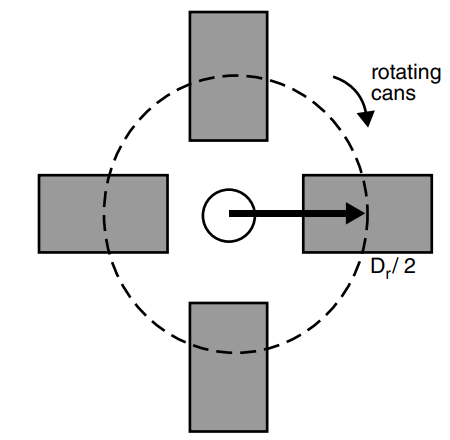
The Cooper Cooler is a novel cooling device that rotates a cylindrical beverage can within a chilled environment in order to cool down the beverage. In a related process shown in the figure, the correlation for convective heat transfer associated with the liquid film on the inside surfaces of a
Consider a continuous-flow device described below used to pasteurize liquid milk, whose properties approach those of water. Milk at 20°C enters a preheater tube at a volumetric flow rate of 6 L/min. The inner diameter of the tube is 1.5 cm. The tube winds through a steam chest, which heats the
A 1.905-cm-diameter brass tube is used to condense steam on its outer surface at 10.13 kPa pressure. Water at 290 K is circulated through the tube. Inside and outside surface coefficients are 1700 and 8500 W/m2 · K, respectively. Find the rate of steam condensed per hour per meter of the tube
Compressed natural gas is fed into a small underground pipeline having an inside diameter of 5.9 in. The gas enters at an initial temperature of 120°C and constant pressure of 132.3 psig. The metered volumetric flow rate at standard pressure of 14.7 psia and standard temperature of 25°C is 195.3
Air at atmospheric pressure and 10°C enters a rectangular duct that is 6 m long having dimensions of 7.5 and 15 cm in cross section. The surfaces are maintained at 70°C by solar irradiation. If the exiting air temperature is to be 30°C, what is the required flow rate of the air?
Air, at 322 K, enters a rectangular duct with a mass velocity of 29.4 kg/s · m2. The duct measures 0.61 m by 1.22 m and its walls are at 300 K.Determine the rate of heat loss by the air per meter of duct length and the corresponding decrease in air temperature per meter.
Cooling water flows through thin-walled tubes in a condenser with a velocity of 1.5 m/s. The tubes are 25.4 mm in diameter. The tube-wall temperature is maintained constant at 370 K by condensing steam on the outer surface. The tubes are 5 m long and the water enters at 290 K.Estimate the exiting
Air is transported through a rectangular duct measuring 2 ft by 4 ft.The air enters at 120°F and flows with amass velocity of 6 lbm/s · ft2. If the duct walls are at a temperature of 80°F, how much heat is lost by the air per foot of duct length? What is the corresponding temperature decrease of
Air at 25 psia is to be heated from 60°F to 100°F in a smooth, 3/4-in.-ID tube whose surface is held at a constant temperature of 120°F. What is the length of the tube required for an air velocity of 25 fps? At 15 fps?
A system for heating water with an inlet temperature of 25°C to an exiting temperature of 70°C involves passing the water through a thick-walled tube with inner and outer diameters of 25 and 45 mm, respectively. The outer tube surface is well insulated, and the electrical heating within the tube
An apparatus, used in an operating room to cool blood, consists of a coiled tube that is immersed in an ice bath. Using this apparatus, blood, flowing at 0.006 m3/h, is to be cooled from 40°C to 30°C. The inside diameter of the tube is 2.5 mm, and the surface coefficient between the ice bath and
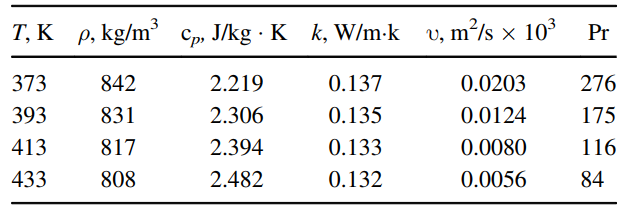
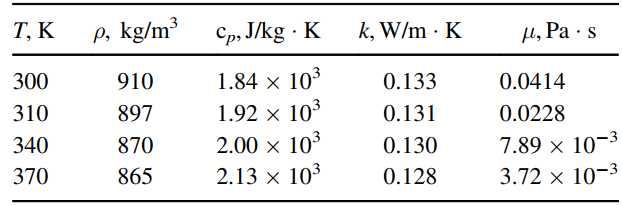
Engine oil with properties given below flows at a rate of 136 kg per hour through a 7.5-cm-ID pipe whose inside surface is maintained at 100°C. If the oil enters at 160°C, what will its temperature be at the exit of a 15-m-long pipe? p, kg/m³ Cp, J/kg · K v, m²/s × 10* T, K k, W/m-k Pr
Oil at 300 K is heated by steam condensing at 372 K on the outside of steel pipes with ID = 2.09 cm, OD = 2.67 cm. The oil flow rate is 1.47 kg/s; six tubes, each 2.5 m long, are used. The properties of oil to be used are as follows:Determine the rate of heat transfer to the oil. k, W/m · K T, K
Steam at 400 psi, 800°F flows through a 1-in. schedule- 40 steel pipe at a rate of 10,000 lbm/h. Estimate the value of h that applies at the inside pipe surface.
When the valve on the water line in Problem 20.38 is opened wide, the water velocity is 35 fps. What is the heat loss per 5 ft of water line in this case if the water and pipe temperatures are the same as specified in Problem 20.38?Data From Problem 20.38A tube bank employs tubes that are 1.30 cm
A valve on a hot-water line is opened just enough to allow a flow of 0.06 fps. The water is maintained at 180°F, and the inside wall of the 1/2-in. schedule-40 water line is at 80°F. What is the total heat loss through 5 ft of water line under these conditions? What is the exit water temperature?
Air at 60°F and atmospheric pressure flows inside a 1-in., 16-BWG copper tube whose surface is maintained at 240°F by condensing steam. Find the temperature of the air after passing through 20 ft of tubing if its entering velocity is 40 fps.
Rework Problem 20.53 for a staggered arrangement. All other conditions remain the same.Data From Problem 20.53Air at atmospheric pressure and 10°C enters a rectangular duct that is 6 m long having dimensions of 7.5 and 15 cm in cross section. The surfaces are maintained at 70°C by solar
A tube bank employs tubes that are 1.30 cm in outside diameter at ST = SL = 1.625 cm. There are eight rows of tubes, which are held at a surface temperature of 90°C. Air, at atmospheric pressure and a bulk temperature 27°C, flows normal to the tubes with a free-stream velocity of 1.25 m/s. The
Rework Problem 20.51 for a staggered arrangement.Data From Problem 20.51Cooling water flows through thin-walled tubes in a condenser with a velocity of 1.5 m/s. The tubes are 25.4 mm in diameter. The tube-wall temperature is maintained constant at 370 K by condensing steam on the outer surface. The
A tube bank employs an in-line arrangement with ST = SL = 3.2 cm and tubes that are 1.8 cm in outside diameter. There are 10 rows of tubes, which are held at a surface temperature of 85°C. Air at atmospheric pressure and 20°C flows normal to the tubes with a free-stream velocity of 6 m/s. The
For the heater consisting of the tube bank described in Problem 20.32, evaluate the heat transferred to the water if the tube array consists of six rows of tubes in the flow direction with eight tubes per row. The tubes are 5 ft long.Data From Problem 20.32Thermophysical properties of N2 gas
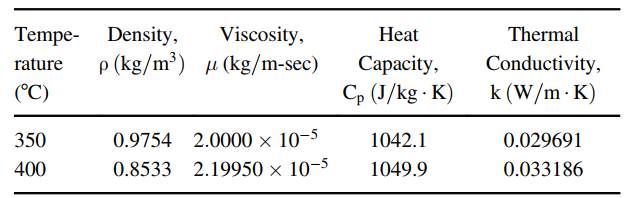
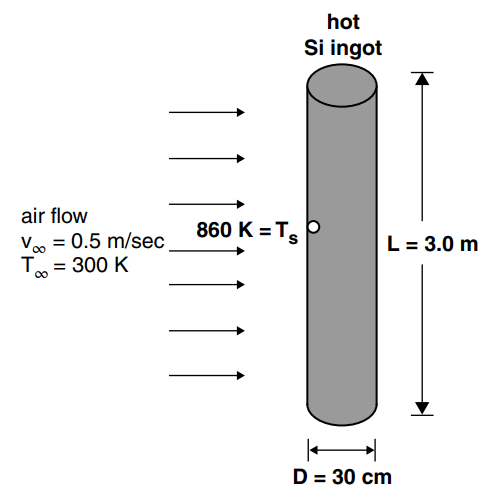
The Solar World manufacturing facility in Portland, Oregon, is the largest producer of silicon-based solar cells in the United States. The manufacturing process begins with the melt crystallization of electronic grade silicon into a cylindrical ingot of poly crystalline silicon. The newly formed
An industrial heater is composed of a tube bundle consisting of horizontal 3/8-in.-OD tubes in a staggered array with tubes arranged in equilateral triangle fashion having a pitch to-diameter ratio of 1.5. If water at 160°F flows at 20 ft/s past the tubes with constant surface temperature of
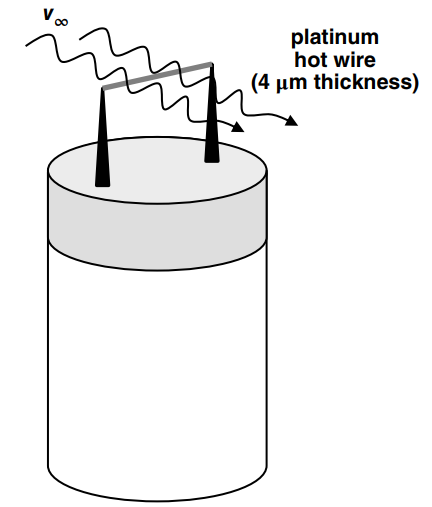
A hot-wire anemometer is a common instrument used to measure the velocity of a flowing gas. A typical probe tip is shown below.Electrical current is passed through a very thin wire of platinum or tungsten. The electrical resistance of the wire generates heat as the current passes through it, making
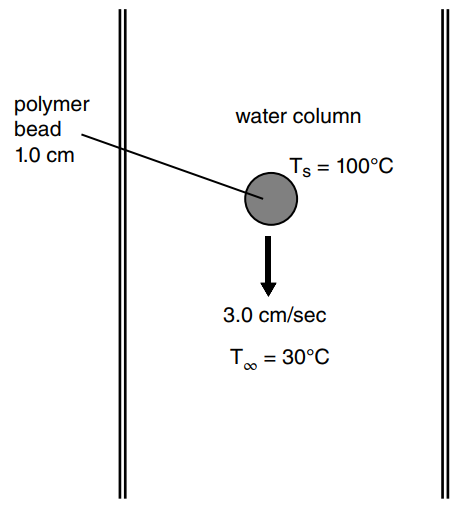
Hot polymer beads are being cooled by allowing them to settle slowly in a long cylindrical tank of water maintained at 30°C as shown in the figure. In this process, 1-cm-diameter spherical beads settle at a terminal velocity of 3 cm/s, which is based on the size of the bead and density of the
We are interested in predicting the time it will take for popcorn kernels to pop in a fluidized bed. The superficial air velocity inside the bed is 3 m/s, which is above the minimum fluidization velocity for popcorn kernels. The air temperature is maintained constant at 520 K (247°C) by heating
An electric light bulb rated at 60 W has a surface temperature of 145°C when cooled by atmospheric air at 25°C. The air flows past the bulb with a velocity of 0.5 m/s. The bulb can be modeled as a sphere with a diameter of 7.5 cm. Determine the heat transfer from the bulb by the mechanism of
What would be the results of Problem 20.18 if a fan provided an air flow normal to the conductor axis at a velocity of 9 m/s?Data From Problem 20.18If the steam line described in Problem 20.40 is bare and surrounded by still air at 70°F, what total heat transfer would be predicted from a 20-ft
Solve Problem 20.29 if the medium flowing past the tube in forced convection is MIL-M-5606 hydraulic fluid.Data From Problem 20.29An electric light bulb rated at 60 W has a surface temperature of 145°C when cooled by atmospheric air at 25°C. The air flows past the bulb with a velocity of 0.5 m/s.
Solve Problem 20.29 if the medium flowing past the tube in forced convection is water at 60°F.Data From Problem 20.29An electric light bulb rated at 60 W has a surface temperature of 145°C when cooled by atmospheric air at 25°C. The air flows past the bulb with a velocity of 0.5 m/s. The bulb
A 1-in., 16-BWG copper tube, 10ft long, has its outside surface maintained at 240°F. Air at 60°F and atmospheric pressure is forced past this tube with a velocity of 40 fps. Determine the heat flux from the tube to the air if the flow of air isa. Parallel to the tubeb. Normal to the tube axis
Saturated steam at 0.1 bar condenses on the outside of a copper tube having inner and outer diameters of 16.5 and 19 mm, respectively. The surface coefficients on the inner (water) surface and outer (steam) surface are 5200 and 6800 W/m2 · K, respectively.When the mean water temperature is 28 K,
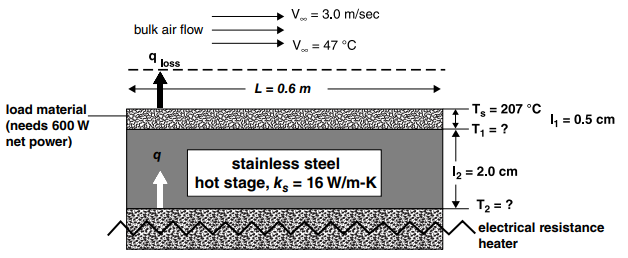
A €œhot stage€ for a manufacturing process is shown in the accompanying figure, where a slab of stainless steel is mounted on top of an electrical resistance heater. The stainless steel slab is 20 cm wide, 60 cm long, and 2 cm thick. A load material, which is placed on top of
A cooking oven has a top surface temperature of 45°C when exposed to still air. At this condition the inside oven temperature and room air temperature are 180°C and 20°C, respectively, and heat is transferred from the top surface at 40 W.To reduce the surface temperature, as required by safety
What thickness of insulation having a thermal conductivity as given in Problem 20.22 must be added to the steam pipe of Problem 20.40 in order that the outside temperature of the insulation not exceed 250°F?
Solve Problem 20.18 if 3 in. of insulation having a thermal conductivity of 0.060 Btu/h ft °F is applied to the outside of the pipe. Neglect radiation from the insulation. What will be the outside surface temperature of the insulation?Data From Problem 20.18If the steam line described in Problem
Solve Problem 20.18 if the bare pipe is located so that 295 K air flows normal to the pipe axis at a velocity of 6.5 m/s.Data From Problem 20.18If the steam line described in Problem 20.40 is bare and surrounded by still air at 70°F, what total heat transfer would be predicted from a 20-ft length
If the steam line described in Problem 20.40 is bare and surrounded by still air at 70°F, what total heat transfer would be predicted from a 20-ft length of bare pipe? Consider the bare pipe to be a black surface and the surroundings black at 70°F.Data From Problem 20.40Air at 60°F and
Work Problem 20.16 for an aluminum conductor of the same size (resistivity of aluminum = 2.83 × 10⁻⁶ ohm-cm).Data From Problem 20.16Copper wire with a diameter of 0.5 cm is covered with 0.65-cm layer of insulating material having a thermal conductivity of 0.242 W/m · K. The air adjacent to
Copper wire with a diameter of 0.5 cm is covered with 0.65-cm layer of insulating material having a thermal conductivity of 0.242 W/m · K. The air adjacent to the insulation is at 290 K. If the wire carries a current of 400 A, determinea. The convective heat-transfer coefficient between the
Given the conditions for Problem 20.14, determine the fraction of incident solar energy lost by convection to the surrounding air at 283 K flowing parallel to the collector surface at a velocity of 6.1 m/s.Data From Problem 20.14A solar energy collector measuring 20 × 20 ft is installed on a roof
A solar energy collector measuring 20 × 20 ft is installed on a roof in a horizontal position. The incident solar energy flux is 200 Btu/h ft2, and the collector surface temperature is 150°F. What fraction of incident solar energy is lost by convection to the stagnant surrounding air at a
A “swimming-pool” nuclear reactor, consisting of 30 rectangular plates measuring 1 ft in width and 3 ft in height, spaced 21/2 in. apart, is immersed in water at 80°F. If 200°F is the maximum allowable plate temperature, what is the maximum power level at which the reactor may operate?
A 0.6-m-diameter spherical tank contains liquid oxygen at 78 K. This tank is covered with 5 cm of glass wool. Determine the rate of heat gain if the tank is surrounded by air at 278 K. The tank is constructed of stainless steel 0.32 cm thick.
Solve Problem 20.10 if the medium surrounding the tube is stagnant water at 60°F.Data From Problem 20.10A 1-in., 16-BWG copper tube has its outside surface maintained at 240°F. If this tube is located in still air at 60°F, what heat flux will be achieved if the tube is orienteda. Horizontally?b.
A 1-in., 16-BWG copper tube has its outside surface maintained at 240°F. If this tube is located in still air at 60°F, what heat flux will be achieved if the tube is orienteda. Horizontally?b. Vertically?The tube length is 10 ft.
Determine the required time for the rubber balls described in Problem 20.8 to reach the condition such that the center temperature is 320 K. What will be the surface temperature when the center temperature reaches 320 K?Data From Problem 20.8Rubber balls are molded into spheres and cured at 360 K.
Rubber balls are molded into spheres and cured at 360 K. Following this operation they are allowed to cool in room air. What will be the elapsed time for the surface temperature of a solid rubber ball to reach 320 K when the surrounding air temperature is 295 K? Consider balls with diameters of
A copper cylinder 20.3 cm long with a diameter of 2.54 cm is being used to evaluate the surface coefficient in a laboratory experiment. When heated to a uniform temperature of 32.5°C and then plunged into a -1°C liquid bath, the center temperature of the cylinder reaches a value of 4.8°C in 3
Determine the steady-state surface temperature of an electric cable, 25 cm in diameter, which is suspended horizontally in still air in which heat is dissipated by the cable at a rate of 27 W per meter of length. The air temperature is 30°C.
A fluorescent light bulb, rated at 100 W, is illuminated in air at 25°C and atmospheric pressure. Under these conditions the surface temperature of the glass is 140°C. Determine the rate of heat transfer from the bulb by natural convection. The bulb is cylindrical, having a diameter of 35 mm and
A 2-in. copper cylinder, 6 in. in length, at a uniform temperature of 200°F, is plunged vertically into a large tank of water at 50°F.a. How long will it take for the outside surface of the cylinder to reach 100°F?b. How long will it take for the center of the cylinder to reach 100°F?c. What is
Water, at 60°F, enters a 1-in.-ID tube that is used to cool a nuclear reactor. The water flow rate is 30 gal/min. Determine the total heat transfer and the exiting water temperature for a 15-ft-long tube if the tube surface temperature is a constant value of 300°F. Compare the answer obtained
An immersion heater, rated at 1000 W, is in the form of a rectangular solid with dimensions 16 cm by 10 cm by 1 cm. Determine the surface temperature of the heater if it is oriented in 295 K water witha. The 16-cm dimension verticalb. The 10-cm dimension vertical
Repeat Problem 20.1 if the stagnant liquid isa. Bismuth at 700°Fb. Hydraulic fluid at 0°FData From Problem 20.1A 750-W immersion heater in the form of a cylinder with 3/4-in. diameter and 6 in. in length is placed in 95°F stagnant water. Calculate the surface temperature of the heater if it is
A 750-W immersion heater in the form of a cylinder with 3/4-in. diameter and 6 in. in length is placed in 95°F stagnant water. Calculate the surface temperature of the heater if it is oriented with its axisa. Verticalb. Horizontal
Work Problem 19.29 for the case in which the flowing fluid is sodium entering the tube at 200°F.Data From Problem 19.29Water at 60°F enters a 1-in.-ID tube that is used to cool a nuclear reactor. The water flow rate is 30 gal/min. Determine the total heat transfer, the exiting water temperature,
Work Problem 19.27 for the case in which the flowing fluid is sodium entering the tube at 200°F.Data From Problem 19.27Water, at 60°F, enters a 1-in.-ID tube that is used to cool a nuclear reactor. The water flow rate is 30 gal/min. Determine the total heat transfer and the exiting water
Work Problem 19.29 for the case in which the flowing fluid is air at 15 fps.Data From Problem 19.29Water at 60°F enters a 1-in.-ID tube that is used to cool a nuclear reactor. The water flow rate is 30 gal/min. Determine the total heat transfer, the exiting water temperature, and the wall
Water at 60°F enters a 1-in.-ID tube that is used to cool a nuclear reactor. The water flow rate is 30 gal/min. Determine the total heat transfer, the exiting water temperature, and the wall temperature at the exit of a 15-ft long tube if the tube wall condition is one of uniform heat flux of 500
Work Problem 19.27 for the case in which the flowing fluid is air at 15 fps.Data From Problem 19.27Water, at 60°F, enters a 1-in.-ID tube that is used to cool a nuclear reactor. The water flow rate is 30 gal/min. Determine the total heat transfer and the exiting water temperature for a 15-ft-long
Showing 300 - 400
of 972
1
2
3
4
5
6
7
8
9
10
Step by Step Answers

 Get 50% OFF
Claim Now
Get 50% OFF
Claim Now