New Semester
Started
Get
50% OFF
Study Help!
--h --m --s
Claim Now
Question Answers
Textbooks
Find textbooks, questions and answers
Oops, something went wrong!
Change your search query and then try again
S
Books
FREE
Study Help
Expert Questions
Accounting
General Management
Mathematics
Finance
Organizational Behaviour
Law
Physics
Operating System
Management Leadership
Sociology
Programming
Marketing
Database
Computer Network
Economics
Textbooks Solutions
Accounting
Managerial Accounting
Management Leadership
Cost Accounting
Statistics
Business Law
Corporate Finance
Finance
Economics
Auditing
Tutors
Online Tutors
Find a Tutor
Hire a Tutor
Become a Tutor
AI Tutor
AI Study Planner
NEW
Sell Books
Search
Search
Sign In
Register
study help
physics
fundamentals momentum heat
Fundamentals Of Momentum Heat And Mass Transfer 6th Edition James Welty, Gregory L. Rorrer, David G. Foster - Solutions
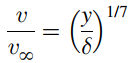
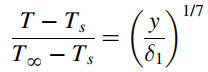
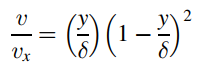
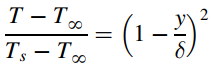
For the case of a turbulent boundary layer on a flat plate, the velocity profile has been shown to follow closely the form Assuming a temperature profile of the same form€”that is,and assuming that δ = δ1, use the integral relation for the boundary layer to
Repeat Problem 19.22 for velocity and temperature profiles of the formv = α sin by, T - Ts = α sin βyData From Problem 19.22Using the appropriate integral formulas for flow parallel to a flat surface with a constant free-stream velocity, develop expressions for the local Nusselt number in terms
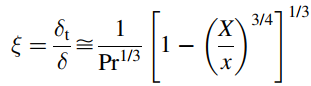
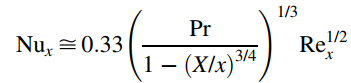
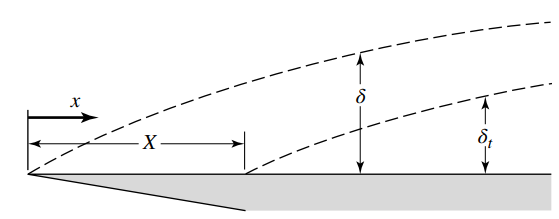
Shown in the figure is the case of a fluid flowing parallel to a flat plate, where for a distance X from the leading edge, the plate and fluid are at the same temperature. For values of x > X, the plate is maintained at a constant temperature, Ts, where Ts> Tˆž. Assuming a cubic
Repeat Problem 19.22 for velocity and temperature profiles of the formv = α + by + cy2 T - Ts = α + βy + vy2Data From Problem 19.22Using the appropriate integral formulas for flow parallel to a flat surface with a constant free-stream velocity, develop expressions for
Using the appropriate integral formulas for flow parallel to a flat surface with a constant free-stream velocity, develop expressions for the local Nusselt number in terms of Rex and Pr for velocity and temperature profiles of the formv = α + by, T - Ts = α + βy
Simplified relations for natural convection in air are of the form h = α(ΔT/L)βwhere α, β are constants; L is a significant length, in ft; ΔT is Ts, – T∞, in oF; and h is the convective heat-transfer coefficient, Btulh ft2 °F. Determine the values for α and β for the plane vertical
Determine the total heat transfer from the vertical wall described in Problem 19.19 to the surrounding air per meter of width if the wall is 2.5 m high.Data From Problem 19.19Using the relations from Problem 19.8, determine, for the case of air at 310 K adjacent to a vertical wall with its surface
Using the relations from Problem 19.8, determine, for the case of air at 310 K adjacent to a vertical wall with its surface at 420 K,a. The thickness of the boundary layer at x = 15 cm, 30 cm, 1.5 mb. The magnitude of hx at 15 cm, 30 cm, 1.5 mData From Problem 19.8Glycerin flows parallel to a flat
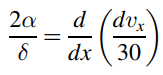
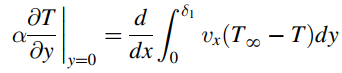
Using the integral relations from Problem 19.17, and assuming the velocity and temperature profiles of the form and where δ is the thickness of both the hydrodynamic and thermal boundary layers, show that the solution in terms of δ and vx from each integral
Ammonia (NH3) and hydrogen sulfide (H2S) must both be stripped from wastewater in a packed tower before the wastewater can be treated for reuse. Individual mass-transfer coefficients for ammonia transfer within a packed tower are kG = 3.20 × 10⁻⁹ kgmole/m2 · s · Pa for the gas film, and kL =
Show that, for the case of natural convection adjacent to a plane vertical wall, the appropriate integral equations for the hydrodynamic and thermal boundary layers are and Эт vz(T∞ – T)dy dx ду ly=0 dvx ду | (T - T)dy dx d vdy + Bg -V-
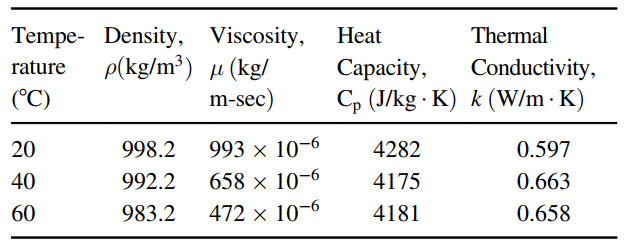
A 0.2-m-wide plate, 0.8 m long, is placed on the bottom of a shallow tank. The plate is heated, and maintained at a constant surface temperature of 60°C. Liquid water 12 cm deep flows over the flat plate with bulk volumetric flow rate of 2.4 × 10⁻³m3/s. The bulk liquid water
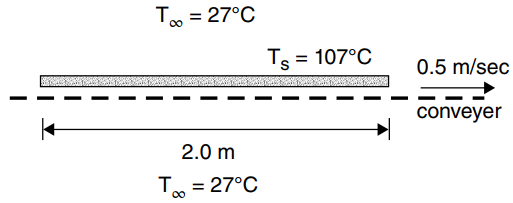
A newly cast polymer sheet is laid down on a moving conveyer belt to cool. A side view of the process is shown below. The polymer sheet measures 2 m by 1.5 m and is 1.5 mm thick. Because the conveyer belt is an open mesh, both sides of the polymer sheet are assumed to be uniformly exposed to air.
An engineered tissue system consists of a flat plate of cell mass immobilized on a scaffold measuring 5 cm in length, and is 0.5 cm thick. The bottom face of the scaffold is exposed to water and organic nutrients. The top face is exposed to flowing O2 gas to provide O2 for aerobic respiration.
A blacktop road surface 18.3 m wide receives solar radiation at the rate of 284 W/m2 at noon and 95 W/m2 are lost by re-radiation to the atmosphere. A wind, at 300 K, flows across the road. Determine the wind velocity that will cause the road surface to be at 308 K if all energy not re-radiated to
Use the results of Problem 19.22 along with those of Chapter 12 to determine δ, Cfx, δ1, and hx at a distance of 40 cm from the leading edge of a flat plane. Air with a free-stream velocity of 5 m/s and T∞ = 300 K flows parallel to the plate surface. The first 20 cm of the plate is unheated;
A plane surface 25 cm wide has its temperature maintained at 80°C. Atmospheric air at 25°C flows parallel to the surface with a velocity of 2.8 m/s. Using the results of boundary layer analysis, determine the following for a 1-m long plate:a. The mean coefficient of skin friction, CfLb. The total
Nitrogen at 100°F and 1 atm flows at a velocity of 100 fps. A flat plate 6 in. wide, at a temperature of 200°F, is aligned parallel to the direction of flow. At a position 4 ft from the leading edge, determine the following(a) δ;(b) δt;(c) Cfx;(d) Cfl;(e) hx;(f) h;(g) Total drag force;(h) Total
Given the conditions specified in Problem 19.8, construct a plot of local heat-transfer coefficient vs. position along the plate for glycerin temperatures of 30°F, 50°F, and 80°F.Data From Problem 19.8Glycerin flows parallel to a flat plate measuring 2 ft by 2 ft with a velocity of 10 fps.
Glycerin flows parallel to a flat plate measuring 2 ft by 2 ft with a velocity of 10 fps. Determine values for the mean convective heat-transfer coefficient and the associated drag force imposed on the plate for glycerin temperatures of 350°F, 50°F, and 180°F. What heat flux will result, in each
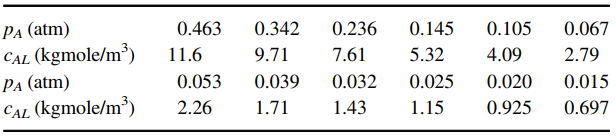
A mass-transfer process is used to remove ammonia (NH3, solute A) from a mixture of NH3and air, using water as the absorption solvent. At the present conditions of operation, the partial pressure of ammonia in the bulk gas phase (pA) is 0.20 atm, and the mole fraction of dissolved NH3in the water
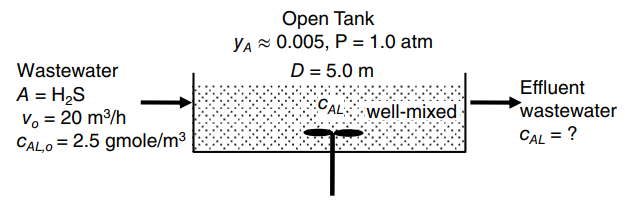
Wastewater containing dissolved hydrogen sulfide (H2S) at concentration of 2.50 gmole/m3(85 mg/L) enters an open tank at a volumetric flow rate of 20 m3/h, and exits at the same volumetric flow rate, as shown in the figure on the next page. The open tank is within a large enclosed building. The
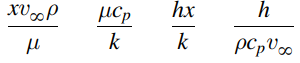
Plot the parameters xv∞Ï/µ, µcp,/k, hx/k, and h/Ïcpv∞vs. temperature for air, water, and glycerin, using the values for x, h, and v from Problem 19-2.Data From Problem 19-2Dimensional analysis has shown the following parameters to be significant for forced convection:Evaluate
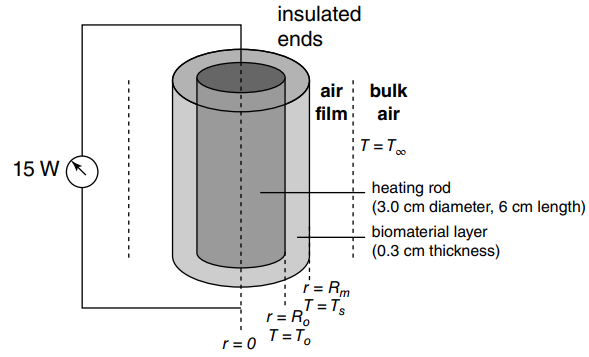
The device shown in the figure below is used to estimate the thermal conductivity of a new bio material by measuring the steady-state heat-transfer rate and temperature. The bio material is wrapped around the cylindrical heating rod as shown in the figure. The exposed ends of the device are sealed
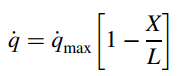
Heat is generated in a radioactive plane wall according to the relationshipwhere q̇ is the volumetric heat generation rate, kW/m3, L is the half thickness of the plate, and x is measured from the plate center line.Develop the equation that expresses the temperature difference between
In a thermal heat sink the heat flux variation along the axis of a cooling passage is approximated as
Given the information in Problem 19.4, determine the total heat transferred for a stack of plates with a combined surface area of 640 ft2, each plate being 4 ft wide.Data From Problem 19.4The fuel plates in a nuclear reactor are 4 ft long and stacked with a 1/2-in. gap between them. The heat flux
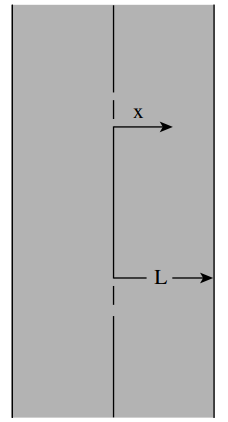
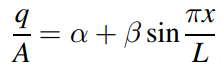
The fuel plates in a nuclear reactor are 4 ft long and stacked with a 1/2-in. gap between them. The heat flux along the plate surfaces varies sinusoidally according to the equation where α = 250 Btu/h ft2, β = 1500 Btu/h ft2, x is the distance from the leading edge of
Dimensional analysis has shown the following parameters to be significant for forced convection:Evaluate each of these parameters at 340 K, for air, water, benzene, mercury, and glycerin. The distance x may be taken as 0.3 m, vˆž = 15 m/s, and h = 34 W/m2 · K. hx хUр ДСр k k
Using dimensional analysis, demonstrate that the parametersare possible combinations of the appropriate variables in describing unsteady-state conduction in a plane wall. at х hL and L? To – T. k
A masonry brick wall 0.45 m thick has a temperature distribution at time, t = 0 which may be approximated by the expression T(K) = 520 + 330 sinπ (x/L) where L is the wall width and x is the distance from either surface. How long after both surfaces of this wall are exposed to air at 280 K will
A brick wall (α = 0.016 ft2/h) with a thickness of 1 1/2 ft is initially at a uniform temperature of 80°F. How long, after the wall surfaces are raised to 300°F and 600°F, respectively, will it take for the temperature at the center of the wall to reach 300°F?
If the temperature profile through the ground is linear, increasing from 35°F at the surface by 0.5°F per foot of depth, how long will it take for a pipe buried 10 ft below the surface to reach 32°F if the outside air temperature is suddenly dropped to 0°F. The thermal diffusivity of soil may
If the heat flux into a solid is given as F(t), show that the penetration depth d for a semi-infinite solid is of the form 1/2 ך [LF(1)di] F(t) 8 = (constant)/a
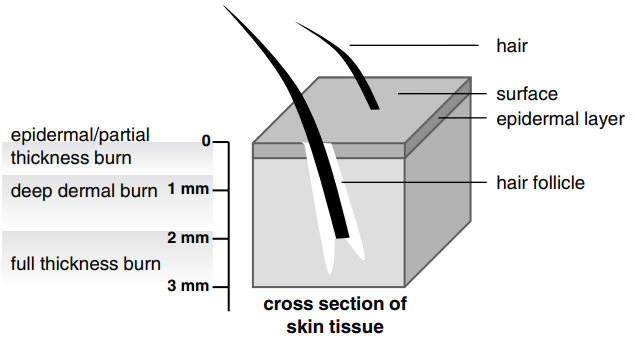
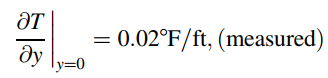
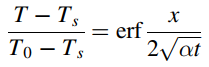
The severity of a burn on human skin is determined by the surface temperature of the hot object contacting the skin and the time of exposure. Skin is considered to be in a damaged state if its temperature is allowed to reach 62.5°C. Consider that, for relatively short times, near the surface of
A thick plate made of stainless steel is initially at a uniform temperature of 300°C. The surface is suddenly exposed to a coolant at 20°C with a convective surface coefficient of 110 W/m2 · K. Evaluate the temperature after 3 min of elapsed time ata. The surfaceb. A depth of 50 mmWork this
A stainless steel bar is initially at a temperature of 25°C. Its upper surface is suddenly exposed to an air stream at 200°C, with a corresponding convective coefficient of 22 W/m2 · K. If the bar is considered semi-infinite, how long will it take for the temperature at a distance of 50 mm from
How long will a 1-ft-thick concrete wall subject to a surface temperature of 1500°F on one side maintain the other side below 130°F? The wall is initially at 70°F.
Air at 65°F is blown against a pane of glass 1/8 in. thick. If the glass is initially at 30°F, and has frost on the outside, estimate the length of time required for the frost to begin to melt.
A thick wall of oak, initially at a uniform temperature of 25°C, is suddenly exposed to combustion exhaust at 800°C. Determine the time of exposure required for the surface to reach its ignition temperature of 400°C, when the surface coefficient between the wall and combustion gas is 20 W/m2 ·
The convective heat-transfer coefficient between a large brick wall and air at 100°F is expressed as h = 0.44 (T - T∞)1/3 Btu/h ft2 °F. If the wall is initially at a uniform temperature of 1000°F, estimate the temperature of the surface after 1, 6, and 24 h.
Soil, having a thermal diffusivity of 5.16 × 10⁻⁷ m2/s, has its surface temperature suddenly raised and maintained at 1100 K from its initial uniform value of 280 K. Determine the temperature at a depth of 0.25 m after a period of 5 h has elapsed at this surface condition.
Determine an expression for the depth below the surface of a semi-infinite solid at which the rate of cooling is maximum. Substitute the information given in Problem 18.22 to estimate how far below Earth’s surface this maximum cooling rate is achieved.Data From Problem 18.22In the canning
After a fire starts in a room, the walls are exposed to combustion products at 950°C. If the interior wall surface is made of oak, how long after exposure to the fire will the wood surface reach its combustion temperature of 400°C? Pertinent data are the following:h = 30 W/m2 · KTi (initial) =
One estimate of the original temperature of Earth is 7000°F. Using this value and the following properties for Earth€™s crust, Lord Kelvin obtained an estimate of 9.8 × 10⁷years for the Earth€™s age:α = 0.0456 ft2 /hT2 = 0oFComment on Lord
A rocket-engine nozzle is coated with a ceramic material having the following properties: k = 1.73 Btu/h ft °F, α = 0.35 ft2 /h. The convective heat-transfer coefficient between the nozzle and the gases, which are at 3000°F, is 200 Btu/h ft2 °F. How long after start-up will it take for the
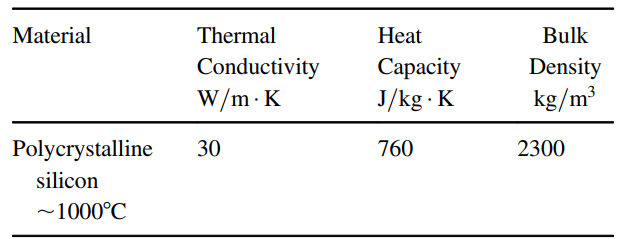
A flat silicon wafer 15 cm in diameter (surface area 176.7 cm2) is removed from an annealing furnace and laid flat-side down onto a flat insulating surface. It is then allowed to cool down to room temperature,which is maintained at a constant 20°C (293 K). Initially the silicon wafer is at
Drug formulations contain an active drug dissolved in a nontoxic solution to facilitate its delivery into the body. They are often packaged into sterile syringes so that the patient can inject the drug formulation directly into the body and then throw the syringe away. Often the drug-loaded
One step in the manufacture of silicon wafers used in the microelectronics industry is the melt crystallization of silicon into a crystalline silicon ingot. This process is carried out within a special furnace. When the newly, solidified ingot is removed from the furnace, it is assumed to have a
In the canning process, sealed cans of food are sterilized with pressurized steam in order to kill any microorganisms initially present in the food and thereby prolong the shelf life of the food. A cylindrical can of food has a diameter of 4 cm and length of 10 cm. The food material has a heat
At an expensive restaurant, a customer makes an unusual request of the chef. She asks that her steak be cooked on a grill until the meat reaches a temperature of 100°C at a depth of 2 mm. The chef knows that the griddle surface temperature is maintained at 250°C, the steak was stored at 0°C, and
Given the cylinder in Problem 18.15, construct a plot of the time for the midpoint temperature to reach 530 K as a function of H/D, where H and D are the height and diameter of the cylinder, respectively.Data From Problem 18.15For an asbestos cylinder with both height and diameter of 13 cm
This problem involves using heat-transfer principles as a guide for cooking a pork roast. The roast is to be modeled as a cylinder, having its length and diameter equal to each other, with properties being those of water. The roast weighs 2.25 kg.Properly cooked, every portion of the meat
Consider a hot dog to have the following dimensions and properties: diameter = 20 mm, cp = 3.35 kJ/kg · K, ρ = -880 kg/ m3, and k = 0.5 W/m · K. For the hot dog initially at 5°C, exposed to boiling water at 100°C, with a surface coefficient of 90W/m2 · K, what will be the cooking time if
Rework Problem 18-4 for the case when air is blown by the surfaces of the rubber block with an effective surface coefficient of 230 W/m2 · K.Data From Problem 18-4Cast-iron cannonballs used in the War of 1812 were occasionally heated for some extended time so that, when fired at houses or ships,
A copper bus bar is initially at 400°F. The bar measures 0.2 ft by 0.5 ft and is 10 ft long. If the edges are suddenly all reduced to 100°F, how long will it take for the center to reach a temperature of 250°F?
For an asbestos cylinder with both height and diameter of 13 cm initially at a uniform temperature of 295 K placed in a medium at 810 K with an associated convective heat-transfer coefficient of 22.8 W/m2 · K, determine the time required for the center of the cylinder to reach 530 K if end effects
It is common practice to treat wooden telephone poles with tar-like materials to prevent damage by water and insects. These tars are cured into the wood at elevated temperatures and pressures.Consider the case of a 0.3-m-diameter pole, originally at 25°C, placed in a pressurized oven. It will be
In the curing of rubber tires, the “vulcanization” process requires that a tire carcass, originally at 295 K, be heated so that its central layer reaches a minimum temperature of 410 K. This heating is accomplished by introducing steam at 435 K to both sides. Determine the time required, after
A type-304 stainless steel billet, 6 in. in diameter, is passing through a 20-ft-long heat-treating furnace. The initial billet temperature is 200°F, and it must be raised to a minimum temperature of 1500°F before working. The heat-transfer coefficient between the furnace gases and the billet
If a rectangular block of rubber (see Problem 18-12 for properties) is set out in air at 297 K to cool after being heated to a uniform temperature of 420 K, how long will it take for the rubber surface to reach 320 K? The dimensions of the block are 0.6 m high by 0.3 m long by 0.45 m wide. The
A cylinder 2 ft high with a diameter of 3 in. is initially at the uniform temperature of 70°F. How long after the cylinder is placed in a medium at 1000°F, with associated convective heat transfer coefficient of 4 Btu/h ft2 °F, will the center temperature reach 500°F if the cylinder is made
A copper cylinder with a diameter of 3 in. is initially at a uniform temperature of 70°F. How long after being placed in a medium at 1000°F with an associated convective heat-transfer coefficient of 4 Btu/h ft2 °F will the temperature at the center of the cylinder reach 500°F, if the height of
Buckshot, 0.2 in. in diameter, is quenched in 90°F oil from an initial temperature of 400°F. The buckshot is made of lead and takes 15 s to fall from the oil surface to the bottom of the quenching bath. If the convective heat-transfer coefficient between the lead and oil is 40 Btu/h ft2 °F, what
A short aluminum cylinder 0.6 m in diameter and 0.6 m long is initially at 475 K. It is suddenly exposed to a convective environment at 345 K with h = 85 W/m2 · K. Determine the temperature in the cylinder at a radial position of 10 cm and a distance of 10 cm from one end of the cylinder after
Water, initially at 40°F, is contained within a thin-walled cylindrical vessel having a diameter of 18 in. Plot the temperature of the water vs. time up to 1 h if the water and container are immersed in an oil bath at a constant temperature of 300°F. Assume that the water is well stirred and that
It is known that oranges can be exposed to freezing temperatures for short periods of time without sustaining serious damage. As a representative case, consider a 0.10-m-diameter orange, originally at a uniform temperature of 5°C, suddenly exposed to surrounding air at -5°C. For a surface
Cast-iron cannonballs used in the War of 1812 were occasionally heated for some extended time so that, when fired at houses or ships, they would set them afire. If one of these, the so-called “hot shot,” were at a uniform temperature of 2000°F, how long after being exposed to air at 0°F with
Aluminum wire, having a diameter of 0.794 mm, is immersed in an oil bath that is at 25°C. Aluminum wire of this size has an electrical resistance of 0.0572 Ω/m. For conditions where an electric current of 100 A is flowing through the wire and the surface coefficient between the wire and oil bath
An electrical system employs fuses that are cylindrical in shape and have lengths of 0.5 cm and diameters of 0.1 mm. Air, at 30°C, surrounds a fuse with a surface coefficient of 10 W/m2 ? K. The fuse material melts at 900°C. Assuming all heat transfer to be from the fuse surface, estimate
A household iron has a stainless steel sole plate that weights 3 lb and has a surface area of 0.5 ft2. The iron is rated at 500 W. If the surroundings are at a temperature of 80°F, and the convective heat-transfer coefficient between the sole plate and surroundings is 3 Btu/h ft2 °F, how long
A 32.4-cm-OD pipe, 145-cm long, is buried with its center line 1.2 m below the surface of the ground. The ground surface is at 280 K and the mean thermal conductivity of the soil is 0.66W/m · K. If the pipe surface is at 370 K, what is the heat loss per day from the pipe?
Saturated steam at 400°F is transported through the 1-ft pipe shown in the figure, which may be assumed to be at the steam temperature. The pipe is centered in the 2-ft-square duct, whose surface is at 100°F. If the space between the pipe and duct is filled with powdered 85% magnesia
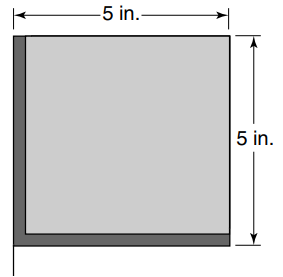
A 5-in. standard-steel angle is attached to a wall with a surface temperature of 600°F. The angle supports a 4.375-in. by 4.375-in. section of building bring whose mean thermal conductivity may be taken as 0.38 Btu/h ft °F. The convective heat transfer coefficient between all surfaces and
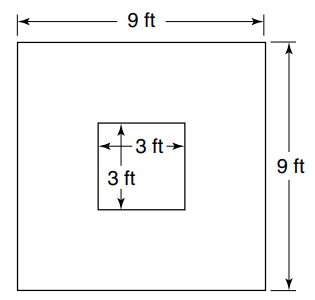
Repeat the previous problem, using a grid size of 1 ft.Data From Previous ProblemDetermine the heat flow per foot for the configuration shown, using the numerical procedure for a grid size of 1 1/2 ft. The material has a thermal conductivity of 0.15 Btu/h ft °F. The inside and outside
Determine the heat flow per foot for the configuration shown, using the numerical procedure for a grid size of 1 1/2 ft. The material has a thermal conductivity of 0.15 Btu/h ft °F. The inside and outside temperatures are at the uniform values of 200°F and 0°F, respectively. 9 ft -3 ft>
A cylindrical tunnel with a diameter of 2 m is dug in permafrost (k = - 0.341 W/m2 · K) with its axis parallel to the permafrost surface at the depth of 2.5 m. Determine the rate of heat loss from the cylinder walls, at 280 K, to the permafrost surface at 220 K.
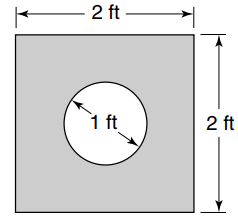
Find the rate of heat transfer from a 3-in.-OD pipe placed eccentrically inside a 6-in.-ID cylinder with the axis of the smaller pipe displaced 1 in. from the axis of the large cylinder. The space between the cylindrical surfaces is filled with rock wool (k = 0.023 Btu/h ft °F). The surface
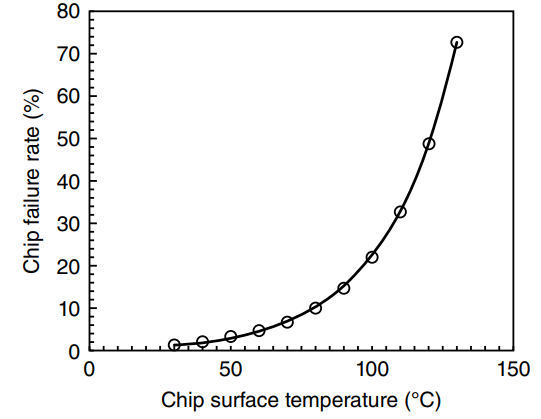
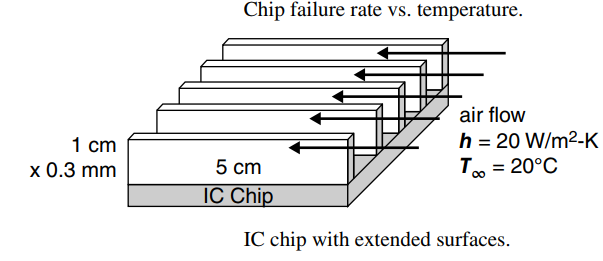
A computer graphics chip measures 5 cm on a side and is 3-mm thick. The chip consumes 15 W of power, which is dissipated as heat from the top side of the chip. A fan blows air over the surface of the chip to promote convective heat transfer. Unfortunately, the chip fails to operate after a certain
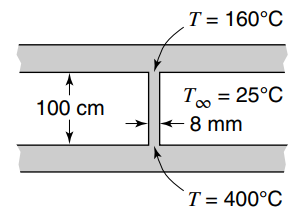
Water flows in the channels between two aluminum plates as shown in the sketch. The ribs that form the channels are also made of aluminum and are 8-mm thick. The effective surface coefficient between all surfaces and water is 300 W/m2· K. For these conditions, how much heat is transferred at
Repeat Problem 17.45 for the case of an aluminum pipeand-fin arrangement.Data From Problem 17.45A 2-in.-OD stainless steel tube has 16 longitudinal fins spaced around its outside surface as shown. The fins are 1/16-in. thick and extend 1 in. from the outside surface of the tube.a. If the outside
A 2-in.-OD stainless steel tube has 16 longitudinal fins spaced around its outside surface as shown. The fins are 1/16-in. thick and extend 1 in. from the outside surface of the tube.a. If the outside surface of the tube wall is at 250°F, the surrounding air is at 80°F, and the convective
Heat from a flat wall is to be enhanced by adding straight fins, of constant thickness, made of stainless steel. The following specifications apply:h
Circular fins are employed around the cylinder of a lawn mower engine to dissipate heat. The fins are made of aluminum are 0.3-m thick, and extend 2 cm from base to tip. The outside diameter of the engine cylinder is 0.3 m. Design operating conditions are T∞ = 30°C and h = 12 W/m2
Repeat Problem 17.41 for the case of an aluminium beam.Data From Problem 17.41A steel I-beam with a cross-sectional area as shown has its lower and upper surfaces maintained at 700 and 370 K, respectively.a. Assuming a negligible temperature change through both flanges, develop an expression for
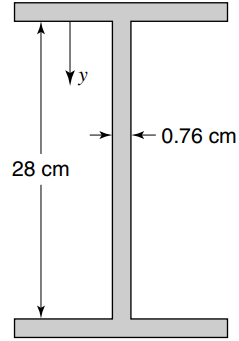
A steel I-beam with a cross-sectional area as shown has its lower and upper surfaces maintained at 700 and 370 K, respectively.a. Assuming a negligible temperature change through both flanges, develop an expression for the temperature variation in the web as a function of the distance from the
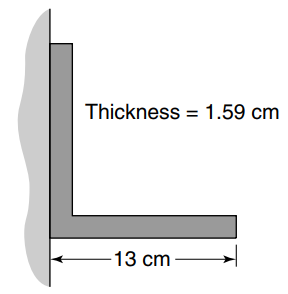
A 13 cm by 13 cm steel angle with the dimensions shown is attached to a wall with a surface temperature of 600 K. The surrounding air is at 300 K, and the convective heat-transfer coefficient between the angle surface and the air is 45 W/m2· K.a. Plot the temperature profile in the angle,
A copper rod 1/4 in. in diameter and 3-ft long runs between two bus bars, which are at 60°F. The surrounding air is at 60°F, and the convective heat-transfer coefficient is Btu/h ft2 °F. Assuming the electrical resistivity of copper to be constant at 1.72 × 10⁻⁶ ohm – cm, determine the
An iron bar used for a chimney support is exposed to hot gases at 625 K with the associated convective heat-transfer coefficient of 740 W/m2 · K. The bar is attached to two opposing chimney walls, which are at 480 K. The bar is 1.9 cm in diameter and 45-cm long. Determine the maximum temperature
A semiconductor material with k = 2 W/m · K and electrical resistivity, ρ = 2 × 10⁻⁵ Ω - m, is used to fabricate a cylindrical rod 40-mm long with a diameter of 10 mm. The longitudinal surface of the rod is well insulated and may be considered adiabatic while the ends are maintained at
Heat is to be transferred from water to air through an aluminum wall. It is proposed to add rectangular fins 0.05-in. thick and 3/4-in. long spaced 0.08 in. apart to the aluminium surface to aid in transferring heat. The heat-transfer coefficients on the air and water sides are 3 and 25 Btu/h ft2
A cylindrical rod 3 cm in diameter is partially inserted into a furnace with one end exposed to the surrounding air, which is at 300 K. The temperatures measured at two points 7.6 cm apart are 399 and 365 K, respectively. If the convective heat-transfer coefficient is 17 W/m2 · K, determine the
Solve Problem 17.33 if the convective heat-transfer coefficient is increased to 60 Btu/h ft2 °F by forcing air past the tube surface.Data From Problem 17.33A 1-in.-OD steel tube has its outside wall surface maintained at 250°F. It is proposed to increase the rate of heat transfer by adding fins
A 1-in.-OD steel tube has its outside wall surface maintained at 250°F. It is proposed to increase the rate of heat transfer by adding fins of 3/32-in. thickness and 3/4-in. long to the outside tube surface. Compare the increase in heat transfer achieved by adding 12 longitudinal straight fins or
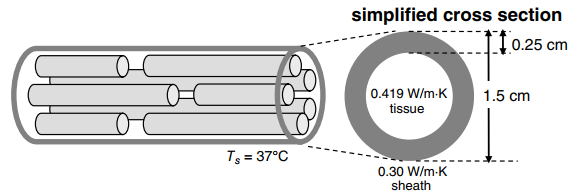
Consider a section of muscle tissue of cylindrical shape with a radius of 1.5 cm. During highly rigorous exercise, metabolic processes generate 15 kW/m3of bulk tissue. The outer surface of the tissue is maintained at 37°C.The thermal conductivity of the muscle tissue is km = 0.419 W/m ·
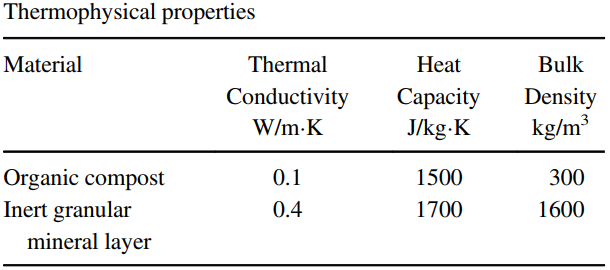
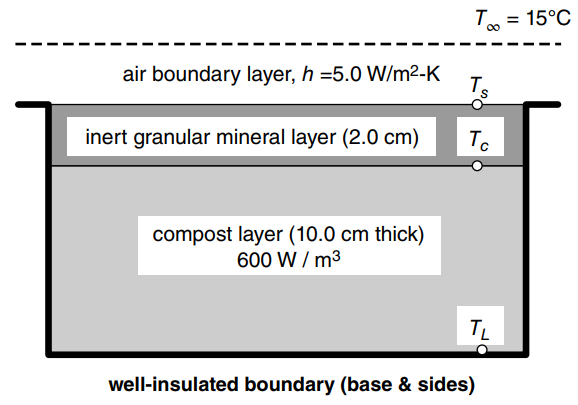
Consider the compost bed shown in the right-hand figure. The dimensions of the bed are 1 m by 2 m. A 10-cm (0.10-m) thick layer of organic compost lines the bottom as shown. Slow bacterial decomposition of the organic material in the compost generates heat at a constant rate of 600 W per m3of
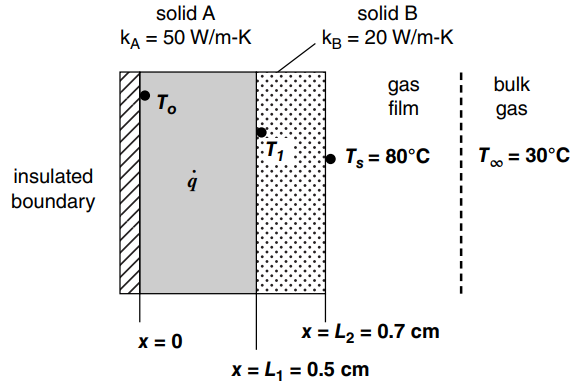
Consider the composite solid shown. Solid A is a thermally conductive material that is 0.5-cm thick and has a thermal conductivity, kA= 50 W/m · K. The back side of solid A (x = 0) is thermally insulated. Electrical current is applied to solid A such that 20 W per cm3is generated
An engineered tissue system consists of a slice of cell mass immobilized on a scaffold measuring 5 cm in length and 0.5 cm in thickness. The top face of the tissue scaffold is exposed to water, dissolved oxygen, and organic nutrients maintained at 30°C. The bottom face of the tissue is thermally
Radioactive waste is stored in a cylindrical stainless steel container with inner and outer diameters of 1 m and 1.2 m, respectively, so that R0 = 0.5 m and R1 = 0.6 m. Thermal energy is generated uniformly within the waste material at a volumetric rate of 2 × 10⁵ W/m3. The outer container surface
A cylindrical nuclear fuel element is 10.16 cm long and 10.77 cm in diameter. The fuel generates heat uniformly at a rate of 51.7 × 10³ kJ/s · m3. The fuel is placed in an environment having a temperature of 360 K with a surface coefficient of 4540 W/m2 · K. The fuel material has k = 33.9 W/m ·
Showing 400 - 500
of 972
1
2
3
4
5
6
7
8
9
10
Step by Step Answers

 Get 50% OFF
Claim Now
Get 50% OFF
Claim Now





![1/2 ך [LF(1)di] F(t) 8 = (constant)/a](https://dsd5zvtm8ll6.cloudfront.net/si.question.images/images/question_images/1540/3/7/7/6785bd04c4ed4f211540360133062.jpg)