New Semester
Started
Get
50% OFF
Study Help!
--h --m --s
Claim Now
Question Answers
Textbooks
Find textbooks, questions and answers
Oops, something went wrong!
Change your search query and then try again
S
Books
FREE
Study Help
Expert Questions
Accounting
General Management
Mathematics
Finance
Organizational Behaviour
Law
Physics
Operating System
Management Leadership
Sociology
Programming
Marketing
Database
Computer Network
Economics
Textbooks Solutions
Accounting
Managerial Accounting
Management Leadership
Cost Accounting
Statistics
Business Law
Corporate Finance
Finance
Economics
Auditing
Tutors
Online Tutors
Find a Tutor
Hire a Tutor
Become a Tutor
AI Tutor
AI Study Planner
NEW
Sell Books
Search
Search
Sign In
Register
study help
physics
modern physics
Modern Physics 6th Edition Paul A. Tipler, Ralph Llewellyn - Solutions
Consider the possible fission reaction(a) Compute the energy released in the reaction. (b) Is this reaction likely to occur? Explain. 120, n+ 235U-¹2Cd + ¹/R + 3n 44 92
(a) Assuming that the natural abundance of deuterium given in Appendix A is reflected in the formation of water molecules, compute the energy that would be released if all the deuterons in 1.0 m3 of water were fused via the reaction 2H + 1H → 3He + ϒ.(b) Given that the world’s 5.9 x 10⁹ people
A bone claimed to be 10,000 years old contains 15 g of carbon. What should the decay rate of 14C be for this bone?
A sample of animal bone unearthed at an archeological site is found to contain 175 g of carbon, and the decay rate of 14C in the sample is measured to be 8.1 Bq. How old is the bone?
The 87Rb/87Sr ratio for a particular rock is measured to be 36.5. How old is the rock?
In a PIXE experiment, an element with A = 80 forms 0.001 percent by weight of a thin foil whose mass is 0.35 mg/cm2. The foil is bombarded with a 250 nA proton beam for 15 minutes. The cross section for exciting the L shell is 650 b. If the probability that the excited atom will emit an L x ray is
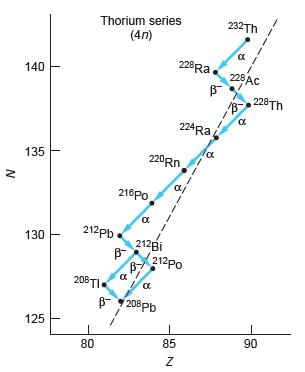
The naturally occurring A = 4n decay series begins with 232Th and eventually ends on 208Pb (see Figure 11-18). A particular rock is measured to contain 4.11 g of 232Th and 0.88 g of 208Pb. Compute the age of the rock.Figure 11-18 N 140 135 130 125 Thorium series (4n) 212pb 208
Compute the resonance frequency of free protons in a magnetic field of (a) 0.5 x 10⁻⁴ T (the approximate strength of Earth’s field), (b) 0.25 T, and (c) 0.5 T.
A small piece of papyrus is to be 14C-dated using AMS. During a 10-minute run with the system set to record 14C, 1500 ions are counted. With the system set to transmit 12C+3 ions, the beam current is 12 μA.(a) Compute the 14C/12C ratio, assuming both isotopes are transmitted with the same
A wooden spear thrower found in the mountains of southeastern Spain had 14C activity of 2.05 disintegrations per minute per gram. How old is it? (The 14C activity of live wood is 15.6 disintegrations per minute per gram.)
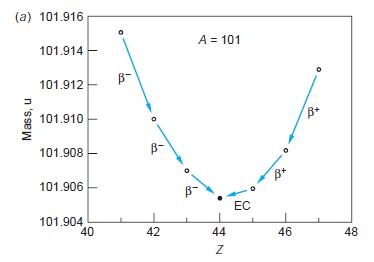
Using Equation 11-14 and the constants in Table 11-3, find the Z for which dM/dZ = 0, that is, the minimum of curves like Figure 11-22a for(a) A = 27, (b) A = 65, and (c) A = 139. Do these calculations give the correct stable isobars 27Al, 65Cu, and 139La?Figure 11-22a (a) 101.916 Mass,
An empirical expression for distance that a particles can travel in air, called the range, is R(cm) = (0.31)E3/2 for E in MeV and 4 < E < 7 MeV.(a) What is the range in air of a 5 MeV a particle? (b) Express this range in g/cm2, using ρ = 1.29 x 10⁻³ g/cm3 for air.(c) Assuming the
Show that the average electrostatic energy of a proton proton pair is about 6ke2/5R, where R is the separation of the pair and k = 1/4π∈0.
A sample of 114Nd has a mass of 0.05394 kg and emits an average of 2.36 a particles per second. Determine the decay constant and the half-life.
The half-life of 227Th is 18.72 days. It decays by a emission to 223Ra, an a emitter whose half-life is 11.43 days. A particular sample contains 106 atoms of 227Th and no 223Ra at time t = 0. (a) How many atoms of each type will be in the sample at t = 15 days?(b) At what time will the number
The Mössbauer effect was discovered using the decay of the 0.12939 MeV second excited state of 191Ir. The lifetime of this isomer is 0.13 ns.(a) Compute the width Г of this level.(b) Compute the recoil energy of a free 191Ir atom that emits the 0.12939 MeV photon.(c) Resonant (recoilless)
3He and 3H are a pair of mirror nuclei. Compute the difference in total binding energy between the two nuclides and compare the result to the electrostatic repulsion of the protons in 3He. Let the protons be separated by the radius of the helium nucleus.
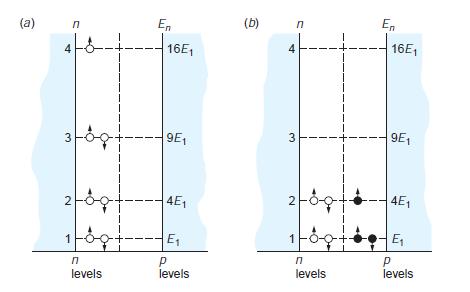
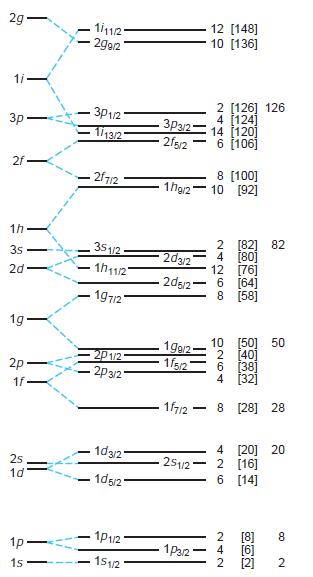
(a) Use Figure 11-35 to make a diagram like Figure 11-9 for the ground state of 11B. What do you predict for the value of j for this state? (b) The first excited state of 11B involves excitation of a proton. Draw the diagram for this state and predict its j value.(c) The j value for the second
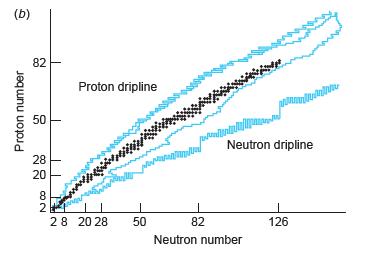
Approximately 2000 nuclides remain to be discovered between the proton and neutron driplines in Figure 11-15b. Consider those that lie on the energy parabola (see Figure 11-22a) for A = 151, whose only stable isotope is 151Eu.(a) From the data in Appendix A, draw an accurate diagram of the A = 151
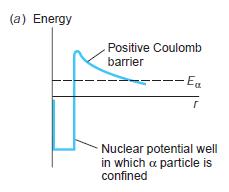
The centripetal force of a nucleus with I ≠ 0 makes it more stable toward a decay. Use Figure 11-1a and a (classical) argument to show why this is the case.Figure 11-1a (a) Energy Positive Coulomb barrier --Ea Nuclear potential well in which a particle is confined
(a) Compute the binding-energy differences between the two nuclides of the mirror pairs (7Li, 7Be), (11B, 11C), and (15N, 15O). (b) From each value computed in (a), determine a value of the constant a3 in Equation 11-14. Compare each value and their average with the value given in Table 11-3.
A photon of energy E is incident on a deuteron at rest. In the center-of-mass reference frame, both the photon and the deuteron have momentum p. Prove that the approximation p ≈ E/c is good by showing that the deuteron with this momentum has energy much less than E. If the binding energy of the
(a) Using the Compton scattering result that the maximum change in wavelength is Δλ = 2hc/Mc2 and the approximation ΔE ≈ hcΔλ/λ2, show that for a photon to lose an amount of energy Ep to a proton, the energy of the photon must be at least E = [ (1/2) Mc2Ep ]1/2.(b) Calculate the photon
Neutron activation analysis is used to study a small sample of automotive enamel found at the scene of a hit-and-run collision. The sample was exposed to a thermal neutron flux of 3.5 x 10¹² neutrons/cm2 . s for 2.0 minutes. Placed immediately in a gamma-ray detector, it was found to have an
There are theoretical reasons to expect that a cluster of relatively long-lived nuclides will exist in the neighborhood of the doubly magic nucleus with Z = 126 and N = 184, the latter being the next magic number beyond 126 predicted by the shell model.(a) Compute the mass of this exotic nucleus
The (4n + 3) decay chain begins with 235U and ends on 207Pb.(a) How many a decays are there in the chain? (b) How many β decays are there? (c) Compute the total energy released when one 235U atom decays through the complete chain. (d) Assuming no energy escapes, determine the
The Sun is moving with speed 2.5 x 10⁵ m/s in a circular orbit about the center of the Galaxy. How long (in Earth years) does it take to complete one orbit? How many orbits has it completed since it was formed?
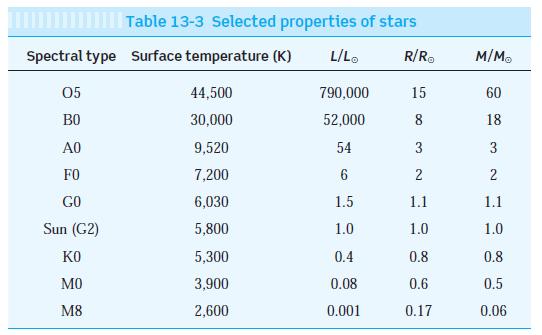
Using data from Table 13-3, construct a graph that demonstrates the validity of Equation 13-17.Table 13-3 Spectral type Surface temperature (K) 05 ВО A0 FO GO Sun (G2) ΚΟ Table 13-3 Selected properties of
The reason that massive neutrinos were considered as a candidate for solving the missing mass problem is that, at the conclusion of the lepton era, the universe contained about equal numbers of photons and neutrinos. They are still here, for the most part. The former can be observed and their
A unit of length often used by astronomers to measure distances in “nearby” space is the parsec (pc), defined as the distance at which a star subtends a parallax angle of one arc second due to Earth’s orbit around the Sun (see Equation 13-11 and Example 13-4). The practical limit of such
Astronomers often use the apparent magnitude m as a means of comparing the visual brightness of stars and relating the comparison to the luminosity and distance to “standard” stars, such as the Sun (see Equation 13-9). The difference in the apparent magnitudes of two stars m1 and m2 is defined
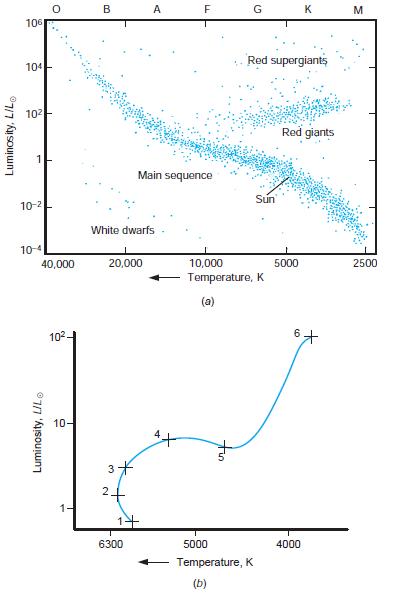
Using the H-R diagram (Figure 13-17), determine the effective temperature and the luminosity of a star whose mass is(a) 0.3 MΘ and (b) 3 MΘ. (c) Compute the radius of each star. (d) Determine their expected lifetimes relative to that of the Sun.Figure 13-17 Luminosity,
Two stars in a binary system are 100 c . y from Earth and separated from each other by 108 km. What is the angular separation of the stars in arc seconds? In degrees?
Compute the energy required (in MeV) to produce each of the photodisintegration reactions in Equations 13-18 and 13-19. 56 Fe→ 13 He + 4n 26 13-18
One mode of weak decay of the K̅0 isShowing the quark content of the particles, draw the Feynman diagram of this so-called semileptonic decay. Kº K+μ+ Pμ
(a) A particular light-water 235U-fueled reactor had a reproduction factor of 1.005 and an average neutron lifetime of 0.08 s. By what percentage will the rate of energy production by the reactor increase in 5 s?(b) By what fraction must the neutron flux in the reactor be reduced in order to reduce
Compute the reproduction factor for uranium enriched to (a) 5 percent and(b) 95 percent in 235U. Compute the corresponding fission rate doubling time in each case. Assuming no loss of neutrons and the release of 200 MeV/fission, at what rate will energy be produced in each case 1.0 s after the
Draw two different Feynman diagrams for each of the following events. (a) e+ + e- → e+ + e-; (b) ϒ + e- → ϒ + e-.
Draw a Feynman diagram illustrating each of the following scattering events:(a) Electron-electron,(b) Electron-positron, and(c) Compton effect.
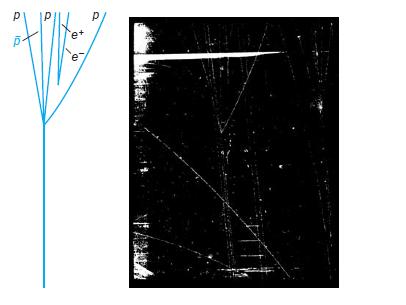
Figure 12-2 shows the production of the first antiproton. It was produced by the reaction p + p → p + p + p + p̅ and required a minimum kinetic energy of 5.6 GeV. (The proton beam energy was actually 25 GeV.) Less energy would be required by either of the following reactions. Why is neither of
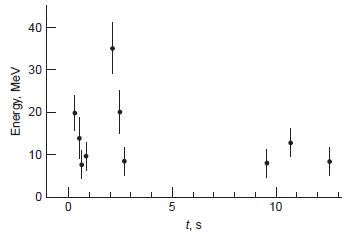
Using the information concerning the neutrinos from SN1987A, including Figure 12-33, compute an upper limit to the mass of the electron neutrino.Figure 12-33 Energy, MeV 40 30 20 10 0 5 t, s 10
Find (a) The energy of the electron, (b) The energy of the 32S nucleus, and(c) The momentum of each in the decay 32P → 32S + e-, assuming no neutrino in the final state (n → p + e-). (The rest mass of 32P is 31.973762 u.)
The fate of an antiproton is usually annihilation via the reaction p + p̅ → ϒ + ϒ. Assume that the proton and antiproton annihilate at rest.(a) Why must there be two photons rather than just one? (b) What is the energy of each photon?(c) What is the wavelength of each photon?(d) What is
Which of the following decays—π0 → ϒ + ϒ or π- → μ- + v̅μ—would you expect to have the longer lifetime? Why?
Of the following reactions, which are allowed to proceed via the weak interaction and which are forbidden? Justify your answer.(a) K+ → π0 + μ+ + vμ(b) p + e- + ve → e- + π+ + p(c) Λ0 → π+ + e- + v̅e(d) p + vμ → μ+ + n
Which of the four fundamental interactions is most likely responsible for the following reactions?(a) 16O (excited state) → 16O (ground state) + ϒ(b) ve + e → ve + e(c) p + p̅ → ϒ + ϒ(d ) p + v̅e → n + e+(e) π0 + p → π0 + p(f) 3H → 3He + e- + v̅e
The rest energies of the ∑+ and ∑- are slightly different, but those of the π+ and π- are exactly the same. Explain this difference in behavior.
Show that the neutron cannot undergo the weak decay shown for the Λ0 in Problem 12-32.Problem 12-32One mode of weak decay of the K̅0 isShowing the quark content of the particles, draw the Feynman diagram of this so-called semileptonic decay. Kº K+μ+ Pμ
Draw Feynman diagrams of the following decays:(a) μ+ → e+ + ve + v̅μ(b) π- → μ- + v̅μ(c) t- → μ- + v̅μ + vt
What is the uncertainty in the rest energies of the following particles? (a) Λ(1670), (b) Σ(2030), (c) Δ(1232).
The neutral pion decays 99 percent of the time by the reaction π0 → 2ϒ. The π- decays by the reaction π- → μ- + v̅μ.(a) Assuming the π0 to consist of a uu̅ quark pair, show how the 2ϒ occurs. (b) Why is a π0 decay to a single photon not possible? (c) The π- is a u̅d quark
The rules for determining the isospin of two or more particles are the same as those for combining angular momentum. For example, since T = 1/2 for nucleons, the combination of two nucleons can have either T = 1 or T = 0 or may be a mixture of these isospin states. Since T3 = +1/2 for the proton,
For each of the following particles, write down two possible decays that satisfy all conservation laws:(a) Ω-, (b) Σ+, (c) Λ0, (d) π0, and (e) K+.
Draw two Feynman diagrams that represent the decay of the anti-bottom quark.
Some quark combinations can exist in two or more isospin states, with each state corresponding to a different hadron. One such combination is uds.(a) What is the value of T3 for this combination?(b) What are the possible values of total isospin T for this combination?(c) Find the baryon number,
Compute the approximate range of a weak interaction mediated by a W+.
The Λ0 undergoes a weak decay as follows: Λ0 → p + π-. Showing the quark content of the particles, draw the Feynman diagram of this so-called nonleptonic decay.
The decay of the Λ0 shown in Problem 12-33 can also proceed via the strong interaction. Showing the quark content of the particles, draw the Feynman diagram that illustrates the strong decay of the Λ0.Problem 12-33The Λ0 undergoes a weak decay as follows: Λ0 → p + π-. Showing the quark
The X0 (1193) can be produced by the reaction K- + p → π0 + X0.(a) Determine the baryon, strangeness, charm, and bottom quantum numbers of the X0 (1193).(b) From your answer to (a), what is the quark content of the X0 (1193)?
The lifetime of the Σ0 is 6 x 10-20 s. The lifetime of the Σ+ is 0.8 x 10⁻¹⁰ s and that of the Σ- is 1.48 x 10⁻¹⁰ s, nearly twice as long. How can these differences in lifetimes between members of the same isospin multiplet be explained?
GUTs predict a lifetime of about 1032 y for the proton. If that is the case, how many protons will decay each year in the world’s oceans? (Assume the average depth of the oceans to be 1 km and that they cover 75 percent of Earth’s surface.)
Grand unification theories predict that the proton is unstable. If that turns out to be true, why does it mean that baryon number is not conserved? If leptons and quarks are interchangeable at the unification energy, does this mean that there is a new, conserved “leptoquark number”?
Protons might decay via a number of different modes. What conservation laws are violated by the following possibilities?(a) p → e+ + Λ0 + ve(b) p → π+ + ϒ(c) p → π+ + K0
Find a possible quark combination for the following particles: (a) n̅, (b) Ξ0, (c) Σ+, (d) Ω-, and (e) Ξ-.
Show that the Z0 cannot decay into two identical zero-spin particles.
There are six hadrons with quantum numbers (Q,U,S,C,B) = (2,1,0,1,0); (0,1,-2,1,0); (0,0,1,0,-1); (0,-1,1,0,0); (0,1,-1,1,0); (-1,1,-3,0,0). Determine the quark content of each hadron.
Show that the following decays conserve all lepton numbers.(a) μ+ → e+ + ve + v̅μ(b) t- → μ- + vμ + vt(c) n → p + e- + v̅e
A π0 with energy 850 MeV decays in flight via the reaction π0 → ϒ + ϒ. Compute the angles made by the momenta of the gammas with the original direction of the π0.
The mass of the hydrogen atom is smaller than the sum of the masses of the proton and the electron, the difference being the binding energy. The mass of the π+ is 139.6 MeV/c2; however, the masses of the quarks of which it is composed are only a few MeV/c2. How can that be explained?
There are three possible decay modes for the t-. (a) Draw the Feynman diagrams for each mode. (b) Which mode is the most probable? Explain why.
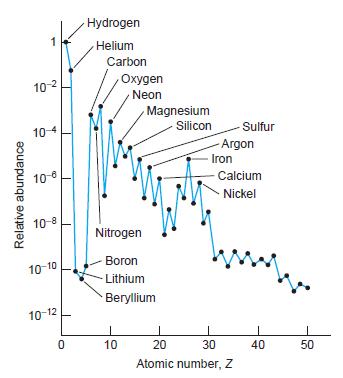
Lithium, beryllium, and boron (Z = 3, 4, and 5, respectively) have very low abundances in the cosmos compared to many heavier elements (see Figure 13-33). Considering the fusion of He to C, explain these low abundances.Figure 13-33 Relative
Measurement of the Doppler shift of spectral lines in light from the east and west limbs of the Sun at the solar equator reveal that the tangential velocities of the limbs differ by 4 km>s. Use this result to compute the approximate period of the Sun’s rotation (RΘ = 6.96 x10⁵ km).
The gravitational potential energy U of a self-gravitating spherical body of mass M and radius R is a function of the details of the mass distribution. For the Sun, UΘ = -2GM2ΘRΘ. What would be the approximate lifetime of the Sun, radiating at its present rate, if the source of its emitted
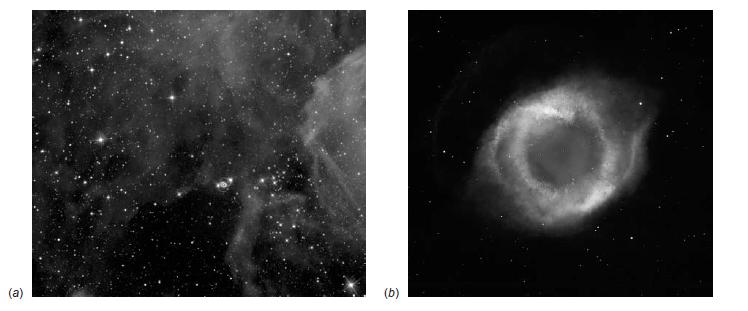
The gas shell of the planetary nebula shown in Figure 13-18 is expanding at 24 km/s. Its diameter is 1.5 c · y.(a) How old is the gas shell? (b) If the central star of the planetary nebula is 12 times as luminous as the Sun and 15 times hotter, what is the radius of the central star in units
Calculate the Schwarzschild radius of a star whose mass is equal to that of (a) The Sun, (b) Jupiter, (c) Earth. (The mass of Jupiter is approximately 318 times that of Earth.)
Redshift measurements for a particular galaxy indicate that it has a recession velocity of 72,000 km/s. (a) Compute the distance to the galaxy. (b) The value of Hubble’s constant depends critically on calibration distance measurements, which are difficult to make. If the calibration
Consider a neutron star whose mass equals 2MΘ.(a) Compute the star’s radius.(b) If the neutron star is rotating at 0.5 rev>s and assuming its density to be uniform, what is its rotational kinetic energy? (c) If its rotation slows by 1 part in 108 per day and the lost kinetic energy is
If the 90 percent of the Milky Way’s mass that is “missing” resides entirely in a large black hole at the center of the Galaxy, what would be the black hole’s(a) Mass and(b) Radius?
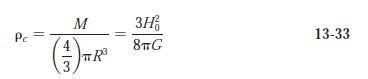
Evaluate Equation 13-33 for the critical density of the universe. Pc 3 M πTR³ 3H 8TC 13-33
The wavelength of the Ha line in the hydrogen spectrum is 656.3 nm. Use Hubble’s law to determine the wavelength of the Ha line emitted from galaxies at distances of(a) 5 x 10⁶ c · y, (b) 50 x 106 c · y, (c) 500 x 106 c · y, and (d) 5 x 10⁹ c · y from Earth.
The bright core of a certain Seyfert galaxy had a luminosity of 1010 LΘ. The luminosity increased by 100 percent in a period of 18 months. Show that this means that the energy source of the core is less than 9.45 x 10⁴ AU in diameter. How does this compare to the diameter of the Milky Way?
Cosmological theory suggests that the average separation of galaxies, that is, the scale of the universe, is inversely proportional to the absolute temperature. If that is true, relative to the present size, how large was the universe compared to the scale today(a) 2000 years ago,(b) 106 years
Determine the value of the mass density of the universe for t = Planck time. How does this compare to the density of the proton? Of osmium?
How long after the Big Bang did it take the universe to cool to the threshold temperature for the formation of muons? What would be the mass of a particle-antiparticle pair that could be formed by the average energy of the current 2.725 K background radiation?
At what wavelength is the blackbody radiation distribution of the cosmic microwave background at a maximum?
Show that the present mass density of the universe ρ0 = R(t) ρ (t).
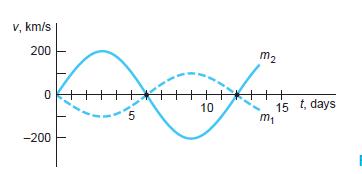
Consider an eclipsing binary whose orbital plane is parallel to our line of sight. Doppler measurements of the radial velocity of each component of the binary are shown in Figure 13-36. Assume that the mass m1 > m2 and that the orbits of each component about the center of mass are circular.(a)
If Hubble’s law is true for an observer in the Milky Way (i.e., us), prove that it must also be true for observers in other galaxies.
Find the minimum magnitude of the radius a that a dust particle in orbit around the Sun may have in order to avoid being blown out of the solar system by the Sun’s radiation pressure. Assume that the particle is a sphere of mass m with the same density ρ as Earth, 5500 kg/m3. Ignore the solar
Show that the mass density of the universe at redshift z is given by ρ (z) = ρ (1 + z)3.
When the Sun was formed, about 75 percent of its mass was hydrogen, of which only about 13 percent ever becomes available for fusion. (The rest is in regions of the Sun where the temperature is too low for fusion reactions to occur.) MΘ = 2 x 1030 kg and the Sun fuses about 6 x 10¹¹ kg/s.(a)
Supernova SN1987A was first visible at Earth in 1987.(a) How many years B.P. (before present) did the explosion occur? (b) If protons with 100 GeV of kinetic energy were produced in the event, when should they arrive at Earth?
Assume that the Sun when it first formed was composed of 70 percent hydrogen. How many hydrogen nuclei were there in the Sun at that time? How much energy would ultimately be released if all of the hydrogen nuclei fused into helium? Astrophysicists have predicted that the Sun can radiate energy at
Kepler’s third law states that the square of a planet’s orbital speed is proportional to the cube of its average orbital radius. Use Kepler’s third law to answer each of the following questions. (a) The Moon’s orbital radius is 3.84 x 10⁵ km and it orbits Earth once every 27.3 d.
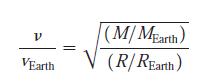
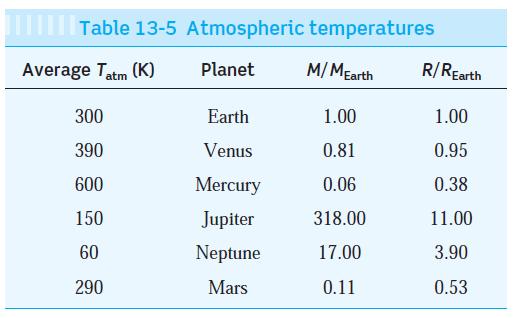
The ability of a planet to retain particular gases in an atmosphere depends on the temperature that its atmosphere has (or would have) and the escape velocity for the planet. In general, if the average speed of a particular gas molecule exceeds 1/6 of the escape velocity, that gas will disappear
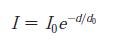
The approximate mass of dust in the Galaxy can be computed from the observed extinction of starlight. Assuming the mean radius of dust grains to be R with a uniform number density n grains/cm3,(a) show that the mean free path d0 of a photon in interstellar dust is given by d0 = 1/ (nπR2). (b)
Prove that the total energy of Earth’s orbital motion E = (mv2/2) + (-GMΘm/r) is equal to one-half of its gravitational potential energy (-GMΘm/r), where r is Earth’s orbit radius.
Given the currently accepted value of the Hubble constant and the fact that the average matter density of the universe is one H atom/m3, what creation rate of new H atoms would be necessary in a steady-state model to maintain the present mass density, even though the universe is expanding? (Give
Using the parallax technique, compute the distance to (a) Alpha Centauri (parallax angle 0.742 arc second) and (b) Procyon (parallax angle 0.0286 arc second). Express each answer in both light-years and parsecs.
As the Sun evolves into a red giant star, suppose that its luminosity increases by a factor of 102. Show that Earth’s oceans will evaporate, but that the water vapor will not escape from the atmosphere.
Showing 100 - 200
of 585
1
2
3
4
5
6
Step by Step Answers

 Get 50% OFF
Claim Now
Get 50% OFF
Claim Now