New Semester
Started
Get
50% OFF
Study Help!
--h --m --s
Claim Now
Question Answers
Textbooks
Find textbooks, questions and answers
Oops, something went wrong!
Change your search query and then try again
S
Books
FREE
Study Help
Expert Questions
Accounting
General Management
Mathematics
Finance
Organizational Behaviour
Law
Physics
Operating System
Management Leadership
Sociology
Programming
Marketing
Database
Computer Network
Economics
Textbooks Solutions
Accounting
Managerial Accounting
Management Leadership
Cost Accounting
Statistics
Business Law
Corporate Finance
Finance
Economics
Auditing
Tutors
Online Tutors
Find a Tutor
Hire a Tutor
Become a Tutor
AI Tutor
AI Study Planner
NEW
Sell Books
Search
Search
Sign In
Register
study help
physics
modern physics
Modern Physics 6th Edition Paul A. Tipler, Ralph Llewellyn - Solutions
Prove that the photoelectric effect cannot occur with a completely free electron, that is, one not bound to an atom.
When a beam of monochromatic x rays is incident on a particular NaCl crystal, Bragg reflection in the first order (i.e., with m = 1) occurs at θ = 20°. The value of d = 0.28 nm. What is the minimum voltage at which the x-ray tube can be operating?
A 100 W beam of light is shined onto a blackbody of mass 2 x 10⁻³ kg for 104 s. The blackbody is initially at rest in a frictionless space.(a) Compute the total energy and momentum absorbed by the blackbody from the light beam,(b) Calculate the blackbody’s velocity at the end of the period of
This problem is to derive the Wien displacement law, Equation 3-5. (a) Show that the energy density distribution function can be written u = Cλ-5(ea/λ -1)-1, where C is a constant and a = hc/kT. (b) Show that the value of λ for which du/dλ = 0 satisfies the equation 5λ
The x-ray spectrometer on board a satellite measures the wavelength at the maximum intensity emitted by a particular star to be λm = 82.8 nm. Assuming that the star radiates like a blackbody, (a) Compute the star’s surface temperature. (b) What is the ratio of the intensity radiated at
Determine the fraction of the energy radiated by the Sun in the visible region of the spectrum (350 nm to 700 nm). Assume that the Sun’s surface temperature is 5800 K.
A photon can be absorbed by a system that can have internal energy. Assume that a 15 MeV photon is absorbed by a carbon nucleus initially at rest. The recoil momentum of the carbon nucleus must be 15 MeV/c. (a) Calculate the kinetic energy of the carbon nucleus. What is the internal energy of
The maximum kinetic energy given to the electron in a Compton scattering event plays a role in the measurement of gamma-ray spectra using scintillation detectors. The maximum is referred to as the Compton edge. Suppose that the Compton edge in a particular experiment is found to be 520 keV. What
An electron accelerated to 50 keV in an x-ray tube has two successive collisions in being brought to rest in the target, emitting two bremsstrahlung photons in the process. The second photon emitted has a wavelength 0.095 nm longer than the first. (a) What are the wavelengths of the two
Derive Equation 3-17 from Equations 3-15 and 3-16. SI-E (= 0=0 1-2-3-93
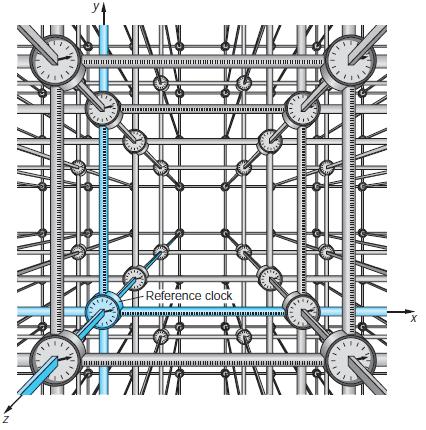
Suppose a system S consisting of a cubic lattice of meter sticks and synchronized clocks, for example, the eight clocks closest to you in Figure 1-13, moves from left to right (the +x direction) at high speed. The meter sticks parallel to the x direction are, of course, contracted and the cube
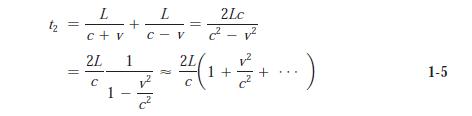
In one series of measurements of the speed of light, Michelson used a path length L of 27.4 km (17 mi).(a) What is the time needed for light to make the round trip of distance 2L? (b) What is the classical correction term in seconds in Equation 1-5, assuming Earth’s speed is v =
In episode 5 of Star Wars the Empire’s spaceships launch probe droids throughout the galaxy to seek the base of the Rebel Alliance. Suppose a spaceship moving at 2.3 x 10⁸ m/s toward Hoth (site of the rebel base) launches a probe droid toward Hoth at 2.1 x 10⁸ m/s relative to the spaceship.
A shift of one fringe in the Michelson-Morley experiment would result from a difference of one wavelength or a change of one period of vibration in the round-trip travel of the light when the interferometer is rotated by 90°. What speed would Michelson have computed for Earth’s motion through
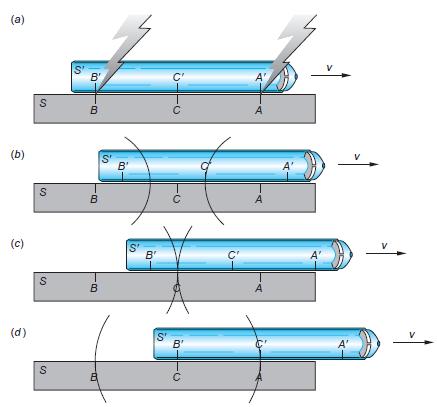
Assume that the train shown in Figure 1-14 is 1.0 km long as measured by the observer at C' and is moving at 150 km/h. What time interval between the arrival of the wave fronts at C' is measured by the observer at C in S?Figure 1-14
In the “old days” (circa 1935) pilots used to race small, relatively high-powered airplanes around courses marked by a pylon on the ground at each end of the course. Suppose two such evenly matched racers fly at airspeeds of 130 mph. (Remember, this was a long time ago!) Each flies one complete
Paul Ehrenfest suggested the following thought experiment to illustrate the dramatically different observations that might be expected, dependent on whether light moved relative to a stationary ether or according to Einstein’s second postulate:Suppose that you are seated at the center of a huge
Two events happen at the same point x'0 in frame S' at times t'1 and t'2. (a) Use Equations 1-19 to show that in frame S the time interval between the events is greater than t'2 - t'1 by a factorϒ. (b) Why are Equations 1-18 less convenient than Equations 1-19 for this problem? x = y(x'
Einstein reported that as a boy he wondered about the following puzzle. If you hold a mirror at arm’s length and look at your reflection, what will happen as you begin to run?In particular, suppose you run with speed v = 0.99c. Will you still be able to see yourself? If so, what would your image
Verify by calculation that the result of the Michelson-Morley experiment places an upper limit on Earth’s speed relative to the ether of about 5 km/s.
Consider two inertial reference frames. When an observer in each frame measures the following quantities, which measurements made by the two observers must yield the same results? Explain your reason for each answer.(a) The distance between two events(b) The value of the mass of a proton(c) The
Starting with the Lorentz transformation for the components of the velocity (Equation 1-23), derive the transformation for the components of the acceleration. Ux = u' + v (1+) Uy || u'y y 1 + vu', || u₂ vu', y (1 + 4/²) 1-23
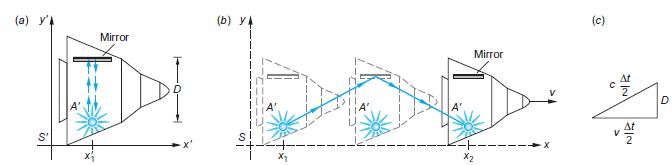
The light clock in the spaceship in Figure 1-25 uses a light pulse moving up the y axis to reflect back from a mirror as the ship moves along the x axis. Suppose instead the light pulse moves along the x' axis between x' = 0 and a mirror at x' = L. (a) What is the time required for the pulse
Suppose that A' , B', and C' are at rest in frame S', which moves with respect to S at speed v in the +x direction. Let B' be located exactly midway between A' and C'. At t' = 0, a light flash occurs at B' and expands outward as a spherical wave.(a) According to an observer in S', do the wave
Make a graph of the relativistic factor ϒ = 1/(1- v2 /c2)1/2 as a function of β = v/c. Use at least 10 values of β ranging from 0 up to 0.995.
Suppose that an event occurs in inertial frame S with coordinates x = 75 m, y = 18 m, z = 4.0 m at t = 2.0 x 10⁵ s. The inertial frame S' moves in the + x direction with v = 0.85c. The origins of S and S' coincided at t = t' = 0. (a) What are the coordinates of the event in S'? (b) Use
Show that the null effect of the Michelson-Morley experiment can be accounted for if the interferometer arm parallel to the motion is shortened by a factor of (1-v2 /c2)1/2.
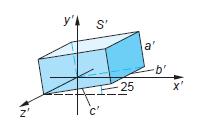
A rectangular box at rest in S' has sides a' = 2 m, b' = 2 m, and c' = 4 m and is oriented as shown in Figure 1-44. S' moves with b = 0.65 with respect to the laboratory frame S. (a) Compute the volume of the box in S' and in S. (b) Draw an accurate diagram of the box as seen by an
Consider a clock at rest at the origin of the laboratory frame. (a) Draw a spacetime diagram that illustrates that this clock ticks slow when observed from the reference frame of a rocket moving with respect to the laboratory at v = 0.8c. (b) When 10 s have elapsed on the rocket clock,
A nova is the sudden, brief brightening of a star (see Chapter 13). Suppose Earth astronomers see two novas occur simultaneously, one in the constellation Orion (The Hunter) and the other in the constellation Lyra (The Lyre). Both nova are the same distance from Earth, 2.5 x10³c·y, and are in
A meter stick moves parallel to its length with speed v = 0.6c relative to you.(a) Compute the length of the stick measured by you. (b) How long does it take for the stick to pass you? (c) Draw a spacetime diagram from the viewpoint of your frame with the front of the meter stick at x = 0
A meter stick at rest in S is tilted at an angle of 30° to the x' axis. If S' moves at β = 0.8, how long is the meter stick as measured in S and what angle does it make with the x axis?
The light from a nearby star is observed to be shifted toward the blue by 2 percent; that is, fobs = 1.02f0. Is the star approaching or receding from Earth? How fast is it moving? (Assume motion is directly toward or away from Earth so as to avoid superluminal speeds.)
''Ether drag” was among the suggestions made to explain the null result of the Michelson-Morley experiment (see the More section). The phenomenon of stellar aberration refutes this proposal. Suppose Earth moves relative to the ether at velocity v and a light beam (e.g., from a star) approaches
Stars typically emit the red light of atomic hydrogen with wavelength 656.3 nm (called the Ha spectral line). Compute the wavelength of that light observed at Earth from stars receding directly from us with relative speed v = 10-3c, v = 10-2c, and v = 10-1c.
Heide boards a spaceship and travels away from Earth at a constant velocity 0.45c toward Betelgeuse (a red giant star in the constellation Orion). One year later on Earth clocks, Heide’s twin, Hans, boards a second spaceship and follows her at a constant velocity of 0.95c in the same
You point a laser flashlight at the Moon, producing a spot of light on the Moon’s surface. At what minimum angular speed must you sweep the laser beam in order for the light spot to streak across the Moon’s surface with speed v > c? Why can’t you transmit information between research bases
Einstein used trains for a number of relativity thought experiments since they were the fastest objects commonly recognized in those days. Let’s consider a train moving at 0.65c along a straight track at night. Its headlight produces a beam with an angular spread of 60° according to the
In 1971 four portable atomic clocks were flown around the world in jet aircraft, two eastbound and two westbound, to test the time dilation predictions of relativity.(a) If the westbound plane flew at an average speed of 1500 km/h relative to the surface, how long would it have had to fly for the
A rod of proper length L moves past you a speed v. You reach out and grab the back end of the rod, bringing that point instantly to rest in your frame of reference. Assuming that this information, that the back of the rod has stopped, travels toward the front of the rod at the speed of light (it
A burst of π+ mesons (pions) travels down an evacuated beam tube at Fermilab moving at β = 0.92 with respect to the laboratory.(a) Compute ϒ for this group of pions. (b) The proper mean lifetime of pions is 2.6 x 10⁻⁸ s. What mean lifetime is measured in the lab?(c) If the burst contained
H. A. Lorentz suggested 15 years before Einstein’s 1905 paper that the null effect of the Michelson-Morley experiment could be accounted for by a contraction of that arm of the interferometer lying parallel to Earth’s motion through the ether to a length L = Lp(1-v2/c2)-1/2. He thought of this,
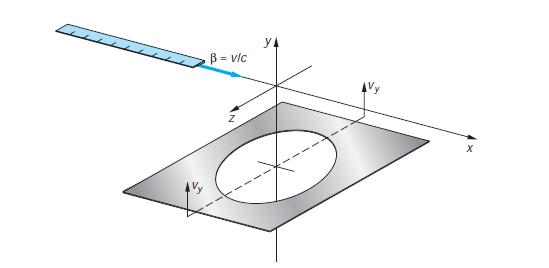
An interesting paradox has been suggested by R. Shaw that goes like this. A very thin steel plate with a circular hole 1 m in diameter centered on the y axis lies parallel to the xz plane in frame S and moves in the +y direction at constant speed vy as illustrated in Figure 1-45. A meter stick
Two spaceships, each 100 m long when measured at rest, travel toward each other with speeds of 0.85c relative to Earth. (a) How long is each ship as measured by someone on Earth? (b) How fast is each ship traveling as measured by an observer on the other?(c) How long is one ship when
The null result of the Michelson-Morley experiment could be explained if the speed of light depended on the motion of the source relative to the observer. Consider a binary eclipsing star system, that is, a pair of stars orbiting their common center of mass with Earth lying in the orbital plane of
A cosmic-ray proton streaks through the lab with velocity 0.85c at an angle of 50° with the +x direction (in the xy plane of the lab). Compute the magnitude and direction of the proton’s velocity when viewed from frame S' moving with β = 0.72.
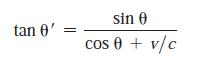
A meter stick is parallel to the x axis in S and is moving in the +y direction at constant speed vy. From the viewpoint of S' show that the meter stick will appear tilted at an angle θ' with respect to the x' axis of S' moving in the +x direction at β = 0.65. Compute the angle θ' measured in S'.
Two observers agree to test time dilation. They use identical clocks, and one observer in frame S' moves with speed v = 0.6c relative to the other observer in frame S. When their origins coincide, they start their clocks. They agree to send a signal when their clocks read 60 min and to send a
Two rockets A and B leave a space station with velocity vectors vA and vB relative to the station frame S, perpendicular to each other.(a) Determine the velocity of A relative to B, vBA. (b) Determine the velocity of B relative to A, vAB. (c) Explain why vAB and vBA do not point in
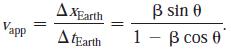
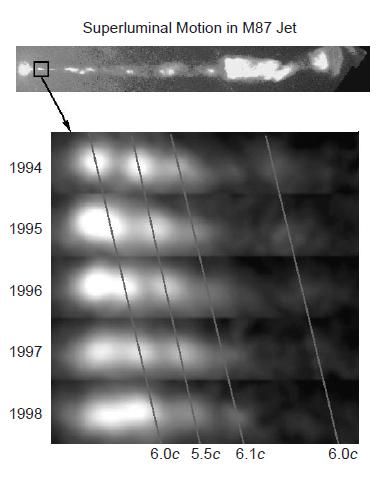
Like jets emitted from some galaxies (see Figure 1-41), some distant astronomical objects can appear to travel at speeds greater than c across our line of sight. Suppose distant galaxy AB15 moving with velocity v at an angle θ with respect to the direction toward Earth emits two bright flashes of
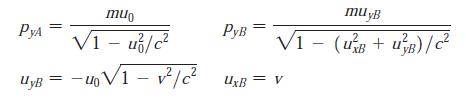
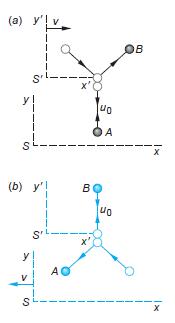
Show that pyA = -pyB, where pyA and pyB are the relativistic momenta of the balls in Figure 2-1, given byFigure 2.1 PyA UyB muo V1 - uč/c² -uoV1 - v²/c² 2 2 PyB muyB 2 2 V1 - (ukB + uyB)/с² UxB = V
Figure 1-11b (in the More section about the Michelson-Morley experiment) shows an eclipsing binary. Suppose the period of the motion is T and the binary is a distance L from Earth, where L is sufficiently large so that points A and B in Figure 1-11b are a half orbit apart. Consider the motion of
Show that d(ϒmu) = m(1-u2/c2)-3/2 du.
An electron of rest energy mc2 = 0.511 MeV moves with respect to the laboratory at speed u = 0.6c. Find(a) ϒ, (b) P in units of MeV/c, (c) E, and (d) Ek.
Two 1 kg masses are separated by a spring of negligible mass. They are pushed together, compressing the spring. If the work done in compressing the spring is 10 J, find the change in mass of the system in kilograms. Does the mass increase or decrease?
At what value of u/c does the measured mass of a particle exceed its rest mass by (a) 10 percent, (b) A factor of 5, and (c) A factor of 20?
A cosmic-ray proton is moving at such a speed that it can travel from the Moon to Earth in 1.5 s.(a) At what fraction of the speed of light is the proton moving? (b) What is its kinetic energy? (c) What value would be measured for its mass by an observer in Earth’s reference frame?(d)
How much work must be done on a proton to increase its speed from (a) 0.15c to 0.16c? (b) 0.85c to 0.86c? (c) 0.95c to 0.96c?Notice that the change in the speed is the same in each case.
An electron with rest energy of 0.511 MeV moves with speed u = 0.2c. Find its total energy, kinetic energy, and momentum.
The orbital speed of the Sun relative to the center of the Milky Way is about 250 km/s. By what fraction do the relativistic and Newtonian values differ for(a) The Sun’s momentum and (b) The Sun’s kinetic energy?
Suppose that you seal an ordinary 60 W lightbulb and a suitable battery inside a transparent enclosure and suspend the system from a very sensitive balance. (a) Compute the change in the mass of the system if the lamp is on continuously for one year at full power. (b) What difference, if
The energy released when sodium and chlorine combine to form NaCl is 4.2 eV. (a) What is the increase in mass (in unified mass units) when a molecule of NaCl is dissociated into an atom of Na and an atom of Cl? (b) What percentage of error is made in neglecting this mass difference? (The
An elementary particle of mass M completely absorbs a photon, after which its mass is 1.01M. (a) What was the energy of the incoming photon? (b) Why is that energy greater than 0.01Mc2?
The energy released in the fission of a 235U nucleus is about 200 MeV. How much rest mass (in kg) is converted to energy in this fission?
Compute the force exerted on the palm of your hand by the beam from a 1.0 W flashlight (a) If your hand absorbs the light and (b) If the light reflects from your hand. What would be the mass of a particle that exerts that same force in each case if you hold it at Earth’s surface?
An electron-positron pair combined as positronium is at rest in the laboratory. The pair annihilate, producing a pair of photons (gamma rays) moving in opposite directions in the lab. Show that the invariant rest energy of the gamma rays is equal to that of the electron pair.
Show that Equation 2-31 can be written E = mc2(1 + p2/m2c2)1/2 and use the binomial expansion to show that, when pc is much less than mc2, E ≈ mc2 + p2 /2m.
An electron of rest energy 0.511 MeV has a total energy of 5 MeV. (a) Find its momentum in units of MeV/c. (b) Find u/c.
Make a sketch of the total energy of an electron E as a function of its momentum p. (See Equations 2-36 and 2-40 for the behavior of E at large and small values of p.) E pc for E>>> mc² 2-36
A proton is bent into a circular path of radius 2 m by a magnetic field of 0.5 T.(a) What is the momentum of the proton? (b) What is its kinetic energy?
An electron of total energy 4.0 MeV moves perpendicular to a uniform magnetic field along a circular path whose radius is 4.2 cm. (a) What is the strength of the magnetic field B? (b) By what factor does gm exceed m?
What is the speed of a particle that is observed to have momentum 500 MeV/c and energy 1746 MeV? What is the particle’s mass (in MeV/c2)?
For a spinning disk, such as a CD or DVD, show that in the reference frame of the disk Equation 2-44 follows from Equation 2-43. ds² = cdt² (dr² + r²d² + dz²) 2-43
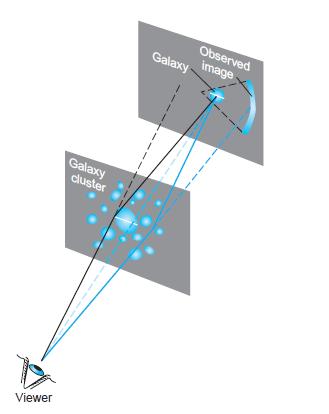
Compute the deflection angle α for light from a distant star that would, according to general relativity, be measured by an observer on the Moon as the light grazes the edge of Earth.
A set of twins work in the Sears Tower, a very tall office building in Chicago. One works on the top floor and the other works in the basement. Considering general relativity, which twin will age more slowly? (a) They will age at the same rate. (b) The twin who works on the top floor will
Show that the substitution of dt from Equation 2-45 into Equation 2-44 removes the spacetime cross term dφ'dt, resulting in Equation 2-46. ds² = (c²r²w²) di² - (dr² + r² dp² + 2r²wdp'dt + dz²) 2-44
For a particle moving in the xy plane of S, show that the y' component of the acceleration is given by a'y ay axUzv/c² + y²(1 u₂v/c²)²² (1 u₂v/c²)³ -
Use Equation 2-47 to obtain the gravitational redshift in terms of the wavelength λ. Use that result to determine the shift in wavelength of light emitted by a white dwarf star at 720.00 nm. Assume the white dwarf has the same mass as the Sun (1.99 x 1030 kg) but a radius equal to only 1 percent
With inertial systems S and S' arranged with their corresponding axes parallel and S' moving in the +x direction, it was apparent that the Lorentz transformation for y and z would be y' = y and z' = z. The transformation for the y and z components of the momentum are not so apparent, however. Show
Show that the creation of an electron-positron pair (or any particle-antiparticle pair, for that matter) by a single photon is not possible in isolation, that is, that additional mass (or radiation) must be present.
In ancient Egypt the annual flood of the Nile was predicted by the rise of Sirius (the Dog Star). Sirius is one of a binary pair whose companion is a white dwarf. Orbital analysis of the pair indicates that the dwarf ’s mass is 2 x 1030 kg (i.e., about one solar mass). Comparison of spectral
A clock (or a light-emitting atom) located at Earth’s equator moves at about 463 m/s relative to one located at the pole. The equator clock is also about 21 km farther from the center of Earth than the pole clock due to Earth’s equatorial bulge. For an inertial reference frame centered on
A particular distant star is found to be 92c . y from Earth. On a direct line between us and the star and 35c . y from the distant star is a dense white dwarf star with a mass equal to 3 times the Sun’s mass MΘ and a radius of 104 km. Deflection of the light beam from the distant star by
A spaceship of mass 106 kg is coasting through space when suddenly it becomes necessary to accelerate. The ship ejects 103 kg of fuel in a very short time at a speed of c/2 relative to the ship.(a) Neglecting any change in the rest mass of the system, calculate the speed of the ship in the frame in
A synchronous satellite “parked” in orbit over the equator is used to relay microwave transmissions between stations on the ground. To what frequency must the satellite’s receiver be tuned if the frequency of the transmission from Earth is exactly 9.375 GHz? (Ignore all Doppler effects.)
Showing 500 - 600
of 585
1
2
3
4
5
6
Step by Step Answers

 Get 50% OFF
Claim Now
Get 50% OFF
Claim Now