New Semester
Started
Get
50% OFF
Study Help!
--h --m --s
Claim Now
Question Answers
Textbooks
Find textbooks, questions and answers
Oops, something went wrong!
Change your search query and then try again
S
Books
FREE
Study Help
Expert Questions
Accounting
General Management
Mathematics
Finance
Organizational Behaviour
Law
Physics
Operating System
Management Leadership
Sociology
Programming
Marketing
Database
Computer Network
Economics
Textbooks Solutions
Accounting
Managerial Accounting
Management Leadership
Cost Accounting
Statistics
Business Law
Corporate Finance
Finance
Economics
Auditing
Tutors
Online Tutors
Find a Tutor
Hire a Tutor
Become a Tutor
AI Tutor
AI Study Planner
NEW
Sell Books
Search
Search
Sign In
Register
study help
physics
modern physics
Modern Physics 6th Edition Paul A. Tipler, Ralph Llewellyn - Solutions
Current theory suggests that black holes evaporate by the emission of Hawking radiation in a time t that depends on the mass M of the black hole according to the following relation:(a) Explain without calculating anything why the formula implies that high-mass black holes have longer lifetimes than
The supernova SN1987A certainly produced some heavy elements. Compared to the energy released in fusing 56 1H atoms into one 56Fe atom starting from the protonproton cycle, how much energy would be required to fuse two 56Fe atoms into one 112Cd atom?
Normalize the wave function in Problem 6-2 between -a and +a. Why can’t that wave function be normalized between - ∞ and + ∞?Problem 6-2Show that Ψ(x, t) = Aei(kx - ωt) satisfies both the time dependent Schrödinger equation and the classical wave equation (Equation 6-1). 2-12 c² at² 6-1
Show that Ψ(x, t) = Aei(kx - ωt) satisfies both the time dependent Schrödinger equation and the classical wave equation (Equation 6-1). 2-12 c² at² 6-1
The allowed energies for a particle of mass m in a one-dimensional infinite square well are given by Equation 6-24. Show that a level with n = 0 violates the Heisenberg uncertainty principle. En = 222 TT 2m[² n². n²E₁ n = 1, 2, 3, ... 6-24
Show that in Davisson and Germer’s experiment with 54 eV electrons using the D = 0.215 nm planes, diffraction peaks with n = 2 and higher are not possible.
Show that the wave function Ψ(x,t) = Aekx - ωt does not satisfy the time-dependent Schrödinger equation.
In a region of space, a particle has a wave function given by Ψ (x) = Ae-x2/2L2 and energy ћ2/2mL2, where L is some length. (a) Find the potential energy as a function of x, and sketch V versus x.(b) What is the classical potential that has this dependence?
(a) Show that the wave function Ψ(x, t) = Asin(kx - ωt) does not satisfy the time-dependent Schrödinger equation.(b) Show that Ψ(x, t) = Acos(kx - ωt) + iA sin(kx - ωt) does satisfy this equation.
The wave function for a free electron, that is, one on which no net force acts, is given by Ψ(x) = Asin(2.5 x 10¹⁰x), where x is in meters. Compute the electron’s(a) Momentum,(b) Total energy, and (c) De Broglie wavelength.
The wavelength of light emitted by a ruby laser is 694.3 nm. Assuming that the emission of a photon of this wavelength accompanies the transition of an electron from the n = 2 level to the n = 1 level of an infinite square well, compute L for the well.
A particle is in an infinite square well of size L. Calculate the ground-state energy if(a) The particle is a proton and L = 0.1 nm, a typical size for a molecule; (b) The particle is a proton and L = 1 fm, a typical size for a nucleus.
A particle with mass m and total energy zero is in a particular region of space where its wave function is Ψ (x) = Ce-x2/L2. (a) Find the potential energy V(x) versus x and(b) Make a sketch of V(x) versus x.
A particle of mass m is confined to a tube of length L. (a) Use the uncertainty relationship to estimate the smallest possible energy.(b) Assume that the inside of the tube is a force-free region and that the particle makes elastic reflections at the tube ends. Use Schrödinger’s equation to
Suppose we construct a simple model of a neutral uranium atom as a collection of electrons confined in a one-dimensional box of width 0.05 nm with one electron per energy level. (a) Compute the energy of the most energetic electron in the model atom.(b) Compare the result in (a) with the rest
Suppose a macroscopic bead with a mass of 2.0 g is constrained to move on a straight frictionless wire between two heavy stops clamped firmly to the wire 10 cm apart. If the bead is moving at a speed of 20 nm/y (i.e., to all appearances it is at rest), what is the value of its quantum number n?
An electron moving in a one-dimensional infinite square well is trapped in the n = 5 state. (a) Show that the probability of finding the electron between x = 0.2 L and x = 0.4 L is 1/5. (b) Compute the probability of finding the electron within the “volume” Δx = 0.01 L at x = L/2.
In the early days of nuclear physics before the neutron was discovered, it was thought that the nucleus contained only electrons and protons. If we consider the nucleus to be a one-dimensional infinite well with L = 10 fm and ignore relativity, compute the ground-state energy for(a) An electron
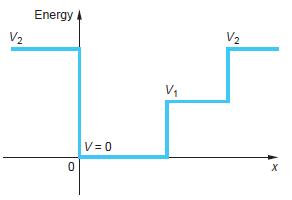
Using arguments concerning curvature, wavelength, and amplitude, sketch very carefully the wave function corresponding to a particle with energy E in the finite potential well shown in Figure 6-33.Figure 6-33 V₂ Energy 0 V=0 V₁ V₂ X
The wave functions of a particle in a one-dimensional infinite square well are given by Equation 6-32. Show that for these functions ∫Ψn(x)Ψm(x) dx = 0, that is, that Ψn(x) and Ψm(x) are orthogonal. 4, (x) = 2 -sin- VL IWX L n = 1, 2, 3, ... 6-32
An electron is in the ground state with energy En of a one-dimensional infinite well with L = 10-10 m. Compute the force that the electron exerts on the wall during an impact on either wall.
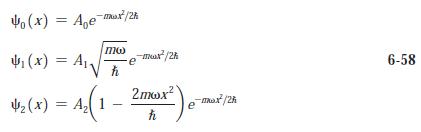
Compute (x) and (x2) for the ground state of a harmonic oscillator (Equation 6-58). Use A0 = (mω/ћπ)1/4. (x) = Ae-²/28 ₁(x) = A₁₁ №2(x) = A₂(1 – Πω -max²/2h ħ 2mw.x² ħ max²/2k 6-58
Findfor the ground-state wave function of an infinite square well. (Use the fact that (p) = 0 by symmetry and (p2) = (2mE) from Problem 6-32.)Problem 6-32Show directly from the time-independent Schrödinger equation that (p2) = (2m[E - V(x)]) in general and that (p2) = (2mE) for the infinite square
Sketch(a) The wave function and (b) The probability distribution for the n = 4 state for the finite square well potential.
For a finite square well potential that has six quantized levels, if a = 10 nm (a) Sketch the finite well,(b) Sketch the wave function from x = -2a to x = +2a for n = 3, and(c) Sketch the probability density for the same range of x.
For the harmonic oscillator ground state n = 0, the Hermite polynomial Hn(x) in Equation 6-57 is given by H0 = 1. Find(a) The normalization constant C0,(b) (x2), and(c) (V(x)) for this state. ↓, (x) = C₂e-²/2 H₂ (x) 6-57
Show directly from the time-independent Schrödinger equation that (p2) = (2m[E - V(x)]) in general and that (p2) = (2mE) for the infinite square well. Use this result to compute (p2) for the ground state of the infinite square well.
A quantum harmonic oscillator of mass m is in the ground state with classical turning points at ± A.(a) With the mass confined to the region Δx ≈ 2A, compute Δp for this state.(b) Compare the kinetic energy implied by Δp with (1) The ground-state total energy and (2) The expectation
For particles incident on a step potential with E < V0, show that T = 0 using Equation 6-70. T + R = 1 6-70
Show that the wave functions for the ground state and the first excited state of the simple harmonic oscillator, given in Equation 6-58, are orthogonal, that is, show that ∫Ψ0(x)Ψ1(x) dx = 0. ₁(x) = A₁e-²/25 mo -Muar²/28 ₁ (x) A₁ ħ $₂(x) = A₂(1 – 2mw.x² ħ -max²/2h 6-58
Derive Equations 6-66 and 6-67 from those that immediately precede them. B= = K₁ - K₂ k₁+k₂ E¹/2 - (E-V)¹/2 E¹/2 + (E-V)¹/2" 6-66
The period of a macroscopic pendulum made with a mass of 10 g suspended from a massless cord 50 cm long is 1.42 s.(a) Compute the ground-state (zero-point) energy.(b) If the pendulum is set into motion so that the mass raises 0.1 mm above its equilibrium position, what will be the quantum number of
A proton with energy 44 MeV is in a nuclear potential well 50 MeV deep. The proton “sees” a Coulomb barrier 10-15 m wide at the nuclear surface.(a) Use Equation 6-76 to compute the probability that the proton will tunnel through the barrier on a single approach.(b) Assuming that the radius R of
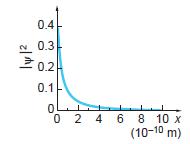
A beam of electrons, each with kinetic energy E = 2.0 eV, is incident on a potential barrier with V0 = 6.5 eV and width 5.0 x 10⁻¹⁰ m (see Figure 6-26). What fraction of the electrons in the beam will be transmitted through the barrier?Figure 6-26 0.4 ~0.3 0.2 0.1- 0 0 2 4 6 8 10 x (10-10 m)
A proton is in an infinite square well potential given by Equation 6-21 with L = 1 fm.(a) Find the ground-state energy in MeV. (b) Make an energy-level diagram for this system. Calculate the wavelength of the photon emitted for the transitions(c) n = 2 to n = 1,(d) n = 3 to n = 2, and(e)
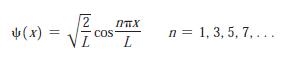
For the wave functionscorresponding to an infinite square well of length L, show that (x) = √sin: nux L n = 1, 2, 3, ....
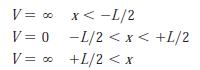
A particle is in the ground state of an infinite square well potential given by Equation 6-21. Calculate the probability that the particle will be found in the region(a) 0 < x < 1/2 L, (b) 0 < x < 1/3 L, and (c) 0 < x < 3/4 L. V(x) = 0 V(x) = 0⁰ 0 < x < L x < 0 and x >
A particle of mass m is in an infinite square well potential given bySince this potential is symmetric about the origin, the probability density|Ψ (x)|2 must also be symmetric. (a) Show that this implies that either Ψ(-x) = Ψ(x) or Ψ(-x) = -Ψ(x).(b) Show that the proper solutions of the
A beam of protons, each with kinetic energy 40 MeV, approaches a step potential of 30 MeV.(a) What fraction of the beam is reflected and transmitted? (b) How does your answer change if the particles are electrons?
A particle of mass m moves in a region in which the potential energy is constant, V = V0.(a) Show that neither Ψ(x,t) = Asin(kx - ωt) nor Ψ(x,t) = Acos (kx-ωt) satisfies the time-dependent Schrödinger equation.(b) Show that Ψ(x, t) = A[cos(kx - ωt) + isin (kx - ωt)] = Aei(kx - ωt) does
Use the Schrödinger equation to show that the expectation value of the kinetic energy of a particle is given by +00 (Ex) = - [ + (x) (-22 2²u(x)) dx 2m
(a) Derive Equation 6-75. (b) Show that, if αa >> 1, Equation 6-76 follows from Equation 6-75 as an approximation. T= |F|² |A|² 1 + sinhaa E E +(1. V. 6-75
The wave function Ψ0(x) = Ae-x2/2L2 represents the ground-state energy of a harmonic oscillator. (a) Show that Ψ1(x) = LdΨ0(x)/dx is also a solution of Schrödinger’s equation.(b) What is the energy of this new state? (c) From a look at the nodes of this wave function, how would you
An electron in an infinite square well with L = 10-12 m is moving at relativistic speed; hence, the momentum is not given by p = (2mE)1/2.(a) Use the uncertainty principle to verify that the speed is relativistic.(b) Derive an expression for the electron’s allowed energy levels and(c) Compute
A beam of protons, each with energy E = 20 MeV, is incident on a potential step 40 MeV high. Graph the relative probability of finding protons at values of x > 0 from x = 0 to x = 5 fm.
Find the energies E311, E222, and E321 and construct an energy-level diagram for the three-dimensional cubic well that includes the third, fourth, and fifth excited states. Which of the states on your diagram are degenerate?
Consider a particle moving in a two-dimensional space defined by V = 0 for 0 < x < L and 0 < y < L and V = ∞ elsewhere.(a) Write down the wave functions for the particle in this well. (b) Find the expression for the corresponding energies. (c) What are the sets of quantum
Determine the minimum angle that L can make with the z axis when the angular momentum quantum number is(a) ℓ = 4 and (b) ℓ = 2.
The moment of inertia of a compact disc is about 10-5 kg-m2. (a) Find the angular momentum L = Iω when the disc rotates at ω/2π = 735 rev/min and (b) Find the approximate value of the quantum number ℓ.
Draw an accurately scaled vector model diagram illustrating the possible orientations of the angular momentum vector L for(a) ℓ = 1, (b) ℓ = 2, (c) ℓ = 4. (d) Compute the magnitude of L in each case.
For ℓ = 2, (a) What is the minimum value of L2x + L2y? (b) What is the maximum value of L2x + L2y?(c) What is L2x + L2y for ℓ = 2 and m = 1? Can either Lx or Ly be determined from this? (d) What is the minimum value of n that this state can have?
Show that, if V is a function only of r, then dL/dt = 0, that is, L is conserved.
A hydrogen atom electron is in the 6f state. (a) What are the values of n and ℓ ?(b) Compute the energy of the electron. (c) Compute the magnitude of L. (d) Compute the possible values of Lz in this situation.
If a classical system does not have a constant charge-to-mass ratio throughout the system, the magnetic moment can be writtenwhere Q is the total charge, M is the total mass, and g ≠ 1. (a) Show that g = 2 for a solid cylinder (I = 1/2 MR2) that spins about its axis and has a uniform charge
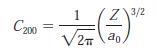
The value of the constant C200 in Equation 7-33 isFind the values of (a) Ψ, (b) Ψ2, and (c) The radial probability density P(r) at r = a0 for the state n = 2, ℓ = 0, m = 0 in hydrogen. Give your answers in terms of a0. C₂00 Z3/2 1 √2a0.
Show that an electron in the n = 2, ℓ = 1 state of hydrogen is most likely to be found at r = 4a0.
Assuming the electron to be a classical particle, a sphere of radius 10-15 m and a uniform mass density, use the magnitude of the spin angular momentum |S|= [s (s + 1) ]1/2 ћ = (3/4)1/2 ћ to compute the speed of rotation at the electron’s equator. How does your result compare with the
How many lines would be expected on the detector plate of a Stern-Gerlach experiment (see Figure 7-15) if we use a beam of (a) Potassium atoms, (b) Calcium atoms,(c) Oxygen atoms, and (d) Tin atoms?
(a) The angular momentum of the yttrium atom in the ground state is characterized by the quantum number j = 3/2. How many lines would you expect to see if you could do a Stern-Gerlach experiment with yttrium atoms? (b) How many lines would you expect to see if the beam consisted of atoms with
The spin-orbit effect removes a symmetry in the hydrogen atom potential, splitting the energy levels. (a) Considering the state with n = 4, write down in spectroscopic notation the identification of each state and list them in order of increasing energy. (b) If a weak external magnetic
Suppose the outer electron in a potassium atom is in a state with ℓ = 2. Compute the magnitude of L. What are the possible values of j and the possible magnitudes of J?
A hydrogen atom is in the 3d state (n = 3, ℓ = 2). (a) What are the possible values of j? (b) What are the possible values of the magnitude of the total angular momentum?(c) What are the possible z components of the total angular momentum?
The prominent yellow doublet lines in the spectrum of sodium result from transitions from the 3P3/2 and 3P1/2 states to the ground state. The wavelengths of these two lines are 589.0 nm and 589.6 nm.(a) Calculate the energies in eV of the photons corresponding to these wavelengths. (b) The
Compute the angle between L and S in (a) The d5/2 and (b) The d3/2 states of atomic hydrogen.
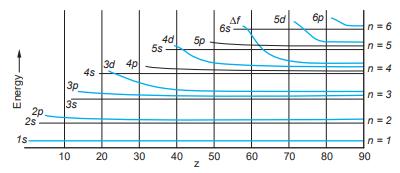
Using Figure 7-34, determine the ground-state electron configurations of tin (Sn, Z = 50), neodymium (Nd, Z = 60), and ytterbium (Yb, Z = 70). Check your answers with Appendix C. Are there any disagreements? If so, which one(s)?Figure 7-34 Energy 2p 2s 1s- 3p 35 10 45 3d
The Lamb shift energy difference between the 22 S1/2 and 22 P1/2 levels in atomic hydrogen is 4.372 x 10⁻⁶ eV. (a) What is the frequency of the photon emitted in this transition? (b) What is the photon’s wavelength?(c) In what part of the electromagnetic spectrum does this transition
Two neutrons are in an infinite square well with L = 2.0 fm. What is the minimum total energy that the system can have? (Neutrons, like electrons, have antisymmetric wave functions. Ignore spin.)
Five identical noninteracting particles are place in an infinite square well with L = 1.0 nm. Compare the lowest total energy for the system if the particles are(a) Electrons and (b) Pions. Pions have symmetric wave functions and their mass is 264 me.
Write the ground-state electron configuration of (a) Carbon,(b) Oxygen, and (c) Argon.
Which of the following transitions in sodium do not occur as electric dipole transitions? (Give the selection rule that is violated.) 451/2 3S1/2 4D3/23P1/2 4S1/2 3P3/2 4D3/2 351/2 4P3/2 3S1/2 5D3/2 451/2 4D5/23P1/2 5P1/2 351/2
Which of the following atoms would you expect to have its ground state split by the spin-orbit interaction: Li, B, Na, Al, K, Ag, Cu, Ga?
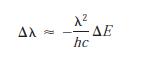
Show that the change in wavelength Δλ of a transition due to a small change in energy is Αλ 12 hc - ΔΕ
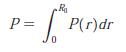
The radius of the proton is about R0 = 10-15m. The probability that the electron is inside the volume occupied by the proton is given bywhere P(r) is the radial probability density. Compute P for the hydrogen ground state. P = Ra 0 P(r)dr
If the 3s electron in sodium did not penetrate the inner core, its energy would be -13.6 eV/32 = -1.51 eV. Because it does penetrate, it sees a higher effective Z and its energy is lower. Use the measured ionization potential of 5.14 V to calculate Zeff for the 3s electron in sodium.
If a rigid body has moment of inertia I and angular velocity ω, its kinetic energy iswhere L is the angular momentum. The solution of the Schrödinger equation for this problem leads to quantized energy values given by(a) Make an energy-level diagram of these energies, and indicate the transitions
The relative penetration of the inner-core electrons by the outer electron in sodium can be described by the calculation of Zeff from E = - [Z2 eff(13.6) eV]/n2 and comparing with E = -13.6 eV/n2 for no penetration.(a) Find the energies of the outer electron in the 3s, 3p, and 3d states from Figure
A hydrogen atom in the ground state is placed in a magnetic field of strength Bz = 0.55 T.(a) Compute the energy splitting of the spin states.(b) Which state has the higher energy?(c) If you wish to excite the atom from the lower- to the higher-energy state with a photon, what frequency must the
In a Stern-Gerlach experiment hydrogen atoms in their ground state move with speed vx = 14.5 km/s. The magnetic field is in the z direction and its maximum gradient is given by dBz/dz = 600 T/m.(a) Find the maximum acceleration of the hydrogen atoms.(b) If the region of the magnetic field extends
A container holds 128 identical molecules whose speeds are distributed as follows:Graph these data and indicate on the graph vm, (v), and vrms. 12 20 24 20 16 12 8 6 4 No. of molecules 4 Speed range (m/s) 0.0-1.0 1.0-2.0 2.0-3.0 3.0-4.0 4.0-5.0 5.0-6.0 6.0-7.0 7.0-8.0 8.0-9.0 9.0-10.0
Show that the most probable speed vm of the Maxwell distribution of speeds is given by Equation 8-9. 1/2 *-- (247) ⁰² V = 8-9
Calculate the most probable kinetic energy Em from the Maxwell distribution of kinetic energies (Equation 8-13). n(E) dE= 2TN (Tk7) 3/2 E¹/2e-E/KT dE 8-13
If relativistic effects are ignored, the n = 3 level for one-electron atoms consists of the 32S1/2, 32P1/2, 32P3/2, 32D3/2, and 32D5/2 states. Compute the spin-orbit-effect splittings of 3P and 3D states for hydrogen.
If the angular momentum of the nucleus is I and that of the atomic electrons is J, the total angular momentum of the atom is F = I + J, and the total angular momentum quantum number f ranges from I + J to |I - J|. Show that the number of possible f values is 2I + 1 if I < J or 2J + 1 if J <
(a) Calculate vrms for H2 at T = 300 K.(b) Calculate the temperature T for which vrms for H2 equals the escape speed of 11.2 km/s.
(a) The ionization energy for hydrogen atoms is 13.6 eV. At what temperature is the average kinetic energy of translation equal to 13.6 eV?(b) What is the average kinetic energy of translation of hydrogen atoms at T = 107 K, a typical temperature in the interior of the Sun?
Show that the SI units of (3RT/M)1/2 are m/s.
(a) Find the total kinetic energy of translation of 1 mole of N2 molecules at T = 273 K.(b) Would your answer b(e the same, greater, or less for 1 mole of He atoms at the same temperature? Justify your answer.
From the absorption spectrum it is determined that about one out of 106 hydrogen atoms in a certain star is in the first excited state, 10.2 eV above the ground state (other excited states can be neglected). What is the temperature of the star?
A monatomic gas is confined to move in two dimensions so that the energy of an atom is Ek = 1/2 mv2x + 1/2 mv2y. What are CV, CP, and ϒ for this gas? (CP, the heat capacity at constant pressure, is equal to CV + nR and ϒ = CP/CV.)
Neutrons in a nuclear reactor have a Maxwell speed distribution when they are in thermal equilibrium. Find (v) and vm for neutrons in thermal equilibrium at 300 K. Show that n(v) (Equation 8-8) has its maximum value at v = vm = (2kT/m)1/2.
Compute the total translational kinetic energy of one liter of oxygen held at a pressure of one atmosphere and a temperature of 20°C.
Use the Dulong-Petit law that CV = 3R for solids to calculate the specific heat cv = CV/M in cal/g for(a) Aluminum, M = 27.0 g/mol, (b) Copper, M = 63.5 g/mol, and (c) Lead, M = 207 g>mol, and compare your results with the values given in a handbook. (Include the handbook reference in
The first excited rotational energy state of the H2 molecule (g2 = 3) is about 4 x 10⁻³ eV above the lowest energy state (g1 = 1). What is the ratio of the numbers of molecules in these two states at room temperature (300 K)?
(a) Show that the speed distribution function can be written n(v) = 4π-1/2 (v/vm)2v -1m e-(v/vm)2, where vm is the most probable speed. Consider 1 mole of molecules and approximate dv by Δv = 0.01 vm. Find the number of molecules with speeds in dv at(b) v = 0,(c) v = vm, (d) v = 2vm,
Consider a sample containing hydrogen atoms at 300 K. (a) Compute the number of atoms in the first (n = 2) and second (n = 3) excited states compared to those in the ground state (n = 1). Include the effects of degeneracy in your calculations.(b) At what temperature would 1 percent of the
Compute N0>N from Equation 8-52 for(a) T = 3Tc /4, (b) T = 1/2 Tc, (c) T = Tc /4, and (d) T = Tc /8. *~1-(7) N 3/2 8-52
Consider a sample of non-interacting lithium atoms (Li, Z = 3) with the third (outer) electron in the 3p state in a uniform 4.0 T magnetic field. (a) Determine the fraction of the atom in the m1 = +1, 0, and -1 states at 300 K. (b) In the 3p → 2s transition, what will be the relative
Given three containers all at the same temperature, one filled with a gas of classical molecules, one with a fermion gas, and one with a boson gas, which will have the highest pressure? Which will have the lowest pressure? Support your answer.
(a) For T = 5800 K, at what energy will the Bose-Einstein distribution function fBE (E) equal one (for a = 0)?(b) Still with a = 0, to what value must the temperature change if fBE (E) = 0.5 for the energy in part (a)?
A container at 300 K contains H2 gas at a pressure of one atmosphere. At this temperature H2 obeys the Boltzmann distribution. To what temperature must the H2 gas be cooled before quantum effects become important and the use of the Boltzmann distribution is no longer appropriate?
Showing 200 - 300
of 585
1
2
3
4
5
6
Step by Step Answers

 Get 50% OFF
Claim Now
Get 50% OFF
Claim Now