







Question: Let (X=left(X_{t} ight)_{t geqslant 0}) be the process from Example 21.2. Show that (X) is a Gaussian process with independent increments and find (C(s, t)=mathbb{E}
Let \(X=\left(X_{t}\right)_{t \geqslant 0}\) be the process from Example 21.2. Show that \(X\) is a Gaussian process with independent increments and find \(C(s, t)=\mathbb{E} X_{s} X_{t}, s, t \geqslant 0\).
Let \(0=t_{0}
Data From 21.2 Example
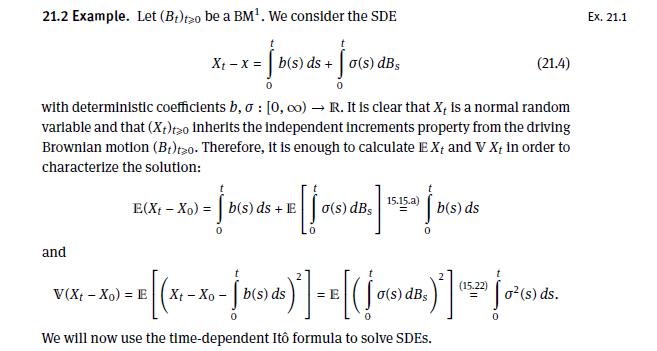
21.2 Example. Let (Bt)tzo be a BM. We consider the SDE Xt-x = [b(s) ds + [o(s) dBs (21.4) with deterministic coefficients b, : [0, ) R. It is clear that X, is a normal random variable and that (X+) to inherits the independent increments property from the driving Brownian motion (Bt)tzo. Therefore, it is enough to calculate EX+ and V X+ in order to characterize the solution: E(X+ - Xo) = [b(s) ds +E 15.15.a) (s) dBs b(s) ds and V(Xt Xo) EXt-Xo- - - b(s)ds) t (15.22) (s) dBs j 15)] = [(ja(s) We will now use the time-dependent It formula to solve SDES. (s) ds. Ex. 21.1
Step by Step Solution
3.46 Rating (149 Votes )
There are 3 Steps involved in it

Get step-by-step solutions from verified subject matter experts
 Study Help