



Question: 1. After reading the companion article (Viewing Brands in Multiple Dimensions) and reviewing the companion video (What Consumers Want), provide an executive briefing note regarding
1. After reading the companion article (Viewing Brands in Multiple Dimensions) and reviewing the companion video (What Consumers Want), provide an executive briefing note regarding the significance to the firm's marketing management of the information contained in these two source materials. Carefully consider the benefits of strategically integrating information on page 44 of the article and the 2X2 matrix specified in the video by Joseph Pine.
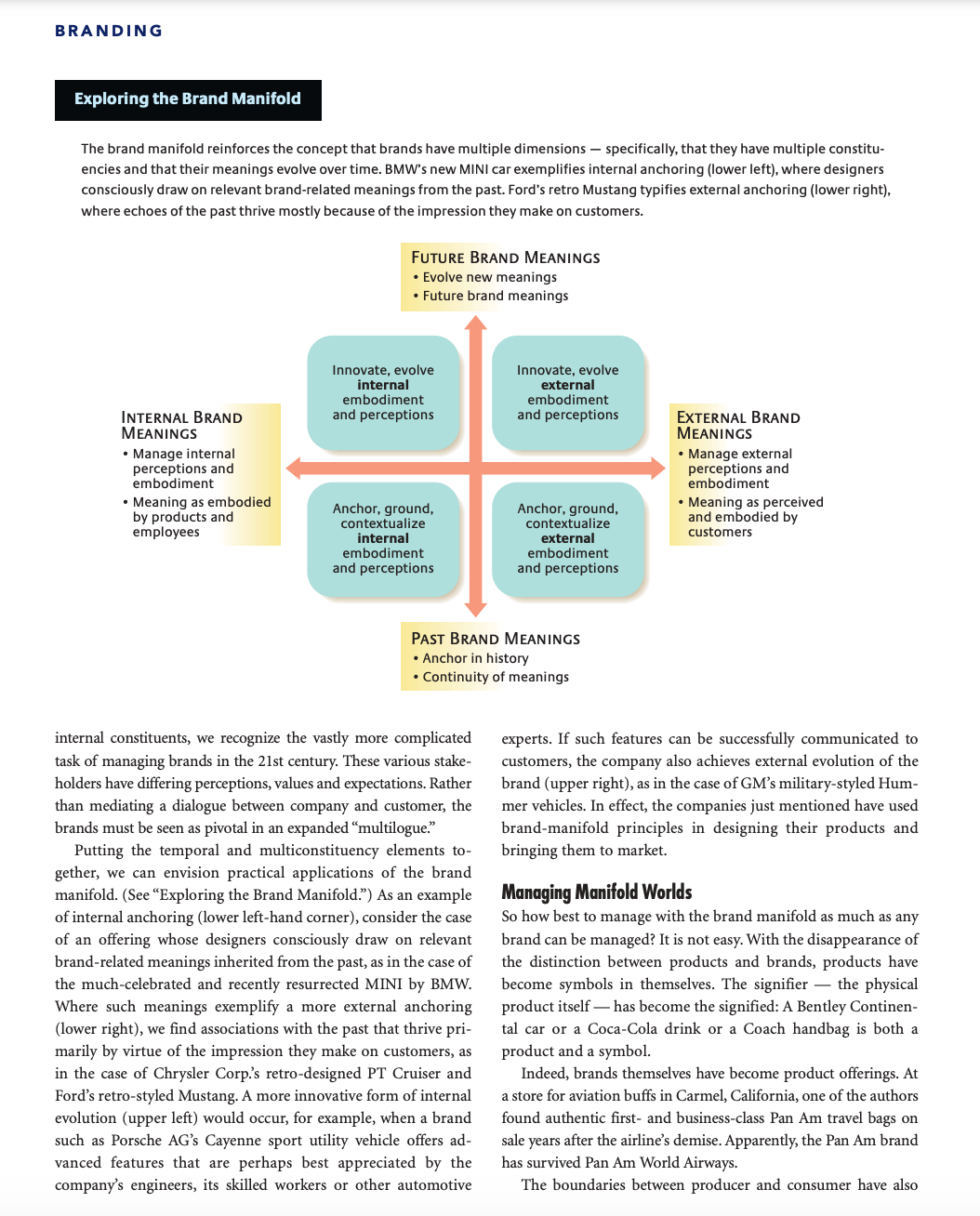
The brand manifold reinforces the concept that brands have multiple dimensions - specifically, that they have multiple constituencies and that their meanings evolve over time. BMW's new MINI car exemplifies internal anchoring (lower left), where designers consciously draw on relevant brand-related meanings from the past. Ford's retro Mustang typifies external anchoring (lower right), where echoes of the past thrive mostly because of the impression they make on customers. Future BRAND MEANINGS - Evolve new meanings internal constituents, we recognize the vastly more complicated task of managing brands in the 21st century. These various stakeholders have differing perceptions, values and expectations. Rather than mediating a dialogue between company and customer, the brands must be seen as pivotal in an expanded "multilogue." Putting the temporal and multiconstituency elements together, we can envision practical applications of the brand manifold. (See "Exploring the Brand Manifold.") As an example of internal anchoring (lower left-hand corner), consider the case of an offering whose designers consciously draw on relevant brand-related meanings inherited from the past, as in the case of the much-celebrated and recently resurrected MINI by BMW. Where such meanings exemplify a more external anchoring (lower right), we find associations with the past that thrive primarily by virtue of the impression they make on customers, as in the case of Chrysler Corp.'s retro-designed PT Cruiser and Ford's retro-styled Mustang. A more innovative form of internal evolution (upper left) would occur, for example, when a brand such as Porsche AG's Cayenne sport utility vehicle offers advanced features that are perhaps best appreciated by the company's engineers, its skilled workers or other automotive experts. If such features can be successfully communicated to customers, the company also achieves external evolution of the brand (upper right), as in the case of GM's military-styled Hummer vehicles. In effect, the companies just mentioned have used brand-manifold principles in designing their products and bringing them to market. Managing Manifold Worlds So how best to manage with the brand manifold as much as any brand can be managed? It is not easy. With the disappearance of the distinction between products and brands, products have become symbols in themselves. The signifier - the physical product itself - has become the signified: A Bentley Continental car or a Coca-Cola drink or a Coach handbag is both a product and a symbol. Indeed, brands themselves have become product offerings. At a store for aviation buffs in Carmel, California, one of the authors found authentic first- and business-class Pan Am travel bags on sale years after the airline's demise. Apparently, the Pan Am brand has survived Pan Am World Airways. The boundaries between producer and consumer have also
Step by Step Solution
There are 3 Steps involved in it

Get step-by-step solutions from verified subject matter experts