







Question: 1. For each solute below, state whether it is soluble in water or soluble in hexane. Subsequently, indicate the types of intermolecular forces (London dispersion,
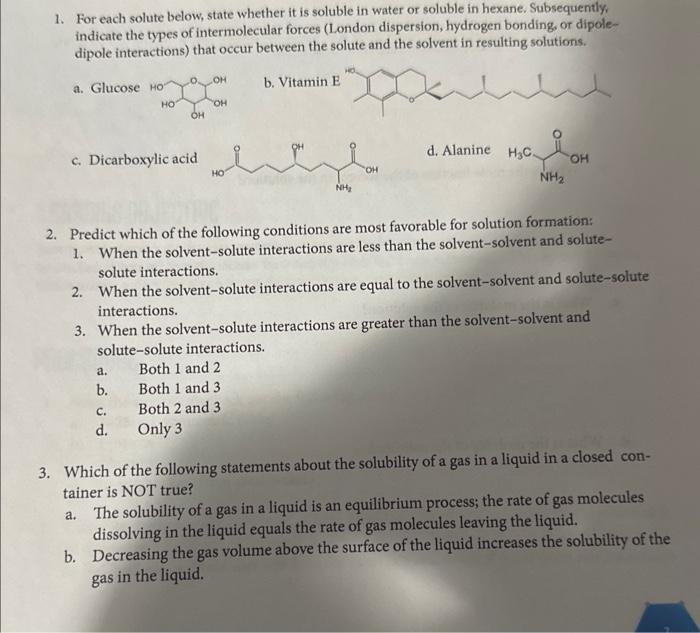
1. For each solute below, state whether it is soluble in water or soluble in hexane. Subsequently, indicate the types of intermolecular forces (London dispersion, hydrogen bonding, or dipoledipole interactions) that occur between the solute and the solvent in resulting solutions. a. Glucose b. Vitamin E c. Dicarboxylic acid d. Alanine 2. Predict which of the following conditions are most favorable for solution formation: 1. When the solvent-solute interactions are less than the solvent-solvent and solutesolute interactions. 2. When the solvent-solute interactions are equal to the solvent-solvent and solute-solute interactions. 3. When the solvent-solute interactions are greater than the solvent-solvent and solute-solute interactions. a. Both 1 and 2 b. Both 1 and 3 c. Both 2 and 3 d. Only 3 3. Which of the following statements about the solubility of a gas in a liquid in a closed container is NOT true? a. The solubility of a gas in a liquid is an equilibrium process; the rate of gas molecules dissolving in the liquid equals the rate of gas molecules leaving the liquid. b. Decreasing the gas volume above the surface of the liquid increases the solubility of the gas in the liquid
Step by Step Solution
There are 3 Steps involved in it

Get step-by-step solutions from verified subject matter experts
 Study Help