





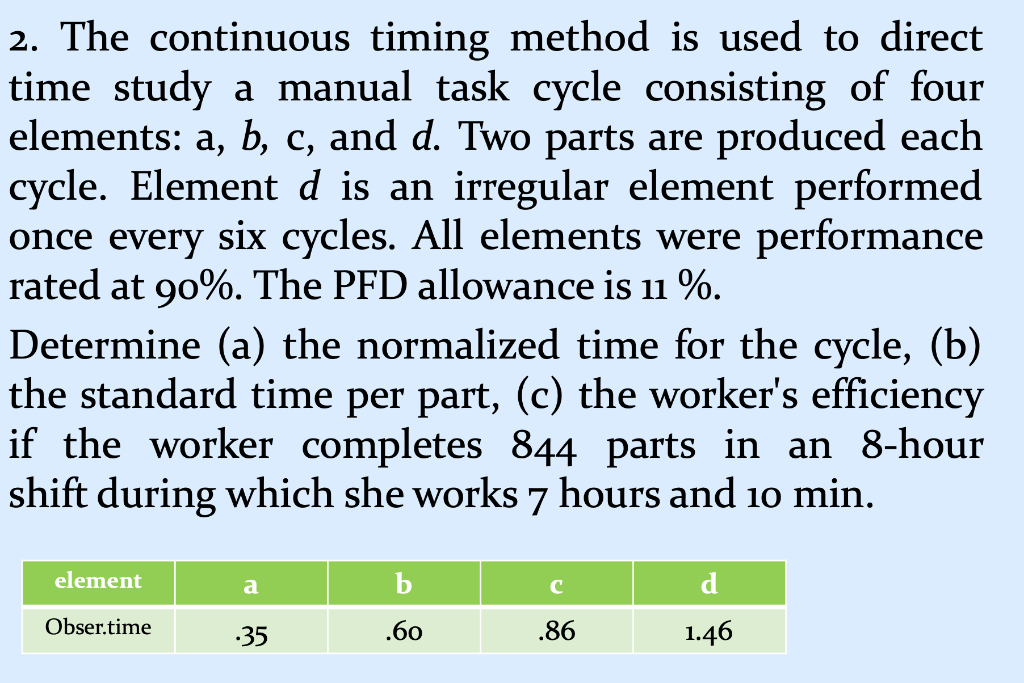
Question: 2. The continuous timing method is used to direct time study a manual task cycle consisting of four elements: a, b, c, and d. Two
2. The continuous timing method is used to direct2. The continuous timing method is used to direct

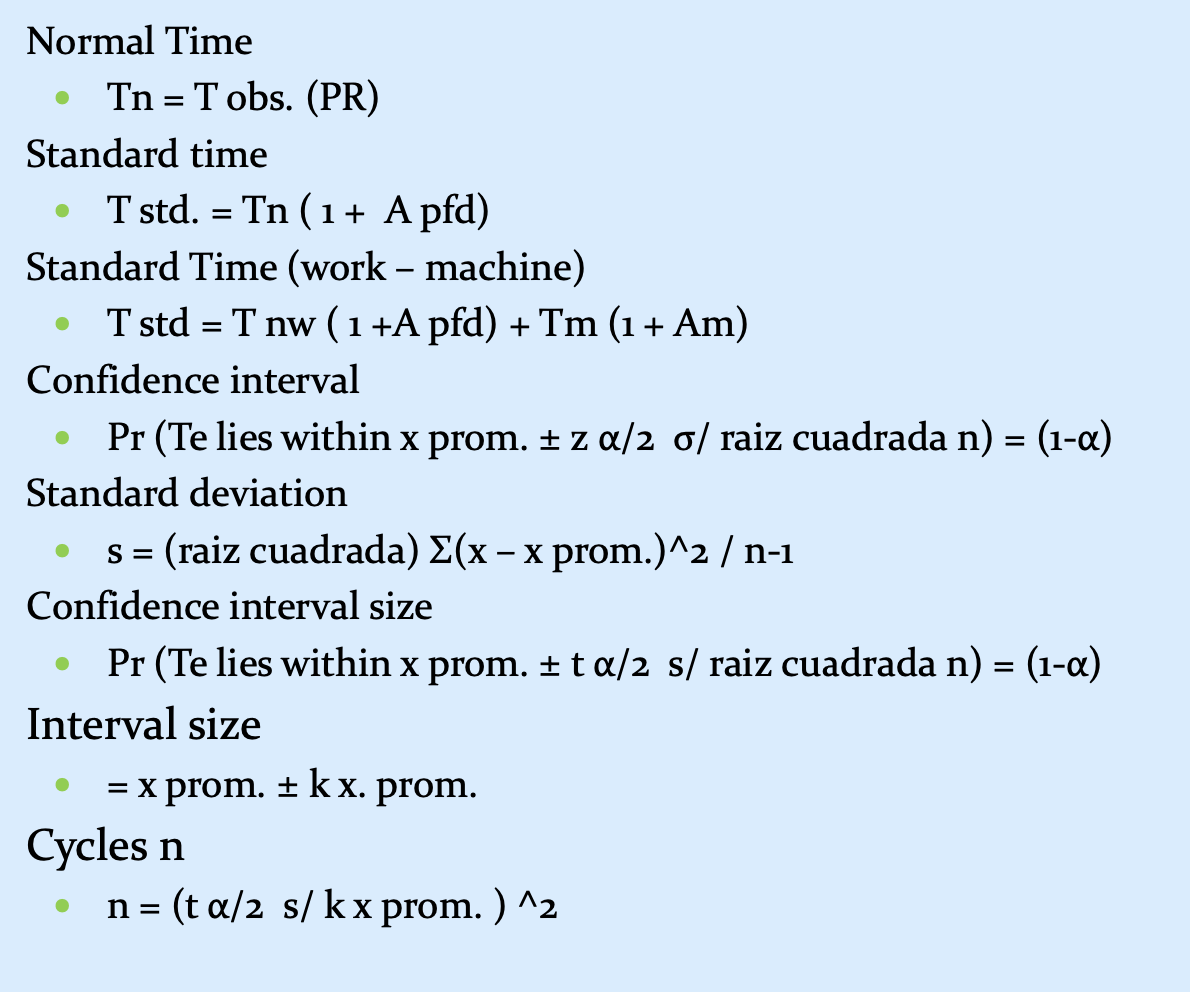
2. The continuous timing method is used to direct time study a manual task cycle consisting of four elements: a, b, c, and d. Two parts are produced each cycle. Element d is an irregular element performed once every six cycles. All elements were performance rated at 90%. The PFD allowance is 11 %. Determine (a) the normalized time for the cycle, (b) the standard time per part, (c) the worker's efficiency if the worker completes 844 parts in an 8-hour shift during which she works 7 hours and 10 min. element a b d Obser.time 35 .60 .86 1.46 Normal Time Tn = T obs. (PR) Standard time T std. = Tn (1+ A pfd) Standard Time (work - machine) T std = T nw ( 1 +A pfd) + Tm (1 + Am) Confidence interval Pr (Te lies within x prom. z a/2 o/ raiz cuadrada n) = (1-a) Standard deviation S = (raiz cuadrada) (x - x prom.)^2 / n-1 Confidence interval size Pr (Te lies within x prom. Ita/2 s/ raiz cuadrada n) = (1-x) Interval size x prom. = kx. prom. Cycles n n= (t a/2 s/kx prom.) ^2 =

Step by Step Solution

There are 3 Steps involved in it

1 Expert Approved Answer
Step: 1 Unlock blur-text-image

Question Has Been Solved by an Expert!

Get step-by-step solutions from verified subject matter experts

Step: 2 Unlock
Step: 3 Unlock

Students Have Also Explored These Related General Management Questions!