







Question: 3a Consider the following two ASP programs: P(X):-q(X, Y), not p(Y). q(1,2). q(2,1). s(1,a). s(2, b). t1(1). t1(2). t2(a). t2(b). B = H =
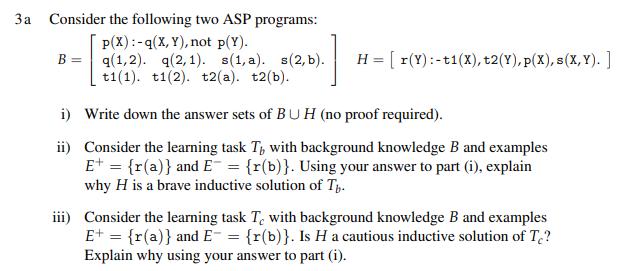
3a Consider the following two ASP programs: P(X):-q(X, Y), not p(Y). q(1,2). q(2,1). s(1,a). s(2, b). t1(1). t1(2). t2(a). t2(b). B = H = [ r(Y) :-t1 (X), t2 (Y), p(x), s(X,Y). ] i) Write down the answer sets of BUH (no proof required). ii) Consider the learning task Ty, with background knowledge B and examples E = {r(a)} and E= {r(b)}. Using your answer to part (1), explain why H is a brave inductive solution of Tb. iii) Consider the learning task T, with background knowledge B and examples E+ = {r(a)} and E= = {r(b)}. Is H a cautious inductive solution of Te? Explain why using your answer to part (i). 3a Consider the following two ASP programs: P(X):-q(X, Y), not p(Y). q(1,2). q(2,1). s(1,a). s(2, b). t1(1). t1(2). t2(a). t2(b). B = H = [ r(Y) :-t1 (X), t2 (Y), p(x), s(X,Y). ] i) Write down the answer sets of BUH (no proof required). ii) Consider the learning task T, with background knowledge B and examples E = {r(a)} and E= {r(b)}. Using your answer to part (i), explain why H is a brave inductive solution of Tb. iii) Consider the learning task T, with background knowledge B and examples E+ = {r(a)} and E= = {r(b)}. Is H a cautious inductive solution of Te? Explain why using your answer to part (i).
Step by Step Solution
There are 3 Steps involved in it
The image depicts a question about Answer Set Programming ASP which is a form of declarative programming oriented towards difficult search problems Th... View full answer

Get step-by-step solutions from verified subject matter experts
 Study Help