


Question: 4.2 Probing Acid-Base Properties of pH-Sensitive Dyes with Liquid-Liquid Extraction Scen ario: You may have used pH indicators in previous chemistry experiments, but have you
4.2 Probing Acid-Base Properties of pH-Sensitive4.2 Probing Acid-Base Properties of pH-Sensitive4.2 Probing Acid-Base Properties of pH-Sensitive
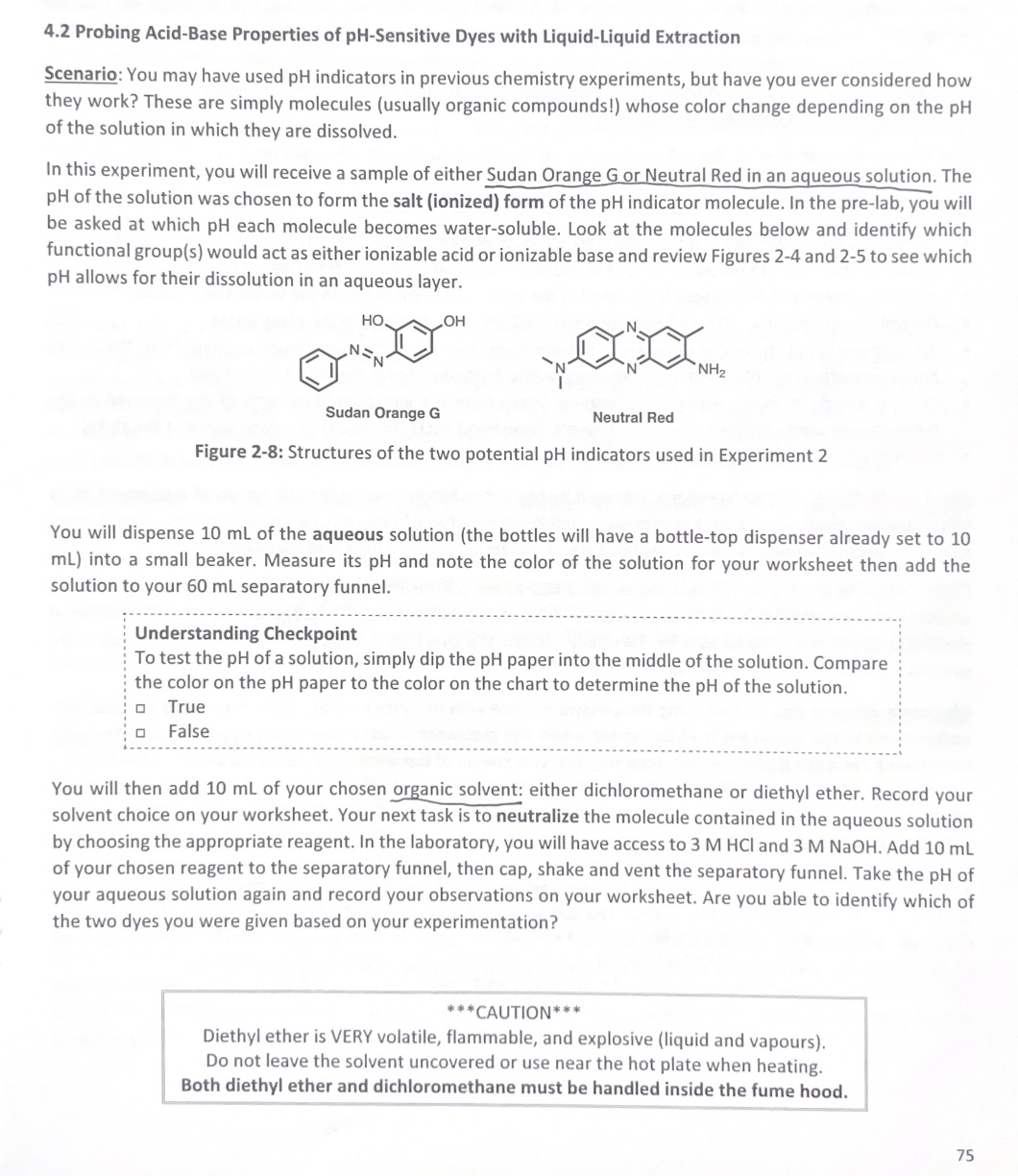
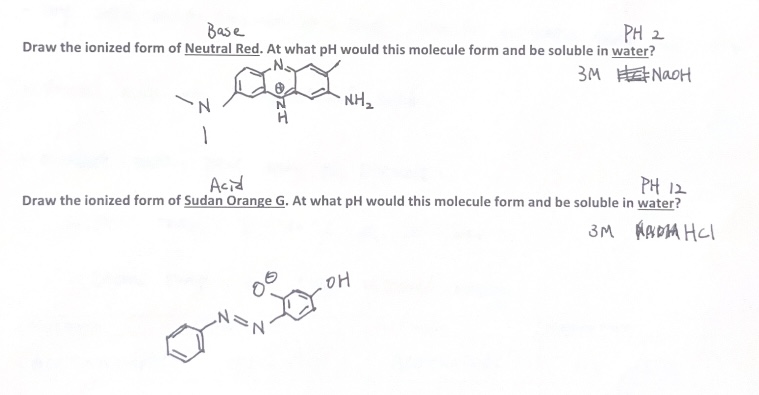
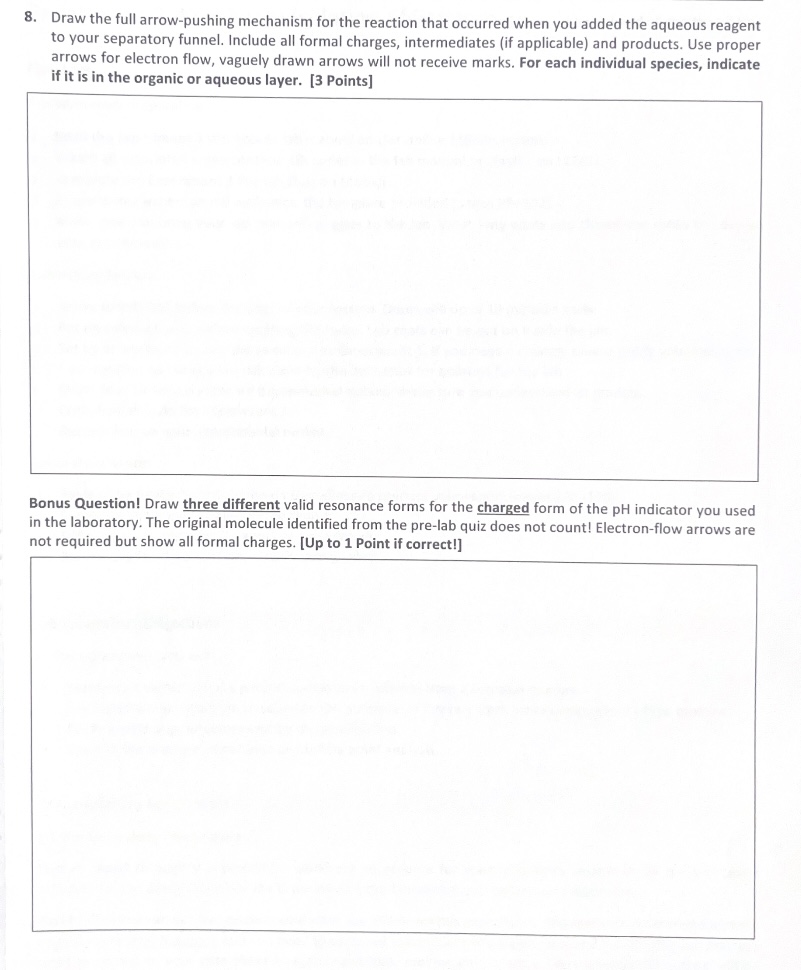
4.2 Probing Acid-Base Properties of pH-Sensitive Dyes with Liquid-Liquid Extraction Scen ario: You may have used pH indicators in previous chemistry experiments, but have you ever considered how they work? These are simply molecules (usually organic compounds!) whose color change depending on the pH of the solution in which they are dissolved. In this experiment, you will receive a sample of either Sudan Orange G or Neutral Red in an aqueous solution. The PH of the solution was chosen to form the salt (ionized) form of the pH indicator molecule. In the pre-lab, you will be asked at which pH each molecule becomes water-soluble. Look at the molecules below and identify which functional group(s) would act as either ionizable acid or ionizable base and review Figures 2-4 and 2-5 to see which PH allows for their dissolution in an aqueous layer. Ly N ~ N a DTD Sudan Orange G Neutral Red Figure 2-8: Structures of the two potential pH indicators used in Experiment 2 You will dispense 10 mL of the aqueous solution (the bottles will have a bottle-top dispenser already set to 10 mL) into a small beaker. Measure its pH and note the color of the solution for your worksheet then add the solution to your 60 mL separatory funnel. Understanding Checkpoint : To test the pH of a solution, simply dip the pH paper into the middle of the solution. Compare the color on the pH paper to the color on the chart to determine the pH of the solution. 'og True a False You will then add 10 mL of your chosen organic solvent: either dichloromethane or diethyl ether. Record your solvent choice on your worksheet. Your next task is to neutralize the molecule contained in the aqueous solution by choosing the appropriate reagent. In the laboratory, you will have access to 3 M HCl and 3 M NaOH. Add 10 mL of your chosen reagent to the separatory funnel, then cap, shake and vent the separatory funnel. Take the pH of your aqueous solution again and record your observations on your worksheet. Are you able to identify which of the two dyes you were given based on your experimentation? ***CAUTION*** | | Diethyl ether is VERY volatile, flammable, and explosive (liquid and vapours). ! Do not leave the solvent uncovered or use near the hot plate when heating. Both diethyl ether and dichloromethane must be handled inside the fume hood. | 75 Base PH 2 Draw the ionized form of Neutral Red. At what ph would this molecule form and be soluble in water? N. 3M HEF NaOH N NH, Acid PH 12 Draw the ionized form of Sudan Orange G. At what ph would this molecule form and be soluble in water? 3M MADIAHCI OH N N8. Draw the full arrow-pushing mechanism for the reaction that occurred when you added the aqueous reagent to your separatory funnel. Include all formal charges, intermediates (if applicable) and products. Use proper arrows for electron flow, vaguely drawn arrows will not receive marks. For each individual species, indicate if it is in the organic or aqueous layer. [3 Points] Bonus Question! Draw three different valid resonance forms for the charged form of the PH indicator you used in the laboratory. The original molecule identified from the pre-lab quiz does not count! Electron-flow arrows are not required but show all formal charges. [Up to 1 Point if correct!]
Step by Step Solution

There are 3 Steps involved in it

1 Expert Approved Answer
Step: 1 Unlock blur-text-image

Question Has Been Solved by an Expert!

Get step-by-step solutions from verified subject matter experts

Step: 2 Unlock
Step: 3 Unlock

Students Have Also Explored These Related Accounting Questions!