







Question: 7 . A transfer function, ( mathrm { H } ( mathrm { z } ) ) , has one zero
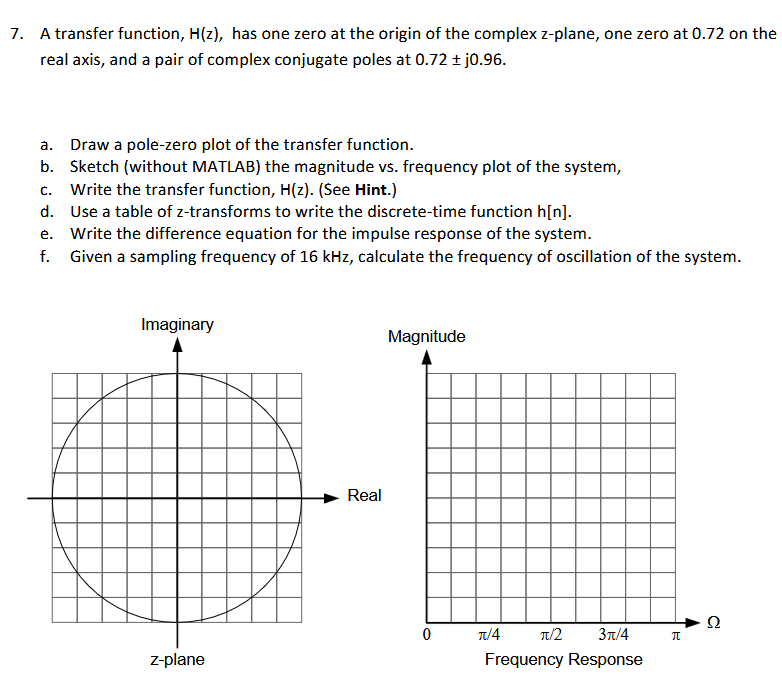
A transfer function, mathrmHmathrmz has one zero at the origin of the complex zplane, one zero at on the real axis, and a pair of complex conjugate poles at pm mathrmj
a Draw a polezero plot of the transfer function.
b Sketch without MATLAB the magnitude vs frequency plot of the system,
c Write the transfer function, HzSee Hint.
d Use a table of z transforms to write the discretetime function mathrmhmathrmn
e Write the difference equation for the impulse response of the system.
f Given a sampling frequency of kHz calculate the frequency of oscillation of the system.
Maanitude
Step by Step Solution
There are 3 Steps involved in it
1 Expert Approved Answer
Step: 1 Unlock

Question Has Been Solved by an Expert!
Get step-by-step solutions from verified subject matter experts
Step: 2 Unlock
Step: 3 Unlock
 Study Help