







Question: A discrete-time system can be (1) Static or dynamic Linear or nonlinear (3) Time invariant or time varying (4) Causal or noncausal (5) Stable or
A discrete-time system can be
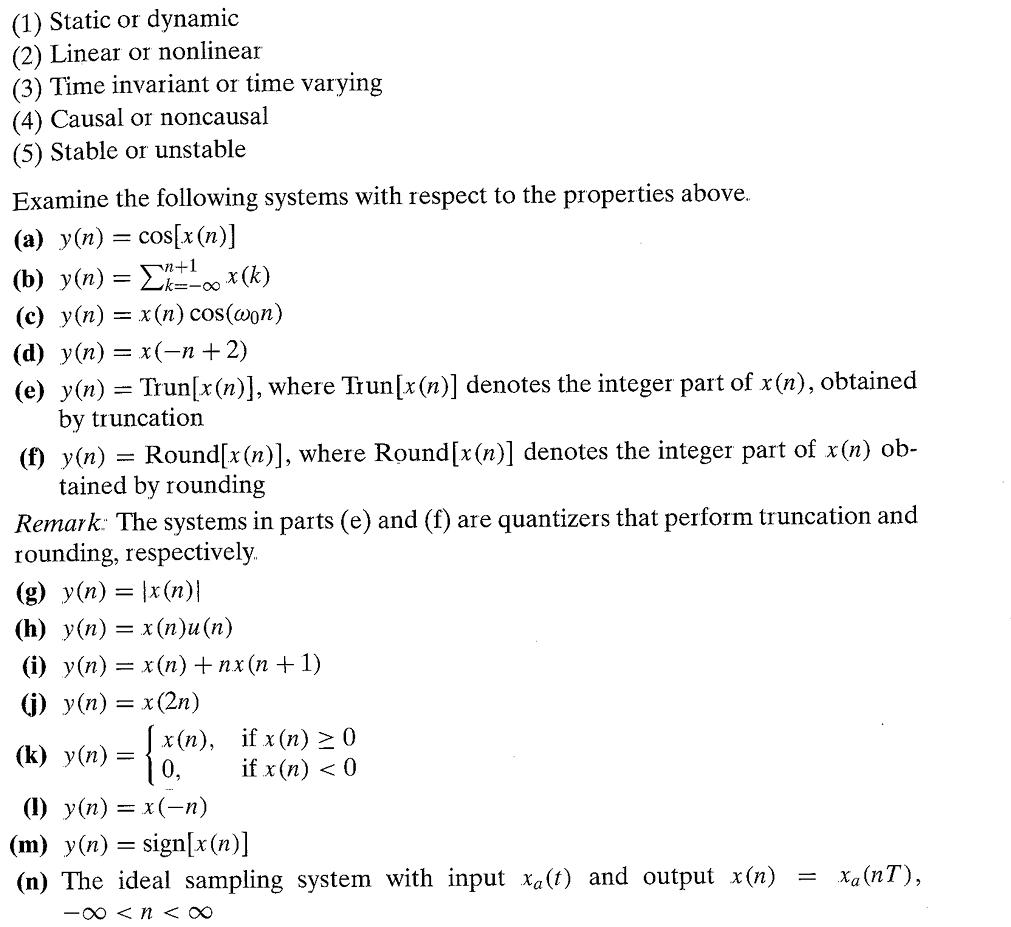
(1) Static or dynamic Linear or nonlinear (3) Time invariant or time varying (4) Causal or noncausal (5) Stable or unstable Examine the following systems with respect to the properties above. (a) y(n) = cos[x (n)] (b) y(n) = x (k) n+1 k=- (c) y(n) = x(n) cos(won) (d) y(n) = x(-n+2) (e) y(n)= Trun[x(n)], where Trun[x (n)] denotes the integer part of x(n), obtained by truncation (f) y(n) Round[x (n)], where Round[x(n)] denotes the integer part of x(n) ob- tained by rounding Remark: The systems in parts (e) and (f) are quantizers that perform truncation and rounding, respectively. = (g) y(n) = x(n)| (h) y(n) = x (n)u(n) (i) y(n) = x(n) + nx(n+1) (j) y(n) = x(2n) (k) y(n) = { [x(n), if x(n) 0 if x(n) < 0 (1) y(n) = x(-n) (m) y(n) = sign[x(n)] (n) The ideal sampling system with input xa(t) and output x(n) xa (nT), -
Step by Step Solution
3.30 Rating (156 Votes )
There are 3 Steps involved in it
Lets analyze each system with respect to the properties mentioned Properties Static or Dynamic Static Does not depend on time or the sequences past va... View full answer

Get step-by-step solutions from verified subject matter experts
 Study Help