







Question: Activity Duration (days) Immediate predecessors Cost ($) A 3 - 3,000 B 4 - 2,000 C 3 - 6,000 D 2 C 2,000 E 1
| Activity | Duration (days) | Immediate predecessors | Cost ($) |
| A | 3 | - | 3,000 |
| B | 4 | - | 2,000 |
| C | 3 | - | 6,000 |
| D | 2 | C | 2,000 |
| E | 1 | B | 1,000 |
| F | 5 | A | 10,000 |
| G | 2 | B | 4,000 |
| H | 3 | B | 9,000 |
| I | 11 | C | 11,000 |
| J | 3 | D, E | 3,000 |
| K | 1 | F, G | 1,000 |
| L | 4 | K | 2,000 |
| M | 4 | J, H | 8,000 |
With reference to Table above,
Assuming that the cost of each activity is linearly distributed over its duration, create two budgets as follows:
- The first budget should assume an early-start schedule
- The second budget should assume a late-start schedule
- Explain why the two budgets are different
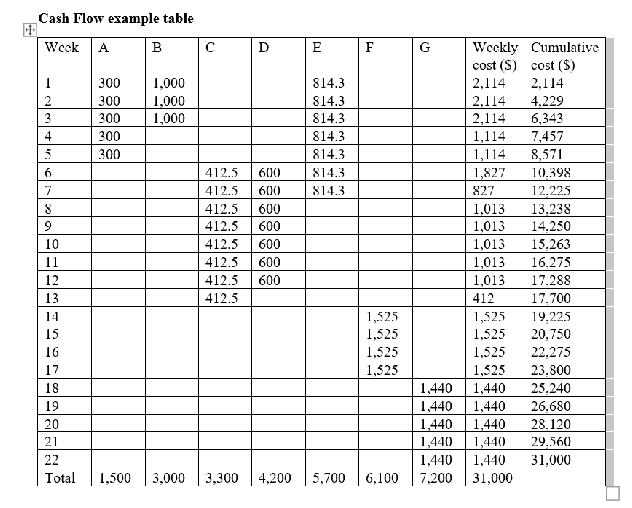
the 2 budgets should look like the example table
Step by Step Solution
There are 3 Steps involved in it
1 Expert Approved Answer
Step: 1 Unlock

Question Has Been Solved by an Expert!
Get step-by-step solutions from verified subject matter experts
Step: 2 Unlock
Step: 3 Unlock
 Study Help